



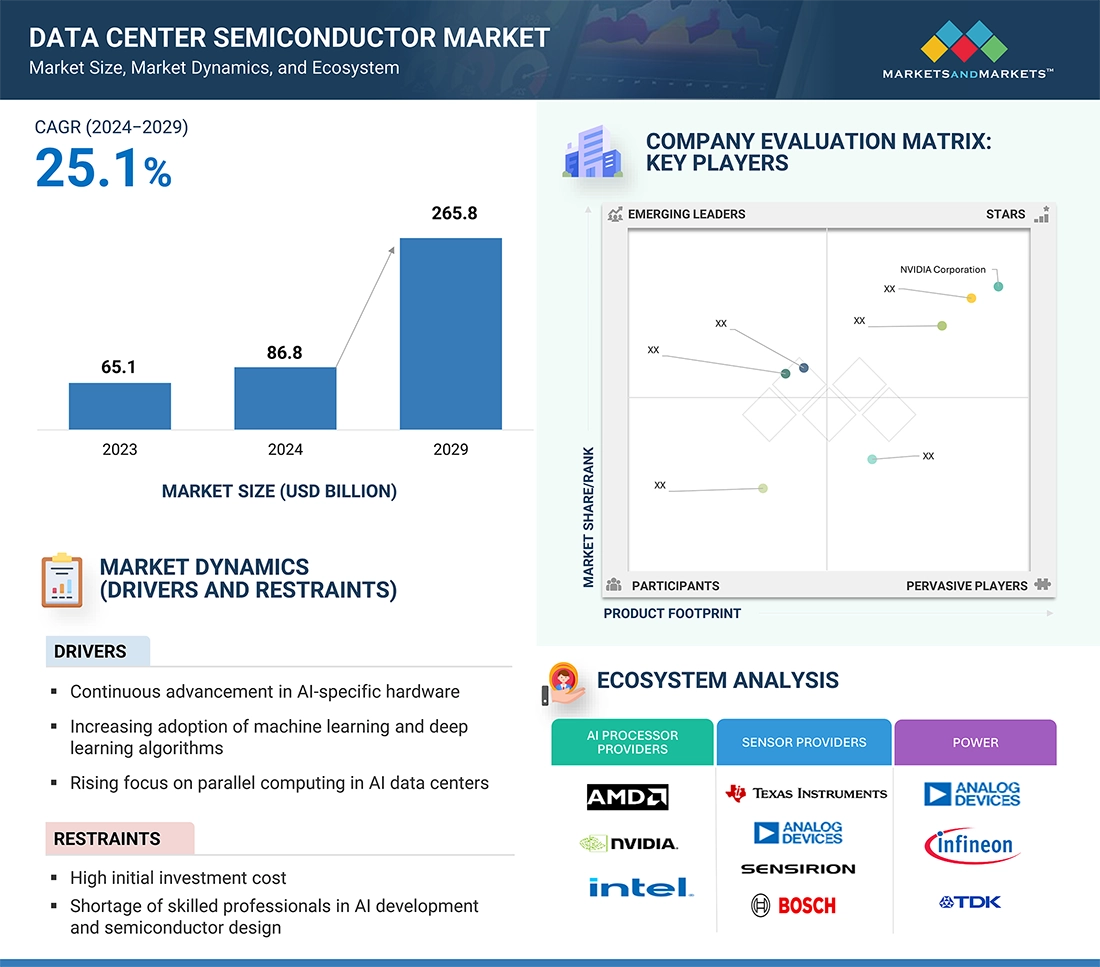
The global data center semiconductor market is expected to grow from USD 86.8 billion in 2024 to USD 265.8 billion by 2029, at a CAGR of 25.1% from 2024 to 2029. The growth is primarily driven by the rapid expansion of AI and generative AI workloads, increased investments by hyperscale cloud providers, rising demand for high-performance computing and accelerated processors, growing adoption of advanced memory technologies such as High Bandwidth Memory (HBM), and the need for high-speed, low-latency data processing in modern cloud data center infrastructures.
Attractive Opportunities in the Data Center Semiconductor Market

The exponential growth of artificial intelligence and machine learning workloads is driving demand for high-performance semiconductors, particularly GPUs, ASICs, and specialized AI accelerators.

Growing development of AI data centers will increase the demand for parallel computing, thus acting as a driver for the market.

Increasing adoption of cloud bases AI services such as cloud computing an AI-as-a-Service are expected to offer growth opportunities in the next five years.

The surge in the adoption of deep learning and machine learning algorithms across data center applications drives demand for AI semiconductors tailored for servers, optimizing server performance to execute complex AI tasks effectively.
Continuous advances in AI-specific hardware are a major driver of growth in the data center semiconductor market, as companies increasingly develop specialized processors to handle complex AI workloads more efficiently. Leading cloud providers, including Google, Amazon Web Services, Meta Platforms, Microsoft, and Tencent, are investing heavily in custom silicon, such as TPUs, Trainium, and Inferentia chips, to optimize performance for AI tasks like deep learning and neural network training. These purpose-built accelerators deliver higher efficiency and lower latency than general-purpose processors. Recent innovations, including Meta’s MTIA accelerator, Microsoft’s Maia 100 AI chip and Cobalt CPU, and Tencent’s Zixiao, Canghai, and Xuanling chips, highlight the shift toward in-house ASIC development. This trend is strengthening the AI server ecosystem by improving workload optimization, reducing reliance on third-party vendors, and accelerating overall data center performance.
The high upfront investment is a key restraint on the data center semiconductor market, as AI-focused infrastructure requires significantly higher capital and operational expenditures than traditional systems. While GPUs have evolved into powerful accelerators for AI and data analytics, their advanced capabilities come at a premium, particularly for high-end configurations. The cost burden extends beyond hardware acquisition to include implementation, network integration, system management, maintenance, training, and software licensing, along with substantial power and cooling expenses. A major cost differentiator between AI servers and conventional servers is the GPU, which can account for over 70% of the bill of materials. As a result, AI servers—especially those built on platforms like NVIDIA A100 and NVIDIA H100—can be 15 to 32 times more expensive than standard servers, limiting adoption, particularly for smaller enterprises.
Cloud service providers' planned investments in data centers create a significant opportunity for AI semiconductors, as these companies increasingly rely on advanced chips to power AI workloads. By integrating specialized semiconductors into servers, cloud providers can improve processing performance, enhance scalability, and efficiently support a wide range of AI applications. Major players such as Microsoft, Google, and Amazon Web Services are actively expanding their global data center footprint, signaling strong future demand for high-performance semiconductor solutions. For instance, Microsoft announced a USD 500 million investment to expand its cloud and AI infrastructure in Quebec, while Google is advancing its Teros data center project in Uruguay. Similarly, AWS plans to invest over USD 5.3 billion in Saudi Arabia to establish new data centers. These large-scale investments are expected to accelerate the adoption of AI semiconductors and drive sustained market growth.
Supply chain disruptions pose a significant challenge to the data center semiconductor market, particularly for the timely deployment of AI server infrastructure. Delays in GPU deliveries can create critical bottlenecks for organizations seeking to scale AI capabilities, as these processors are essential for training and inference workloads. Such delays are often caused by component shortages, production constraints, and surging demand, leading to cascading impacts across hardware manufacturers, system integrators, cloud providers, and end users. The imbalance between supply and demand is especially evident for high-performance GPUs like the NVIDIA H100 and A100, where lead times for GPU servers can extend to 52 weeks. These prolonged delivery cycles slow infrastructure expansion, increase costs, and hinder the overall growth momentum of the AI server and data center semiconductor market.
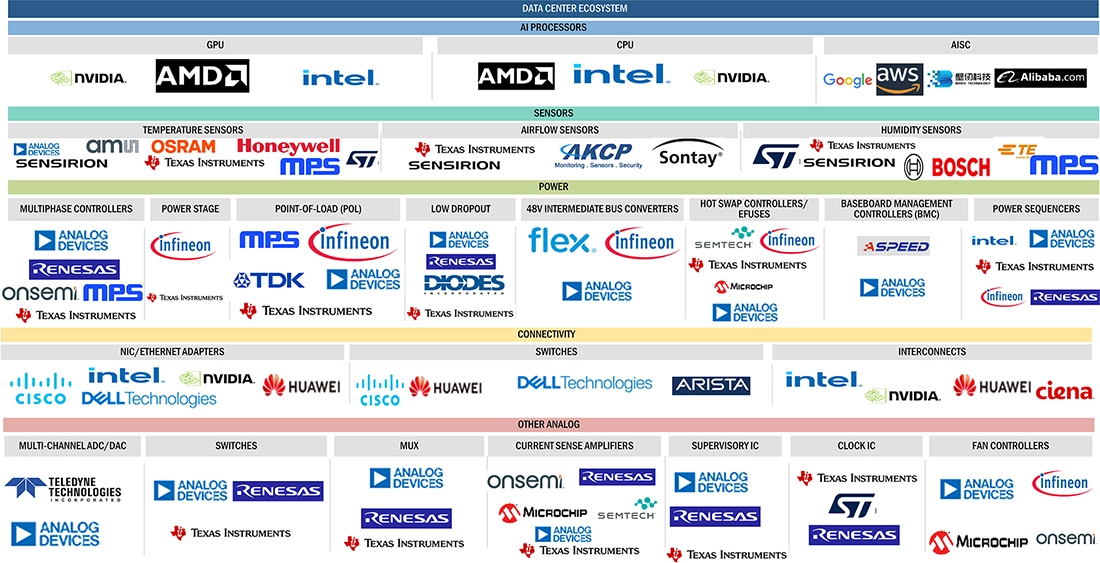
The data center ecosystem is a highly integrated architecture comprising multiple semiconductor layers that collectively enable high-performance computing and AI workloads. At the core are AI processors, including GPUs, CPUs, and ASICs from companies such as NVIDIA, AMD, Intel, Google, and Amazon Web Services, which drive compute capabilities. Surrounding this are sensor components (temperature, airflow, humidity) that ensure operational efficiency, followed by power management systems, including controllers, converters, and PMICs from vendors like Analog Devices and Infineon Technologies. The connectivity layer, featuring NICs, switches, and interconnects from players such as Cisco and Arista Networks, enables high-speed data transfer across the infrastructure. Additionally, analog components such as signal converters and controllers support system stability, making the ecosystem a tightly coupled network of compute, power, sensing, and communication technologies.
The edge processor/GPU segment is expected to capture the largest market share in 2029, driven by the explosive growth of AI inference at the edge, where real-time data processing is critical. Applications such as autonomous systems, industrial automation, smart surveillance, and edge analytics require low-latency decision-making, best enabled by high-performance processors and GPUs deployed closer to the data source. Unlike centralized cloud processing, edge environments demand efficient, compact, and power-optimized compute solutions, driving strong adoption of advanced edge processors and GPUs. Additionally, the proliferation of AI-enabled devices and the expansion of 5G networks are accelerating edge computing deployments, further boosting demand for localized processing capabilities. Leading semiconductor companies such as NVIDIA, Intel, and Advanced Micro Devices are continuously innovating in edge AI hardware, enhancing performance-per-watt and scalability. As enterprises increasingly prioritize real-time insights, bandwidth optimization, and data privacy, the edge processor/GPU segment is set to dominate the market landscape by 2029.
The temperature sensor segment is expected to hold the largest market share in 2029, driven by the critical need for thermal monitoring and management in increasingly dense, power-intensive data center environments. As AI workloads push rack power densities higher, maintaining optimal operating temperatures is essential for performance, reliability, and hardware longevity. Temperature sensors are deployed extensively across servers, GPUs, power units, and cooling systems, making them among the most widely used components in data centers. The rise of high-performance processors and accelerators from companies such as NVIDIA and Intel has significantly increased heat generation, necessitating precise, real-time thermal monitoring. Temperature sensors also enable advanced cooling techniques, including liquid cooling and AI-driven thermal optimization systems. As data centers continue to scale and prioritize energy efficiency and uptime, demand for temperature sensors is expected to grow substantially, driving their dominant market share by 2029.
| Report Attribute | Details | |
|---|---|---|
| Market size available for years | 2024–2031 | |
| Base year considered | 2025 | |
| Forecast period | 2026–2031 | |
| Forecast units | Value (USD Million/Billion) | |
| Segments Covered | Product Type, End User, and Region | |
The major factors driving the data center semiconductor market include the continuous advancement of AI-specific hardware and the increasing adoption of machine learning and deep learning algorithms.
The projected size of the data center semiconductor market in 2029 is 265.8 billion.
AI is significantly increasing demand for GPUs, ASICs, and advanced memory solutions, as data centers require high computational power for training and inference workloads.
GPUs are leading the market due to their superior parallel processing capabilities, making them ideal for AI and high-performance computing workloads.
 Exclusive indicates content/data unique to MarketsandMarkets and not available with any competitors.
TITLE
PAGE NO
INTRODUCTION
1
EXECUTIVE SUMMARY
2
PREMIUM INSIGHTS
3
MARKET OVERVIEW
4
4.2 4.2.1
DRIVERS
4.3 4.2.2
RESTRAINTS
4.4 4.2.3
OPPORTUNITIES
4.5 4.2.4
CHALLENGES
INDUSTRY TRENDS
5
REGULATORY LANDSCAPE
6
AI SEMICONDUCTOR MARKET, BY PRODUCT
7
7.2 7.2.1
EDGE PROCESSORS/GPU
7.3 7.2.2
TPU, TRAINIUM, INFERENTIA, ALI, BIREN, ETC.
7.4 7.2.3
CPU
7.2 7.3.1
TEMPERATURE SENSORS
7.3 7.3.2
HUMIDITY SENSORS
7.4 7.3.3
AIRFLOW SENSORS
7.2 7.4.1
NIC/ETHERNET ADAPTERS
7.3 7.4.2
SWITCHES
7.4 7.4.3
INTERCONNECTS
7.2 7.5.1
MULTIPHASE CONTROLLERS
7.3 7.5.2
POWER STAGE
7.4 7.5.3
POINT-OF-LOAD (POL) (DC/DC CONVERTERS)
7.5 7.5.4
LOW DROPOUT (LDO)
7.6 7.5.5
48V INTERMEDIATE BUS CONVERTERS (IBC)
7.7 7.5.6
12V HOT SWAP CONTROLLERS/EFUSE
7.8 7.5.7
48V HOT SWAP CONTROLLERS/EFUSE
7.9 7.5.8
POWER SEQUENCERS
7.10 7.5.9
BASEBOARD MANAGEMENT CONTROLLERS (BMC)
7.2 7.6.1
MULTI-CHANNEL ADC/DAC
7.3 7.6.2
SWITCHES
7.4 7.6.3
MUX
7.5 7.6.4
CURRENT SENSE AMPLIFIERS (CSA)
7.6 7.6.5
SUPERVISORY IC
7.7 7.6.6
FAN CONTROLLERS
7.8 7.6.7
CLOCK IC
CLOUD DATA CENTER, AI SEMICONDUCTOR MARKET, BY PRODUCT
8
8.2 8.2.1
EDGE PROCESSOR/GPU
8.3 8.2.2
TPU, TRAINIUM, INFERENTIA, ALI, BIREN, ETC.
8.4 8.2.3
CPU
8.2 8.4.1
TEMPERATURE SENSORS
8.3 8.4.2
HUMIDITY SENSORS
8.4 8.4.3
AIRFLOW SENSORS
8.2 8.5.1
NIC/ETHERNET ADAPTERS
8.3 8.5.2
SWITCHES
8.4 8.5.3
INTERCONNECTS
8.2 8.6.1
MULTIPHASE CONTROLLERS
8.3 8.6.2
POWER STAGE
8.4 8.6.3
POINT-OF-LOAD (POL) (DC/DC CONVERTERS)
8.5 8.6.4
LOW DROPOUT (LDO)
8.6 8.6.5
48V INTERMEDIATE BUS CONVERTERS (IBC)
8.7 8.6.6
12V HOT SWAP CONTROLLERS/EFUSE
8.8 8.6.7
48V HOT SWAP CONTROLLERS/EFUSE
8.9 8.6.8
POWER SEQUENCERS
8.10 8.6.9
BASEBOARD MANAGEMENT CONTROLLERS (BMC)
8.2 8.7.1
MULTI-CHANNEL ADC/DAC
8.3 8.7.2
SWITCHES
8.4 8.7.3
MUX
8.5 8.7.4
CURRENT SENSE AMPLIFIERS (CSA)
8.6 8.7.5
SUPERVISORY IC
8.7 8.7.6
FAN CONTROLLERS
8.8 8.7.7
CLOCK IC
DATA CENTER SEMICONDUCTOR MARKET, COMPETITIVE LANDSCAPE
9
RESEARCH METHODOLOGY
10
10.2 10.1.1
SECONDARY DATA
10.1.1.1
- KEY DATA FROM SECONDARY SOURCES
10.3 10.1.2
PRIMARY DATA
10.1.2.1
- KEY DATA FROM PRIMARY SOURCES
10.1.2.2
- KEY PRIMARY PARTICIPANTS
10.1.2.3
- BREAKDOWN OF PRIMARY INTERVIEWS
10.1.2.4
- KEY INDUSTRY INSIGHTS
10.2 10.2.1
BOTTOM-UP APPROACH
10.3 10.2.2
TOP-DOWN APPROACH
10.4 10.2.3
BASE NUMBER CALCULATION
10.2 10.3.1
SUPPLY SIDE
10.3 10.3.2
DEMAND SIDE
APPENDIX
11
The research process for this technical, market-oriented, and commercial study of the data center semiconductor market included the systematic gathering, recording, and analysis of data on companies operating in the market. It involved extensive use of secondary sources, directories, and databases (Factiva, OANDA) to identify and collect relevant information. In-depth interviews were conducted with primary respondents, including experts from core and related industries and preferred manufacturers, to obtain and verify critical qualitative and quantitative information and to assess the market's growth prospects. Key players in the data center semiconductor market were identified through secondary research, and their market rankings were determined through both primary and secondary research. This included studying the annual reports of top players and interviewing key industry experts, such as CEOs, directors, and marketing executives.
In the secondary research process, various secondary sources were consulted to identify and collect information relevant to this study. Secondary sources included annual reports, press releases, and investor presentations of companies; white papers, certified publications, and articles by recognized authors; directories; and databases. Secondary research was conducted primarily to obtain key information on the industry's supply and value chains; a comprehensive list of key players; and market segmentation by industry trends, geographic markets, and key developments from market- and technology-oriented perspectives.
In the primary research process, primary sources from the supply and demand sides were interviewed to obtain qualitative and quantitative information for this report. Primary sources from the supply side included experts such as CEOs, vice presidents, marketing directors, technology and innovation directors, subject-matter experts, consultants, and key executives from major companies and organizations operating in the data center semiconductor market.
After the complete market engineering process (market statistics calculations, market breakdown, market size estimates, market forecasting, and data triangulation), extensive primary research was conducted to gather information and verify and validate the critical market numbers.
Several primary interviews were conducted with experts from the demand and supply sides across four major regions—North America, Europe, Asia-Pacific, and RoW. Approximately 25% of the primary interviews were conducted with the demand side and 75% with the supply side. This primary data was collected through questionnaires, emails, and telephone interviews.
BREAKDOWN OF PRIMARY INTERVIEW PARTICIPANTS
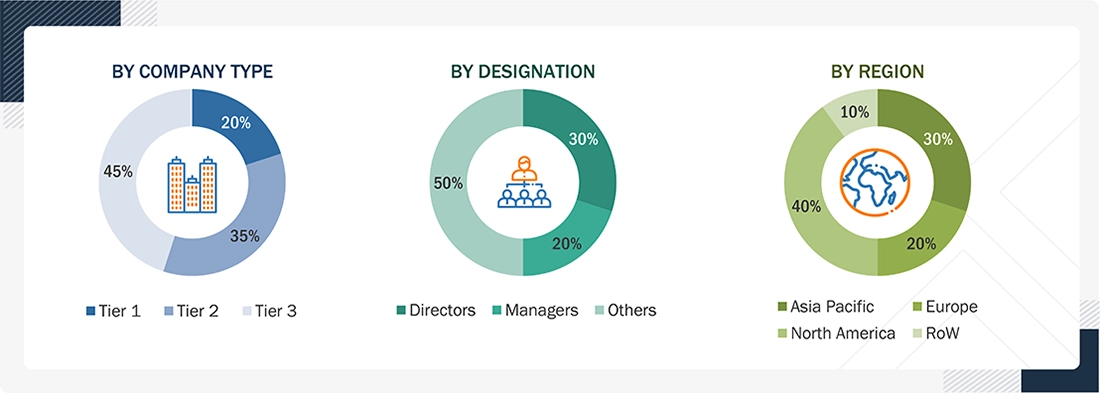
Notes: Other designations include technology heads, media analysts, sales managers, marketing managers, and product managers.
The three tiers of the companies are based on their total revenues as of 2025; Tier 1: >USD 1 billion, Tier 2: USD 500 million–1 billion, and Tier 3: <USD 500 million.
To know about the assumptions considered for the study, download the pdf brochure
In the comprehensive market engineering process, top-down and bottom-up approaches, along with several data triangulation methods, were used to estimate and forecast the overall market segments and subsegments listed in this report. Key players in the market were identified through secondary research, and their market shares in the respective regions were determined through primary and secondary research. This entire procedure includes the study of annual and financial reports of the top market players and extensive interviews for key insights (quantitative and qualitative) with industry experts (CEOs, VPs, directors, and marketing executives).
All percentage shares, splits, and breakdowns were determined using secondary sources and verified through primary sources. All parameters affecting the markets covered in this research study were accounted for, examined in detail, verified through primary research, and analyzed to obtain the final quantitative and qualitative data. This data was consolidated and supplemented with detailed inputs and analysis from MarketsandMarkets and presented in this report. The following figure represents this study’s overall market size estimation process.
BOTTOM-UP APPROACH
TOP-DOWN APPROACH
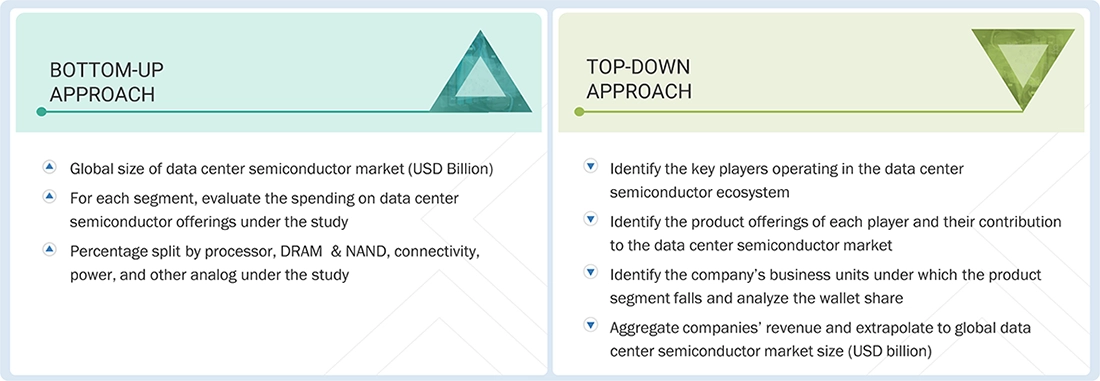
After determining the overall market size, the market was segmented into several segments and subsegments using the market size estimation processes explained above. Data triangulation and market breakdown procedures were employed to complete the entire market engineering process and determine the exact statistics for each market segment and subsegment. The data was triangulated by analyzing various factors and trends from both the demand and supply sides in the data center semiconductor market.
The data center semiconductor market encompasses the design, manufacturing, and deployment of integrated circuits that enable computing, storage, networking, sensing, and power management in modern data centers. This includes high-performance processors and accelerators such as CPUs, GPUs, and AI-specific ASICs that handle training and inference workloads, along with connectivity chips (e.g., NICs, switches, and interconnects) that enable high-speed data transfer across servers and networks. The market also covers sensing components (temperature, humidity, and airflow sensors) that maintain optimal operating conditions, as well as power management semiconductors, including multiphase controllers, power stages, voltage regulators (POL and LDO), intermediate bus converters, and protection devices that regulate, distribute, and optimize energy use across data center infrastructure.
With the given market data, MarketsandMarkets offers customizations according to the company’s specific needs. The following customization options are available for the report:
此内容由惯性聚合(RSS阅读器)自动聚合整理,仅供阅读参考。 原文来自 — 版权归原作者所有。