



- DESCRIPTION
- TABLE OF CONTENTS
- METHODOLOGY
- DOWNLOAD PDF
Automotive Camera Market by Technology (Digital, Infrared, Thermal), ICE and EV Application (ACC, BSD, AFL, IPA, OMS, NVS, & PA), Vehicle Type (PC, LCV, HCV), View (Front, Rear, Surround), EV Type, Level of Autonomy, Region - Global Forecast to 2033

USD 15.82 BN
MARKET SIZE, 2033

CAGR 7.9%
(2026-2033)

403
REPORT PAGES

506
MARKET TABLES
OVERVIEW
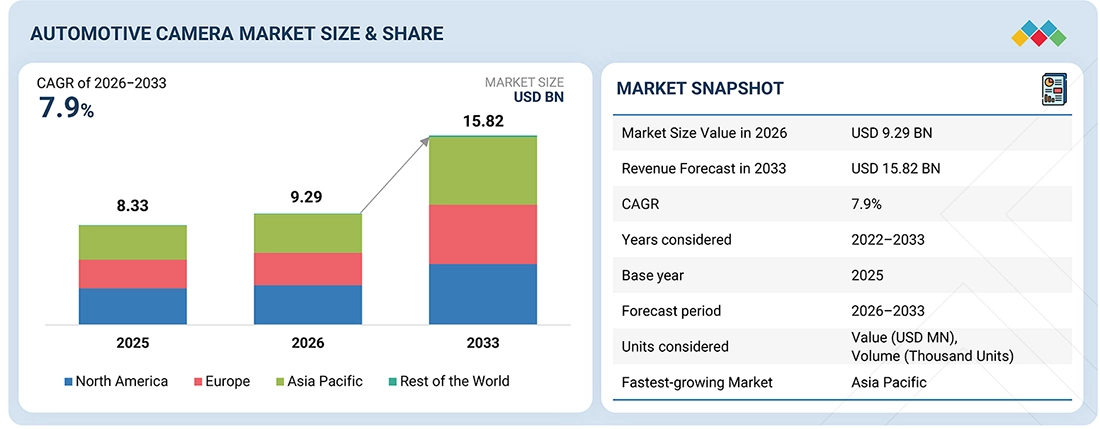
Source: Secondary Research, Interviews with Experts, MarketsandMarkets Analysis
The global automotive camera market is experiencing strong growth, driven by the increasing integration of vision-based sensing in modern vehicles. The global automotive camera market size is projected to grow from USD 9.29 billion in 2026 to USD 15.82 billion by 2033, at a CAGR of 7.9%. The automotive camera market is being propelled by the shift toward multi-camera sensor-fusion architectures, stricter regulations mandating vision-based safety systems, the emergence of mirror-to-camera replacements, growing adoption of in-cabin monitoring, and the standardization of ADAS in mid-segment vehicles. However, growth is constrained by performance limitations in adverse weather conditions, high system integration costs, and increasing data processing and bandwidth requirements associated with multi-camera setups.
KEY TAKEAWAYS
-
ICE By Application
Blind spot detection, lane assist, and lane departure warning collectively contributed around 20% of the global ICE automotive camera market in 2025.
-
By ICE Vehicle Type
LCVs and HCVs are witnessing higher camera adoption per vehicle due to fleet safety regulations, despite passenger cars leading in the value segment with a CAGR of 7.4%.
-
By Technology
The thermal camera segment is the fastest-growing technology with the CAGR of 10.2%.
-
By View Type
The surround-view segment is the fastest growing view type.
-
EV By Application
The night vison segment is the fastest-growing EV by application with a CAGR of 22.8%.
-
By EV Type
BEVs lead both volume and value markets, supporting advanced perception and autonomous features.
-
By Level of Autonomy
The shift toward Level 2+ is driving multi-camera setups (5–10 cameras per vehicle) as a core requirement for perception.
-
By Aftermarket
Growth is driven by cost-effective retrofits like rear-view cameras and dashcams, especially in emerging markets.
-
By Region
The Asia Pacific leads the volume market, Europe is regulation-driven, and North America is driven by both regulations and consumer demand.
-
Competitive Landscape: Key Players
Robert Bosch GmbH (Germany), Magna International Inc. (Canada), Valeo (France), ZF Friedrichshafen AG (Germany), and DENSO CORPORATION (Japan), among others, have been identified as start players in the automotive camera market due to their strong market presence and effective business strategies.
-
Competitive Landscape: Startups/SMEs
Samsung Electro-Mechanics (South Korea), Teledyne FLIR LLC (US), and Hyundai Mobis (South Korea), among others, have been identified as startups in the automotive camera market due to their strong potential to build robust business strategies.
Camera adoption in the automotive sector is becoming increasingly tiered across vehicle segments. Cost-sensitive segments focus on essential camera-based features such as rear-view cameras, parking assist, and basic lane detection, while mid-range vehicles integrate front-view ADAS cameras, surround-view systems, and blind spot camera solutions. Premium vehicles and mobility fleets, on the other hand, invest in advanced multi-camera architectures including driver/occupant monitoring systems (DMS/OMS), 360° perception, and AI-enabled camera-based autonomy, reducing reliance on expensive sensors through camera-dominant perception. On the operational side, calibration, validation of multi-camera systems, and real-world performance testing now account for a significant share of development costs, often exceeding hardware expenses. This is driving the adoption of AI-based image processing, synthetic data for scenario training, over-the-air (OTA) updates, and partnerships with multiple Tier 1 suppliers such as Robert Bosch GmbH and Valeo to optimize performance, ensure regulatory compliance, and mitigate supply chain risks.
TRENDS & DISRUPTIONS IMPACTING CUSTOMERS' CUSTOMERS
The automotive camera market is undergoing significant transformation, driven by supply-side innovation, evolving OEM strategies, and changing end-customer expectations. On the supply side, camera manufacturers are shifting from commodity imaging to AI-enabled perception systems, while increasing camera content per vehicle and adapting to centralized, software-defined architectures amid pricing pressures on basic modules. Tier 1 suppliers are focusing on key growth areas such as 360° surround-view systems, driver monitoring systems, high-resolution front cameras, and vision-first ADAS solutions to enhance differentiation and scalability. At the same time, OEMs are pushing toward higher levels of autonomy, software-defined vehicles, and connected EV ecosystems, where cameras act as critical data inputs for safety and user experience. Together, these trends are driving the adoption of cost-efficient, camera-centric solutions, positioning cameras at the core of next-generation mobility systems.
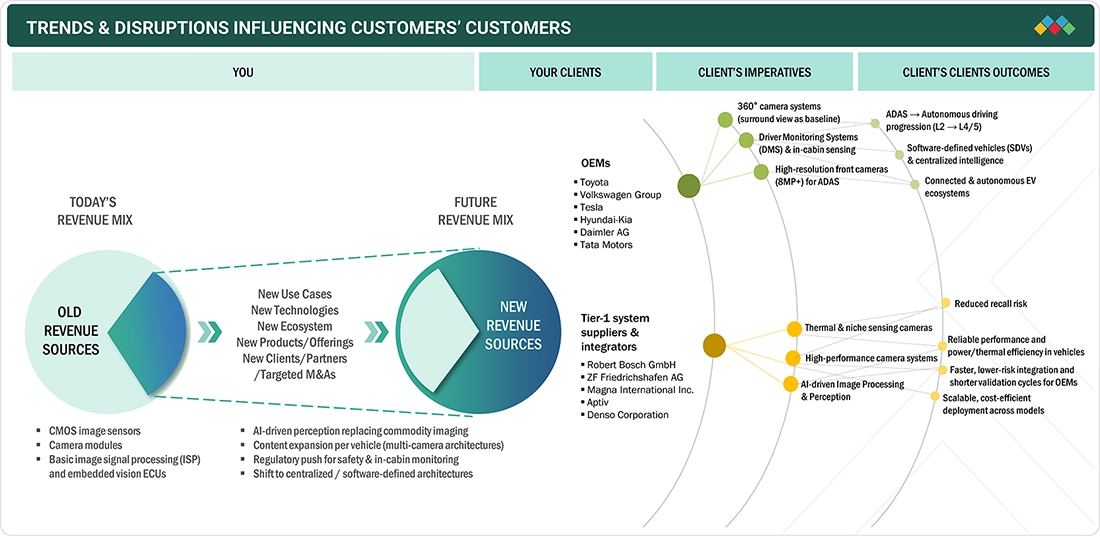
Source: Secondary Research, Interviews with Experts, MarketsandMarkets Analysis
MARKET DYNAMICS

Drivers
Impact
Level
-
Shift toward camera-based perception systems in entry and mid-level vehicles

-
Regulatory push for automotive safety features.


RESTRAINTS
Impact
Level
-
High validation and calibration complexity for multi-camera systems

-
Susceptibility to environmental conditions


OPPORTUNITIES
Impact
Level
-
Rapid adoption of camera-only or camera-dominant perception architectures in ADAS

-
Rise of in-cabin sensing applications


CHALLENGES
Impact
Level
-
Bandwidth and data processing limitations with increasing camera count

-
Ensuring performance reliability in real-world environments

Source: Secondary Research, Interviews with Experts, MarketsandMarkets Analysis
OEMs are increasingly shifting toward camera-based perception systems in entry and mid-level vehicles as they look to balance cost with ADAS scalability. Cameras provide a more economical alternative to ultrasonic sensors and LiDAR, while delivering strong performance in object detection, lane tracking, and traffic sign recognition. With continuous improvements in AI-driven computer vision and image processing, both single- and multi-camera configurations can now support ADAS features such as lane keep assistance, forward collision warning, and automatic emergency braking. This trend is more pronounced in price-sensitive markets like India and Southeast Asian countries, where OEMs are focused on offering safety features at accessible price points. At the same time, the industry’s move toward centralized vehicle architectures and software-defined platforms is making it easier to process and integrate camera data at scale. While radar and LiDAR continue to play a critical role in higher levels of autonomy for redundancy and reliability, cameras are becoming the primary sensing technology for L1 and L2 ADAS applications. Similarly, camera-based perception is primarily dominant in economy and mid-segment passenger cars, where OEMs rely on mono/stereo cameras for ADAS features such as lane assist, rear-view, and traffic sign recognition due to cost efficiency. Simultaneously, premium and luxury segments increasingly adopt radar and LiDAR alongside cameras (sensor fusion) to enable advanced functionalities like adaptive cruise control, 360° perception, and higher levels of autonomous driving.
The rapid integration adoption of multi-camera architectures across ADAS, surround-view, and in-cabin monitoring systems is significantly increasing the complexity of validation and calibration. Each camera must be precisely aligned and synchronized to ensure accurate perception, object detection, and in-depth estimation, as where even minor misalignments can impact critical safety functions such as lane keeping, automated parking, and collision avoidance. Multi-camera setups such as surround view (360°), driver monitoring, and forward perception systems require precise alignment, synchronization, and real-time data fusion to function, such as 360° surround-view, driver monitoring, and forward-perception systems, require alignment and real-time data fusion to operate accurately. The shift toward software-defined vehicles and centralized architectures further raises increases complexity, as multiple cameras generate large volumes of real-time data that must be processed instantly in real time for ADAS functions. If processing units are not efficient, data lag can lead to delayed responses or system malfunction, driving the need for high-performance ECUs, advanced wiring harnesses, and faster data inefficient, data lag can lead to delayed responses or system malfunctions, driving the need for high-performance ECUs, advanced wiring harnesses, and faster data-processing systems. This raises development time, costs, and validation efforts, making consistent performance across vehicle models variants a key issue.
The automotive sector is quickly shifting toward camera-dominant perception architectures, driven by the need to balance performance with cost efficiency. OEMs are leveraging cameras as the primary sensing modality for ADAS, supported by advances in AI and computer vision that enable accurate object detection, lane recognition, and scene understanding. This reduces dependency on costly sensors such as LiDAR and radar, thereby supporting broader ADAS penetration in high-volume vehicle segments. The global adoption of camera-based ADAS is further increasing as automakers increasingly favor software-defined vehicles, which leverage centralized platforms to efficiently process large volumes of visual data.
As vehicles integrate more cameras for ADAS and higher automation, managing the resulting data load is becoming a major challenge. High-resolution (8MP+) cameras across front-, rear-, surround-view, and in-cabin systems generate massive amounts of data, putting pressure on in-vehicle bandwidth and processing capacity. While OEMs are shifting toward centralized and zonal architectures, this requires high compute power, advanced compression, and robust data pipelines, which adds cost and complexity, especially for mass-market vehicles. Bandwidth constraints can also lead to latency and data lag, impacting real-time perception.
AUTOMOTIVE CAMERA MARKET SIZE, SHARE & ANALYSIS: COMMERCIAL USE CASES ACROSS INDUSTRIES
| COMPANY | USE CASE DESCRIPTION | BENEFITS |
|---|---|---|
|
|
Develops a Driver Monitoring System (DMS) using near-infrared camera technology and CMOS image sensors to track driver facial features, posture, and eye movements under varying lighting conditions; the system leverages advanced imaging algorithms and a large facial database for accurate detection of distraction and drowsiness | Enables real-time driver alertness monitoring, reduces risk of accidents through early warning alerts, enhances vehicle safety, and supports compliance with growing regulations on driver monitoring systems |
|
|
Develops Mpilot autonomous parking and highway driving system using a combination of cameras, ultrasonic sensors, and HD maps; the system enables autonomous parking, navigation in complex urban environments, lane changes, and interaction with surrounding vehicles | Enhances urban mobility and parking efficiency, improves driving safety through real-time environment awareness, and supports advanced autonomous driving capabilities |
|
|
Offers R-Car Software Development Kit (SDK) for ADAS and automated driving, integrating software tools for camera-based perception, deep learning, and autonomous system development across multiple vehicle types. | Accelerates ADAS development and deployment, reduces integration time and costs, and improves efficiency in building and validating intelligent vehicle systems |



Logos and trademarks shown above are the property of their respective owners. Their use here is for informational and illustrative purposes only.
MARKET ECOSYSTEM
The automotive camera market is characterized by a vertically integrated supply chain spanning from OEMs (Volkswagen, Toyota, BMW, Ford, Hyundai) who drive demand specifications, to Tier 1 Suppliers (Bosch, Magna, Denso, Valeo, Aptiv) providing integrated camera systems and ADAS solutions. The ecosystem is powered by specialized technology providers including autonomous vehicle developers (Waymo, Cruise, AutoX, Apollo) advancing Level 4/5 capabilities, 3D/Trunkit industrialists (Sensing Systems, LeddarTech, AEye) delivering sensing fusion hardware, and critical component manufacturers like processors (NVIDIA, Renesas, NXP, Qualcomm, Intel, Infineon) supplying AI-enabled SoCs and sensors (Sony, OmniVision, ON Semiconductor, Melexis, STMicroelectronics) providing CMOS image sensors and optics. This collaborative ecosystem reflects the convergence of traditional automotive manufacturing with semiconductor innovation, software intelligence, and autonomous driving technology creating a USD 15.82 billion market (2033) driven by regulatory mandates (Euro NCAP, NHTSA), safety imperatives, and the accelerating transition toward software-defined vehicles with advanced driver assistance and autonomous capabilities.
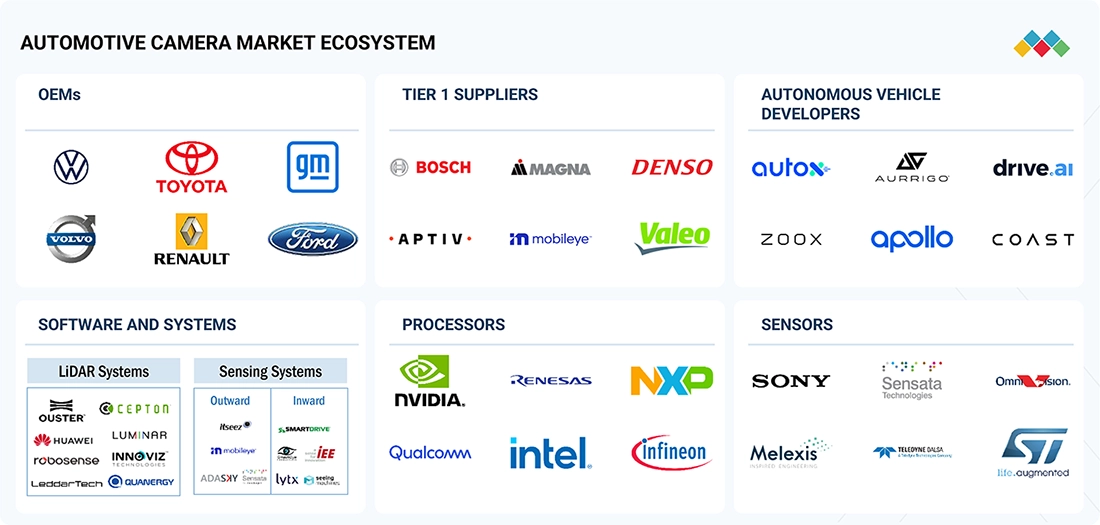
Logos and trademarks shown above are the property of their respective owners. Their use here is for informational and illustrative purposes only.
MARKET SEGMENTS
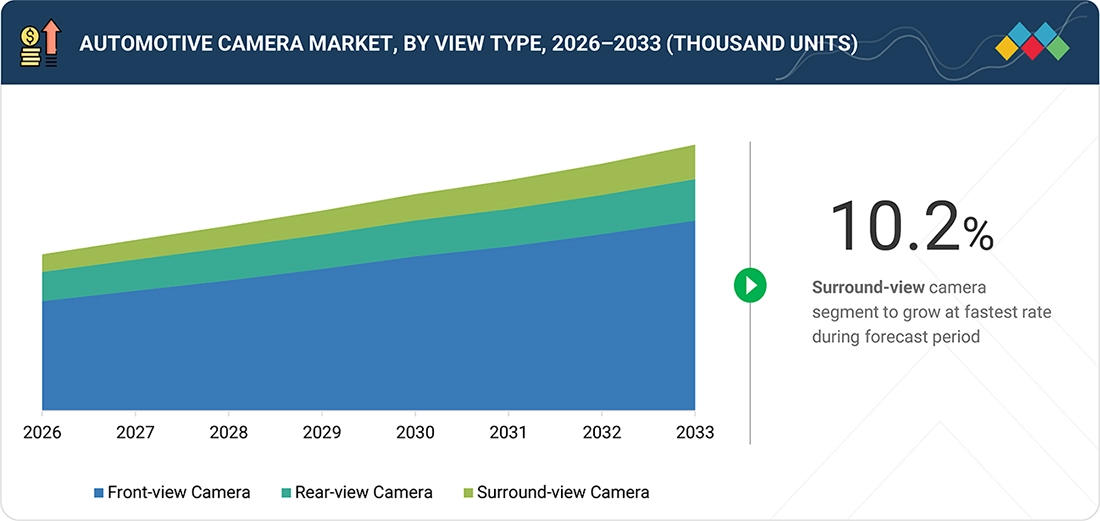
Source: Secondary Research, Interviews with Experts, MarketsandMarkets Analysis
Includes ADAS (ACC, AEB, LDW, BSD), parking assistance, driver/occupant monitoring (DMS/OMS), and night vision, with ADAS dominating due to regulatory mandates and increasing camera-based perception adoption
Segmented into passenger cars, LCVs, and HCVs, where passenger cars lead due to high volumes, while LCVs/HCVs show growth in fleet safety applications like blind-spot and rear-view cameras
Comprises digital, infrared, and thermal cameras, with digital cameras dominating, while thermal and infrared cameras gaining traction for enhanced perception in low-visibility conditions
Includes front-view (ADAS), rear-view (parking & compliance), and surround-view (360° systems), with surround-view systems witnessing fastest growth due to premiumization and safety demand
Covers ADAS, autonomous driving, parking assist, and in-cabin monitoring, with EVs showing higher camera integration due to software-defined and electronic architectures
Segmented into BEVs, PHEVs, and FCEVs, where BEVs dominate due to higher penetration of advanced ADAS and camera-based systems
Includes Level 0/1, Level 2, and Level 3, with Level 2 leading currently, while Level 2+ and Level 3 driving multi-camera system demand (5–10 cameras per vehicle)
Consists of dashcams, rear-view cameras, and parking assistance kits, driven by cost-effective retrofitting and rising safety awareness in emerging markets
Covers Asia Pacific, Europe, North America, and Rest of the World, with Asia Pacific leading due to high vehicle production and cost-sensitive ADAS adoption, followed by Europe and North America driven by stringent safety regulations
REGION
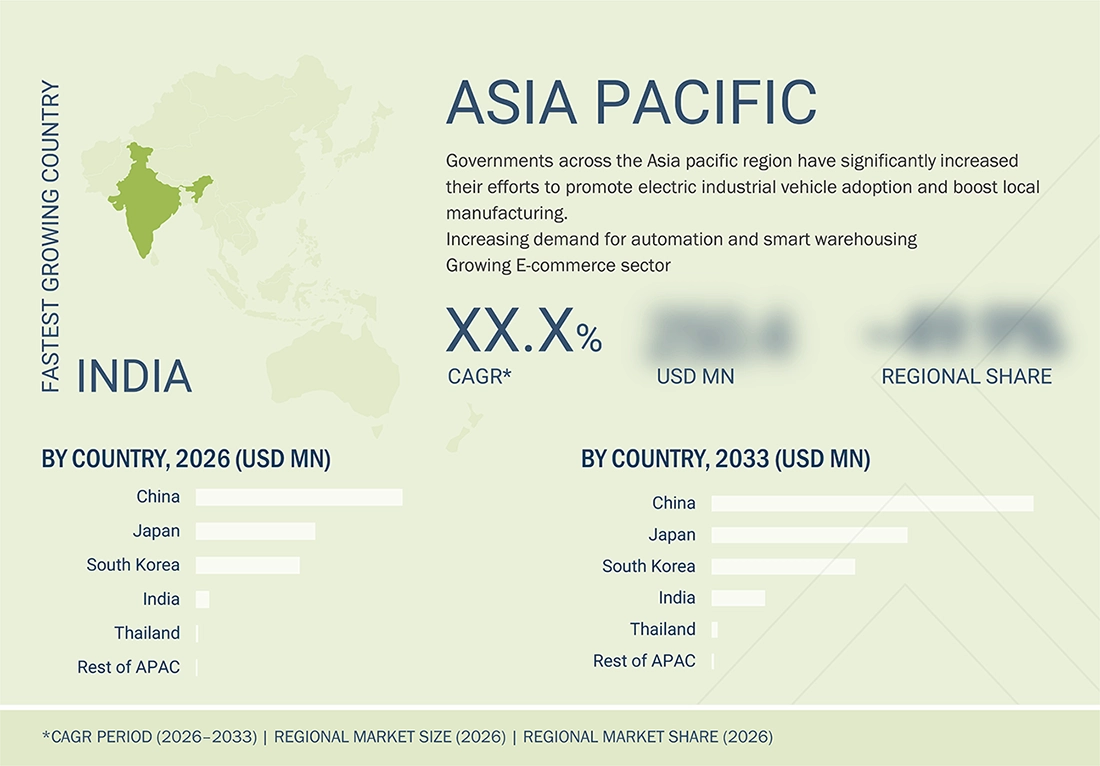
Asia Pacific is projected to be the fastest-growin automotive camera market during the forecast period.
The Asia Pacific automotive camera market is driven by regulatory mandates, rising vehicle demand, and tech advancements. Countries, such as India, are enforcing safety features such as advanced emergency braking and blind spot warnings. Large automotive markets such as China, growing consumer safety awareness, and reduced sensor/software costs are accelerating the regional automotive camera market across passenger and commercial vehicles.
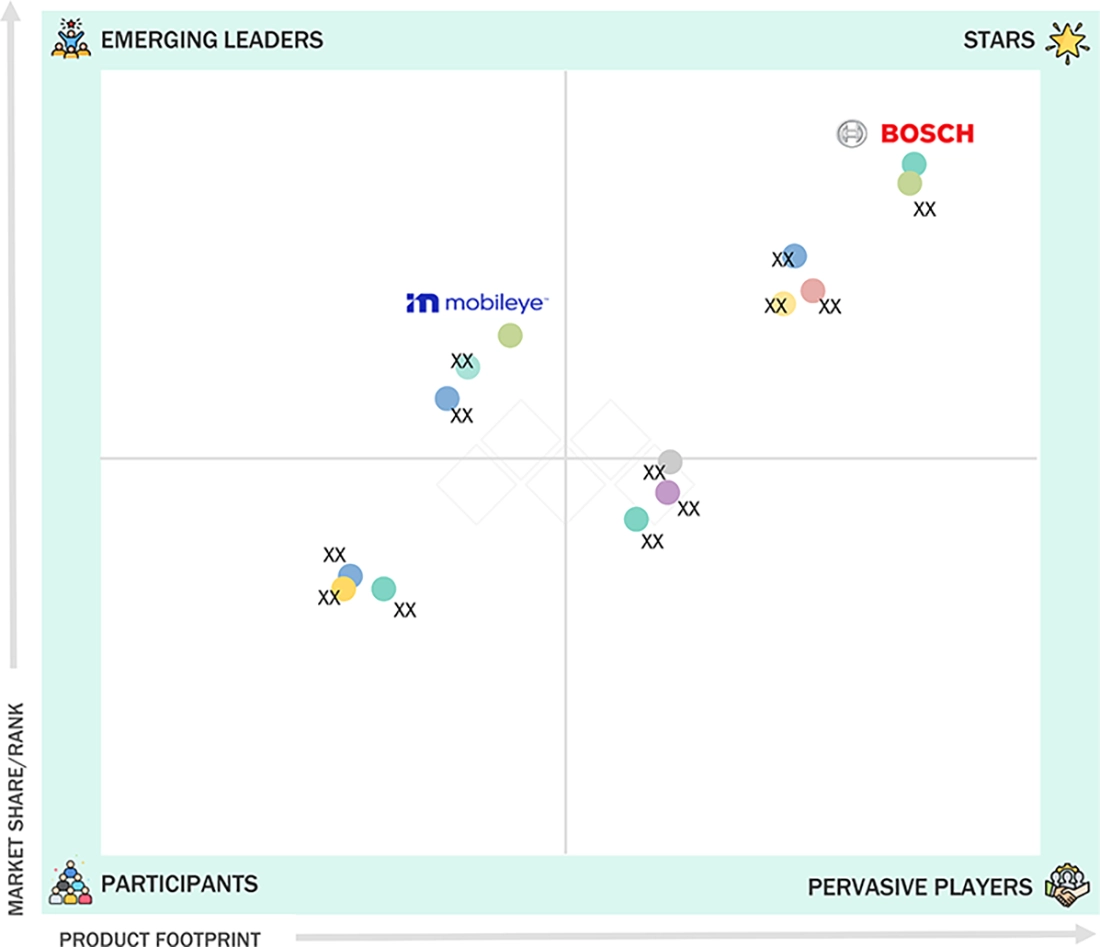
AUTOMOTIVE CAMERA MARKET SIZE, SHARE & ANALYSIS: COMPANY EVALUATION MATRIX
The quadrant chart highlights the positioning of key players based on market share/rank and product footprint. Mobileye stands out as a prominent emerging Leader, demonstrating strong momentum in the ADAS and autonomous driving space. Bosch is positioned in the top-right quadrant as a Star, reflecting its dominant market presence and extensive product portfolio. Several other companies are scattered across the matrix, indicating varied levels of market penetration and technological breadth.
Source: Secondary Research, Interviews with Experts, MarketsandMarkets Analysis
KEY MARKET PLAYERS
MARKET SCOPE
| REPORT METRIC | DETAILS |
|---|---|
| Market Size Value in 2026 | USD 9.29 Billion |
| Revenue Forecast in 2033 | USD 15.82 Billion |
| Growth Rate | CAGR of 7.9% from 2026 to 2033 |
| Actual Data | 2022-2033 |
| Base Year | 2025 |
| Forecast Period | 2026-2033 |
| Units Considered | Volume (Thousand Units) and Value (USD Million) |
| Report Coverage | Revenue forecast, company ranking, competitive landscape, growth factors, and trends |
| Segments Covered |
|
| Regional Scope | Asia Pacific, Europe, North America, and the Rest of the World |
WHAT IS IN IT FOR YOU: AUTOMOTIVE CAMERA MARKET SIZE, SHARE & ANALYSIS REPORT CONTENT GUIDE
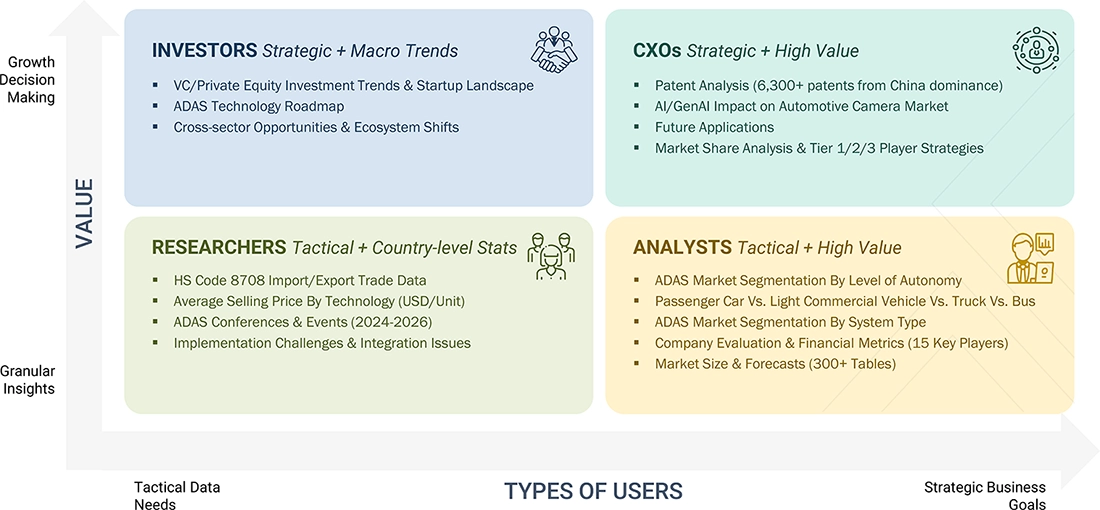
DELIVERED CUSTOMIZATIONS
We have successfully delivered the following deep-dive customizations:
| CLIENT REQUEST | CUSTOMIZATION DELIVERED | VALUE ADDS |
|---|---|---|
| Global Tier 1 Supplier (Europe) | • Competitive benchmarking of Robert Bosch GmbH, Magna International, ZF Friedrichshafen AG, Valeo • Technology roadmap tracking for camera modules (front, surround, DMS/OMS) | • Identify innovation white spaces in automotive camera systems • Guide R&D investment and strategic partnerships |
| Automotive OEM (North America) | • Camera feature mapping across vehicle segments (economy, mid-range, luxury, EVs) • Cost-benefit analysis of single vs. multi-camera (surround-view, DMS) systems | • Support product positioning with differentiated camera-based safety features • Improve profitability through optimal feature bundling |
| Semiconductor Company (Asia Pacific) | • Market sizing for automotive camera components (image sensors, processors, AI chips) • Supply chain risk assessment for camera modules and sensors | • Identify fastest-growing camera component applications (ADAS, DMS) • Mitigate risks from supply shortages and geopolitical disruptions |
| Mobility-as-a-Service Operator (Global) | • Evaluation of camera-enabled fleet safety solutions (driver monitoring, surround view) • Case studies on accident reduction using camera-based ADAS | • Reduce fleet accidents and downtime • Improve safety compliance and operational efficiency |
| Cloud/AI Provider (US) | • Analysis of edge vs. cloud-based video data processing for automotive cameras • Mapping partnerships with OEMs and Tier 1s for AI-based vision systems | • Expand opportunities in automotive vision analytics and cloud services • Strengthen position in AI-driven ADAS and autonomous ecosystem |
RECENT DEVELOPMENTS
- January 2026 : Bosch showcased AI-driven perception systems in which cameras integrated with advanced visual language models can interpret complex real-world environments, significantly improving scene understanding.
- January 2026 : Valeo showcased its Panovision system, which combines interior and exterior cameras to deliver adaptive alerts based on driver gaze, enhancing both safety and user experience. The system is integrated into a broader ADAS and UX platform, representing a next-generation approach to camera-based perception and seamless human-machine interaction.
- January 2026 : ZF showcased AI-powered ADAS solutions and centralized computing platforms, highlighting deeper integration of camera data within software-defined vehicle architectures. This reflects the transition of cameras from standalone hardware components to software-driven perception systems in next-generation mobility.
- January 2026 : Aptiv showcased AI-driven perception systems that combine cameras with sensor fusion to enable real-time decision-making, supported by intelligent edge computing.
- June 2025 : ZF highlighted its enhanced ADAS capabilities, maintaining around 30% global market share in smart cameras with over 75 million units delivered worldwide, while focusing on tighter integration of cameras, software, and central compute systems.
Table of Contents
 Exclusive indicates content/data unique to MarketsandMarkets and not available with any competitors.
TITLE
PAGE NO
1
INTRODUCTION
15
2
EXECUTIVE SUMMARY
3
PREMIUM INSIGHTS
4
MARKET OVERVIEW
4.1
INTRODUCTION
4.2
MARKET DYNAMICS
4.2.1
DRIVERS
4.2.2
RESTRAINTS
4.2.3
OPPORTUNITIES
4.2.4
CHALLENGES
4.3
UNMET NEEDS AND WHITE SPACES
4.4
INTERCONNECTED MARKETS AND CROSS-SECTOR OPPORTUNITIES
4.5
STRATEGIC MOVES BY TIER 1/2/3 PLAYERS
5
INDUSTRY TRENDS
5.1
MACROECONOMIC OUTLOOK
5.1.1
INTRODUCTION
5.1.2
GDP TRENDS AND FORECAST
5.1.3
TRENDS IN GLOBAL AUTOMOTIVE & TRANSPORTATION INDUSTRY
5.2
SUPPLY CHAIN ANALYSIS
5.2.1
RAW MATERIAL SUPPLIERS
5.2.2
COMPONENT MANUFACTURERS/TECHNOLOGY PROVIDERS
5.2.3
CLOUD SERVICE PROVIDERS
5.2.4
OEMS
5.2.5
END USERS
5.3
SUPPLIER LIST OF AUTOMOTIVE CAMERA COMPONENTS AND THEIR STRATEGIES
5.3.1
LIST OF IMAGE SENSOR SUPPLIERS
5.3.2
LIST OF CAMERA MODULE SUPPLIERS
5.3.3
LIST OF TIER 1 ADAS SUPPLIERS
5.3.4
LIST OF SOFTWARE SUPPLIERS
5.3.5
LIST OF SEMICONDUCTOR SUPPLIERS
5.4
PRICING ANALYSIS
5.4.1
AVERAGE SELLING PRICE TREND, BY TECHNOLOGY, 2023-2025
5.4.2
AVERAGE SELLING PRICE TREND, BY REGION, 2023-2025
5.5
TRADE ANALYSIS
5.5.1
IMPORT SCENARIO OF AUTOMOTIVE CAMERA
5.5.2
EXPORT SCENARIO OF AUTOMOTIVE CAMERA
5.6
KEY CONFERENCES & EVENTS IN 2026 &
5.7
TRENDS/DISRUPTIONS IMPACTING CUSTOMER BUSINESS
5.8
INVESTMENT AND FUNDING SCENARIO
5.9
FUNDING, BY USE-CASE/APPLICATION
5.10
CASE STUDY ANALYSIS
5.11
ECOSYSTEM ANALYSIS
5.12
PATENT ANALYSIS
5.13
AUTOMOTIVE CAMERA MARKET: OEM-WISE SUPPLIER
5.14
AUTOMOTIVE CAMERA MARKET: PRODUCT DEVELOPMENTS BY SUPPLIERS
6
TECHNOLOGICAL ADVANCEMENTS, AI-DRIVEN IMPACT, PATENTS, INNOVATIONS, AND FUTURE STRATEGIC APPLICATIONS
6.1
TECHNOLOGY ANALYSIS
6.1.1
KEY TECHNOLOGIES
6.1.1.1
VEHICLE PLATFORM AND E/E ARCHITECTURE IMPACT
6.1.1.1.1
CENTRALIZED COMPUTE PLATFORMS
6.1.1.1.2
ZONAL ARCHITECTURE IMPACT ON CAMERA COUNT
6.1.1.1.3
SOFTWARE DEFINED VEHICLE INFLUENCE
6.1.1.1.4
HIGH-SPEED NETWORK ADOPTION
6.1.1.1.5
OTA/AI UPDATE CAPABILITY
6.1.2
COMPLEMENTARY AND ADJACENT TECHNOLOGIES
6.1.2.1
RADAR/LIDAR/ULTRASONIC RELATION
6.1.2.2
ADAS ECUS
6.1.3
ADJACENT TECHNOLOGIES
6.1.3.1
IMPACT OF 5G NETWORK ON MACHINE-TO-MACHINE COMMUNICATION
6.2
IMPACT OF EU-FTA TRADE DEAL ON AUTOMOTIVE & TRANSPORTATION INDUSTRY
6.3
IMPACT OF ISRAEL-IRAN WAR ON AUTOMOTIVE & TRANSPORTATION INDUSTRY
7
REGULATORY LANDSCAPE
8
CUSTOMER LANDSCAPE & BUYER BEHAVIOR
8.1
DECISION-MAKING PROCESS
8.2
BUYER STAKEHOLDERS AND BUYING EVALUATION CRITERIA
8.3
ADOPTION BARRIERS & INTERNAL CHALLENGES
8.4
UNMET NEEDS FROM VARIOUS END-USE INDUSTRIES
8.5
MARKET PROFITABILITY
9
ELECTRIC AND HYBRID VEHICLE CAMERA MARKET, BY APPLICATION
9.1
INTRODUCTION
9.2
ADAPTIVE CRUISE CONTROL
9.3
ADAPTIVE CRUISE CONTROL + FORWARD COLLISION WARNING
9.4
ADAPTIVE CRUISE CONTROL + FORWARD COLLISION WARNING + TRAFFIC SIGN RECOGNITION
9.5
BLIND SPOT DETECTION
9.6
BLIND SPOT DETECTION + LANE KEEP ASSIST + LANE DEPARTURE WARNING
9.7
ADAPTIVE LIGHTING SYSTEM
9.8
INTELLIGENT PARKING ASSIST
9.9
DRIVER MONITORING SYSTEM
9.10
VISION SYSTEM
9.11
PARKING ASSIST
9.12
KEY PRIMARY INSIGHTS
10
ELECTRIC AND HYBRID VEHICLE CAMERA MARKET, BY ELECTRIC VEHICLE TYPE
10.1
INTRODUCTION
10.2
BATTERY ELECTRIC VEHICLE
10.3
PLUG-IN HYBRID ELECTRIC VEHICLE
10.4
FUEL CELL ELECTRIC VEHICLE
10.5
KEY PRIMARY INSIGHTS
11
AUTOMOTIVE CAMERA ICE MARKET, BY APPLICATION
11.1
INTRODUCTION
11.2
ADAPTIVE CRUISE CONTROL
11.3
ADAPTIVE CRUISE CONTROL + FORWARD COLLISION WARNING
11.4
ADAPTIVE CRUISE CONTROL + FORWARD COLLISION WARNING + TRAFFIC SIGN RECOGNITION
11.5
BLIND SPOT DETECTION
11.6
BLIND SPOT DETECTION + LANE KEEP ASSIST + LANE DEPARTURE WARNING
11.7
ADAPTIVE LIGHTING SYSTEM
11.8
INTELLIGENT PARKING ASSIST
11.9
DRIVER MONITORING SYSTEM
11.10
NIGHT VISION SYSTEM
11.11
PARKING ASSIST
11.12
KEY PRIMARY INSIGHTS
12
AUTOMOTIVE CAMERA MARKET, BY LEVEL OF AUTONOMY
12.1
INTRODUCTION
12.2
LEVEL 0/LEVEL
12.3
LEVEL
12.4
LEVEL
12.5
KEY PRIMARY INSIGHTS
13
AUTOMOTIVE CAMERA MARKET FOR ICE VEHICLES, BY TECHNOLOGY
13.1
INTRODUCTION
13.2
DIGITAL
13.3
INFRARED
13.4
THERMAL
13.5
KEY PRIMARY INSIGHTS
14
AUTOMOTIVE CAMERA MARKET ICE VEHICLES, BY VEHICLE TYPE
14.1
INTRODUCTION
14.2
PASSENGER CAR
14.3
LIGHT COMMERCIAL VEHICLE
14.4
HEAVY COMMERCIAL VEHICLE
14.5
KEY PRIMARY INSIGHTS
15
AUTOMOTIVE CAMERA MARKET ICE VEHICLES, BY VIEW TYPE
15.1
INTRODUCTION
15.2
FRONT VIEW
15.3
REAR VIEW
15.4
SURROUND VIEW
15.5
KEY PRIMARY INSIGHTS
16
AUTOMOTIVE CAMERA MARKET ICE VEHICLES, BY REGION
16.1
INTRODUCTION
16.2
ASIA PACIFIC
16.2.1
CHINA
16.2.2
INDIA
16.2.3
JAPAN
16.2.4
SOUTH KOREA
16.2.5
THAILAND
16.2.6
REST OF ASIA PACIFIC
16.3
EUROPE
16.3.1
GERMANY
16.3.2
FRANCE
16.3.3
SPAIN
16.3.4
RUSSIA
16.3.5
UK
16.3.6
TURKEY
16.3.7
REST OF EUROPE
16.4
NORTH AMERICA
16.4.1
US
16.4.2
CANADA
16.4.3
MEXICO
16.5
REST OF THE WORLD
16.5.1
BRAZIL
16.5.2
IRAN
16.5.3
OTHERS
17
AUTOMOTIVE CAMERA AFTERMARKET DEMAND
17.1
AFTERMARKET VALUE CHAIN & MARKET STRUCTURE: ORGANIZED PLAYERS VS. UNORGANIZED PLAYERS
17.2
REGIONAL TRENDS FOR AUTOMOTIVE CAMERA AFTERMARKET DEMAND
17.3
AFTERMARKET PRICING ANALYSIS FOR DIFFERENT TYPES OF CAMERA AT REGIONAL LEVEL
17.4
TECHNOLOGY LANDSCAPE IN AFTERMARKET AUTOMOTIVE CAMERAS
18
COMPETITIVE LANDSCAPE
STRATEGIC ASSESSMENT OF LEADING PLAYERS, MARKET RANKING/SHARE, REVENUE ANALYSIS, COMPANY POSITIONING, AND COMPETITIVE BENCHMARKS INFLUENCING MARKET POTENTIAL
18.1
OVERVIEW
18.2
KEY PLAYER COMPETITIVE STRATEGIES/ RIGHT TO WIN
18.3
REVENUE ANALYSIS (2023-2025)
18.4
MARKET SHARE ANALYSIS,
18.5
COMPANY VALUATION AND FINANCIAL METRICS
18.6
BRAND COMPARISON OF TOP FIVE PLAYERS
18.7
COMPANY EVALUATION MATRIX: KEY PLAYERS,
18.7.1
STARS
18.7.2
EMERGING LEADERS
18.7.3
PERVASIVE PLAYERS
18.7.4
PARTICIPANTS
18.7.5
COMPANY FOOTPRINT
18.7.5.1
BY REGION
18.7.5.2
BY VIEW TYPE
18.7.5.3
BY TECHNOLOGY
18.7.5.4
BY VEHICLE TYPE
18.8
COMPANY EVALUATION MATRIX: STARTUPS/SMES,
18.8.1
PROGRESSIVE COMPANIES
18.8.2
RESPONSIVE COMPANIES
18.8.3
DYNAMIC COMPANIES
18.8.4
STARTING BLOCKS
18.8.5
COMPETITIVE BENCHMARKING: STARTUPS/SMES,
18.8.5.1
LIST OF KEY STARTUPS/SEMS
18.8.5.2
COMPETITIVE BENCHMARKING OF KEY STARTUPS/SMES
18.9
COMPETITIVE SCENARIO
18.9.1
PRODUCT LAUNCHES
18.9.2
DEALS
18.9.3
EXPANSIONS
18.9.4
OTHER DEVELOPMENTS
19
COMPANY PROFILES
IN-DEPTH REVIEW OF COMPANIES, PRODUCTS, RECENT INITIATIVES, AND POSITIONING STRATEGIES IN THE AUTOMOTIVE CAMERA MARKET LANDSCAPE
19.1
KEY PLAYERS AUTOMOTIVE CAMERA MARKET
19.1.1
ROBERT BOSCH GMBH
19.1.2
MAGNA INTERNATIONAL INC.
19.1.3
VALEO
19.1.4
ZF FRIEDRICHSHAFEN AG
19.1.5
DENSO CORPORATION
19.1.6
FICOSA INTERNACIONAL SA
19.1.7
APTIV
19.1.8
CONTINENTAL AG
19.1.9
FORVIA
19.1.10
RICOH
19.1.11
KYOCERA CORPORATION
19.2
OTHER PLAYERS
19.2.1
MOTHERSON
19.2.2
AMBARELLA INTERNATIONAL LP
19.2.3
OMNIVISION
19.2.4
HITACHI ASTEMO, LTD
19.2.5
GENTEX CORPORATION
19.2.6
SAMSUNG ELECTRO-MECHANICS
19.2.7
TELEDYNE FLIR LLC
19.2.8
HYUNDAI MOBIS
19.2.9
MCNEX CO., LTD.
19.2.10
STONKAM CO., LTD.
19.2.11
BRIGADE ELECTRONICS GROUP PLC
19.2.12
H.P.B. OPTOELECTRONICS CO., LTD.
19.2.13
SONY SEMICONDUCTOR SOLUTIONS CORPORATION
19.2.14
LG ELECTRONICS
19.2.15
GARMIN LTD.
20
RESEARCH METHODOLOGY
20.1
RESEARCH DATA
20.1.1
SECONDARY DATA
20.1.1.1
KEY DATA FROM SECONDARY SOURCES
20.1.2
PRIMARY DATA
20.1.2.1
KEY DATA FROM PRIMARY SOURCES
20.1.2.2
KEY PRIMARY PARTICIPANTS
20.1.2.3
BREAKDOWN OF PRIMARY INTERVIEWS
20.1.2.4
KEY INDUSTRY INSIGHTS
20.2
MARKET SIZE ESTIMATION
20.2.1
BOTTOM-UP APPROACH
20.2.2
TOP-DOWN APPROACH
20.2.3
BASE NUMBER CALCULATION
20.3
MARKET FORECAST APPROACH
20.3.1
SUPPLY SIDE
20.3.2
DEMAND SIDE
20.4
DATA TRIANGULATION
20.5
FACTOR ANALYSIS
20.6
RESEARCH ASSUMPTIONS
20.7
RESEARCH LIMITATIONS AND RISK ASSESSMENT
21
APPENDIX
21.1
INSIGHTS FROM INDUSTRY EXPERTS
21.2
DISCUSSION GUIDE
21.3
KNOWLEDGESTORE: MARKETSANDMARKETS’ SUBSCRIPTION PORTAL
21.4
CUSTOMIZATION OPTIONS
21.4.1
GLOBAL AUTOMOTIVE CAMERA MARKET, BY APPLICATION AND VEHICLE TYPE
21.4.2
ELECTRIC & HYBRID VEHICLE CAMERA MARKET, BY APPLICATION AND ELECTRIC VEHICLE TYPE
21.4.3
COMPANY INFORMATION
21.4.3.1
PROFILING OF ADDITIONAL MARKET PLAYERS (UP TO 5)
21.5
RELATED REPORTS
21.6
AUTHOR DETAILS
Methodology
The study involved four major activities to estimate the current size of the automotive camera market. Exhaustive secondary research collected information on the market, the peer market, and model mapping. The next step was to validate these findings and assumptions and size them with industry experts across value chains through primary research. The bottom-up and top-down approaches were employed to estimate the total market size. After that, market breakdown and data triangulation were used to determine the market size of segments and subsegments.
Secondary Research
In the secondary research process, various secondary sources were used to identify and collect information on the automotive camera market for this study. Secondary sources for this research study include corporate filings, such as annual reports, investor presentations, and financial statements; trade, business, and professional associations; whitepapers and automotive software-related journals; certified publications; articles by recognized authors; directories; and databases. Secondary research was used to obtain key information about the industry's supply chain, the overall pool of key players, market classification and segmentation according to industry trends to the bottom-most level, regional markets, and key developments from the market- and technology-oriented perspectives.
Primary Research
Extensive primary research was conducted after understanding the automotive camera market scenario through secondary research. Several primary interviews were conducted with market experts from demand-side automotive camera providers and supply-side OEMs across four major regions: North America, Europe, the Asia Pacific, and the Rest of the World. Approximately 30% and 70% of primary interviews were conducted from the demand and supply sides, respectively. Primary data was collected through questionnaires, emails, and telephonic interviews. In the canvassing of primaries, various departments within organizations, such as sales, operations, and marketing, were covered to provide a holistic viewpoint in the report.
After interacting with industry experts, brief sessions with highly experienced independent consultants were conducted to reinforce the findings from our primaries. This, along with the in-house subject matter expert opinions, led to the findings as described in the remainder of this report.

Note: Tiers of companies are based on the supply chain of the automotive camera market; companies’ revenues have not been considered.
To know about the assumptions considered for the study, download the pdf brochure
Market Size Estimation
Both top-down and bottom-up approaches were used to estimate and validate the total size of the automotive camera market. These methods were also used extensively to estimate the size of various subsegments in the market. The research methodology used to estimate the market size includes the following:
Bottom-Up Approach, By Application and Vehicle Type
The bottom-up approach was used to estimate and validate the size of the automotive camera market. In this approach, the country-level production of each vehicle type (passenger cars, LCVs, and HCVs) was identified using country-level associations and OICA data. The vehicle production forecast for each country was based on multiple factors, including country-specific macroeconomic indicators, emission regulations, automotive industry growth, GDP growth, and government initiatives.
Further, to determine the automotive camera market in terms of volume, country-level penetration of various ADAS applications by vehicle type was identified through model mapping for each country, and the automotive camera installed per application by vehicle type was derived from secondary research and validated with industry experts. The country-level vehicle type production was then multiplied by the country-level ADAS application penetration for each vehicle type, and the number of cameras installed in each ADAS application yields the country-level automotive market by vehicle type and application, in terms of volume.
The average selling price of automotive cameras installed in each ADAS application for each vehicle type was derived through secondary sources and further validated by industry experts. The country-level automotive camera market volume, by application, was multiplied by the average selling price of automotive cameras, yielding the automotive camera market in terms of value (USD million) by vehicle type and application.
Further, the summation of country-level markets provided the regional-level markets in terms of volume (thousand units) and value (USD million). A further breakdown of regional markets for the global automotive camera market, by volume (thousand units) and value (USD million), was provided by region and application. A similar approach was followed to derive the total number of automotive camera installations in electric vehicles by application and vehicle type.
Global Automotive Camera Market Size: Top-Down Approach, By Level of Autonomy, View Type, and Technology
A top-down approach was used to determine the automotive camera market size by view type, technology, and level of autonomy, in terms of volume and value. The automotive camera market volume and value by region (Asia Pacific, North America, Europe, and the Rest of the World) were derived from the global automotive camera market. For the view type, technology type, and level of autonomy, consider the different ADAS applications under different view types (front view, rear view, and surround view), different technologies (digital, infrared, and thermal), and level of autonomy (L0/L1, L2, and L3). Through this, the market volume and value for automotive cameras, by view type, technology, and level of autonomy, were derived. The summation of all region-wise markets was performed to obtain the total automotive camera market by view type, technology, and level of autonomy, in terms of volume (thousand units) and value (USD million).

Data Triangulation
After arriving at the overall market size through the aforementioned methodology, the automotive camera market was split into several segments and subsegments. The data triangulation procedure was employed, wherever applicable, to complete the overall market engineering process and arrive at the exact market value for key segments and subsegments. The extrapolated market data was triangulated by studying various macro indicators and regional trends from both the demand- and supply-side participants.
Market Definition
Automotive Camera: A camera is a device that records visual images in the form of photographs, film, or video signals. In the automotive sector, the camera is used as an advanced safety device for enhancing the visibility of the surrounding environment of a driver to improve vehicle safety. An automotive camera records images through lenses and converts them into electrical signals. The growing demand for advanced driver assist systems (ADAS) in developed and emerging economies is attributed to the use of cameras in various applications such as parking assist, cross-traffic alert, and pedestrian detection systems.
Key Stakeholders
- Automotive OEMs
- Tier 1 Automotive Suppliers (System Integrators)
- Image Sensor Manufacturers
- Semiconductor & AI Chip Companies
- Lens & Optical Component Suppliers
- Raw Material & Glass Suppliers
- ADAS & Software Developer Companies
- Contract Manufacturers / Module Assemblers
- Regulators & Safety Organizations
- Autonomous & Software-defined Vehicle Manufacturers
Report Objectives
- To segment and forecast the automotive camera market in terms of volume (thousand units) and value (USD million)
- To analyze regional OE markets for growth trends, prospects, in terms of volume (thousand units) and value (USD million)
- For ICE Vehicles, by application (adaptive cruise control; adaptive cruise control + forward collision warning; adaptive cruise control + forward collision warning + traffic sign recognition; blind spot detection; blind spot detection; blind spot detection; blind spot detection + lane keep assist + lane departure warning; adaptive lighting system; intelligent parking assist; driver monitoring system; night vision system; and parking assist)
- By vehicle type (ICE) [passenger car, light commercial vehicle (LCV), heavy commercial vehicle (HCV)]
- By view type (front view, surround view, and rear view)
- By technology (digital, infrared, and thermal)
- By EV type [battery electric vehicle (BEV), plug-in hybrid electric vehicle (PHEV), fuel cell electric vehicle (FCEV)]
- By EV application (adaptive cruise control; adaptive cruise control + forward collision warning; adaptive cruise control + forward collision warning + traffic sign recognition; blind spot detection; blind spot detection; blind spot detection; blind spot detection + lane keep assist + lane departure warning; adaptive lighting systems; intelligent parking assist; driver monitoring systems; night vision systems; and parking assist)
- By level of autonomy (Level 0/ Level 1, Level 2, and Level 3)
- By region [North America, Europe, Asia Pacific, and the Rest of the World (RoW)]
- Automotive camera aftermarket demand (qualitative) (organized, unorganized, regional trends (APAC, NA, Europe, and ROW), pricing analysis for different types of cameras at the regional level, and technology landscape.
- To analyze the current and future technological developments impacting the camera market
- To provide detailed information about the major factors influencing market growth (drivers, challenges, restraints, and opportunities)
- To strategically analyze the market, considering individual growth trends, prospects, and contributions to the total market
- To study the following concerning the market
- Impact of AI/Generative AI on the automotive camera market
- Trends/Disruptions impacting customer business
- Supply chain analysis
- Ecosystem analysis
- Technology analysis
- Trade analysis/HS code analysis
- Case study analysis
- Patent analysis
- Regulatory landscape
- Key stakeholders and buying criteria
- Key conferences and events
- Supplier analysis
- Investment and funding scenario
- To estimate the following with respect to the automotive camera market:
- Pricing analysis
- By vehicle type
- By Region
- To strategically profile key players and comprehensively analyze their market share and core competencies
- To track and analyze competitive developments, such as product launches, deals, and expansions, carried out by key industry participants
Available customizations:
With the given market data, MarketsandMarkets offers customizations in accordance with the company’s specific needs.
Global Automotive Camera Market, By Application and Vehicle Type (ICE)
- Note: The market will be provided for ICE vehicle types – passenger cars, light commercial vehicles, and heavy commercial vehicles. No further bifurcation at the regional level will be provided.
Electric & Hybrid Vehicle Camera Market, by Application and Electric vehicle Type
- Note: The market will be provided for electric & hybrid vehicle types – BEV, PHEV, and FCEV. No further bifurcation at the regional level will be provided.
AUTOMOTIVE CAMERA AFTERMARKET, BY REGION
- Note: The market will be provided for aftermarket camera, Asia Pacific, Europe, North America, and Rest of the world at the regional level will be provided.
Company Information:
- Profiling of additional market players (Up to 5)
Key Questions Addressed by the Report
The automotive camera market is projected to grow from USD 8.40 billion in 2025 to USD 15.34 billion by 2035 at a CAGR of 9.0%.
Thermal camera technology is projected to grow the fastest in the global automotive camera market during the forecast period. Increasing adoption of night vision systems will drive the thermal camera technology.
Asia Pacific holds the largest market share during the forecast period, followed by North America. The higher demand for cameras in Asia Pacific is mainly due to the growing demand for driver assistance features by consumers in the region and rising vehicle production of passenger cars and heavy-duty vehicles in developing countries like India and China.
Growing demand for the automotive camera market will impact adjacent companies such as sensors, software, ECUs, lenses, cloud services, and wiring harnesses.
The new market trends, such as the growth of autonomous vehicles and advancements in thermal imaging, are impacting the growth of the automotive camera market.

What the Automotive Camera Report Didn't Show You?
Explore the strategic intelligence behind the Automotive Camera Market
- 🏆 Competitors
- 🎯 Opportunities
- 📈 Growth Signals
Generate 15+ consulting-grade insights instantly
Powered by 17 years of MarketsandMarkets intelligence