



- DESCRIPTION
- TABLE OF CONTENTS
- METHODOLOGY
- DOWNLOAD PDF
Methanol Ships Market by Engine Output (< 5, 5-20, > 20 MW), Ship Type (Cargo, Passenger, Offshore, Research & Survey Vessels, Tugboats), System (Propulsion, Fuel, Air & Ventilation, Cooling, Electrical, Safety), Build and Region - Global Forecast to 2035

USD 40.53 BN
MARKET SIZE, 2035

CAGR 12.8%
(2026-2035)

300
REPORT PAGES

200
MARKET TABLES
OVERVIEW
Source: Secondary Research, Interviews with Experts, MarketsandMarkets Analysis
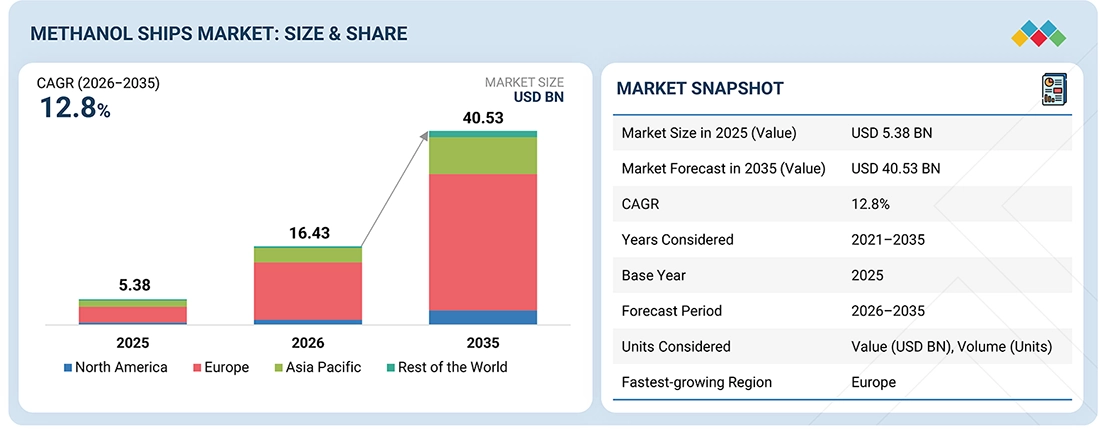
The methanol ships market is projected to grow from USD 16.43 billion in 2026 to USD 40.53 billion by 2035, reflecting a compound annual growth rate (CAGR) of 12.8%. In terms of volume, the market is expected to increase from 57 units in 2025 to 417 units by 2035. This growth is driven by the increasing adoption of methanol as a viable marine fuel, thanks to its easier storage and handling, as well as its compatibility with existing ship designs compared to other alternative fuels. Further support for market growth comes from a rising number of methanol-fueled vessel orders, particularly within the container and tanker segments. Additionally, growing regulatory pressure from the International Maritime Organization (IMO) and regional policies is accelerating the adoption of methanol across global fleets. Improved methanol bunkering infrastructure and the increasing availability of green methanol are also making large-scale deployment more feasible.
KEY TAKEAWAYS
-
By Region
By region, the Europe methanol engines market is estimated to account for a 72.5% share in 2026.
-
By Build
By build, the retrofit segment is expected to register a higher CAGR (28.6%) than the newbuild segment between 2026 and 2035.
-
By System
By system, the propulsion segment is projected to be the most dominant during the forecast period.
-
Competitive Landscape
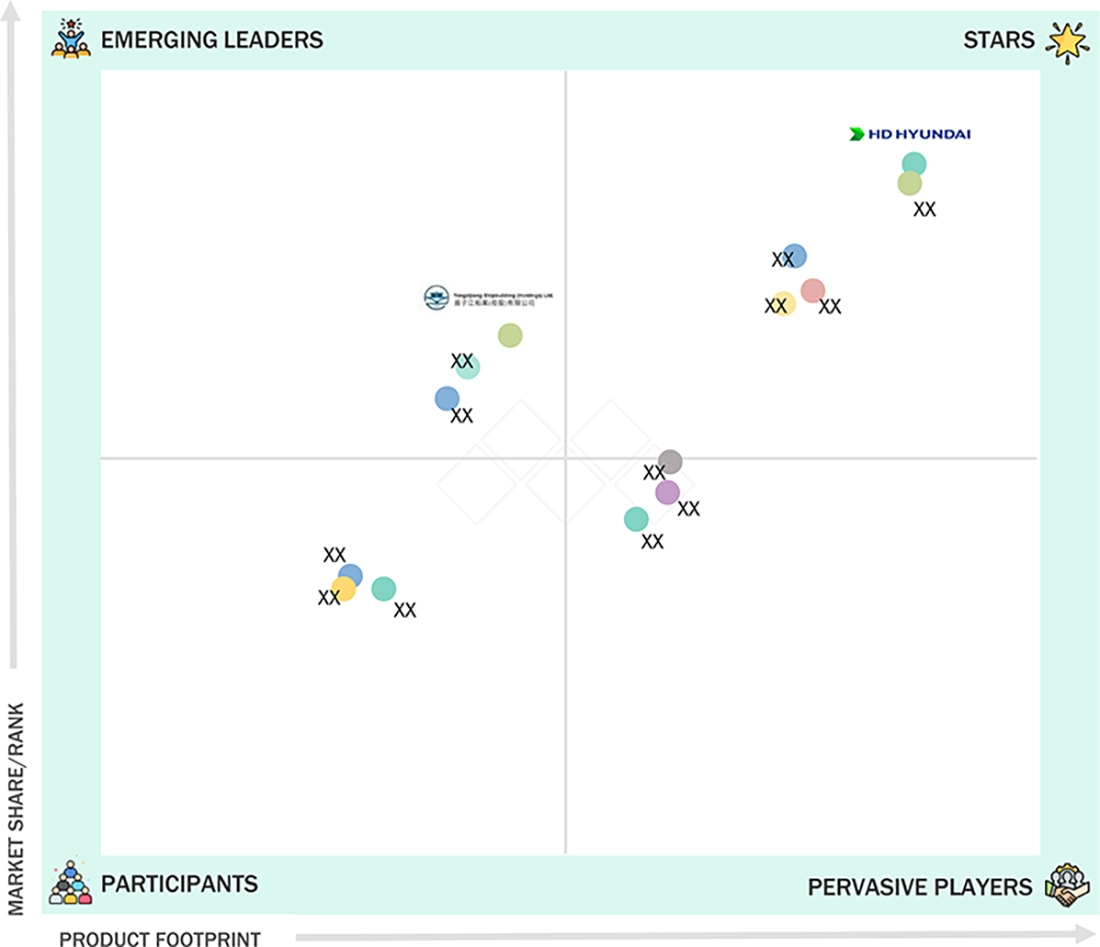
HD Hyundai Heavy Industries, Samsung Heavy Industries, and Jiangnan Shipyard were identified as star players in the methanol ships market (global), given their strong market share and product footprint.
-
Competitive Landscape
Uzmar Shipyar and Cemre Shipyard, among others, have distinguished themselves among startups and SMEs by securing strong footholds in specialized niche areas, underscoring their potential as emerging market leaders.
The methanol ships market is being driven by the increasing pressure on ship owners to operate vessels with low emissions while still maintaining long-distance operations and cargo efficiency. As shipping routes remain extensive and operational demands continue to rise, there is a growing need for vessel solutions that can support cleaner fuels without compromising range, capacity, or performance. This situation is prompting shipowners and shipbuilders to invest in vessels that are capable of using methanol, enabling stable operations, fuel flexibility, and compliance with evolving environmental standards.
TRENDS & DISRUPTIONS IMPACTING CUSTOMERS' CUSTOMERS
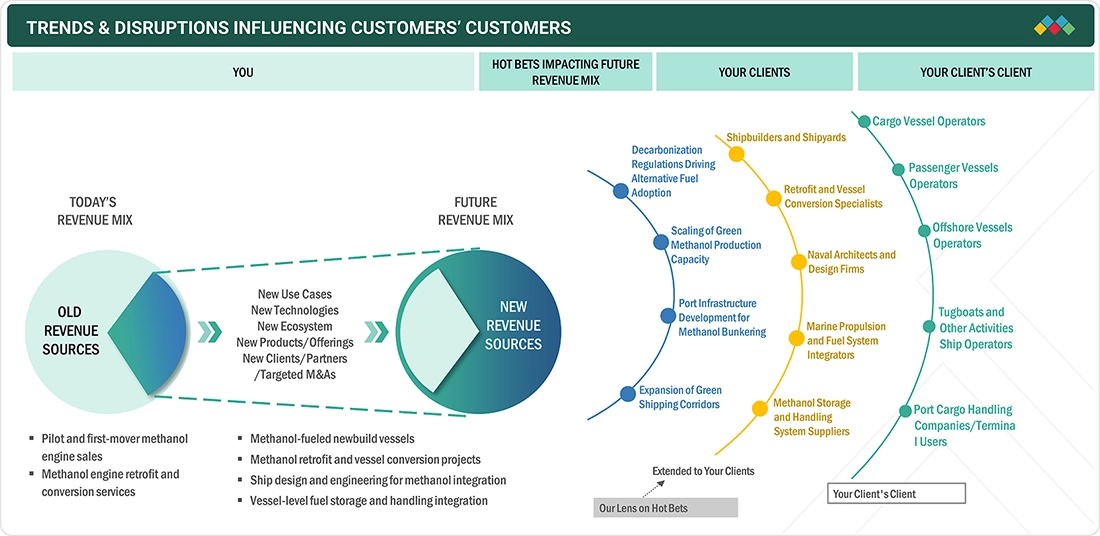
The impact of the methanol ships market on customers' customers largely stems from the increasing demand for low-emission shipping solutions that maintain commercial operations without compromising vessel range or cargo capacity. As decarbonization regulations tighten and green methanol production continues to scale up, ship owners, operators, and cargo companies are becoming increasingly reliant on methanol-fueled vessels and the necessary bunkering infrastructure. Additionally, new developments such as methanol-ready newbuild vessels, retrofit and conversion projects, and enhanced ship design and engineering for methanol integration are transforming how these vessels are constructed and operated. Consequently, there is a rising demand for scalable and efficient methanol ship solutions. End users are also seeking cleaner marine transport options that ensure regulatory compliance, provide fuel flexibility, and support long-term operational efficiency.
Source: Secondary Research, Interviews with Experts, MarketsandMarkets Analysis
MARKET DYNAMICS

Drivers
Impact
Level
-
Stringent emission regulations accelerating shift toward methanol-fueled ships

-
Growing investment in cleaner and future-ready shipping fleets


RESTRAINTS
Impact
Level
-
High upfront cost compared to conventional vessels

-
Limited supply and high cost of green methanol fuel


OPPORTUNITIES
Impact
Level
-
Strong potential to retrofit existing ships

-
Expanding adoption across multiple vessel types


CHALLENGES
Impact
Level
-
Handling and safety requirements for methanol fuel

-
Limited bunkering infrastructure across ports

Source: Secondary Research, Interviews with Experts, MarketsandMarkets Analysis
Global regulations, such as the International Maritime Organization (IMO) and regional policies like the EU Emissions Trading System (ETS), are compelling ship owners to reduce emissions at the vessel level. Thus, methanol is increasingly being adopted because it enables compliance without significant alterations to vessel operations or trading routes. This trend is directly impacting new shipbuilding orders and influencing decisions regarding fleet-wide transitions.
Methanol-capable ships necessitate extra investment in fuel storage tanks, handling systems, and safety infrastructure. This increases the initial capital required, particularly for large commercial ships, leading some operators to postpone their adoption. The cost difference is especially significant in segments with tight margins and longer fleet replacement cycles.
A significant portion of the global fleet continues to operate on conventional fuels, presenting a valuable opportunity for conversion to methanol. Retrofitting existing vessels enables ship owners to prolong their operational life and comply with emission regulations without the need to invest in new ships. This option is particularly appealing for vessels that have a longer remaining lifespan and operate on stable trade routes.
Methanol is toxic and has unique combustion characteristics. This means it requires specialized storage, ventilation, and leak detection systems onboard. Additionally, crew training and operational procedures must be enhanced to ensure the safe handling of methanol. These requirements increase the complexity of vessel design and operations, particularly during the early stages of adoption.
METHANOL SHIPS MARKET SIZE, SHARE & TRENDS: COMMERCIAL USE CASES ACROSS INDUSTRIES
| COMPANY | USE CASE DESCRIPTION | BENEFITS |
|---|---|---|
|
|
Deployment of Berlin Maersk, a 17,480 TEU dual-fuel methanol container ship, for regular liner shipping operations | New class of large methanol-capable container ships and part of Maersk’s expanding low-emission flee | Demonstrates commercial use of methanol in large-scale container shipping | Supports emission reduction in long-haul trade while maintaining fleet scale, route flexibility, and mainstream cargo transport capability |
|
|
Commercial use of Brave Pioneer, a green methanol dual-fuel dry bulk vessel, for transporting bulk commodities on international routes | First of five chartered by Cargill under its low-carbon shipping initiative | Demonstrates utility of methanol-fueled ships in bulk cargo transport without changing the core commercial role of the vessel | Supports low-emission freight movement and expands methanol adoption beyond container shipping |
|
|
Entry into commercial service of New Explorer, the world’s first methanol dual-fuel VLCC, built for crude oil transportation, marking methanol adoption in very large tanker operations | Highlights methanol’s use in large tanker shipping, showing that the fuel is moving beyond pilot-scale deployment into mainstream commercial marine transport | Supports decarbonization in high-capacity crude oil shipping |

Logos and trademarks shown above are the property of their respective owners. Their use here is for informational and illustrative purposes only.
MARKET ECOSYSTEM
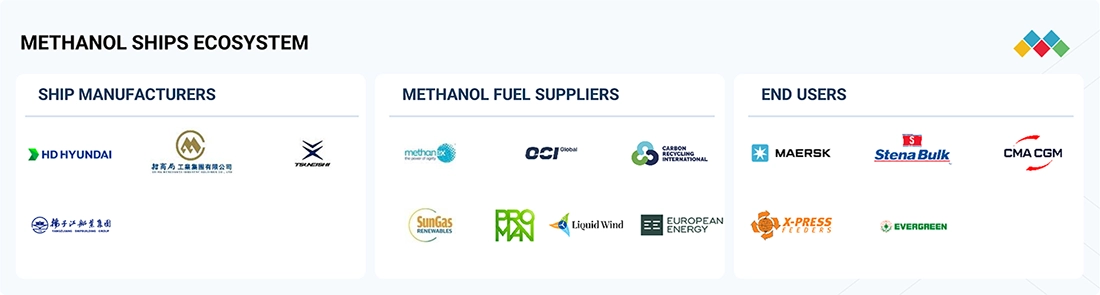
The methanol ships market includes a mix of ship manufacturers, methanol fuel suppliers, and commercial vessel operators such as HD Hyundai, China Merchants Industry Holdings, TSUNEISHI, and Jiangnan Shipyard. These players support different vessel programs through newbuild construction, methanol-ready ship design, and integration of onboard fuel storage and handling systems, while working closely with end users like Maersk, Stena Bulk, CMA CGM, X-Press Feeders, and Evergreen. Methanol fuel suppliers, along with ship manufacturers and operators, play an important role in enabling vessel deployment and making sure fuel is available across key trade routes. This kind of coordination across the ecosystem helps in smoother vessel adoption, more reliable fuel access, and overall wider use of methanol in commercial shipping.
Logos and trademarks shown above are the property of their respective owners. Their use here is for informational and illustrative purposes only.
MARKET SEGMENTS
Source: Secondary Research, Interviews with Experts, MarketsandMarkets Analysis
The newbuild segment is the driving force in the methanol ships market, as most vessel orders are now being placed for methanol-ready designs from the very beginning. Ship manufacturers are opting for newbuilds to guarantee better integration of fuel systems, improved safety features, and long-term compliance with emission regulations.
The propulsion segment is projected to account for the largest share of the methanol ships market during the forecast period, as it is crucial for vessel operation and fuel compatibility. Furthermore, using methanol as a fuel source requires modifications to the engine and propulsion system, which makes this aspect the highest value contributor for both new vessels and retrofitted ones.
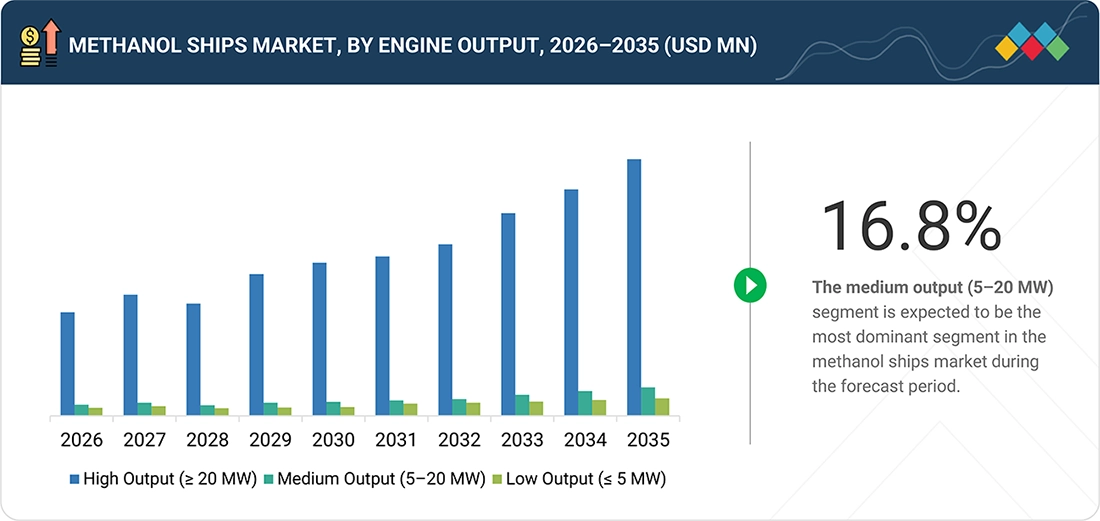
The high output (≥ 20 MW) segment is expected to be the largest market during the forecast period. This is primarily due to their use in large commercial vessels, such as container ships, bulk carriers, and tankers, which require higher power capacities. As a result, high-output engines have become the most commonly utilized configuration in these types of vessels.
The cargo vessels segment is expected to lead the methanol ships market during the forecast period, representing the majority of global fleet capacity and trade volumes. The early adoption of methanol has primarily been observed in container ships and tankers, where major operators are actively investing in methanol-fueled vessels to meet their decarbonization goals.
REGION
Europe to be fastest-growing region in global methanol ships market during forecast period
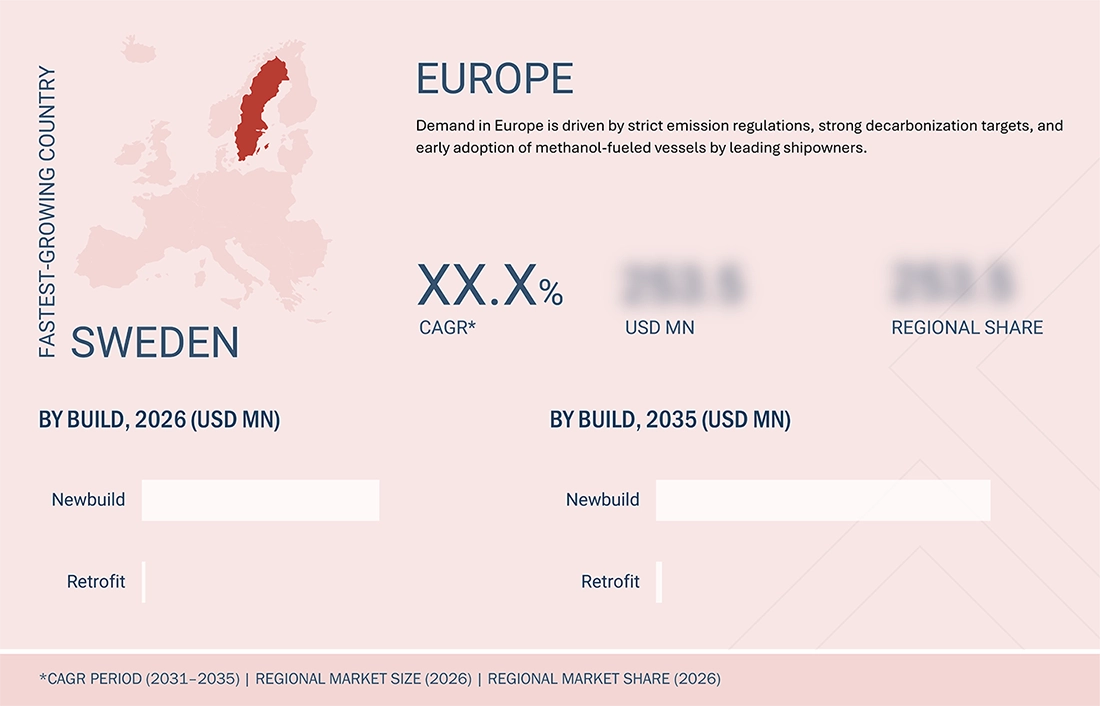
The Europe methanol ships market is expected to account for the largest share during the forecast period. The market is driven by strict emission regulations, strong decarbonization targets, and early adoption of methanol-fueled vessels by leading ship owners in the region. Additionally, European players are investing in green shipping corridors, methanol bunkering infrastructure, and low-carbon fuel partnerships, which are also supporting wider deployment of methanol ships across newbuild and retrofit vessel programs.
METHANOL SHIPS MARKET SIZE, SHARE & TRENDS: COMPANY EVALUATION MATRIX
In the methanol ships market, HD Hyundai (Star) is at the forefront, boasting a strong market presence and significant shipbuilding capabilities. This advantage stems from its active involvement in major methanol-fueled vessel programs and a robust global customer base. Similarly, Yangzijiang Shipbuilding (Emerging Leader) is steadily enhancing its position by increasing its participation in the construction of methanol-capable vessels and expanding its order book visibility in the container ship segment. While HD Hyundai benefits from established shipyard capacity and strong relationships with leading shipowners, Yangzijiang shows promising potential to close the gap with the leaders as newbuild activity rises and methanol vessel orders grow, particularly due to the increasing demand for alternative-fuel ships in commercial shipping.
Source: Secondary Research, Interviews with Experts, MarketsandMarkets Analysis
KEY MARKET PLAYERS
- HD Hyundai Heavy Industries (South Korea)
- Samsung Heavy Industries (South Korea)
- Jiangnan Shipyard (China)
- Yangzijiang Shipbuilding Group (China)
- Guangzhou Shipyard International (China)
- Dalian Shipbuilding Industry Co. (China)
- Yantai CIMC Raffles (China)
- Tsuneishi Shipbuilding (Japan)
- HJ Shipbuilding & Construction (South Korea)
- Mitsubishi Shipbuilding (Japan)
- Nippon Shipyard (Japan)
- Tersan Shipyard (Turkey)
- Minaminippon Shipbuilding (Japan)
- China Merchants Heavy Industry (China)
- Mazagon Dock Shipbuilders (India)
MARKET SCOPE
| REPORT METRIC | DETAILS |
|---|---|
| Market Size in 2025 | USD 5.38 Billion |
| Market Forecast in 2035 | USD 40.53 Billion |
| CAGR | 12.8% for 2026–2035 |
| Years Considered | 2021–2035 |
| Base Year | 2025 |
| Forecast Period | 2026–2035 |
| Units Considered | Value (USD Billion), Volume (Units) |
| Report Coverage | Revenue forecast, company ranking, competitive landscape, growth factors, and trends |
| Segments Covered |
|
| Regions Covered | North America, Asia Pacific, Europe, Rest of the World |
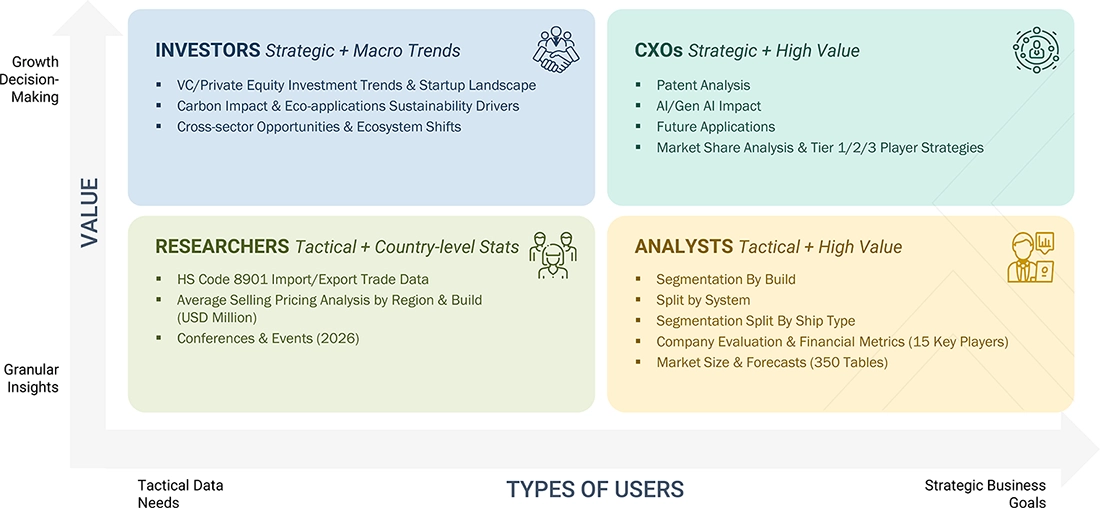
WHAT IS IN IT FOR YOU: METHANOL SHIPS MARKET SIZE, SHARE & TRENDS REPORT CONTENT GUIDE
DELIVERED CUSTOMIZATIONS
We have successfully delivered the following deep-dive customizations:
| CLIENT REQUEST | CUSTOMIZATION DELIVERED | VALUE ADDS |
|---|---|---|
| Leading Manufacturer | Additional segment breakdown for countries | Additional country-level market sizing tables for segments/sub-segments covered at the regional/global level to gain an understanding of market potential by each country |
| Emerging Leader | Additional company profiles | Competitive information on targeted players to gain granular insights on direct competition |
| Regional Market Leader | Additional country market estimates | Additional country-level deep dive for a more targeted understanding of the total addressable market |
RECENT DEVELOPMENTS
- June 2025 : Mitsui O.S.K. Lines (Japan) announced the delivery of Kohzan Maru VII, a dual-fuel methanol carrier built at HD Hyundai Mipo. The vessel will serve Mitsubishi Gas Chemical under a long-term charter, showing that methanol-fueled ship deployment is expanding beyond container shipping into dedicated methanol and chemical transport.
- December 2025 : Hapag-Lloyd placed an order for eight dual-fuel methanol container ships as part of its fleet expansion strategy. The vessels are scheduled for delivery between 2027 and 2029 and reflect growing adoption of methanol-powered ships in regional and feeder container segments.
- February 2026 : TSUNEISHI SHIPBUILDING (Japan) announced the delivery of a methanol dual-fuel container vessel and highlighted its expanding track record in alternative-fuel ships. The company also noted that this followed its May 2025 delivery of a methanol dual-fuel Ultramax bulk carrier and its January 2026 delivery of the world’s first methanol dual-fuel KAMSARMAX bulk carrier, showing broader use across vessel classes.
Table of Contents
 Exclusive indicates content/data unique to MarketsandMarkets and not available with any competitors.
TITLE
PAGE NO
1
INTRODUCTION
15
2
EXECUTIVE SUMMARY
3
PREMIUM INSIGHTS
4
MARKET OVERVIEW
4.1
INTRODUCTION
4.2
MARKET DYNAMICS
4.2.1
DRIVERS
4.2.2
RESTRAINTS
4.2.3
OPPORTUNITIES
4.2.4
CHALLENGES
4.3
UNMET NEEDS & WHITE SPACES
4.4
INTERCONNECTED MARKETS AND CROSS-SECTOR OPPORTUNITIES
4.5
STRATEGIC MOVES BY TIER-1/2/3 PLAYERS
5
INDUSTRY TRENDS
5.1
ECOSYSTEM ANALYSIS
5.2
VALUE CHAIN ANALYSIS
5.3
PRICING ANALYSIS
5.3.1
AVERAGE SELLING PRICE OF METHANOL SHIP, BY BUILD,
5.3.2
AVERAGE SELLING PRICE TREND, BY REGION (2021-2025)
5.4
IMPACT OF 2025 US TARIFF – METHANOL SHIPS MARKET
5.4.1
INTRODUCTION
5.4.2
KEY TARIFF RATES
5.4.3
PRICE IMPACT ANALYSIS
5.4.4
IMPACT ON COUNTRY/REGION
5.4.4.1
NORTH AMERICA
5.4.4.2
EUROPE
5.4.4.3
ASIA PACIFIC
5.4.5
IMPACT ON END-USE INDUSTRIES
5.5
TRADE ANALYSIS
5.5.1
IMPORT SCENARIO (HS CODE: 8901)
5.5.2
EXPORT SCENARIO (HS CODE: 8901)
5.6
CASE STUDY ANALYSIS
5.7
KEY CONFERENCES & EVENTS,
5.8
INVESTMENT AND FUNDING SCENARIO
5.9
TRENDS/DISRUPTION IMPACTING CUSTOMER’S BUSINESS
5.10
OPERATIONAL DATA
5.11
TOTAL COST OF OWNERSHIP (TCO)
5.12
MACROECONOMIC OUTLOOK
5.12.1
INTRODUCTION
5.12.2
GDP TRENDS AND FORECAST
5.12.3
TRENDS IN GLOBAL METHANOL INDUSTRY
5.12.4
TRENDS IN GLOBAL MARINE INDUSTRY
5.13
VOLUME DATA
5.14
BILL OF MATERIALS
6
TECHNOLOGICAL ADVANCEMENTS, AI-DRIVEN IMPACT, PATENTS, INNOVATIONS, AND FUTURE APPLICATIONS
6.1
KEY EMERGING TECHNOLOGIES
6.2
COMPLEMENTARY TECHNOLOGIES
6.3
ADJACENT TECHNOLOGIES
6.4
TECHNOLOGY ROADMAP
6.5
PATENT ANALYSIS
6.6
FUTURE APPLICATIONS
6.7
IMPACT OF AI/GEN AI ON METHANOL SHIPS MARKET
6.7.1
TOP USE CASES AND MARKET POTENTIAL
6.7.2
BEST PRACTICES FOLLOWED BY MANUFACTURERS
6.7.3
CASE STUDIES OF AI IMPLEMENTATION IN THE METHANOL SHIPS MARKET
6.7.4
INTERCONNECTED ADJACENT ECOSYSTEM AND IMPACT ON MARKET PLAYERS
6.7.5
CLIENTS’ READINESS TO ADOPT AI-INTEGRATED METHANOL SHIPS
6.8
SUCCESS STORIES AND REAL-WORLD APPLICATIONS
7
METHANOL BUNKERING LANDSCAPE
7.1
INTRODUCTION
7.2
ROLE OF BUNKERING IN METHANOL SHIP ADOPTION
7.3
METHANOL BUNKERING ECOSYSTEM
7.3.1
METHANOL PRODUCERS
7.3.2
FUEL SUPPLIERS
7.3.3
TRANSPORT, STORAGE, AND LOGISTICS PROVIDERS
7.3.4
SERVICE PROVIDERS
7.3.5
SHIPOWNERS AND VESSEL OPERATORS
7.4
CURRENT STATE OF METHANOL BUNKERING
7.4.1
ACTIVE PORTS
7.4.2
PORTS UNDER DEVELOPMENT
7.5
BUNKERING INFRASTRUCTURE AND DELIVERY MODELS
7.5.1
TRUCK-TO-SHIP
7.5.2
SHIP-TO-SHIP
7.5.3
TERMINAL-TO-SHIP
7.6
SAFETY STANDARDS AND OPERATIONAL REQUIREMENTS
7.6.1
REGULATORY AND CLASS FRAMEWORK
7.6.2
BUNKERING PROCEDURES AND OPERATING CONTROLS
7.7
KEY CHALLENGES AND GAPS IN METHANOL BUNKERING
8
REGULATORY LANDSCAPE AND SUSTAINABILITY INITIATIVES
8.1
REGIONAL REGULATIONS AND COMPLIANCE
8.1.1
REGULATORY BODIES, GOVERNMENT AGENCIES, AND OTHER ORGANIZATIONS
8.1.2
INDUSTRY STANDARDS
8.2
SUSTAINABILITY INITIATIVES
8.3
IMPACT OF REGULATORY POLICIES ON SUSTAINABILITY INITIATIVES
9
CUSTOMER LANDSCAPE & BUYER BEHAVIOR
9.1
DECISION-MAKING PROCESS
9.2
KEY STAKEHOLDERS IN BUYING PROCESS AND THEIR EVALUATION CRITERIA
9.2.1
KEY STAKEHOLDERS IN BUYING PROCESS
9.2.2
BUYING CRITERIA
9.3
ADOPTION BARRIERS & INTERNAL CHALLENGES
9.4
UNMET NEEDS FROM VARIOUS END-USE INDUSTRIES
10
METHANOL SHIPS MARKET, BY ENGINE OUTPUT
(POWER-RANGE-WISE DEMAND POTENTIAL AND GROWTH TRENDS SHAPING METHANOL SHIPS ADOPTION ACROSS MARINE APPLICATIONS)
10.1
INTRODUCTION
10.2
LOW OUTPUT (≤ 5 MW)
10.3
MEDIUM OUTPUT (5–20 MW)
10.4
HIGH OUTPUT (≥ 20 MW)
11
METHANOL SHIPS MARKET, BY SYSTEM
(SYSTEM-WISE DEMAND POTENTIAL AND VALUE CONTRIBUTION SHAPING METHANOL SHIPS ADOPTION ACROSS MARINE APPLICATIONS)
11.1
INTRODUCTION
11.2
PROPULSION SYSTEM
11.2.1
MAIN PROPULSION
11.2.2
AUXILIARY POWE
11.3
FUEL SYSTEM
11.3.1
FUEL STORAGE, CONTAINMENT, AND VENTING
11.3.2
FUEL SUPPLY AND DISTRIBUTION
11.3.3
FUEL INJECTION AND VALVE TRAIN
11.4
AIR, EXHAUST AND VENTILATION SYSTEM (COMBUSTION AIR, EXHAUST GAS HANDLING, HAZARDOUS-SPACE VENTILATION, TRUNK/MAST VENTILATION)
11.5
COOLING AND LUBRICATION SYSTEM
11.6
ELECTRICAL AND CONTROL SYSTEM
11.6.1
ELECTRICAL INSTALLATIONS
11.6.2
CONTROL AND AUTOMATION
11.6.3
MONITORING AND DIAGNOSTICS
11.7
SAFETY SYSTEM
11.7.1
LEAK AND VAPOR DETECTION
11.7.2
EMERGENCY SHUTDOWN AND FIRE PROTECTION
12
METHANOL SHIPS MARKET, BY SHIP TYPE
(SHIP-TYPE-WISE DEMAND POTENTIAL AND GROWTH TRENDS SHAPING METHANOL SHIPS ADOPTION ACROSS MAJOR VESSEL CLASSES)
12.1
INTRODUCTION
12.2
CARGO VESSELS
12.2.1
CONTAINER SHIPS
12.2.2
BULK CARRIERS
12.2.3
RO-RO CARGO SHIPS (FREIGHT-ONLY OR CARGO-LED ROLL-ON/ROLL-OFF VESSELS)
12.2.4
CAR CARRIERS
12.2.5
CHEMICAL TANKERS
12.2.6
CRUDE OIL TANKERS
12.3
PASSENGER VESSELS
12.3.1
CRUISE SHIPS
12.3.2
ROPAX VESSELS (PASSENGER-LED ROLL-ON/ROLL-OFF VESSELS)
12.4
OFFSHORE VESSELS
12.4.1
OFFSHORE SUPPLY SHIPS
12.4.2
OFFSHORE SUPPORT VESSELS
12.5
TUGBOATS
12.6
RESEARCH AND SURVEY VESSELS
13
METHANOL SHIPS MARKET, BY BUILD (BUILD-SPECIFIC ADOPTION TRENDS, DEMAND DYNAMICS, AND POTENTIAL ACROSS MARINE APPLICATIONS)
13.1
INTRODUCTION
13.2
NEWBUILD
13.3
RETROFIT
14
METHANOL SHIPS MARKET, REGIONAL ANALYSIS
(ASSESSING GROWTH PATTERNS, INDUSTRY FORCES, REGULATORY LANDSCAPE, AND MARKET POTENTIAL ACROSS KEY GEOGRAPHIES AND COUNTRIES)
14.1
INTRODUCTION
14.2
NORTH AMERICA
14.3
EUROPE
14.3.1
DENMARK
14.3.2
FRANCE
14.3.3
SWEDEN
14.3.4
GERMANY
14.3.5
SWITZERLAND
14.3.6
NETHERLANDS
14.3.7
NORWAY
14.4
ASIA
14.4.1
CHINA
14.4.2
JAPAN
14.4.3
SOUTH KOREA
14.4.4
INDIA
14.4.5
SINGAPORE
14.4.6
TAIWAN
14.5
REST OF THE WORLD
14.5.1
MIDDLE EAST (UAE)
14.5.2
LATIN AMERICA (BRAZIL)
15
COMPETITIVE LANDSCAPES
(STRATEGIC ASSESSMENT OF LEADING PLAYERS, MARKET SHARE, REVENUE ANALYSIS, COMPANY POSITIONING, AND COMPETITIVE BENCHMARKS INFLUENCING MARKET POTENTIAL)
15.1
OVERVIEW
15.2
KEY PLAYER COMPETITIVE STRATEGIES/RIGHT TO WIN (AUGUST 2021 – MARCH 2026)
15.3
MARKET SHARE ANALYSIS,
15.4
REVENUE ANALYSIS, 2021-2025
15.5
COMPANY EVALUATION MATRIX: KEY PLAYERS,
15.5.1
STARS
15.5.2
EMERGING LEADERS
15.5.3
PERVASIVE PLAYERS
15.5.4
PARTICIPANTS
15.5.5
COMPANY FOOTPRINT: KEY PLAYERS,
22.5.5.1
COMPANY FOOTPRINT
22.5.5.2
REGION FOOTPRINT
22.5.5.3
BUILD FOOTPRINT
22.5.5.4
ENGINE OUTPUT FOOTPRINT
22.5.5.5
SHIP TYPE FOOTPRINT
15.6
COMPANY VALUATION AND FINANCIAL METRICS
15.7
COMPANY EVALUATION MATRIX: START-UPS/SME,
15.7.1
PROGRESSIVE COMPANIES
15.7.2
RESPONSIVE COMPANIES
15.7.3
DYNAMIC COMPANIES
15.7.4
STARTING BLOCKS
15.7.5
COMPETITIVE BENCHMARKING: STARTUPS/SMES,
22.7.5.1
DETAILED LIST OF STARTUPS/SMES
22.7.5.2
COMPETITIVE BENCHMARKING OF KEY STARTUPS/SMES
15.8
TECHNOLOGY COMPARISON
15.9
COMPETITIVE SCENARIO
15.9.1
PRODUCT LAUNCHES
15.9.2
DEALS
15.9.3
EXPANSIONS
16
COMPANY PROFILES
(IN-DEPTH REVIEW OF COMPANIES, PRODUCTS, SERVICES, RECENT INITIATIVES, AND POSITIONING STRATEGIES IN THE METHANOL SHIPS MARKET LANDSCAPE)
16.1
KEY PLAYERS
16.1.1
HD HYUNDAI HEAVY INDUSTRIES
16.1.1.1
BUSINESS OVERVIEW
16.1.1.2
PRODUCTS OFFERED
16.1.1.3
RECENT DEVELOPMENTS
16.1.2
SAMSUNG HEAVY INDUSTRIES
16.1.3
JIANGNAN SHIPYARD
16.1.4
YANGZIJIANG SHIPBUILDING GROUP
16.1.5
GUANGZHOU SHIPYARD INTERNATIONAL (GSI)
16.1.6
DALIAN SHIPBUILDING INDUSTRY CO. (DSIC)
16.1.7
YANTAI CIMC RAFFLES
16.1.8
TSUNEISHI SHIPBUILDING
16.1.9
HJ SHIPBUILDING & CONSTRUCTION
16.1.10
MITSUBISHI SHIPBUILDING
16.1.11
NIPPON SHIPYARD
16.1.12
TERSAN SHIPYARD
16.1.13
MINAMINIPPON SHIPBUILDING
16.1.14
CHINA MERCHANTS HEAVY INDUSTRY
16.1.15
MAZAGON DOCK SHIPBUILDERS
16.2
OTHER PLAYERS
16.2.1
UZMAR SHIPYARD
16.2.2
CEMRE SHIPYARD
16.2.3
SEFINE SHIPYARD
16.2.4
FASSMER
16.2.5
KANASASHI HEAVY INDUSTRIES
16.2.6
TAIZHOU SANFU SHIP ENGINEERING
16.2.7
NEW DAYANG SHIPBUILDING
16.2.8
JIANGSU ZHENJIANG SHIPYARD
16.2.9
ZHOUSHAN HEHUI SHIPBUILDING
16.2.10
JIANGSU QINFENG SHIPBUILDING
17
RESEARCH METHODOLOGY
17.1
RESEARCH DATA
17.1.1
SECONDARY DATA
17.1.2
KEY DATA FROM SECONDARY SOURCES
17.1.3
LIST OF KEY SECONDARY SOURCES
17.1.4
PRIMARY DATA
17.1.5
KEY DATA FROM PRIMARY SOURCES
17.1.6
KEY PRIMARY PARTICIPANTS
17.1.7
BREAKDOWN OF PRIMARY INTERVIEWS
17.1.8
KEY INDUSTRY INSIGHTS
17.2
MARKET SIZE ESTIMATION
17.2.1
BOTTOM-UP APPROACH
17.2.2
TOP-DOWN APPROACH
17.2.3
MARKET SIZE CALCULATION FOR BASE YEAR
17.3
MARKET FORECAST APPROACH
17.3.1
SUPPLY SIDE
17.3.2
DEMAND SIDE
17.4
DATA TRIANGULATION
17.5
FACTOR ANALYSIS
17.6
RESEARCH ASSUMPTIONS
17.7
RESEARCH LIMITATIONS AND RISK ASSESSMENT
18
APPENDIX
18.1
DISCUSSION GUIDE
18.2
KNOWLEDGESTORE: MARKETSANDMARKETS’ SUBSCRIPTION PORTAL
18.3
CUSTOMIZATION OPTIONS
18.4
RELATED REPORTS
18.5
AUTHOR DETAILS
Methodology
The study involved four major activities in estimating the current size of the methanol ships market. Exhaustive secondary research was done to collect information on the market, its adjacent markets, and its parent market. The next step was to validate these findings, assumptions, and sizing with industry experts across the value chain through primary research. Demand-side analysis was conducted to estimate the overall market size. After that, market breakdown and data triangulation procedures were employed to estimate the sizes of various segments and subsegments within the market.
Secondary Research
During the secondary research process, various sources were consulted to identify and collect information for this study. The secondary sources included government sources, such as SIPRI; corporate filings, including annual reports, press releases, and investor presentations from companies; white papers, journals, and certified publications; and articles from recognized authors, directories, and databases.
Primary Research
Extensive primary research was conducted after acquiring information regarding the methanol ships market scenario through secondary research. Several primary interviews were conducted with market experts from the demand and supply sides across major countries of North America, Europe, Asia, and RoW. Primary data was collected through questionnaires, emails, and telephonic interviews.

To know about the assumptions considered for the study, download the pdf brochure
Market Size Estimation
The top-down and bottom-up approaches were used to estimate and validate the size of the methanol ships market. The research methodology used to estimate the size of the market included the following details:
- Key players in the methanol ships market were identified through secondary research, and their market shares were determined through a combination of primary and secondary research. This included a study of the annual and financial reports of the top market players, as well as extensive interviews with leaders, including directors, engineers, marketing executives, and other key stakeholders of leading companies operating in the market.
- All percentage shares, splits, and breakdowns were determined using secondary sources and verified through primary sources.
- All possible parameters that affect the markets covered in this research study were accounted for, viewed in extensive detail, verified through primary research, and analyzed to obtain the final quantitative and qualitative data on the methanol ships market. This data was consolidated, enhanced with detailed inputs, analyzed by MarketsandMarkets, and presented in this report.
Methanol Ships Market Size: Bottom-up & Top-Down Approach

Data Triangulation
After determining the overall market size, the total market was divided into several segments and subsegments. The data triangulation and market breakdown procedures explained below were implemented, wherever applicable, to complete the overall market engineering process and arrive at the estimated market numbers for the market segments and subsegments. The data was triangulated by studying various factors and trends from the demand and supply sides. Additionally, the market size was validated using top-down and bottom-up approaches.
Market Definition
The methanol ships market refers to the market for ships that are built or converted to operate on methanol as a marine fuel. It includes vessels using methanol through dual-fuel or methanol-capable engine systems and covers newbuild and retrofit ships. The market is segmented by engine output, system, ship type, and build. It includes cargo vessels, passenger vessels, offshore vessels, tugboats, and research and survey vessels equipped with the required propulsion, fuel handling, electrical, control, and safety systems for methanol use. The market captures vessel-level demand driven by cleaner fuel adoption across marine applications.
Key Stakeholders
- Shipowners and Fleet Operators
- Shipyards and Vessel Builders
- Methanol Engine and Propulsion System Providers
- Marine System Integrators and Retrofit Solution Providers
- Fuel Suppliers and Methanol Producers
- Bunkering Infrastructure Providers
- Port Authorities and Terminal Operators
- Classification Societies
- Government and Regulatory Bodies
Report Objectives
- To describe, segment, and forecast the size of the methanol ships market, by build, engine output, system, and ship type, in terms of value
- To forecast the size of market segments based on four regions: North America, Europe, Asia, and the Rest of the World, in terms of value and volume
- To identify and analyze key drivers, restraints, opportunities, and challenges influencing the growth of the market
- To identify industry trends, market trends, and technology trends prevailing in the market
- To analyze micromarkets with respect to individual technological trends, prospects, and their contribution to the overall market
- To strategically profile key market players and comprehensively analyze their market ranking and core competencies
- To provide a detailed competitive landscape of the market and analyze competitive growth strategies, such as product developments, contracts, partnerships, agreements, and collaborations, adopted by key players in the market
- To identify the detailed financial position of key players, as well as their key products, unique selling points, and key developments
Available customizations:
MarketsandMarkets offers the following customizations for this market report:
- Additional country-level analysis of the methanol ships market
- Profiling of other market players (up to 5)
Product Analysis
- Product matrix, which provides a detailed comparison of the product portfolio of each company in the methanol ships market

Still Researching the Methanol Ships Ecosystem?
Before you go, explore the intelligence strategy teams use to analyze this market.
- Methanol Ships Competitor Landscape
- Methanol Ships Technology Shifts
- Methanol Ships supply consulting-grade strategic intelligence outputs tailored to your Methanol Ships growth question.
Generate 15+ consulting-grade strategic intelligence outputs tailored to your Methanol Ships growth question.