



- DESCRIPTION
- TABLE OF CONTENTS
- METHODOLOGY
- DOWNLOAD PDF
Autoinjectors Market by Type (Devices, Finished Formulation), Usage (Disposable, Reusable), Actuation Mechanism (Mechanical, Electronic), Therapy (Rheumatoid Arthritis, Obesity, Diabetes), ROA (SC, IM), Volume (< 3ml, > 3ml) - Global Forecast to 2031

USD 300.46 BN
MARKET SIZE, 2031

CAGR 18.7%
(2026-2031)

500
REPORT PAGES

550
MARKET TABLES
AUTOINJECTORS MARKET SIZE, SHARE & GROWTH SNAPSHOT
Source: Secondary Research, Interviews with Experts, MarketsandMarkets Analysis
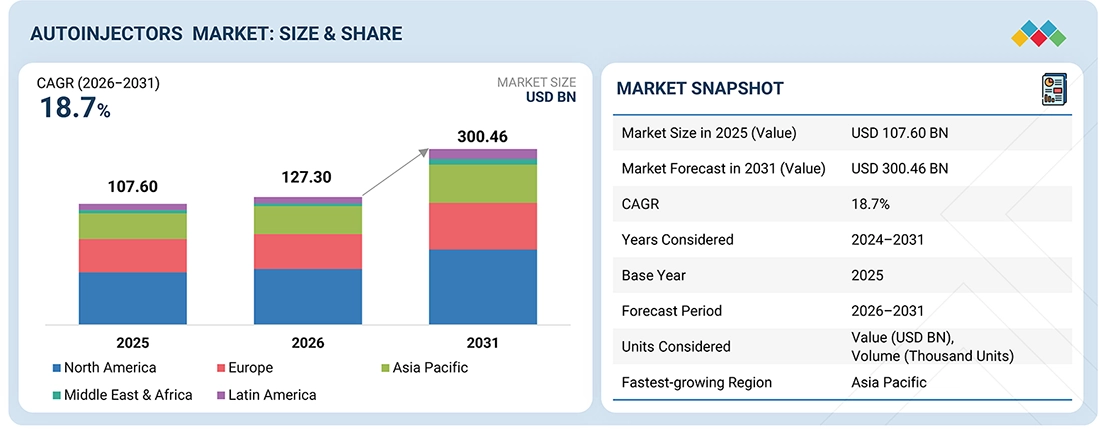
The global autoinjectors market, valued at USD 107.60 billion in 2025, stood at USD 127.30 billion in 2026 and is projected to advance at a resilient CAGR of 18.7% from 2026 to 2031, culminating in a forecasted valuation of USD 300.46 billion by the end of the period. This market is expected to grow at a significantly, due to the rising prevalence of chronic and autoimmune diseases such as diabetes, multiple sclerosis, & arthritis, and an increase in regulatory approvals worldwide. Moreover, there is an increase in the adoption of self-administered medicines, especially for chronic diseases, which require long-term injectable therapies, government support. Additionally, favorable reimbursement policies for the wider adoption of autoinjectors at affordable prices propel the demand for autoinjectors.
KEY TAKEAWAYS
-
By Usage
By usage, the disposable autoinjectors segment is projected to register the highest CAGR during forecast period.
-
By Actuation Mechanism
Based on actuation mechanism, the mechanical (spring-based) autoinjectors segment dominated the market in 2025.
-
By Route of Administartion
By route of administration, the subcutaneous segment dominated the market with a share 91.3% in 2025.
-
By Therapy Area
Based on therapy area, obesity is projected to register highest CAGR during the forecast period.
-
By Drug Type
By drug type, the biologics segment held the largest market share in 2025.
-
By Volume
Based on volume, the up to 3 ml segment dominatd, in terms of market share in 2025.
-
By End User
Based on end user, the home care settings segment is projected to register the highest CAGR of 19.3% during the forecast period.
The global autoinjectors market is experiencing steady growth, driven by the rising prevalence of chronic and autoimmune diseases such as diabetes, multiple sclerosis, and arthritis, along with increasing regulatory approvals worldwide. The growing adoption of self-administered therapies, particularly for the long-term treatment of chronic conditions further supports market expansion. In addition, government initiatives and favorable reimbursement policies are improving accessibility and affordability, collectively boosting demand for autoinjectors.
TRENDS & DISRUPTIONS IMPACTING CUSTOMERS' CUSTOMERS
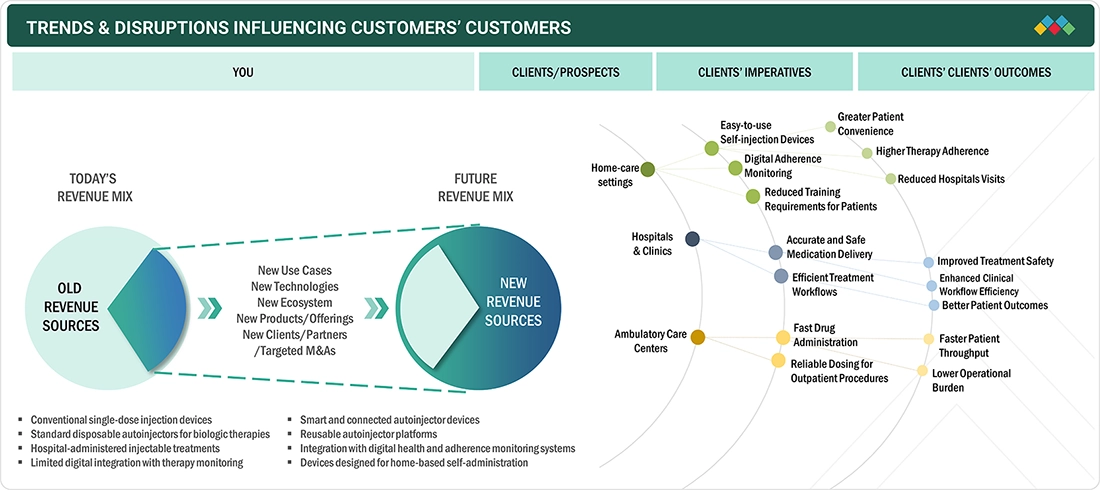
The autoinjectors market is undergoing a significant transformation driven by technological advancements, evolving customer needs, and regulatory changes. Revenue largely comes from conventional single-dose injection devices, standard disposable autoinjectors for biologic therapies, and limited digital integration. The future, however, is shifting toward smart and connected autoinjector devices, reusable autoinjector platforms, and integration with digital health and adherence monitoring systems. Clients, such as home-care settings, hospitals & clinics, and ambulatory care centers, are focused on ensuring compliance, improving efficiency, and integrating real-time data to enhance patient care. These imperatives translate into better end-user outcomes, including greater patient convenience, higher therapy adherence, reduced hospital visits, and improved overall experience.
Source: Secondary Research, Interviews with Experts, MarketsandMarkets Analysis
MARKET DYNAMICS

Drivers
Impact
Level
-
Rising prevalence of chronic and autoimmune diseases globally

-
Increasing regulatory approvals for autoinjectors


RESTRAINTS
Impact
Level
-
Focus on needle-free drug delivery systems and prevalence of needle phobia


OPPORTUNITIES
Impact
Level
-
Impending patent expiry of biological molecules

-
Launch of technologically advanced autoinjectors


CHALLENGES
Impact
Level
-
Development of autoinjectors for multiple drug viscosities

-
Risk of device malfunctions and recalls

Source: Secondary Research, Interviews with Experts, MarketsandMarkets Analysis
The rising prevalence of chronic disease is a key driver of the autoinjectors market. As per the International Diabetes Federation (IDF) report published in 2025, 589 million adults live with diabetes, which is one in nine adults globally. This number is expected to rise to 853 million by 2050. With increasing population and lifestyle-related risk factors such as obesity, diabetes, and arthritis, the demand for long-term therapies is rising. This is fueling sustained demand for autoinjectors, which are critical for long-term treatments in both hospitals and home-care settings.
Needle phobia among patients with diabetes, rheumatoid arthritis, and cardiovascular diseases acts as a major barrier. According to a 2025 study published in the Journal of Psychiatry Research Communications by Elsevier, nearly one-third of adults report fearing needles, which hampers their medical care. Despite this barrier, continued innovation in hidden needle mechanisms, needle-free drug delivery devices, and shorter injection times is helping to reduce anxiety.
Technologically advanced autoinjectors have significant growth potential in emerging markets. Ongoing innovation makes autoinjectors more user-friendly, reliable, and effective. The U.S. FDA granted 510(k) clearance for the SmartPilot autoinjector developed by Ypsomed (Switzerland), which captures key injection data and securely transmits it via Bluetooth to the patient's smartphone. These advancements help improve patient compliance and are expected to drive market growth in the coming years.
A major challenge in the autoinjector market is ensuring device compatibility with drugs of varying viscosities. Different viscosities require springs with specific physical features, such as composition, length, and thickness, to generate enough force to deliver high-viscosity drugs through the syringe and to the needle. Despite these difficulties, many companies have developed autoinjectors capable of handling a range of drug viscosities, such as the Physioject disposable autoinjector by BD (U.S.) and Molly 2.25 from SHL Medical (Switzerland).
AUTOINJECTORS MARKET: COMMERCIAL USE CASES ACROSS INDUSTRIES
| COMPANY | USE CASE DESCRIPTION | BENEFITS |
|---|---|---|
|
|
Provides management of chronic diseases such as obesity through pre-filled auto-injector platforms such as FlexTouch | Offers ease of use with pre-filled systems that ensure dose accuracy and patient compliance, with audible confirmation of dose delivery and a design that meets patient needs |
|
|
Develops formulations such as the KwikPen prefilled injection systems, facilitating the routine administration of biologic injections for diabetes and immunology treatment | Makes dosing more convenient and precise, simplifies the process, and increases compliance through ready-to-use injection systems |
|
|
Offers treatment of autoimmune disease using autoinjectors for biologics such as Humira Pen, intended for self-injection at home | Simplifies biologics delivery, decreases reliance on clinical settings, and increases patient comfort and compliance through self-injection technology |
|
|
Enables use in various therapeutic areas such as rheumatoid arthritis and cardiovascular diseases through autoinjector platforms such as SureClick (e.g., Enbrel) | Enables consistent and reliable delivery of the drug, ease of use, and long-term therapy compliance in home care settings |
|
|
Develops auto-injector systems for biologics such as Dupixent, enabling patients to self-administer treatments for conditions such as asthma, atopic dermatitis, and other chronic diseases at home | Improves patient adherence and ease of use through ergonomic, ready-to-use auto-injector designs with hidden needles, consistent dose delivery, and reduced need for clinical visits, supporting safe and convenient self-injection |




Logos and trademarks shown above are the property of their respective owners. Their use here is for informational and illustrative purposes only.
MARKET ECOSYSTEM
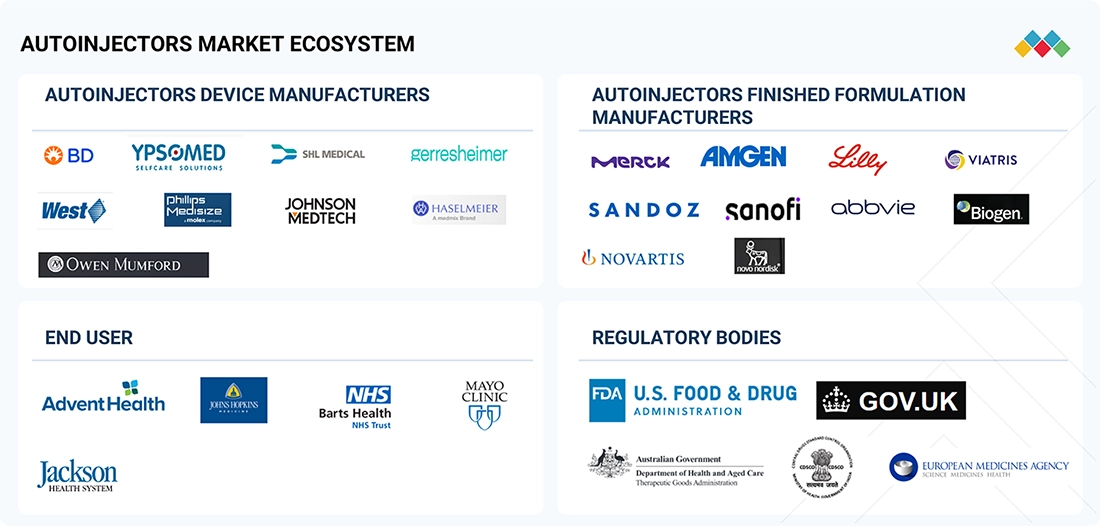
The autoinjectors market operates within a complex, interconnected ecosystem that includes product innovation, regulatory oversight, manufacturing, distribution, and end-user adoption across multiple care settings. At the core of the ecosystem are manufacturers of autoinjector devices, including Becton, Dickinson and Company (US), SHL Medical (Switzerland), and Ypsomed (Switzerland). Key manufacturers in the autoinjector finished-formulation market include Novo Nordisk (Denmark), Eli Lilly and Company (US), and AbbVie (US). They are supported by academic institutes, clinical research bodies, and technology partners. Surrounding this network are regulatory agencies such as the Food and Drug Administration (FDA), the European Medicines Agency (EMA), and national health authorities that enforce strict compliance with device safety, sterility, and performance standards, as well as post-market surveillance. Downstream, the ecosystem culminates with diverse end users, including home-care settings, hospitals & clinics, ambulatory care centers, and other end users whose clinical needs, workflow requirements, and safety priorities directly shape product selection, adoption rates, and long-term technology evolution within the market.
Logos and trademarks shown above are the property of their respective owners. Their use here is for informational and illustrative purposes only.
MARKET SEGMENTS
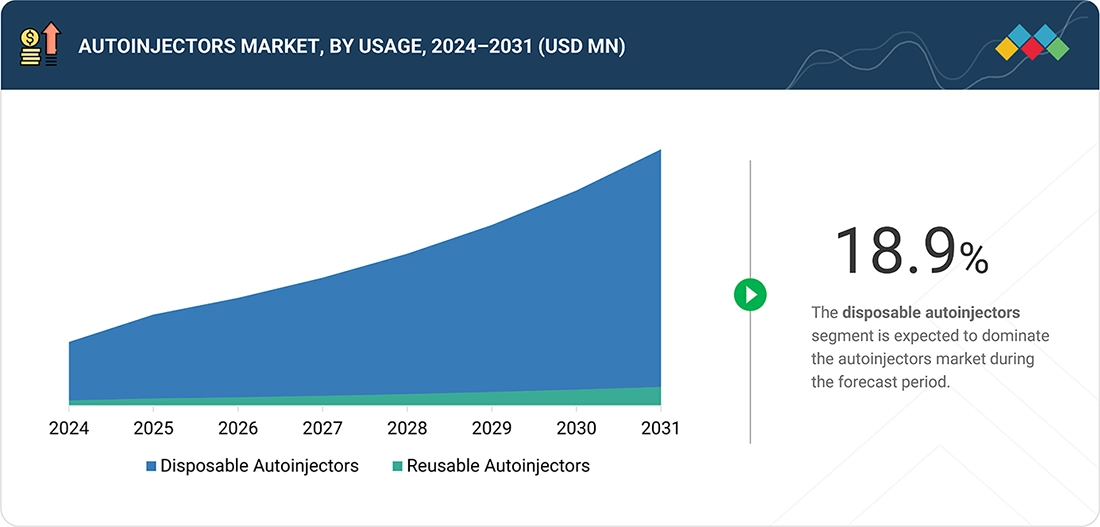
Source: Secondary Research, Interviews with Experts, MarketsandMarkets Analysis
Based on type, the market is segmented into device-only autoinjectors and finished formulation autoinjectors. In 2025, the finished formulation segment held the largest market share, driven by factors such as ease of use, convenience, ready-to-use designs, and minimal dosing errors. These trends collectively contribute to the growth of the autoinjectors market.
Based on actuation mechanism, the market is divided into mechanical (spring-based) autoinjectors and electronic autoinjectors. In 2025, mechanical autoinjectors led due to their cost-effectiveness and minimal training needs. Their established manufacturing process, ease of large-scale production, and lower risk of device failure make them the preferred option, driving adoption in the autoinjectors market.
The autoinjectors market is divided by route of administration into the subcutaneous and intramuscular routes. The subcutaneous route segment is expected to experience rapid growth due to its lower pain perception and suitability for home-care settings. Additionally, it is a preferred choice for biologics administration, which further increases its demand.
Based on therapy area, the market is segmented into rheumatoid arthritis, diabetes, anaphylaxis, multiple sclerosis, obesity, and other therapy areas. The rheumatoid arthritis segment is expected to hold the largest share in the autoinjectors market.
REGION
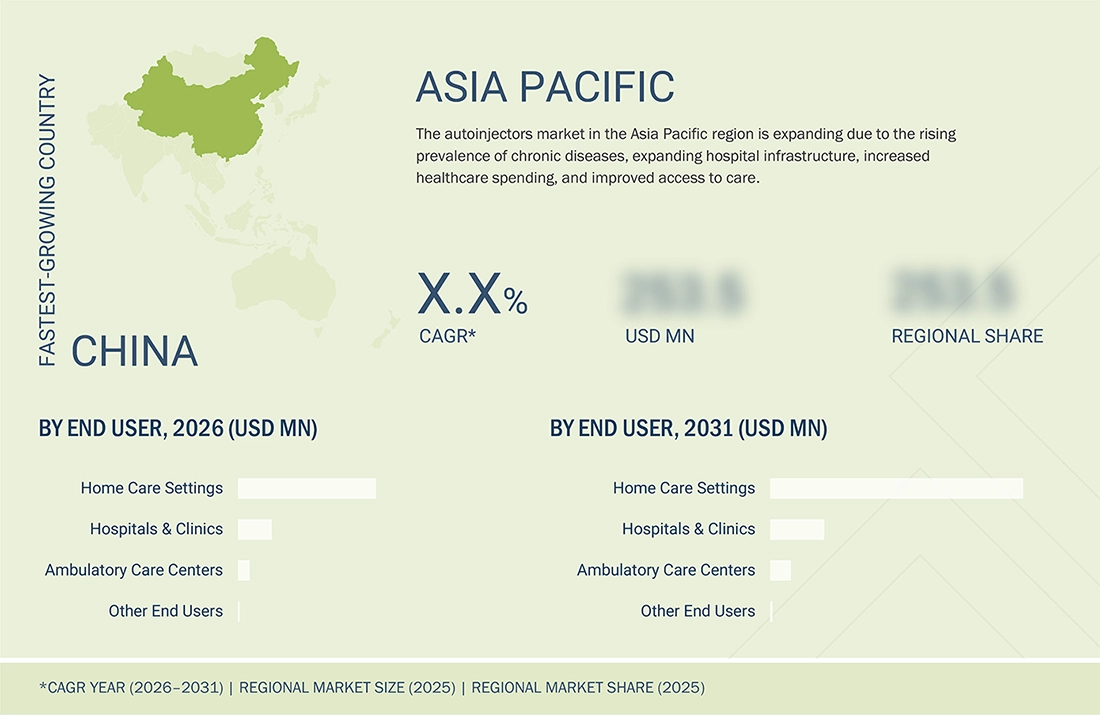
Asia Pacific is expected to be the fastest-growing region in the global autoinjectors market during the forecast period.
The Asia Pacific region is expected to be the fastest-growing market for autoinjectors, driven by rising healthcare spending and a large number of people with diabetes. Additionally, increasing healthcare costs, the rising prevalence of chronic diseases such as diabetes and rheumatoid arthritis, and a growing elderly population are key factors fueling market growth in the region.
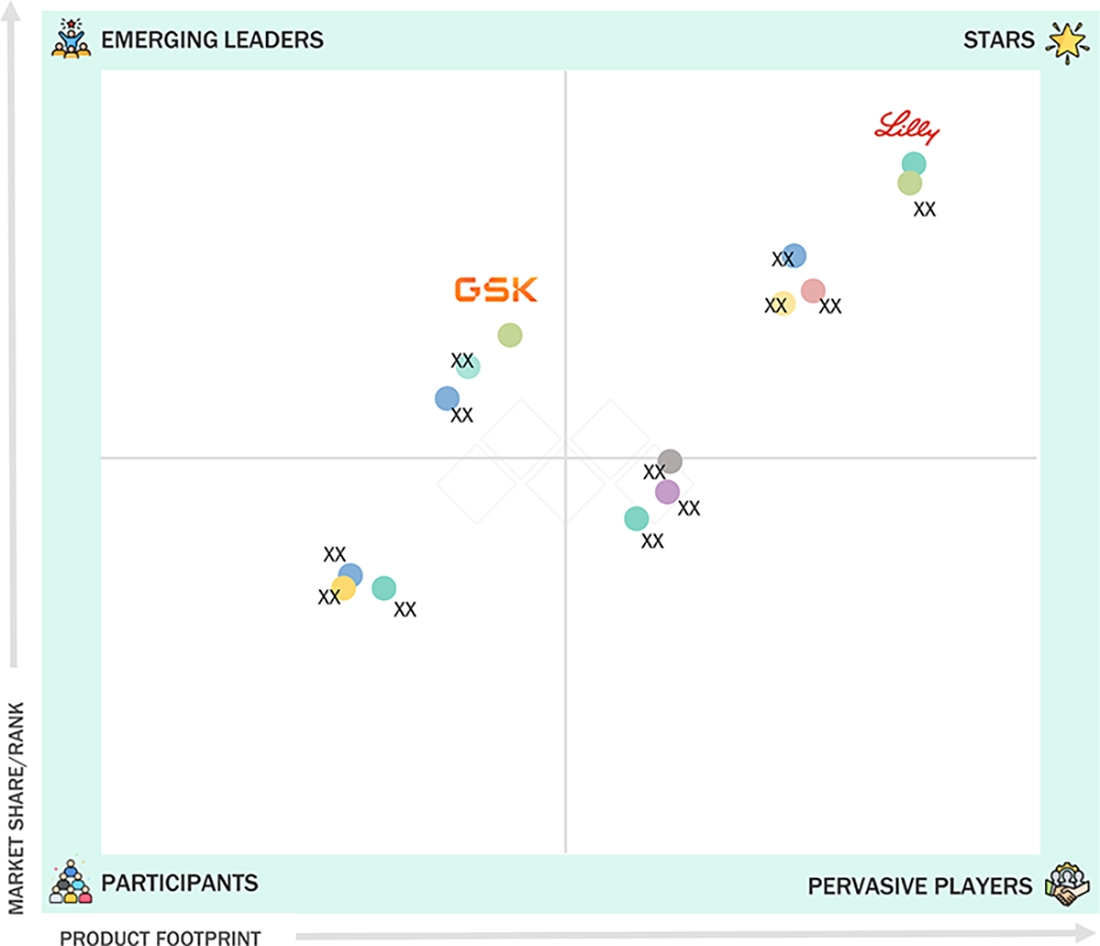
AUTOINJECTORS MARKET: COMPANY EVALUATION MATRIX
In the autoinjectors market matrix, Eli Lilly and Company (Star) leads with a strong global portfolio and advanced, patient-friendly delivery systems that drive widespread adoption. GSK plc (Emerging Leader) is expanding through targeted self-injection solutions, focusing on specialty therapies and home-based care.
Source: Secondary Research, Interviews with Experts, MarketsandMarkets Analysis
KEY MARKET PLAYERS
- Novo Nordisk (Denmark)
- Eli Lilly and Company (US)
- AbbVie (US)
- Amgen (US)
- Sanofi (France)
- AstraZeneca (UK)
- Becton Dickinson and Company (US)
- Ypsomed AG (Switzerland)
- SHL Medical (Switzerland)
- Owen Mumford (UK)
- Philips Medisize (US)
- Halozyme (US)
- GSK (UK)
- Johnson & Johnson (US)
MARKET SCOPE
| REPORT METRIC | DETAILS |
|---|---|
| Market Size in 2025 (Value) | USD 107.60 Billion |
| Market Forecast in 2031 (Value) | USD 300.46 Billion |
| CAGR | 18.7% |
| Years Considered | 2020–2030 |
| Base Year | 2025 |
| Forecast Period | 2026–2031 |
| Units Considered | USD Billion |
| Report Coverage | Revenue forecast, company ranking, competitive landscape, growth factors, and trends |
| Segments Covered |
|
| Regions Covered | North America, Asia Pacific, Europe, the Middle East & Africa, Latin America |
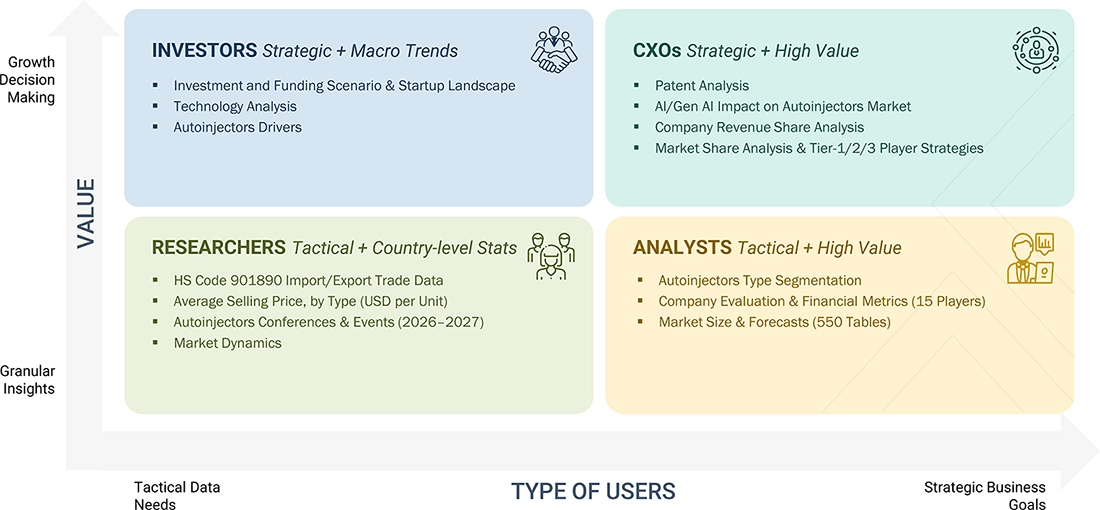
WHAT IS IN IT FOR YOU: AUTOINJECTORS MARKET REPORT CONTENT GUIDE
DELIVERED CUSTOMIZATIONS
We have successfully delivered the following deep-dive customizations:
| CLIENT REQUEST | CUSTOMIZATION DELIVERED | VALUE ADDS |
|---|---|---|
| Product Analysis | In-depth assessment of autoinjectors by type (disposable, reusable), therapy area (anaphylaxis, rheumatoid arthritis, multiple sclerosis, diabetes), drug type (biologics, biosimilars), and route of administration (subcutaneous, intramuscular), along with usability features and safety mechanisms | Analysis of emerging trends such as connected/smart autoinjectors, needle-free technologies, ergonomic and patient-centric designs and integration with digital adherence tracking improving patient compliance and treatment outcomes |
| Company Information | Comprehensive profiles of leading global players such as Becton, Dickinson and Company, Ypsomed, SHL Medical, Owen Mumford, Eli Lilly and Company, Sanofi, Amgen, and other partners | Identification of strategic partnerships between pharma and device companies, platform-based device development, regulatory approvals (e.g., FDA, EMA), product launches, licensing agreements, and mergers & acquisitions driving innovation and market expansion |
| Geographic Analysis | Region- and country-level demand mapping across North America, Europe, Asia-Pacific, Latin America, and Middle East & Africa; evaluation of regulatory frameworks, biologics adoption, pricing dynamics, and healthcare infrastructure | Regional market outlook highlighting growth opportunities driven by increasing prevalence of chronic diseases, rising biologics and biosimilars adoption, shift toward self-administration and home care, expansion of specialty pharmaceuticals, and supportive reimbursement policies |
RECENT DEVELOPMENTS
- August 2026 : Amgen announced that the US Food and Drug Administration (FDA) broadened the approved use of Repatha (evolocumab) to include adults at increased risk for major adverse cardiovascular events (MACE) due to uncontrolled low-density lipoprotein cholesterol (LDL-C), commonly known as 'bad cholesterol'.
- February 2026 : Eli Lilly and Company announced that the US FDA approved a label expansion of Zepbound (tirzepatide), the most prescribed medication for weight management, to include KwikPen, which delivers a full month of treatment in one device.
- January 2026 : Eli Lilly and Company announced plans to invest over USD 3.5 billion in a new manufacturing facility in the Lehigh Valley, Pennsylvania. The site will serve as Lilly's latest injectable medicine and device manufacturing plant, producing next-generation weight-loss therapies.
- January 2025 : AbbVie and West Pharmaceutical Services announced a definitive agreement for AbbVie to acquire a device manufacturing facility in Tempe, Arizona and associated intellectual property from West. The acquisition of the manufacturing site will significantly expand AbbVie's drug delivery device manufacturing capabilities and capacity.
Table of Contents
 Exclusive indicates content/data unique to MarketsandMarkets and not available with any competitors.
TITLE
PAGE NO
1
INTRODUCTION
15
2
EXECUTIVE SUMMARY
3
PREMIUM INSIGHTS
4
MARKET OVERVIEW
4.1
INTRODUCTION
4.2
MARKET DYNAMICS
4.2.1
DRIVERS
4.2.2
RESTRAINTS
4.2.3
OPPORTUNITIES
4.2.4
CHALLENGES
4.3
UNMET NEEDS AND WHITE SPACES
4.4
INTERCONNECTED MARKETS AND CROSS-SECTOR OPPORTUNITIES
4.5
STRATEGIC MOVES BY TIER-1/2/3 PLAYERS
5
INDUSTRY TRENDS
5.1
PORTER’S FIVE FORCES ANALYSIS
5.2
MACROECONOMICS INDICATORS
5.2.1
INTRODUCTION
5.2.2
GDP TRENDS AND FORECASTS
5.2.3
TRENDS IN GLOBAL HEALTHCARE INDUSTRY
5.2.4
TRENDS IN GLOBAL MEDICAL DEVICE INDUSTRY
5.3
SUPPLY CHAIN ANALYSIS
5.4
VALUE CHAIN ANALYSIS
5.5
ECOSYSTEM ANALYSIS
5.6
PRICING ANALYSIS
5.6.1
AVERAGE SELLING PRICE TREND OF KEY PLAYERS, BY END USER, 2023-2025
5.6.2
AVERAGE SELLING PRICE TREND, BY USAGE, 2023-2025
5.6.3
AVERAGE SELLING PRICE TREND, BY THERAPY AREA, 2023-2025
5.6.4
AVERAGE SELLING PRICE TREND, BY REGION, 2023-2025
5.7
TRADE ANALYSIS
5.7.1
IMPORT SCENARIO (HS CODE 901890)
5.7.2
EXPORT SCENARIO (HS CODE 901890)
5.8
KEY CONFERENCES AND EVENTS, 2026–2027
5.9
TRENDS/DISRUPTIONS IMPACTING CUSTOMER BUSINESS
5.10
INVESTMENT AND FUNDING SCENARIO
5.11
SUCCESS STORIES AND REAL-WORLD APPLICATIONS
5.12
IMPACT OF 2025 US TARIFF – AUTOINJECTORS MARKET
5.12.1
INTRODUCTION
5.12.2
KEY TARIFF RATES
5.12.3
PRICE IMPACT ANALYSIS
5.12.4
IMPACT ON COUNTRIES/REGIONS
5.12.4.1
US
5.12.4.2
EUROPE
5.12.4.3
APAC
5.12.5
IMPACT ON END-USE INDUSTRIES
5.13
PIPELINE ANALYSIS (2022-2031)
6
STRATEGIC DISRUPTION THROUGH TECHNOLOGY, PATENTS, DIGITAL, AND AI ADOPTION
6.1
KEY EMERGING TECHNOLOGIES
6.1.1
INJECTION MECHANISM TECHNOLOGY
6.1.2
ELECTRONIC AND CONNECTIVITY SOLUTIONS
6.2
COMPLEMENTARY TECHNOLOGIES
6.2.1
POWER ASSISTANCE MECHANISMS
6.2.2
ADVANCED NEEDLE TECHNOLOGY
6.3
ADJACENT TECHNOLOGIES
6.3.1
WEARABLE DRUG DELIVERY DEVICES
6.4
TECHNOLOGY/PRODUCT ROADMAP
6.5
PATENT ANALYSIS
6.6
FUTURE APPLICATIONS
6.7
IMPACT OF AI/GEN AI ON AUTOINJECTORS MARKET
6.7.1
TOP USE CASES AND MARKET POTENTIAL
6.7.2
BEST PRACTICES IN AUTOINJECTORS MARKET
6.7.3
CASE STUDIES OF AI IMPLEMENTATION IN AUTOINJECTORS MARKET
6.7.4
INTERCONNECTED ADJACENT ECOSYSTEM AND IMPACT ON MARKET PLAYERS
6.7.5
CLIENTS’ READINESS TO ADOPT GENERATIVE AI IN AUTOINJECTORS MARKET
7
SUSTAINABILITY AND REGULATORY LANDSCAPE
7.1
REGIONAL REGULATIONS AND COMPLIANCE
7.1.1
REGULATORY BODIES, GOVERNMENT AGENCIES, AND OTHER ORGANIZATIONS
7.1.2
INDUSTRY STANDARDS
7.2
SUSTAINABILITY INITIATIVES
7.2.1
RECYCLED AND ECO-FRIENDLY MATERIALS FOR AUTOINJECTORS
7.3
SUSTAINABILITY IMPACT AND REGULATORY POLICY INITIATIVES
7.4
CERTIFICATIONS, LABELING, ECO-STANDARDS
8
CUSTOMER LANDSCAPE & BUYER BEHAVIOR
8.1
DECISION-MAKING PROCESS
8.2
BUYER STAKEHOLDERS AND BUYING EVALUATION CRITERIA
8.3
ADOPTION BARRIERS & INTERNAL CHALLENGES
8.4
UNMET NEEDS FROM VARIOUS END-USE INDUSTRIES
8.5
MARKET PROFITABILITY
9
AUTOINJECTORS MARKET, BY TYPE [(MARKET SIZE & FORECAST TO 2031 (IN VALUE - USD MILLION & IN VOLUME - THOUSAND UNITS)]
COMPARATIVE ASSESSMENT OF KEY AUTOINJECTOR TYPES, THEIR MARKET POTENTIAL, AND DEMAND PATTERNS BY VARIOUS SUPPLIER COMPANIES
9.1
INTRODUCTION
9.2
DEVICE-ONLY AUTOINJECTORS
9.3
FINISHED FORMULATION AUTOINJECTORS
10
AUTOINJECTOR DEVICES AND FINISHED FORMULATIONS MARKET, BY USAGE [(MARKET SIZE & FORECAST TO 2031 (IN VALUE - USD MILLION & IN VOLUME - THOUSAND UNITS)]
COMPARATIVE ASSESSMENT OF KEY AUTOINJECTOR TYPES, THEIR MARKET POTENTIAL, AND DEMAND PATTERNS BY VARIOUS SUPPLIER COMPANIES
10.1
INTRODUCTION
10.2
DISPOSABLE AUTOINJECTORS
10.3
REUSABLE AUTOINJECTORS
11
AUTOINJECTOR DEVICES AND FINISHED FORMULATIONS MARKET, BY
ACTUATION MECHANISM [(MARKET SIZE & FORECAST TO 2031 (IN VALUE - USD MILLION & IN VOLUME - THOUSAND UNITS)]
ACTUATION MECHANISM-WISE DEMAND POTENTIAL AND GROWTH PATHWAYS SHAPING AUTOINJECTORS ADOPTION IN DIVERSE INDUSTRIES
11.1
INTRODUCTION
11.2
MECHANICAL (SPRING-BASED) AUTOINJECTORS
11.3
ELECTRONIC AUTOINJECTORS
12
AUTOINJECTORS DEVICES AND FINISHED FORMULATIONS MARKET, BY ROUTE OF ADMINISTRATION [MARKET SIZE & FORECAST TO 2031 (IN VALUE - USD MILLION & IN VOLUME - THOUSAND UNITS)]
ROUTE OF ADMINISTRATION-WISE DEMAND POTENTIAL AND GROWTH PATHWAYS SHAPING AUTOINJECTORS ADOPTION IN DIVERSE INDUSTRIES
12.1
INTRODUCTION
12.2
SUBCUTANEOUS ROUTE OF ADMINISTRATION
12.3
INTRAMUSCULAR ROUTE OF ADMINISTRATION
.
13
AUTOINJECTORS FINISHED FORMULATIONS MARKET, BY THERAPY AREA [(MARKET SIZE & FORECAST TO 2031 (IN VALUE - USD MILLION & IN VOLUME - THOUSAND UNITS)]
THERAPY AREA-WISE DEMAND POTENTIAL AND GROWTH PATHWAYS SHAPING AUTOINJECTORS ADOPTION IN DIVERSE INDUSTRIES
13.1
INTRODUCTION
13.2
RHEUMATOID ARTHRITIS
13.3
DIABETES
13.4
ANAPHYLAXIS
13.5
MULTIPLE SCLEROSIS
13.6
OBESITY
13.7
OTHER THERAPY AREAS
14
AUTOINJECTORS DEVICES AND FINISHED FORMULATIONS MARKET, BY DRUG TYPE [(MARKET SIZE & FORECAST TO 2031 (IN VALUE - USD MILLION & IN VOLUME - THOUSAND UNITS)]
DRUG TYPE-WISE DEMAND POTENTIAL AND GROWTH PATHWAYS SHAPING AUTOINJECTORS ADOPTION IN DIVERSE INDUSTRIES
14.1
INTRODUCTION
14.2
BIOLOGICS
14.3
BIOSIMILARS
14.4
SMALL MOLECULES
15
AUTOINJECTORS DEVICES AND FINISHED FORMULATIONS MARKET, BY VOLUME (MARKET SIZE & FORECAST TO 2031 - IN VOLUME - THOUSAND UNITS)
VOLUME-WISE DEMAND POTENTIAL AND GROWTH PATHWAYS SHAPING AUTOINJECTORS ADOPTION IN DIVERSE INDUSTRIES
15.1
INTRODUCTION
15.2
UPTO 3 ML
15.3
ABOVE 3 ML
16
AUTOINJECTORS MARKET, BY END USER [(MARKET SIZE & FORECAST TO 2031 (IN VALUE - USD MILLION & IN VOLUME - THOUSAND UNITS)]
SECTOR-SPECIFIC ADOPTION DRIVERS, DEMAND DYNAMICS AND MARKET POTENTIAL ACROSS EACH END USER
16.1
INTRODUCTION
16.2
DEVICE-ONLY AUTOINJECTORS
16.2.1
PHARMACEUTICAL & BIOTECH COMPANIES
16.2.2
CONTRACT DEVELOPMENT & MANUFACTURING ORGANIZATIONS (CDMOS)
16.3
FINISHED FORMULATION AUTOINJECTORS
16.3.1
HOME CARE SETTINGS
16.3.2
HOSPITALS & CLINICS
16.3.3
AMBULATORY CARE CENTERS
16.3.4
OTHER END USERS
17
AUTOINJECTORS DEVICES AND FINISHED FORMULATIONS MARKET, BY REGION [(MARKET SIZE & FORECAST TO 2031 (IN VALUE - USD MILLION & IN VOLUME - THOUSAND UNITS)]
ASSESSING GROWTH PATTERNS, INDUSTRY FORCES, REGULATORY LANDSCAPE, AND MARKET POTENTIAL ACROSS KEY GEOGRAPHIES AND COUNTRIES
17.1
INTRODUCTION
17.2
NORTH AMERICA
17.2.1
NORTH AMERICA VOLUME ANALYSIS, 2024–2031 (THOUSAND UNITS)
17.2.2
MACROECONOMIC OUTLOOK FOR NORTH AMERICA
17.2.3
US
17.2.4
CANADA
17.3
EUROPE
17.3.1
EUROPE VOLUME ANALYSIS, 2024 – 2031 (THOUSAND UNITS)
17.3.2
MACROECONOMIC OUTLOOK FOR EUROPE
17.3.3
GERMANY
17.3.4
UK
17.3.5
FRANCE
17.3.6
ITALY
17.3.7
SPAIN
17.4.8
NETHERLANDS
17.3.9
REST OF EUROPE
17.4
ASIA PACIFIC
17.4.1
ASIA PACIFIC VOLUME ANALYSIS, 2024 – 2031 (THOUSAND UNITS)
17.4.2
MACROECONOMIC OUTLOOK FOR ASIA PACIFIC
17.4.3
JAPAN
17.4.4
CHINA
17.4.5
INDIA
17.4.6
AUSTRALIA
17.4.7
SOUTH KOREA
17.4.8
THAILAND
17.4.9
VIETNAM
17.4.10
REST OF ASIA PACIFIC
17.5
LATIN AMERICA
17.5.1
LATIN AMERICA VOLUME ANALYSIS, 2024 – 2031 (THOUSAND UNITS)
17.5.2
MACROECONOMIC OUTLOOK FOR LATIN AMERICA
17.5.3
BRAZIL
17.5.4
MEXICO
17.5.5
REST OF LATIN AMERICA
17.6
MIDDLE EAST & AFRICA
17.6.1
MIDDLE EAST & AFRICA VOLUME ANALYSIS, 2024 – 2031 (THOUSAND UNITS)
17.6.2
MACROECONOMIC OUTLOOK FOR MIDDLE EAST & AFRICA
17.6.3
GCC COUNTRIES
17.6.3.1
KINGDOM OF SAUDI ARABIA (KSA)
17.6.3.2
UNITED ARAB EMIRATES (UAE)
17.6.3.3
OTHER GCC COUNTRIES
17.6.4
REST OF MIDDLE EAST & AFRICA
18
COMPETITIVE LANDSCAPE
STRATEGIC ASSESSMENT OF LEADING PLAYERS, MARKET SHARE, REVENUE ANALYSIS, COMPANY POSITIONING, AND COMPETITIVE BENCHMARKS INFLUENCING MARKET POTENTIAL
18.1
OVERVIEW
18.2
KEY PLAYER STRATEGIES/RIGHT TO WIN
18.3
REVENUE SHARE ANALYSIS OF KEY PLAYERS (2023-2025)
18.4
GLOBAL MARKET SHARE ANALYSIS,
18.4.1
AUTOINJECTOR DEVICES MARKET SHARE ANALYSIS,
18.4.1.1
US MARKET SHARE ANALYSIS,
18.4.2.2
EUROPE MARKET SHARE ANALYSIS,
18.4.2
AUTOINJECTORS FINISHED FORMULATIONS MARKET SHARE ANALYSIS,
18.4.2.1
US MARKET SHARE ANALYSIS,
18.4.2.2
EUROPE MARKET SHARE ANALYSIS,
18.5
BRAND COMPARATIVE ANALYSIS
18.6
COMPANY EVALUATION MATRIX: KEY PLAYERS,
18.6.1
STARS
18.6.2
EMERGING LEADERS
18.6.3
PERVASIVE PLAYERS
18.6.4
PARTICIPANTS
18.6.5
COMPANY FOOTPRINT: KEY PLAYERS,
18.6.5.1
COMPANY FOOTPRINT
18.6.5.2
REGION FOOTPRINT
18.6.5.3
USAGE FOOTPRINT
18.6.5.4
THERAPY AREA FOOTPRINT
18.6.5.4
DRUG TYPE FOOTPRINT
18.7
COMPANY EVALUATION MATRIX: STARTUPS/SMES,
18.7.1
PROGRESSIVE COMPANIES
18.7.2
RESPONSIVE COMPANIES
18.7.3
DYNAMIC COMPANIES
18.7.4
STARTING BLOCKS
18.7.5
COMPETITIVE BENCHMARKING: STARTUPS/SMES,
18.7.5.1
DETAILED LIST OF KEY STARTUPS/SMES
18.7.5.2
COMPETITIVE BENCHMARKING OF STARTUPS/SMES
18.8
COMPANY VALUATION AND FINANCIAL METRICS
18.9
COMPETITIVE SCENARIO
18.9.1
PRODUCT LAUNCHES
18.9.2
DEALS
18.9.3
EXPANSIONS
18.9.4
OTHER DEVELOPMENTS
19
COMPANY PROFILES
IN-DEPTH REVIEW OF COMPANIES, PRODUCTS, RECENT INITIATIVES, AND POSITIONING STRATEGIES IN THE AUTOINJECTORS MARKET LANDSCAPE
19.1
KEY PLAYERS: AUTOINJECTOR DEVICES
19.1.1
BECTON, DICKINSON AND COMPANY (BD)
19.1.2
YPSOMED AG
19.1.3
SHL MEDICAL AG
19.1.4
WEST PHARMACEUTICAL SERVICES, INC.
19.1.5
OWEN MUMFORD LTD.
19.1.6
PHILLIPS-MEDISIZE, LLC
19.1.7
HALOZYME, INC.
19.2
KEY PLAYERS: AUTOINJECTOR FINISHED FORMULATIONS
19.2.1
ABBVIE INC.
19.2.2
AMGEN INC.
19.2.3
ELI LILLY AND COMPANY
19.2.4
NOVO NORDISK A/S
19.2.5
JOHNSON & JOHNSON SERVICES INC.
19.2.6
SANOFI
19.2.7
GSK PLC
19.2.8
ASTRAZENECA
19.3
OTHER PLAYERS
19.3.1
GERRESHEIMER AG
19.3.2
HASELMEIER GMBH
19.3.3
OVAL MEDICAL TECHNOLOGIES LTD. (PART OF SMC LTD.)
19.3.4
KALEO, INC.
19.3.5
SOLTEAM INCORPORATION CO., LTD.
19.3.6
ELCAM DRUG DELIVERY DEVICES (E3D)
19.3.7
CROSSJECT
19.3.8
JABIL, INC.
19.3.9
CONGRUENCE MEDICAL SOLUTIONS LLC
19.3.10
MIDAS PHARMA GMBH
20
RESEARCH METHODOLOGY
20.1
RESEARCH DATA
20.1.1
SECONDARY DATA
20.1.1.1
KEY DATA FROM SECONDARY SOURCES
20.1.2
PRIMARY DATA
20.1.2.1
KEY DATA FROM PRIMARY SOURCES
20.1.2.2
KEY PRIMARY PARTICIPANTS
20.1.2.3
BREAKDOWN OF PRIMARY INTERVIEWS
20.1.2.4
KEY INDUSTRY INSIGHTS
20.2
MARKET SIZE ESTIMATION
20.2.1
BOTTOM-UP APPROACH
20.2.2
TOP-DOWN APPROACH
20.2.3
BASE NUMBER CALCULATION
20.3
MARKET FORECAST APPROACH
20.3.1
SUPPLY SIDE
20.3.2
DEMAND SIDE
20.4
DATA TRIANGULATION
20.5
FACTOR ANALYSIS
20.6
RESEARCH ASSUMPTIONS
20.7
RESEARCH LIMITATIONS AND RISK ASSESSMENT
21
APPENDIX
21.1
DISCUSSION GUIDE
21.2
KNOWLEDGE STORE: MARKETSANDMARKETS’ SUBSCRIPTION PORTAL
21.3
CUSTOMIZATION OPTIONS
21.3.1
PRODUCT ANALYSIS
21.3.2
COMPANY INFORMATION
21.3.3
GEOGRAPHIC ANALYSIS
21.3.4
REGIONAL/COUNTRY LEVEL MARKET SHARE ANALYSIS
21.3.5
COUNTRY LEVEL VOLUME ANALYSIS
21.3.6
BY TYPE MARKET SHARE ANALYSIS (TOP 5 PLAYERS)
21.3.7
ANY CONSULTS/CUSTOM REQUIREMENTS AS PER CLIENT REQUESTS
21.4
RELATED REPORTS
21.5
AUTHOR DETAILS
Methodology
This study utilized both primary and secondary sources extensively. The research involved analyzing various factors affecting the industry to identify segmentation types, industry trends, key players, the competitive landscape, market dynamics, and strategies of major players.
Secondary Research
The secondary research process involves extensively using secondary sources, directories, databases (such as Bloomberg Businessweek, Factiva, and D&B Hoovers), white papers, annual reports, company house documents, investor presentations, and SEC filings. It was employed to gather information for the detailed, technical, market-focused, and commercial analysis of the autoinjectors market. Additionally, it helped obtain important data about key players and market classification and segmentation based on industry trends, down to the most detailed levels, along with key developments related to market and technology perspectives. A database of leading industry players was also created through secondary research.
Primary Research
In the primary research process, various sources from both the supply and demand sides were interviewed to gather qualitative and quantitative information for this report. The primary sources from the supply side include industry experts such as CEOs, vice presidents, marketing and sales directors, technology and innovation directors, and other key executives from various important companies and organizations in the autoinjectors market. The primary sources from the demand side include medical OEMs, medical device ISOs, and service providers, among others. Primary research was conducted to validate the market segmentation, identify key players in the market, and gather insights into major industry trends and key market dynamics.
A breakdown of the primary respondents for the autoinjectors market (supply side) market is provided below:
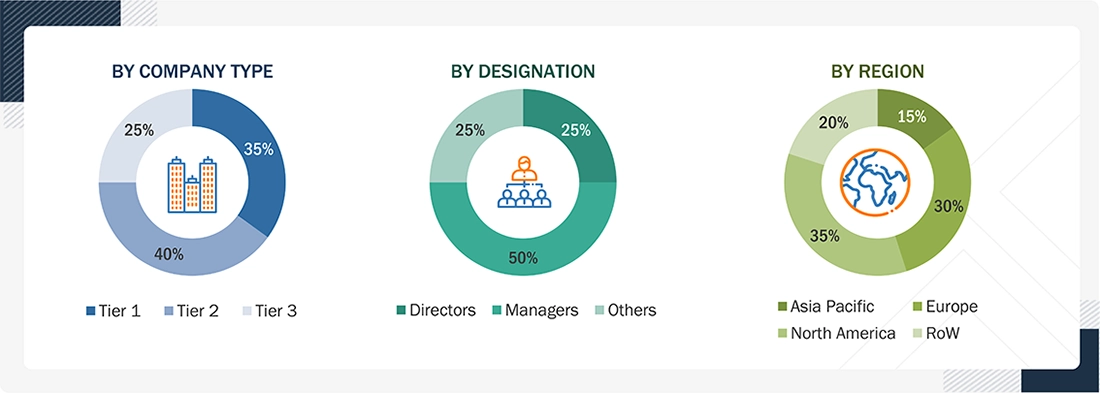
Note 1: C-level primaries include CEOs, COOs, CTOs, and VPs.
Note 2: Others include sales, marketing, and product managers.
Note 3: Companies are classified into tiers based on their total revenue. As of 2025, Tier 1 = >USD 2 billion, Tier 2 = USD 50 million to USD 2 billion, and Tier 3 = < USD 50 million.
To know about the assumptions considered for the study, download the pdf brochure
Market Size Estimation
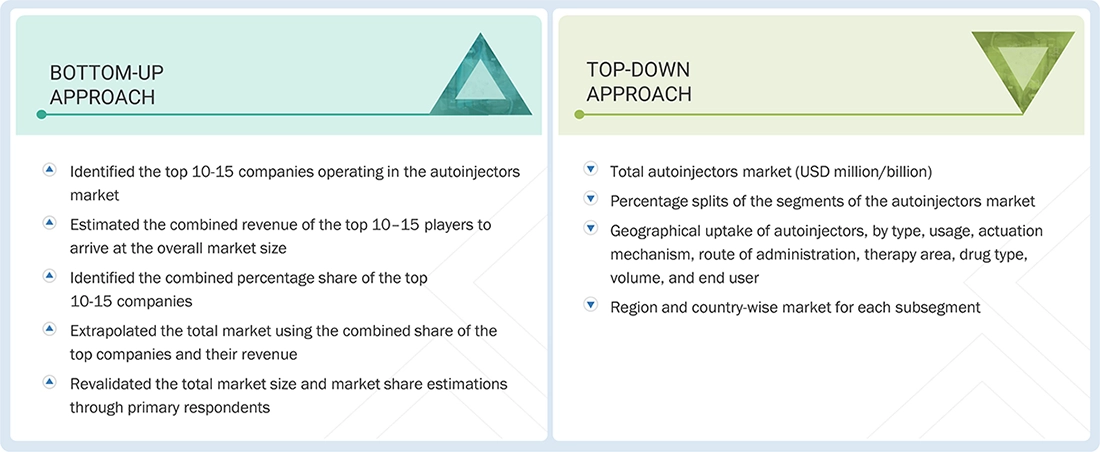
In this report, the global autoinjectors market size was determined through revenue share analysis of leading players. To do this, key market players were identified, and their revenues from autoinjectors were estimated based on insights gathered during primary and secondary research. Secondary research involved analyzing the annual and financial reports of top market players, while primary research included extensive interviews with key opinion leaders such as CEOs, directors, and key marketing executives.
To calculate the global market value, the segmental revenue was calculated based on the revenue mapping of major solution/service providers. This process involves the following steps:
- Generating a list of major global players operating in the autoinjectors market
- Mapping annual revenues generated by major global players from the autoinjectors segment (or nearest reported business unit/service category)
- Revenue mapping of key players to cover a major share of the global market as of 2024
- Extrapolating the global value of the autoinjectors industry
Data Triangulation
After determining the overall market size from the estimation process described above, the global Autoinjectors market was divided into segments and subsegments. Data triangulation and market breakdown methods were used to complete the market analysis and obtain precise statistics for all segments and subsegments. The data was triangulated by examining various factors and trends from both the demand and supply perspectives. Additionally, the autoinjectors market was validated using both, the top-down and bottom-up approaches.
Market Definition
Autoinjectors with finished formulations are prefilled, self-administered devices designed to deliver a precise dose of medication. These devices come pre-loaded with a specific drug formulation, ensuring accurate dosing and ease of use, especially in emergencies or for patients needing regular injections. The design usually includes an automatic needle insertion and drug delivery system, reducing user error and discomfort. Autoinjectors are frequently used for conditions such as allergies, migraines, and chronic diseases, improving patient compliance and making medication administration more convenient.
Stakeholders
- Companies manufacturing autoinjectors
- Original equipment manufacturing companies
- Suppliers and distributors of autoinjectors
- Healthcare service providers
- Health insurance payers
- Government bodies/municipal corporations
- Regulatory bodies
- Medical research institutes
- Business research and consulting service providers
- Venture capitalists
- Market research and consulting firms
Report Objectives
- To define, describe, and forecast the global autoinjector devices market based on type, usage, actuation mechanism, route of administration, drug type, volume, end user, and region
-
To provide detailed information regarding the major factors influencing the market growth
(such as drivers, restraints, opportunities, and challenges) along with the current trends - To strategically analyze micromarkets1 concerning individual growth trends, prospects, and contributions to the overall autoinjectors market
- To analyze the opportunities in the global autoinjectors market for stakeholders and provide details of the competitive landscape for market leaders
- To forecast the size of market segments concerning five main regions, namely, North America, Europe, the Asia Pacific, Latin America, and the Middle East & Africa
- To profile key players and analyze their market share and core competencies2
- To analyze competitive developments, such as product launches, partnerships, agreements, collaborations, expansions, strategic alliances, and acquisitions in the global autoinjector devices and autoinjector finished formulations market.
- To benchmark players within the market using the proprietary “Company Evaluation Matrix” framework, which analyzes market players on various parameters within the broad categories of business and product excellence strategy
⚡ Growth Signals
Personalize This Research
- Triangulate with your Own Data
- Get Data as per your Format and Definition
- Gain a Deeper Dive on a Specific Application, Geography, Customer or Competitor
- Any level of Personalization
Let Us Help You
- What are the Known and Unknown Adjacencies Impacting the Autoinjectors Market
- What will your New Revenue Sources be?
- Who will be your Top Customer; what will make them switch?
- Defend your Market Share or Win Competitors
- Get a Scorecard for Target Partners


JAYANT RAJPUROHIT
Director of Market Insights, Data and Analytics
SFI Health,
Leading Pharmaceutical Company

We at SFI Health approached MarketsandMarkets for an Opportunity Assessment on "Incidence and Prevalence of Focus Indications" as we wanted to know the most attractive HCPs like Physician, Functional MD, Naturopath and Pharmacist. The project was critical for us to ensure our focus on the right target which would enable sustainable growth and profitability for SFI Health. The business insights provided exceeded our expectations and we were extremely impressed. The team at MarketsandMarkets is highly professional and detail oriented and very well understood our business needs. MarketsandMarkets offers a unique combination of expertise and dedicated engagement model. We identified 2 new products to be launched in coming months, based on the research findings provided by MarketsandMarkets. We are happy with the services and would strongly recommend MarketsandMarkets to my peers in the industry.

BEATRIZ DE LA CALLE
Head of Commercial Analytics
Qualicaps,
Leading Pharmaceutical Company

We partnered with MarketsandMarkets for an assessment study on hard empty capsules. The team was extremely professional in understanding our business requirements and we received timely responses to all our queries. The market intelligence and the recommendations has met our business requirements. We were extremely impressed to see the final study results; it really exceeded our expectations. The market intelligence offered by MarketsandMarkets, and clarity on next steps will help us achieve our business objective for the Year 2021. We are happy with the services and would strongly recommend MarketsandMarkets to my peers in the industry.

Bob Williams,
Senior Director Business Development & Innovation
Bracco Diagnostics Inc.,
Italian Multinational in life sciences sector and a World Leader in imaging diagnostics
We were pleased with targeted insights that MarketsandMarkets identified from a custom study on the 'Radiation Dose Management Solutions Market'. Your team identified and characterized the market participants as well as underlying trends accurately. This study was useful to Bracco in formulating business strategies for our dose monitoring product lines and we thank MarketsandMarkets for the job well done.
Cody Coonradt,
Market Development and Strategy Manager
3M Health Information Systems,
Leader in Health care Coding, Payment & Analytics Solutions.
The value for our organization comes from three things: depth of research, specificity of segments and being easy to work with. As important as the first two are, the third can't be underestimated. MarketsandMarkets, maybe more than any other research vendor, wants to know what is top of mind for our team and what big questions we are grappling to answer.
Their customer first approach and high value engagement model, have given us great analysis and excellent value for money

Still Researching the
Autoinjectors Ecosystem?
See the competitors, opportunities, and growth signals shaping it - instantly.
Generate 15+ consulting-grade strategic insights tailored to your growth question.
Explore Autoinjectors Intelligence
Powered by 17 years of MarketsandMarkets intelligence
