









- DESCRIPTION
- TABLE OF CONTENTS
- METHODOLOGY
- Download FREE Sample
Asia Pacific Penetration Testing Market by Service Type (Manual Penetration Testing, Automated Penetration Testing), Attack Surface (Network Security, Cloud Security, OT/ICS Systems, Application Security Pentesting) - Forecast to 2031

USD 1.04 BN
MARKET SIZE, 2031

CAGR 16.5%
(2025-2031)

200
REPORT PAGES

50
MARKET TABLES
OVERVIEW
Source: Secondary Research, Interviews with Experts, MarketsandMarkets Analysis
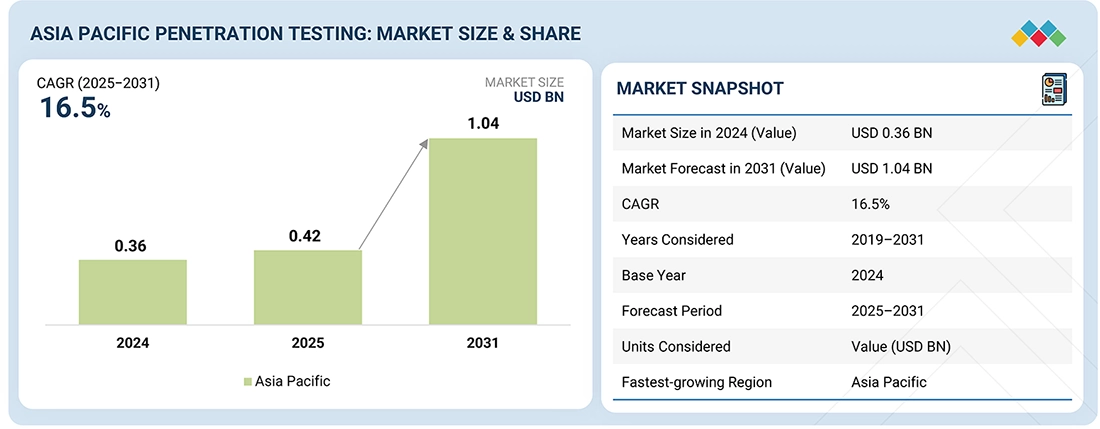
The Asia Pacific penetration testing market size is expected to grow from USD 0.42 billion in 2025 to USD 1.04 billion by 2031 at a CAGR of 16.5% during the forecast period. Rapid growth in digital platforms, rising cloud adoption, and expanding digital infrastructure in Asia are significantly increasing enterprise attack surfaces. The number of cloud services and online transactions is growing exponentially each year, creating a rising demand for penetration testing to secure applications, APIs, and distributed systems.
KEY TAKEAWAYS
-
BY SERVICE TYPE
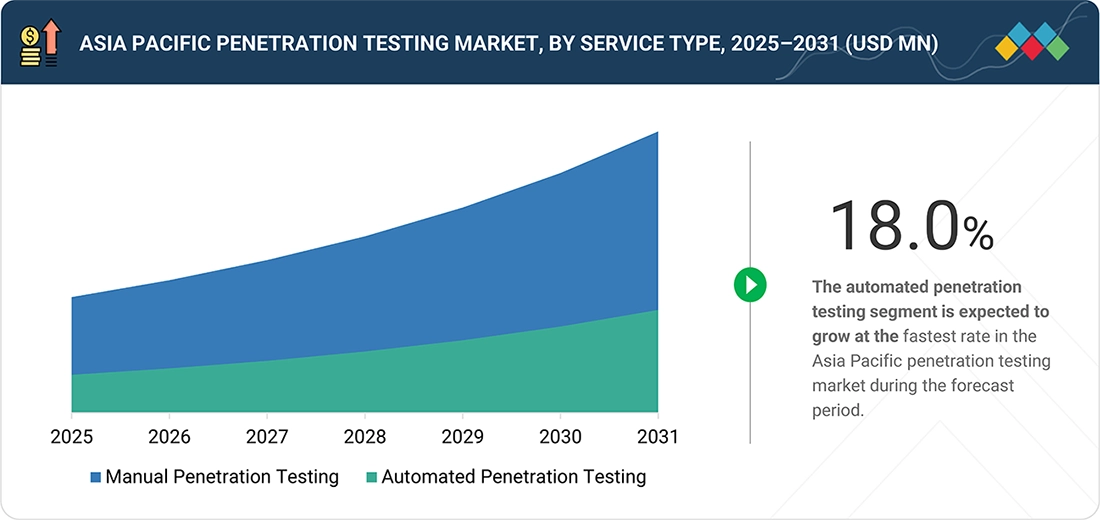
By service type, the manual penetration testing type segment dominated in terms of market share, with ~75.2% in 2025.
-
BY ATTACK SURFACE
By attack surface, the cloud security segment is expected to grow the fastest, at a CAGR of 18.0% during the forecast period.
-
BY DEPLOYMENT MODE
By deployment mode, the on-premises segment will hold the largest market size.
-
BY ORGANIZATION SIZE
By organizations size, the SMEs segment will grow at the fastest rate, at a CAGR of 18.4%.
-
BY VERTICAL
By vertical, the healthcare segment will grow at the highest CAGR during the forecast period.
-
COMPETITIVE LANDSCAPE - KEY PLAYERS
Key players in the Asia Pacific penetration testing market are Rapid7, Inc., NetSPI, Sophos, CyberNX, and Cisco, which provide full-scale offensive security services such as vulnerability testing, red teaming, cloud security testing, and managed security services. Their high presence in the enterprise and security portfolio integration, and the ability to deliver their services worldwide, make them the partners of choice for large organizations that need continuous security validation and risk mitigation.
-
COMPETITIVE LANDSCAPE - STARTUPS
Astra Security, Indusface, and Detectify are new and rapidly developing companies that specialize in application security, automated penetration testing, and continuous vulnerability management. Their platform-based and agile delivery frameworks allow scalable, cost-effective testing solutions, which is of interest to digital-native businesses and mid-sized organizations.
The rising number of security breaches among Asian enterprises is prompting organizations to formalize penetration testing as part of their enterprise risk management systems. Nearly half of the companies in the region have experienced at least one security breach in the last two years, indicating vulnerabilities in current security measures and highlighting the need for ongoing validation of security protocols.
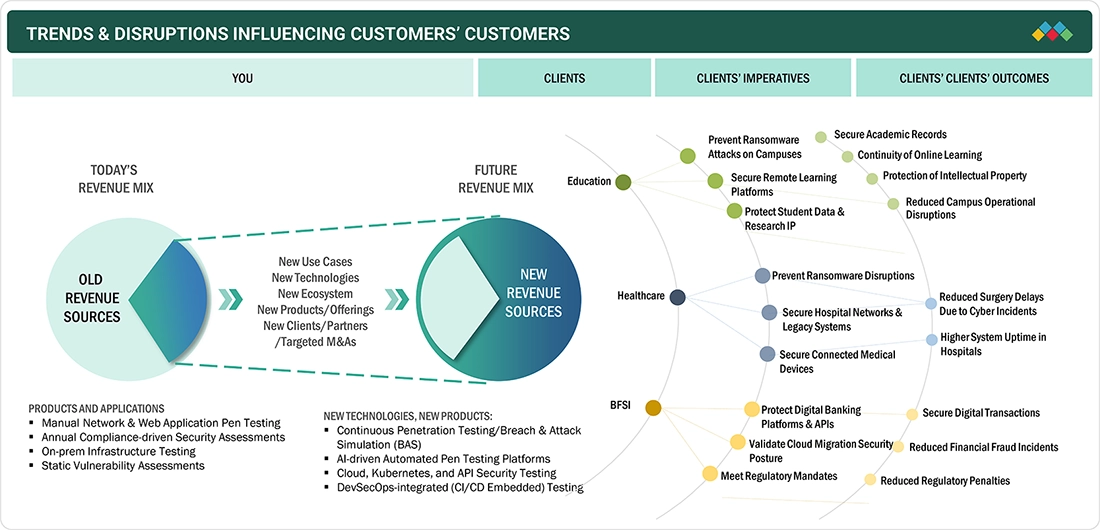
TRENDS & DISRUPTIONS IMPACTING CUSTOMERS' CUSTOMERS
The growth of penetration testing in Asia is shifting toward continuous and automated models due to the rapid expansion of cloud services, fintech, manufacturing, telecom, and digital payments in the region. The increasing adoption of AI, IoT, and smart infrastructure in critical sectors, along with AI-enabled threats and tighter regulatory controls, is disrupting traditional periodic testing and increasing the demand for real-time offensive security validation.
Source: Secondary Research, Interviews with Experts, MarketsandMarkets Analysis
MARKET DYNAMICS

Drivers
Impact
Level
-
Rapid digitalization across government, BFSI, manufacturing, and smart infrastructure

-
Rising cyber threats targeting critical industries and digital platforms


RESTRAINTS
Impact
Level
-
High compliance and localization requirements increasing operational costs

-
Shortage of advanced cybersecurity professionals in specialized domains


OPPORTUNITIES
Impact
Level
-
Growing demand for cloud security, zero-trust, and data protection solutions

-
Increased investments in domestic cybersecurity innovation and platforms


CHALLENGES
Impact
Level
-
Complex and frequently evolving regulatory framework

-
Balancing innovation, data privacy, and government oversight

Source: Secondary Research, Interviews with Experts, MarketsandMarkets Analysis
The rapid growth of digital economies, super-app ecosystems, digital payments, and cloud-native platforms in Asia is significantly increasing enterprise attack surfaces. With IT modernization and the integration of APIs, AI, and IoT into operations, penetration testing is becoming essential to identify vulnerabilities and improve cyber resilience.
The shortage of skilled offensive security personnel and certified red team experts in emerging Asian markets is a persistent issue that limits testing capabilities and increases service costs. Most mid-sized companies struggle to allocate enough budget for advanced or continuous penetration testing, which slows overall market adoption.
Continuous penetration testing and Penetration Testing-as-a-Service models are increasingly being adopted, creating scalable opportunities across Asia. Businesses are focusing more on cloud, API, AI, and zero-trust validation, while digital-native companies demand faster, automated, and subscription-based testing methods to support quick innovation cycles.
Disjointed and frequently changing regulatory systems across Asia create compliance challenges for multinational companies operating in multiple jurisdictions. Additionally, rapid technological advancements in the financial sector, manufacturing, telecommunications, and smart infrastructure often outpace traditional periodic testing methods, making it necessary to adopt more adaptive and real-time security validation strategies.
ASIA PACIFIC PENETRATION TESTING MARKET: COMMERCIAL USE CASES ACROSS INDUSTRIES
| COMPANY | USE CASE DESCRIPTION | BENEFITS |
|---|---|---|
|
|
A major stock exchange engaged a provider for a long-term VAPT program covering applications and systems, including regular ethical hacking and remediation support to identify exploitable vulnerabilities. | Improved security of critical trading systems, continuous risk visibility, stronger resilience against targeted attacks, and enhanced stakeholder confidence |
|
|
Conducted comprehensive network, cloud, and web application penetration testing for a regional digital bank expanding its mobile and API-based payment infrastructure across Asia | Engagement included red teaming and compliance-aligned VAPT assessments | Improved API security posture, faster remediation cycles, strengthened regulatory compliance readiness, and reduced exposure to payment fraud and credential-based attacks |
|
|
Personal care brand Mamaearth engaged Astra Security to strengthen its application security posture by combining automated scanning with expert manual penetration testing. The engagement focused on continuous vulnerability assessment for its web applications and e-commerce platforms to detect and remediate security flaws effectively. | Faster detection and resolution of vulnerabilities, continuous proactive security coverage, detailed real-time vulnerability reports, and expert support that helped safeguard sensitive data and enhance overall security posture |



Logos and trademarks shown above are the property of their respective owners. Their use here is for informational and illustrative purposes only.
MARKET ECOSYSTEM
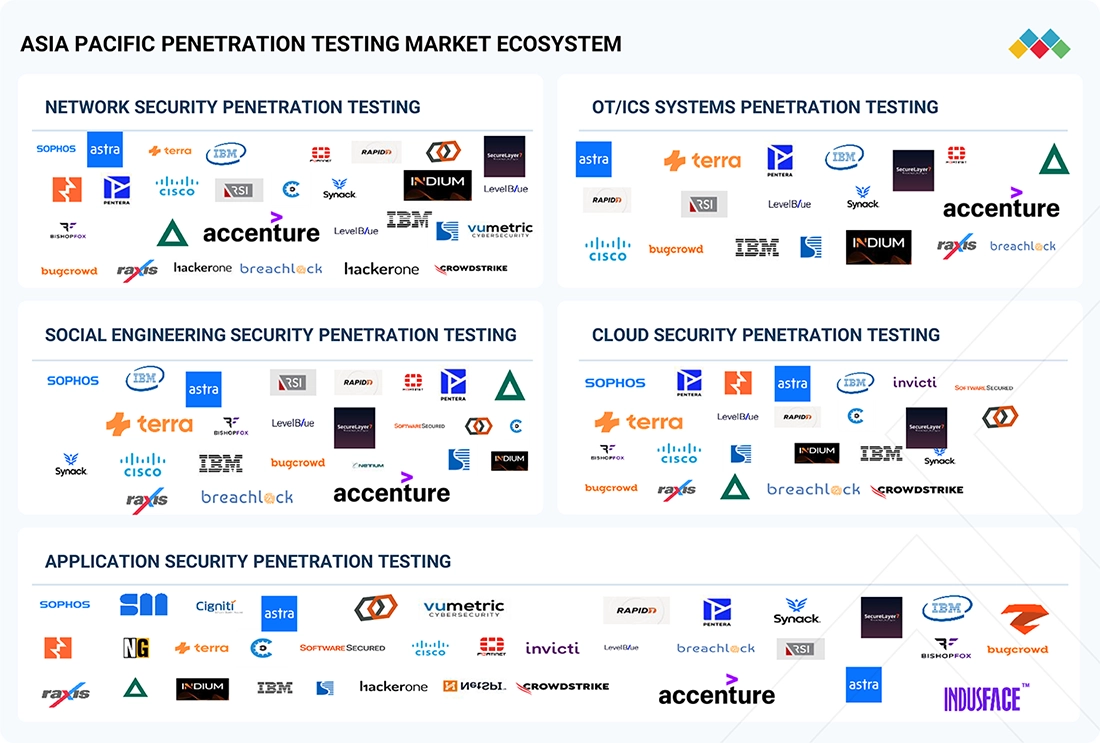
The Asia Pacific penetration testing ecosystem encompasses a variety of specialized sectors, such as network security pentesting, application security pentesting, cloud security, OT ICS systems pentesting, and social engineering security pentesting. It includes global cybersecurity firms, niche offensive security vendors, and platform-based innovators that provide both manual and automated services. The ecosystem reflects a growing demand for diverse testing capabilities aligned with expanding enterprise attack surfaces and regulatory requirements.
Logos and trademarks shown above are the property of their respective owners. Their use here is for informational and illustrative purposes only.
MARKET SEGMENTS
Source: Secondary Research, Interviews with Experts, MarketsandMarkets Analysis
Manual penetration testing holds the largest share in Asia Pacific, as regulated industries such as BFSI, telecom, and government prioritize expert-led assessments to uncover complex vulnerabilities and meet compliance mandates.
Cloud security penetration testing is the fastest-growing segment, driven by rapid multi-cloud adoption, digital banking expansion, and increasing migration of enterprise workloads to hybrid cloud environments.
SMEs are likely to be the fastest-growing segment, supported by rising cybersecurity awareness, increasing regulatory pressure, and growing adoption of subscription-based testing models across emerging digital businesses.
On-premises deployment accounts for a significant share, supported by strict data sovereignty regulations and the need for greater control over sensitive information in government, BFSI, and critical sectors. Many large enterprises and state-owned entities prefer localized infrastructure to meet compliance and audit standards. Security concerns related to external cloud exposure also sustain on-premises demand.
Healthcare is the fastest-growing vertical in the Asia Pacific penetration testing market since hospitals and digital health systems are increasingly targeted by ransomware attacks. The growing digitization of patient records and medical devices is driving demand for comprehensive penetration testing services.
REGION
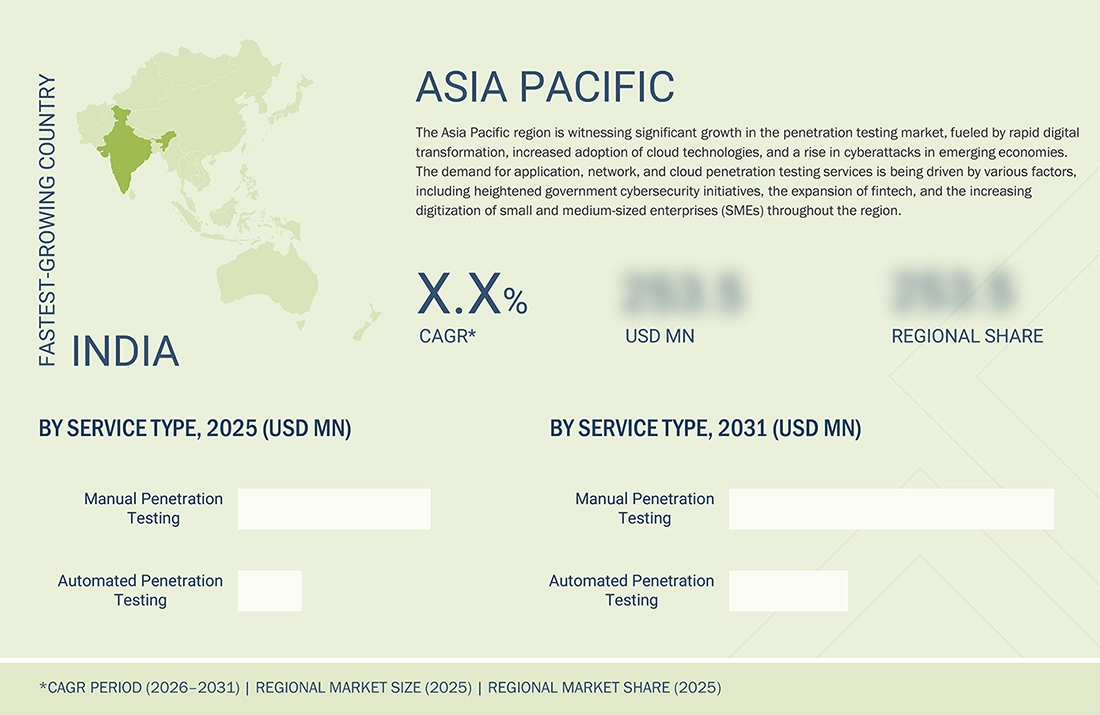
India is expected to be the fastest-growing penetration testing market in Asia Pacific during the forecast period.
India is expected to be the fastest-growing penetration testing market in Asia Pacific, driven by the rapid digital growth in banking, fintech, telecom, e-commerce, and government systems. The Reserve Bank of India mandates regular VAPT for regulated financial entities, which boosts demand through compliance. The increasing number of ransomware cases, rising use of cloud services, growth in digital payment systems, and greater cyber accountability among boards are further propelling the adoption of penetration testing by enterprises.
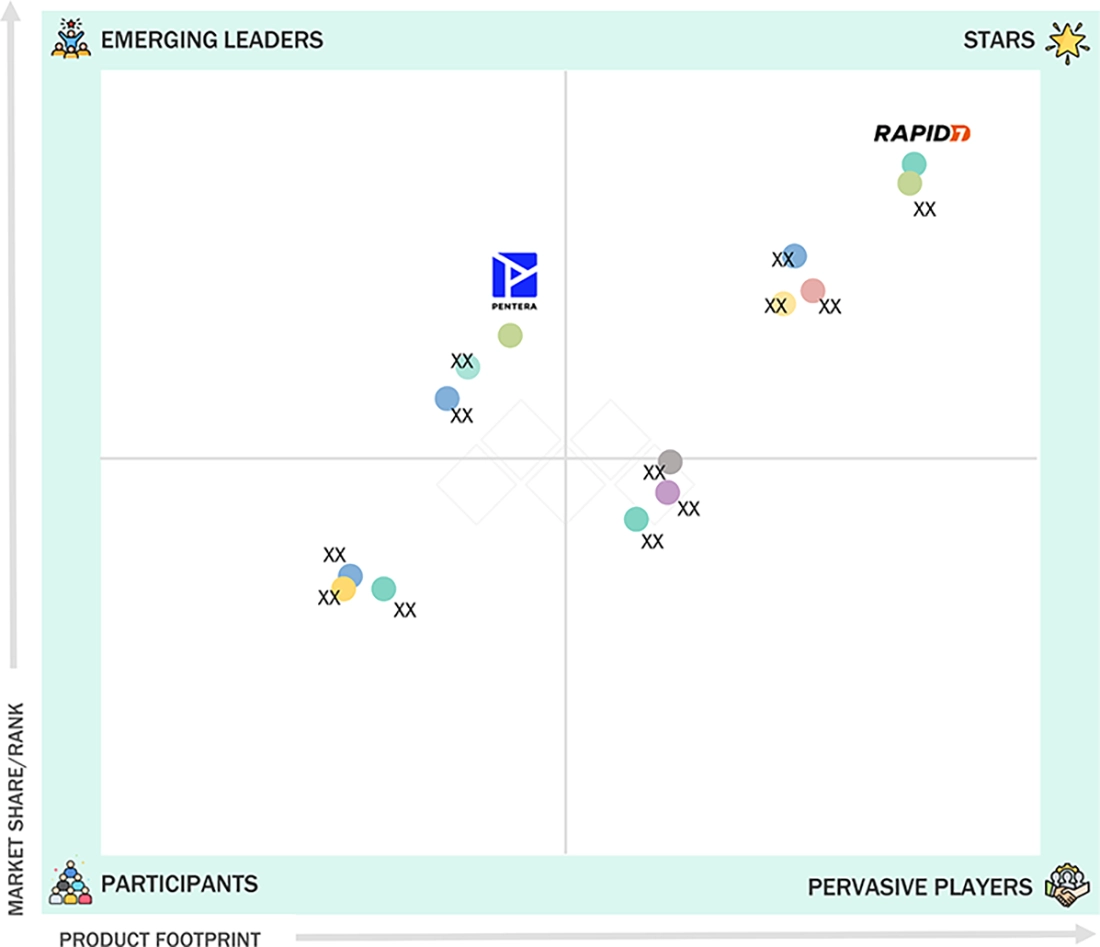
ASIA PACIFIC PENETRATION TESTING MARKET: COMPANY EVALUATION MATRIX
Rapid7 (Leading Player) holds a strong position in the penetration testing market, with comprehensive network, application, and cloud testing capabilities, supported by a strong enterprise presence and compliance-driven engagements across Asia Pacific. Pentera (Emerging Player) is gaining momentum through its automated attack emulation and exposure validation platform, enabling organizations to continuously test security controls and proactively identify exploitable gaps.
Source: Secondary Research, Interviews with Experts, MarketsandMarkets Analysis
KEY MARKET PLAYERS
- Rapid7 (US)
- IBM (US)
- Pentera (US)
- HackerOne (US)
- Sophos (UK)
- Invicti (US)
- NetSPI (US)
- Synack (US)
- Bishop Fox (US)
- Rapid7 (US)
- NowSecure (US)
- Coalfire (US)
- Fortinet (US)
- Indium Software (India)
- Cigniti Technologies (India)
- Astra Security (India)
- Indusface (India)
- SecureLayer7 (India)
- CyberNX (India)
- Horangi (Singapore)
MARKET SCOPE
| REPORT METRIC | DETAILS |
|---|---|
| Market Size in 2024 (Value) | USD 0.36 Billion |
| Market Forecast in 2031 (Value) | USD 1.04 Billion |
| Growth Rate | CAGR of 16.5% from 2025 to 2031 |
| Years Considered | 2019–2031 |
| Base Year | 2024 |
| Forecast Period | 2025–2031 |
| Units Considered | Value (USD Million/Billion) |
| Report Coverage | Revenue Forecast, Company Ranking, Competitive Landscape, Growth Factors, and Trends |
| Segments Covered |
|
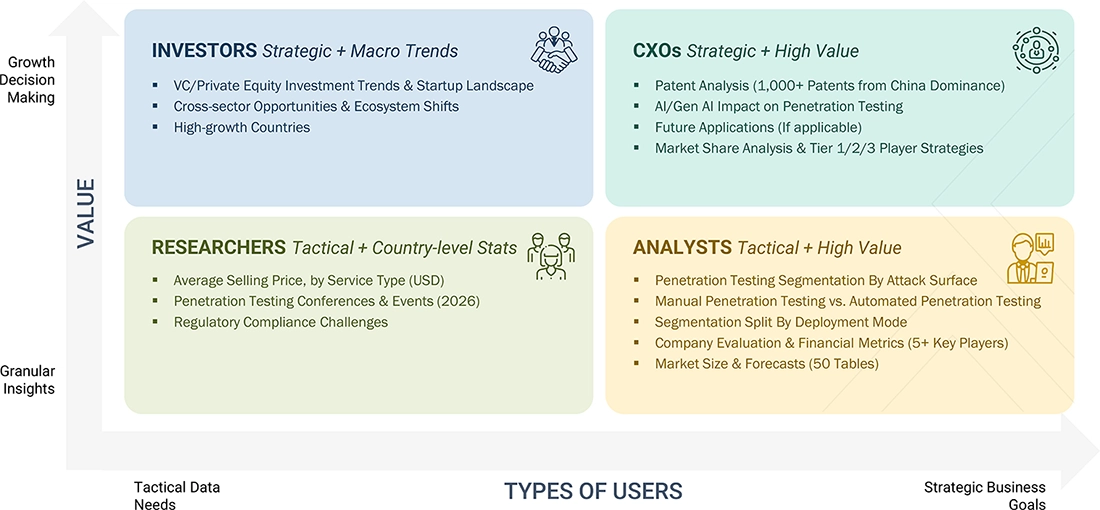
WHAT IS IN IT FOR YOU: ASIA PACIFIC PENETRATION TESTING MARKET REPORT CONTENT GUIDE
DELIVERED CUSTOMIZATIONS
We have successfully delivered the following deep-dive customizations:
| CLIENT REQUEST | CUSTOMIZATION DELIVERED | VALUE ADDS |
|---|---|---|
| Leading Solution Provider (India) |
|
Insights into regulatory-driven demand, competitive differentiation, pricing models, and partnership opportunities within India’s rapidly expanding digital and financial ecosystem |
| Leading Service Provider (Japan) |
|
Clear visibility into competitive positioning, sector specialization (especially manufacturing and critical infrastructure), and localization strategies required to succeed in Japan’s compliance-intensive enterprise market |
RECENT DEVELOPMENTS
- January 2026 : Sprinto, an AI-native governance, risk, and compliance (GRC) automation platform, announced a partnership with Astra Security, a vulnerability assessment and penetration testing (VAPT) provider, to offer a more streamlined path to audit-ready compliance for fast-growing companies. The partnership combines Sprinto’s compliance automation capabilities with Astra Security’s independent vulnerability assessment and penetration testing (VAPT) services.
- September 2025 : Pentera expanded its presence in Asia Pacific by increasing its operations through its Singapore base and enhancing its use of artificial intelligence to boost automation in its attack emulation system. The company has since evolved into a broader exposure validation methodology rather than the traditional automated penetration testing, allowing organizations to continuously test and validate security controls by simulating real-world attacks.
Table of Contents
 Exclusive indicates content/data unique to MarketsandMarkets and not available with any competitors.
TITLE
PAGE NO
1
INTRODUCTION
15
2
EXECUTIVE SUMMARY
3
PREMIUM INSIGHTS
4
MARKET OVERVIEW
4.1
INTRODUCTION
4.2
MARKET DYNAMICS
4.2.1
DRIVERS
4.2.2
RESTRAINTS
4.2.3
OPPORTUNITIES
4.2.4
CHALLENGES
4.3
UNMET NEEDS AND WHITE SPACES
4.4
INTERCONNECTED MARKETS AND CROSS-SECTOR OPPORTUNITIES
4.5
STRATEGIC MOVES BY TIER-1/2/3 PLAYERS
5
INDUSTRY TRENDS
5.1
PORTER’S FIVE FORCES ANALYSIS
5.2
MACROECONOMIC OUTLOOK
5.2.1
INTRODUCTION
5.2.2
GDP TRENDS AND FORECAST
5.2.3
TRENDS IN GLOBAL ICT INDUSTRY
5.2.4
TRENDS IN GLOBAL CYBERSECURITY INDUSTRY
5.3
VALUE CHAIN ANALYSIS
5.4
ECOSYSTEM ANALYSIS
5.5
PRICING ANALYSIS
5.5.1
AVERAGE SELLING PRICE OF PENETRATION TESTING, BY KEY PLAYER (2025)
5.5.2
INDICATIVE PRICING ANALYSIS, BY ATTACK SURFACE (2025)
5.6
KEY CONFERENCES AND EVENTS IN 2026-27
5.7
TRENDS/DISRUPTIONS IMPACTING CUSTOMER BUSINESS
5.8
INVESTMENT AND FUNDING SCENARIO
5.9
CASE STUDY ANALYSIS
5.9.1
CASE STUDY
5.9.2
CASE STUDY
5.9.3
CASE STUDY
5.10
IMPACT OF 2025 US TARIFF – ASIA PACIFIC PENETRATION TESTING MARKET
5.10.1
INTRODUCTION
5.10.2
KEY TARIFF RATES
5.10.3
PRICE IMPACT ANALYSIS
5.10.4
IMPACT ON COUNTRIES/REGIONS
5.10.4.1
US
5.10.4.2
EUROPE
5.10.4.3
ASIA PACIFIC
5.10.5
IMPACT ON END-USE INDUSTRIES
6
TECHNOLOGICAL ADVANCEMENTS, AI-DRIVEN IMPACT, PATENTS, INNOVATIONS, AND FUTURE APPLICATIONS
6.1
KEY TECHNOLOGIES/KEY EMERGING TECHNOLOGIES
6.1.1
ATTACK SURFACE MANAGEMENT
6.1.2
AUTOMATED VULNERABILITY DISCOVERY & EXPLOIT FRAMEWORKS
6.2
COMPLEMENTARY TECHNOLOGIES
6.2.1
CONTINUOUS THREAT EXPOSURE MANAGEMENT (CTEM)
6.2.2
BREACH & ATTACK SIMULATION (BAS)
6.3
ADJACENT TECHNOLOGIES
6.3.1
AI/ML
6.3.2
DAST
6.4
TECHNOLOGY/PRODUCT ROADMAP
6.5
PATENT ANALYSIS
6.6
FUTURE APPLICATIONS (AS APPLICABLE)
6.7
IMPACT OF AI/GEN AI ON ASIA PACIFIC PENETRATION TESTING MARKET
6.7.1
TOP USE CASES AND MARKET POTENTIAL
6.7.2
BEST PRACTICES FOLLOWED BY MANUFACTURERS/OEMS IN ASIA PACIFIC PENETRATION TESTING MARKET
6.7.3
CASE STUDIES OF AI IMPLEMENTATION IN ASIA PACIFIC PENETRATION TESTING MARKET
6.7.4
INTERCONNECTED ECOSYSTEM AND IMPACT ON MARKET PLAYERS
6.7.5
CLIENTS’ READINESS TO ADOPT AI INTEGRATED PENETRATION TESTING IN ASIA PACIFIC
7
REGULATORY LANDSCAPE
7.1
REGIONAL REGULATIONS AND COMPLIANCE
7.1.1
REGULATORY BODIES, GOVERNMENT AGENCIES, AND OTHER ORGANIZATIONS
7.1.2
INDUSTRY STANDARDS
8
CUSTOMER LANDSCAPE & BUYER BEHAVIOR
8.1
DECISION-MAKING PROCESS
8.2
KEY STAKEHOLDERS INVOLVED IN BUYING PROCESS AND THEIR EVALUATION CRITERIA
8.2.1
KEY STAKEHOLDERS IN BUYING PROCESS
8.2.2
BUYING CRITERIA
8.3
ADOPTION BARRIERS & INTERNAL CHALLENGES
8.4
UNMET NEEDS FROM VARIOUS END-USE INDUSTRIES
9
ASIA PACIFIC PENETRATION TESTING MARKET, BY TESTING TYPE (COMPARATIVE ASSESSMENT OF KEY PENETRATION TESTING TYPES, THEIR MARKET POTENTIAL, AND DEMAND PATTERNS BY VARIOUS MANUFACTURERS/SUPPLIER COMPANIES)
9.1
INTRODUCTION
9.1.1
TESTING TYPE: PENETRATION TESTING MARKET DRIVERS
9.2
BLACK BOX TESTING
9.3
WHITE BOX TESTING
9.4
GRAY BOX TESTING
10
ASIA PACIFIC PENETRATION TESTING MARKET, BY SERVICE TYPE (SERVICE TYPE–WISE DEMAND POTENTIAL AND GROWTH PATHWAYS SHAPING PENETRATION TESTING ADOPTION ACROSS ENTERPRISES)
10.1
INTRODUCTION
10.1.1
SERVICE TYPE : ASIA PACIFIC PENETRATION TESTING MARKET DRIVERS
10.2
MANUAL PENETRATION TESTING
10.3
AUTOMATED PENETRATION TESTING
11
ASIA PACIFIC PENETRATION TESTING MARKET, BY ATTACK SURFACE (ATTACK SURFACE–WISE DEMAND POTENTIAL AND GROWTH PATHWAYS SHAPING PENETRATION TESTING ADOPTION ACROSS ENTERPRISES)
11.1
INTRODUCTION
11.1.1
ATTACK SURFACE: ASIA PACIFIC PENETRATION TESTING MARKET DRIVERS
11.2
NETWORK SECURITY PENETRATION TESTING
11.2.1
INTERNAL NETWORK TESTING
11.2.2
EXTERNAL NETWORK TESTING
11.3
APPLICATION SECURITY PENETRATION TESTING
11.3.1
WEB APPLICATION PENETRATION TESTING
11.3.2
MOBILE APPLICATION PENETRATION TESTING
11.3.3
API PENETRATION TESTING
11.4
CLOUD SECURITY PENETRATION TESTING
11.5
SOCIAL ENGINEERING SECURITY PENETRATION TESTING
11.6
OT /ICS SYSTEMS PENETRATION TESTING
12
ASIA PACIFIC PENETRATION TESTING MARKET, BY ORGANIZATION SIZE (ORGANIZATION SIZE-WISE DEMAND POTENTIAL AND GROWTH PATHWAYS SHAPING PENETRATION TESTING ADOPTION IN DIVERSE INDUSTRIES)
12.1
INTRODUCTION
12.1.1
ORGANIZATION SIZE: ASIA PACIFIC PENETRATION TESTING MARKET DRIVERS
12.2
LARGE ENTERPRISES
12.3
SME
13
ASIA PACIFIC PENETRATION TESTING MARKET, BY DEPLOYMENT MODE (DEPLOYMENT MODE-WISE DEMAND POTENTIAL AND GROWTH PATHWAYS SHAPING PENETRATION TESTING ADOPTION IN DIVERSE INDUSTRIES)
13.1
INTRODUCTION
13.1.1
ORGANIZATION SIZE: PENETRATION TESTING MARKET DRIVERS
13.2
CLOUD
13.3
ON-PREMISES
14
ASIA PACIFIC PENETRATION TESTING MARKET, BY VERTICAL (SECTOR-SPECIFIC ADOPTION DRIVERS, DEMAND DYNAMICS, AND MARKET POTENTIAL ACROSS EACH VERTICAL)
14.1
INTRODUCTION
14.1.1
VERTICAL: ASIA PACIFIC PENETRATION TESTING MARKET DRIVERS
14.2
BANKING, FINANCIAL SERVICES, AND INSURANCE (BFSI)
14.3
HEALTHCARE
14.4
GOVERNMENT & PUBLIC SECTOR
14.5
IT & ITES
14.6
TELECOMMUNICATIONS
14.7
MEDIA & ENTERTAINMENT
14.8
MANUFACTURING
14.9
RETAIL & ECOMMERCE
14.10
EDUCATION
14.11
ENERGY & UTILITIES
14.12
TRAVEL & HOSPITALITY
14.13
OTHER VERTICALS
15
ASIA PACIFIC PENETRATION TESTING MARKET, BY COUNTRY (ASSESSMENT OF GROWTH PATTERNS, INDUSTRY FORCES, REGULATORY LANDSCAPE, AND MARKET POTENTIAL ACROSS KEY COUNTRIES)
15.1
INTRODUCTION
15.2
ASIA PACIFIC
15.2.1
ASIA PACIFIC: MARKET DRIVERS
15.2.2
CHINA
15.2.3
JAPAN
15.2.4
INDIA
15.2.5
REST OF ASIA PACIFIC
16
COMPETITIVE LANDSCAPE (STRATEGIC ASSESSMENT OF LEADING PLAYERS, MARKET SHARE, REVENUE ANALYSIS, COMPANY POSITIONING, AND COMPETITIVE BENCHMARKING INFLUENCING MARKET POTENTIAL)
16.1
OVERVIEW
16.2
KEY PLAYER COMPETITIVE STRATEGIES/RIGHT TO WIN, 2023-2025
16.3
REVENUE ANALYSIS,
16.4
MARKET SHARE ANALYSIS,
16.5
BRAND/PRODUCT/TECHNOLOGY COMPARISON,
16.6
COMPANY EVALUATION MATRIX: KEY PLAYERS,
16.6.1
STARS
16.6.2
EMERGING LEADERS
16.6.3
PERVASIVE PLAYERS
16.6.4
PARTICIPANTS
16.6.5
COMPANY FOOTPRINT: KEY PLAYERS,
16.6.5.1
COMPANY FOOTPRINT
16.6.5.2
COUNTRY FOOTPRINT
16.6.5.3
SERVICE TYPE FOOTPRINT
16.6.5.4
ATTACK SURFACE FOOTPRINT
16.6.5.5
VERTICAL FOOTPRINT
16.7
COMPANY EVALUATION MATRIX: STARTUPS/SMES,
16.7.1
PROGRESSIVE COMPANIES
16.7.2
RESPONSIVE COMPANIES
16.7.3
DYNAMIC COMPANIES
16.7.4
STARTING BLOCKS
16.7.5
COMPETITIVE BENCHMARKING: STARTUPS/SMES,
16.7.5.1
DETAILED LIST OF KEY STARTUPS/SMES
16.7.5.2
COMPETITIVE BENCHMARKING OF KEY STARTUPS/SMES
16.8
COMPANY VALUATION AND FINANCIAL METRICS,
16.9
COMPETITIVE SCENARIO
16.9.1
PRODUCT LAUNCHES
16.9.2
DEALS
16.9.3
EXPANSIONS
17
COMPANY PROFILES (IN-DEPTH REVIEW OF COMPANIES, PRODUCTS, SERVICES, RECENT INITIATIVES, AND POSITIONING STRATEGIES IN ASIA PACIFIC PENETRATION TESTING MARKET LANDSCAPE)
17.1
KEY PLAYERS
17.1.1
SOPHOS
17.1.2
FOTRA
17.1.3
IBM
17.1.4
PENTERA
17.1.5
HACKERONE
17.1.6
INVICTI
17.1.7
COBALT
17.1.8
NETSPI
17.1.9
SYNACK
17.1.10
BISHOPFOX
17.1.11
RAPID7
17.1.12
NOWSECURE
17.1.13
COALFIRE
17.1.14
FORTINET
17.1.15
INDIUM SOFTWARE
17.1.16
CIGNITI TECHNOLOGIES
17.1.17
LEVELBLUE
17.1.18
RAXIS
17.1.19
RSI SECURITY
17.1.20
RHINO SECURITY LABS
17.1.21
SCIENCESOFT
17.1.22
PORTSWIGGER
17.1.23
NETRAGAD
17.1.24
SOFTWARE SECURED
17.1.25
VUMETRIC CYBERSECURITY
17.1.26
NETITUDE
17.1.27
ZIMPERIUM
17.1.28
SECURITYMETRIC
17.1.29
BUGCROWD
17.1.30
CISCO
17.1.31
CROWDSTRIKE
17.1.32
SECURELAYER7
17.1.33
ACCENTURE
18
RESEARCH METHODOLOGY
18.1
RESEARCH DATA
18.1.1
SECONDARY DATA
18.1.1.1
KEY DATA FROM SECONDARY SOURCES
18.1.1.2
LIST OF KEY SECONDARY SOURCES
18.1.2
PRIMARY DATA
18.1.2.1
KEY DATA FROM PRIMARY SOURCES
18.1.2.2
KEY PRIMARY PARTICIPANTS
18.1.2.3
BREAKDOWN OF PRIMARY INTERVIEWS
18.1.2.4
KEY INDUSTRY INSIGHTS
18.2
MARKET SIZE ESTIMATION
18.2.1
BOTTOM-UP APPROACH
18.2.2
TOP-DOWN APPROACH
18.2.3
MARKET SIZE CALCULATION FOR BASE YEAR
18.3
MARKET FORECAST APPROACH
18.3.1
SUPPLY SIDE
18.3.2
DEMAND SIDE
18.4
DATA TRIANGULATION
18.5
FACTOR ANALYSIS
18.6
RESEARCH ASSUMPTIONS AND LIMITATIONS
18.7
RISK ASSESSMENT
19
APPENDIX
19.1
DISCUSSION GUIDE
19.2
KNOWLEDGE STORE: MARKETSANDMARKETS’ SUBSCRIPTION PORTAL
19.3
CUSTOMIZATION OPTIONS
19.4
RELATED REPORTS
19.5
AUTHOR DETAILS
Methodology
Secondary research was conducted to collect information useful for this technical, market-oriented, and commercial study of the Asia Pacific Penetration Testing Market. The next step involved validating these findings, assumptions, and sizing with industry experts across the value chain using primary research. Different approaches, including top-down and bottom-up methods, were employed to estimate the total market size. After that, the market breakup and data triangulation procedures were used to estimate the market size of the segments and subsegments of the Asia Pacific Penetration Testing Market.
Secondary Research
During the secondary research process, various secondary sources were consulted to identify and collect information relevant to the study. The secondary sources included annual reports, press releases, investor presentations of penetration testing vendors, forums, certified publications, and whitepapers. The secondary research was mainly used to obtain key information about the industry’s supply chain, the total pool of key players, market classification and segmentation according to industry trends to the bottom-most level, regional markets, and key developments from both market- and technology-oriented perspectives, all of which were further validated by primary sources.
Primary Research
In the primary research process, various primary sources from both the supply and demand sides were interviewed to obtain qualitative and quantitative information for this report. The primary sources from the supply side included various industry experts, including chief executive officers (CEOs), vice presidents (VPs), marketing directors, technology and innovation directors, and related key executives from various key companies and organizations operating in the Asia Pacific Penetration Testing Market.
In the market engineering process, top-down and bottom-up approaches were extensively used, along with several data triangulation methods, to perform market estimation and forecasting for the overall market segments and subsegments listed in this report. Extensive qualitative and quantitative analysis was performed on the complete market engineering process to list key information/insights throughout the report.
After the complete market engineering process (including calculations for market statistics, market breakups, market size estimations, market forecasts, and data triangulation), extensive primary research was conducted to gather information and verify & validate the critical numbers arrived at. The primary research was also conducted to identify segmentation types, the competitive landscape of Asia Pacific Penetration Testing Market players, and key market dynamics, such as drivers, restraints, opportunities, challenges, and key strategies.
Market Size Estimation
Top-down and bottom-up approaches were employed to estimate and validate the size of the Asia Pacific Penetration Testing Market, as well as the size of various dependent subsegments within the overall Asia Pacific Penetration Testing Market. The research methodology used to estimate the market size includes the following details: critical players in the market were identified through secondary research, and their market shares in the respective regions were determined through primary and secondary research. This entire procedure involved studying the annual and financial reports of the top market players, and extensive interviews were conducted with key industry leaders, including CEOs, VPs, directors, and marketing executives, to gather valuable insights.
All percentage splits and breakdowns were determined using secondary sources and verified through primary sources. All possible parameters that affect the market covered in this research study were accounted for, viewed in extensive detail, verified through primary research, and analyzed to get the final quantitative and qualitative data. This data was consolidated and added to detailed inputs and analysis from MarketsandMarkets.
Data Triangulation
The market was split into several segments and subsegments after arriving at the overall market size using the market size estimation processes explained above. The data triangulation and market breakup procedures were employed, wherever applicable, to complete the overall market engineering process and arrive at the exact statistics of each market segment and subsegment. The data was triangulated by studying various factors and trends from both the demand and supply sides.
Market Definition
According to MarketsandMarkets, penetration testing is a proactive cybersecurity assessment approach in which authorized professionals simulate real-world cyberattacks on networks, applications, systems, or devices to identify exploitable vulnerabilities, assess the effectiveness of security controls, and provide remediation recommendations to reduce organizational risk and strengthen the overall security posture.
Key Stakeholders
- Chief Technology and Data Officers
- Consulting Service Providers
- Cybersecurity Professionals
- Business Analysts
- Information Technology (IT) Professionals
- Government Agencies
- Investors and Venture Capitalists
- Small and Medium-sized Enterprises (SMEs) and Large Enterprises
- Third-party Providers
- Consultants/Consultancies/Advisory Firms
Report Objectives
- To describe and forecast the Asia Pacific Penetration Testing Market by service type, attack surface, organization size, deployment mode, vertical, and region from 2025 to 2031, and analyze the various macroeconomic and microeconomic factors that affect market growth
- To forecast the market size of five major regions: North America, Europe, Asia Pacific, the Middle East & Africa, and Latin America
- To analyze the subsegments of the market with respect to individual growth trends, prospects, and contributions to the overall market
- To provide detailed information regarding major factors (drivers, restraints, opportunities, and challenges) influencing the growth of the market
- To analyze opportunities in the market for stakeholders and provide details of the competitive landscape of major players
- To profile key market players, provide a comparative analysis based on the business overviews, regional presence, product offerings, business strategies, and key financials, and illustrate the competitive landscape of the market
- To analyze competitive developments, such as mergers & acquisitions, product developments, partnerships and collaborations, and research & development (R&D) activities, in the market
Customization Options
With the given market data, MarketsandMarkets offers customizations based on company-specific needs. The following customization options are available for the report:
Geographic Analysis
- Further breakdown of the Asia Pacific market into countries
- Further breakdown of the North American market into countries
- Further breakdown of the Latin American market into countries
- Further breakdown of the Middle East & African market into countries
- Further breakdown of the European market into countries
Competitive Landscape Assessment
- Detailed analysis and profiling of additional market players (up to 5)
⚡ Growth Signals
Personalize This Research
- Triangulate with your Own Data
- Get Data as per your Format and Definition
- Gain a Deeper Dive on a Specific Application, Geography, Customer or Competitor
- Any level of Personalization
Let Us Help You
- What are the Known and Unknown Adjacencies Impacting the Asia Pacific Penetration Testing Market
- What will your New Revenue Sources be?
- Who will be your Top Customer; what will make them switch?
- Defend your Market Share or Win Competitors
- Get a Scorecard for Target Partners

Leading IT Company in US
The research and discussions with the MarketsandMarkets team were insightful and influential towards driving our team's strategic direction. After engaging with the analyst team, we were able to have focused use cases, a targeted market segment, and strategic partners to consider as part of our GTM. The insights shared by MarketsandMarkets captured some useful information that we could leverage to develop our point of view for the next steps. The market reports were a great start for the project, but the analyst hours made a rough diamond turn into a polished gem of a project

Still Researching the
Asia Pacific Penetration Testing Ecosystem?
See the competitors, opportunity evaluation, and growth signals shaping it - Instantly!
Generate 15+ consulting-grade strategic intelligence outputs - from competitor analysis to board-ready strategy decks, tailored to your Asia Pacific Penetration Testing growth question.
