
惯性聚合 高效追踪和阅读你感兴趣的博客、新闻、科技资讯
阅读原文 在惯性聚合中打开

推荐订阅源

H
Help Net Security
T
ThreatConnect
SecWiki News
SecWiki News
F
Future of Privacy Forum
AWS News Blog
AWS News Blog
C
Cisco Blogs
A
Arctic Wolf
Vercel News
Vercel News
The GitHub Blog
The GitHub Blog
Scott Helme
Scott Helme
V
V2EX
博客园 - 叶小钗
阮一峰的网络日志
阮一峰的网络日志
K
Kaspersky official blog
G
Google Developers Blog
freeCodeCamp Programming Tutorials: Python, JavaScript, Git & More
P
Privacy International News Feed
C
Cyber Attacks, Cyber Crime and Cyber Security
N
News | PayPal Newsroom
Schneier on Security
NISL@THU
NISL@THU
Microsoft Azure Blog
量子位
The Hacker News
The Hacker News
Stack Overflow Blog
Stack Overflow Blog
Security Latest
Security Latest
M
Microsoft Research Blog - Microsoft Research
Google Online Security Blog
博客园_首页
C
CXSECURITY Database RSS Feed - CXSecurity.com
I
InfoQ
Google DeepMind News
Y
Y Combinator Blog
The Cloudflare Blog
Microsoft Security Blog
Martin Fowler
Martin Fowler
Cisco Talos Blog
Cisco Talos Blog
钛媒体:引领未来商业与生活新知
钛媒体:引领未来商业与生活新知
T
Troy Hunt's Blog
F
Fox-IT International blog
S
Security @ Cisco Blogs
博客园 - 司徒正美
cs.CV updates on arXiv.org
C
Comments on: Blog
Threat Intelligence Blog | Flashpoint
L
LINUX DO - 最新话题
GbyAI
GbyAI
Project Zero
Project Zero
腾讯CDC
T
Tailwind CSS Blog

IDC

Devices at Google I/O 2026: Android XR Glasses, Googlebooks, and Gemini Intelligence Why Research Alone Isn’t Enough: The Delivery Problem No One Is Talking About Digital Accessibility in the Workplace: From Compliance to Competitive Advantage When Pinocchio Became a Real Boy: Security Platforms Have Grown Up Plotting a Future-Proof Course: How The Resorts Companies Turned a Decade of IDC Partnership into a Competitive Edge European CISO priorities in 2026: AI agents, platformization, and sovereignty Why IDC Directions Is Coming to Hangzhou — and Why You Should Be There Telcos’ Next AI Revenue Play: Monetizing Orchestrated Digital Infrastructure The Workforce Skills Gap That AI Can’t Solve for Itself The Agent Takeover: What Happens When AI Becomes the Primary User of Enterprise Software The AI Answer Gap: Why Fast Answers and Defensible Ones Are No Longer the Same Thing The Market Every Western Executive Should Be Watching. IDC’s CEO Already Is. Ecosystem Strategy in 2026: Why AI Is Rewriting Partner-Led Growth Anthropic, SpaceXAI, and the New Compute Race in AI Navigating a Market Where the Wrong Bet Has Real Consequences Renuka Drummond Named Top 10 Corporate Counsel Worldwide by OnCon Icon Awards From Labor Arbitrage to Platform-Led Outcomes: How Agentic AI Is Rewriting the IT Services Playbook EMEA IT Market 2026 – Q2 Updates: 5 Key Takeaways on AI, IT Spending and Market Trends Japan’s AI Infrastructure Market Is Heading for ¥1 Trillion and Here Is What Comes Next Asia Pacific IT Spending Outlook 2026: How the Middle East War Is Reshaping IT Budgets From Digital Access to Accessibility with AI Enablement From Cost Optimization to Continuity: What IT Buyers Need Now and How Suppliers Must Respond AI as an Organizational Stress Test: What Will Break First in Your Operating Model? Japan’s ¥2.1 Trillion IT Modernization Wave: The Race Has Already Begun Semiconductor Market to Surge Past the Trillion-Dollar Threshold: AI Infrastructure Drives Market Growth Hannover Messe 2026: 7 Insights and 3 Pieces of Advice on Industrial AI, Manufacturing, and the Future of the Factory Most AI Investments Don’t Deliver Value – Here’s What EMEA Leaders Are Missing IDC Directions 2026: The AI Conversation Has Shifted. Here’s How to Catch Up. Coding by Prompt Is Coming to Your Business Units: What CIOs Should Do Next FutureScape 2026: Building Trust, Resilience, and Prosperity in the Agentic Future FutureScape 2026: Charting the Path to Enterprise-Wide Orchestration From Task Execution to Value Creation: What the 2026 Humanoid Robot Half Marathon Reveals About Industry Progress Europe’s AI Story Has a New Problem: It’s Actually Working AI Infrastructure Spending Caps Historic Year at ~$90 Billion in Q4 2025; 2029 Spending to Eclipse $1 Trillion Digital Sovereignty: Why “Sovereign” Is No Longer Enough FutureScape 2026: Navigating the Crosscurrents of Disruption Huawei and Apple Support China Smartphone Market Resilience as Shipments Decline 3.3% in Q1 2026 The Dirty Secret of AI in ITSM: Why Bad Data Wins Every Time Wholesale telecommunications: How platform models are reshaping the market Beyond LLMs: Why AI Strategy Now Requires Multi-Model, Multimodal, and Multi-Agent Architectures It’s a Data Thing: Retail and Restaurant AI Investments Will Miss the Mark if Not Led by Data Modernization Inference to Overtake Training by 2027 – Why Japanese First Movers Are Betting on Sovereign AI Infrastructure The productivity plateau: Why efficiency gains no longer differentiate Why I’m Excited about IDC Directions 2026 GTC 2026: Workstations enter the sidetop era Dispelling the myth of a silver bullet in sovereign AI MacBook Neo: Apple’s strategic play to disrupt the PC market AI sovereignty risk: A five-step agenda for CIOs Data pricing for AI is being negotiated without a stable model From cyber risk to business risk: How CISOs should engage the board in 2026
The AI Supercycle Has Started. Where Does Asia/Pacific Stand?
Vanessa Ong · 2026-05-26 · via IDC

The AI Supercycle is not a hype cycle. It is a once-in-three-decades technology expansion, defined by two sequential and overlapping waves.

We are witnessing the strongest global IT spending growth since 1996. 14% growth on a $4.2 trillion market. Unlike the internet and eCommerce boom that defined that era, this one is being driven by something more structurally transformative: artificial intelligence at enterprise scale.

IDC calls it the AI Supercycle. And at IDC Directions Singapore held on 21 May, 2026, IDC senior vice president, Sandra Ng, delivered a keynote that made one thing clear—the organisations debating whether to move are already falling behind the ones that already have.

Key Numbers:

  • $4.2 trillion global IT market size
  • 14% year-on-year IT spending growth, the strongest since 1996
  • $110 billion projected AI infrastructure spend by end of 2026
  • 36% compound annual growth rate (CAGR) for AI infrastructure through 2029
  • 75% Asia/Pacific Japan (APJ) organisations that have deployed agentic AI in at least some initiatives
  • 61% CEOs identifying agentic and generative AI at scale as their top new investment priority
  • 45% APJ organisations citing vendor selection as their number one AI strategy priority

What Is the AI Supercycle?

The first wave, AI infrastructure and platforms, is already well underway. IDC projects $110 billion in AI infrastructure spend by end of 2026, with a compound annual growth rate of 36% through 2029. Compute, cloud, connectivity, and data infrastructure are being built at a pace and scale the market has not seen since the mid-1990s.

The second wave, and the one that will determine long-term competitive position, is AI applications and agentic workflows. This is where AI moves from infrastructure investment into operating model redesign, from procurement decisions into measurable business outcomes. A third curve, AI governance, trust, and compliance, is emerging in parallel and is fast becoming a revenue line in its own right.

As Sandra Ng framed it at IDC Directions: “The AI Supercycle is not one opportunity. It is three overlapping curves with different buyer profiles, sales cycles, and margin structures.”
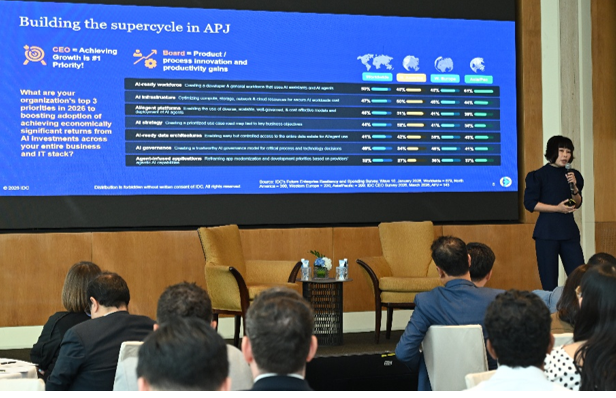
The question for every technology and business leader in APJ is which curve, or curves, your organisation is actively climbing.

APJ Is Not One Market. It Is Five Moving at Different Speeds.

One of the clearer analytical frames from the keynote is “one supercycle, five speeds”. Asia/Pacific is not a monolithic AI market, and the strategic implications differ materially depending on where your organisation operates.

  • AI Superpower Built-Outs – China and Taiwan, competing at the infrastructure layer
  • Legacy Modernisers – Japan and Korea, navigating AI adoption within established enterprise architectures
  • Governance-led AI Enterprises – Singapore, Hong Kong, and ANZ, where regulatory frameworks are shaping the deployment sequence
  • Digital Native Scalers – India, with scale, talent, and a growing domestic AI ecosystem
  • Sovereign Stack Builders – Southeast Asia 5, where governments are becoming a new class of AI infrastructure buyer

For technology vendors operating across multiple APJ markets, a single AI narrative won’t resonate consistently. Localised, market-specific positioning, particularly around sovereign AI and governance, is not just a nice-to-have. It is a commercial imperative.

Where Is AI Budget Moving in APJ?

Presented at the Directions Singapore event, the data points to three areas attracting new and accelerating AI budget across APJ:

  • Agentic AI and workflow automation is the fastest growing new budget category among tech buyers. Finance, procurement, HR, supply chain, and customer experience are the first use cases in motion. Three-quarters of APJ organisations have already deployed agentic AI in at least some tech-driven initiatives. 61% of CEOs identified agentic and generative AI at scale as their number one new investment priority.
  • AI governance, risk, and compliance has moved from a legal consideration to a board-level priority. APJ regulators have moved faster than many vendors anticipated. The organisations treating governance as a competitive advantage, rather than a cost of compliance, are pulling ahead.
  • Sovereign AI is creating an entirely new class of infrastructure buyer. Governments across APJ are building national AI capability. Local language models, domestic data residency, and supply chain compliance requirements are cascading down to mid-market and SME organisations in ways that create both complexity and opportunity.

What Should APJ Leaders Do Now?

IDC’s competitive moat map from the keynote sets out a clear sequence of actions across three horizons:

  • Do now – credibility before you lose the room
  • Do this year – differentiation before the market commoditises
  • Bet on this – positioning before the next curve peaks

Frequently Asked Questions:

What is the biggest AI investment priority for APJ CEOs? Agentic and generative AI at scale. 61% of APJ CEOs identified it as their number one new investment priority in 2026.

What is the number one AI strategy challenge for APJ organisations? Selecting the right AI vendor partners. 45% of APJ organisations cite this as their top AI strategy priority, ahead of implementation, talent, and governance.

What should APJ tech leaders do now? Establish vendor credibility before the market commoditises. As Sandra Ng closed at IDC Directions Singapore 2026, “The vendors who win the APJ AI Supercycle won’t be the ones who moved fastest. They’ll be the ones buyers trusted first.”

Access the Full Insights

Want to explore what the AI Supercycle means specifically for your market position, investment strategy, or go-to-market approach? Speak to our analysts.

Explore IDC’s AI Vendor Strategy resources and discover what’s shaping the future of enterprise AI — visit the page to get started.

Vanessa Ong - Senior Marketing Specialist, Demand Generation - IDC Asia/Pacific

Vanessa Ong is Senior Marketing Specialist, Demand Generation, at IDC Asia/Pacific, where she develops and executes integrated marketing programs that generate qualified leads and support business growth across the APJ region. A seasoned marketing professional with strong expertise in social media marketing and content creation, she is known for turning creative ideas into high-impact campaigns. Vanessa has played a key role in flagship programs including the Future Enterprise Awards and FutureScape, and is recognised as a collaborative team player who brings energy and expertise to every initiative.