






2026-05-27
4 min read

On Tuesday, May 26, Iran’s vice president announced that Internet access had started to be restored in the country after being cut off almost three months ago, following the launch of U.S. and Israeli attacks on February 28.
Cloudflare Radar data confirms increased activity and indicates a partial restoration of the Internet in Iran. In this blog post, we’ll examine a range of data points that provide a lens into this prolonged shutdown – and the signs that Iran’s citizens are increasingly able to connect once again. As the situation continues to unfold, Radar will have the latest data on Iran’s connectivity.
The first shutdown
Iranian citizens have experienced two national Internet shutdowns this year. The first began on January 8 around 16:30 UTC (20:00 local time), and we explored the impact seen over the first few days in a blog post. Traffic from Iran remained near zero until January 21, when a small amount of traffic returned, only to disappear a little over 24 hours later. A similar brief restoration also occurred on January 25, before traffic recovered more fully beginning on January 27.
The second shutdown
In late February, as military strikes on Iran escalated, a second nationwide Internet shutdown began. That sweeping shutdown has persisted for nearly three months.
The shutdown began on February 28. On that date, Cloudflare Radar observed a sharp drop in traffic from Iran beginning around 10:30 local time (07:00 UTC). Traffic levels fell to well under 1% of previous levels, with only small amounts of Web and DNS traffic leaving the country.
Activity on May 26
Our observations indicate that more traffic is now finally able to get through. Starting at around 11:00 UTC on May 26, 87 days after the second shutdown started, Cloudflare Radar observed a marked increase in both traffic and DNS queries.
Traffic increase
Data for bytes transferred across Cloudflare’s network shows a brief spike at 11:45 UTC, followed by a steady increase starting at 12:00 UTC. This surge in activity is roughly 15x than the levels observed during the prior week. Following expected diurnal patterns, the traffic starts declining around 21:00 UTC, followed by an increase starting at May 27 3:00 UTC (6:30 local time).
An increase in bytes transferred shows that a higher volume of data is successfully moving across Cloudflare’s network, which is a hopeful signal that a partial restoration is underway.
Traffic volume by region
Cloudflare Radar’s regional breakdowns, shown below, indicate that the vast majority of this new traffic is localized to Tehran, with 91.6% of HTTP requests originating from the capital city. While other regions show minor increases, they are not nearly as significant.
Traffic volume by network
Following an initial burst at 11:45 UTC, Internet providers TCI, IranCell, RighTel and MCCI each saw increases in traffic. Cloudflare Radar measures this traffic by ASN, the unique identifier assigned to an individual network or group of networks.
DNS query increase
As shown in the graph below, queries to Cloudflare’s public DNS resolver (1.1.1.1) have also spiked. Because an increase in DNS traffic indicates that more users are requesting websites and services, this upward trend serves as a strong indicator that online access is returning.
Traffic has returned to 40% of previous levels
These increases in traffic validates that a partial restoration of Iran’s Internet has taken place. However, though these increases in DNS queries and traffic are significant, they remain well below what we observed prior to either disruption. As shown in the graph below, at its peak on May 26, traffic had only returned to 40% of the maximum amount of activity observed so far in 2026.

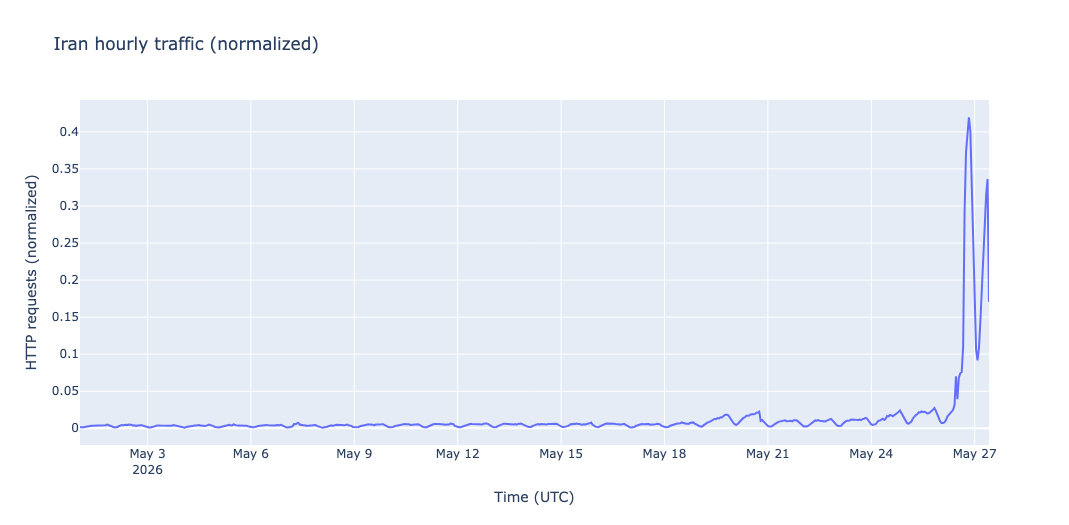
Network activity over the coming days will reveal whether traffic levels will successfully return to their pre-shutdown baselines. It should also be noted, however, that these changes could be temporary; as demonstrated in January, brief periods of recovery can quickly reverse.
IPv6 remains impacted
In January, we reported a near-complete loss of announced IPv6 address space that began several hours before the January 8 traffic drop. While a partial restoration of the country's networks appears to be underway, the volume of announced IPv6 address space — and thus IPv6 traffic from Iran — remains effectively zero.
This is noteworthy because in contrast with IPv6, address space announcements for IPv4 have remained fairly consistent and stable throughout both major 2026 shutdowns in Iran. The fact that IPv4 addresses were not removed from global routing tables, combined with the complete loss of actual traffic, suggests that Iran’s shutdown was achieved through other technical means such as application filtering or whitelisting.
IPV6 address space dropped precipitously in January and has not returned to normal levels.
Amid both 2026 shutdowns, IPv4 address space has stayed relatively consistent.
Conclusion
Having spent the majority of 2026 offline, Iranian citizens face severe disruptions to their daily lives, making these early signs of traffic recovery a critical turning point. We will continue to closely monitor Internet connectivity in Iran and share our findings as the situation evolves.
You can explore more data on Internet connectivity in Iran and the rest of the world at Cloudflare Radar. And you can find our latest observations on X, Mastodon, and Bluesky.