
惯性聚合 高效追踪和阅读你感兴趣的博客、新闻、科技资讯
阅读原文 在惯性聚合中打开

推荐订阅源

爱范儿
爱范儿
E
Exploit-DB.com RSS Feed
Google DeepMind News
F
Full Disclosure
D
Darknet – Hacking Tools, Hacker News & Cyber Security
T
ThreatConnect
Stack Overflow Blog
Stack Overflow Blog
Last Week in AI
Last Week in AI
Martin Fowler
Martin Fowler
G
GRAHAM CLULEY
C
Check Point Blog
T
Threatpost
I
Intezer
Spread Privacy
Spread Privacy
The Register - Security
Project Zero
Project Zero
月光博客
月光博客
人人都是产品经理
人人都是产品经理
阮一峰的网络日志
阮一峰的网络日志
D
DataBreaches.Net
IT之家
IT之家
Malwarebytes
Malwarebytes
T
The Blog of Author Tim Ferriss
P
Privacy International News Feed
P
Palo Alto Networks Blog
T
The Exploit Database - CXSecurity.com
量子位
李成银的技术随笔
Threat Intelligence Blog | Flashpoint
Cisco Talos Blog
Cisco Talos Blog
Know Your Adversary
Know Your Adversary
美团技术团队
The GitHub Blog
The GitHub Blog
T
Tor Project blog
M
MIT News - Artificial intelligence
奇客Solidot–传递最新科技情报
奇客Solidot–传递最新科技情报
Google Online Security Blog
P
Proofpoint News Feed
有赞技术团队
有赞技术团队
让小产品的独立变现更简单 - ezindie.com
博客园 - 司徒正美
OSCHINA 社区最新新闻
OSCHINA 社区最新新闻
C
Comments on: Blog
T
Threat Research - Cisco Blogs
aimingoo的专栏
aimingoo的专栏
Security Latest
Security Latest
NISL@THU
NISL@THU
The Cloudflare Blog
H
Help Net Security
Recent Commits to openclaw:main

The Cloudflare Blog

The day my ping took countermeasures Announcing Claude Compliance API support with Cloudflare CASB Announcing Claude Managed Agents on Cloudflare Project Glasswing: what Mythos showed us Our billing pipeline was suddenly slow. The culprit was a hidden bottleneck in ClickHouse Browser Run: now running on Cloudflare Containers, it’s faster and more scalable When "idle" isn't idle: how a Linux kernel optimization became a QUIC bug Building For The Future How Cloudflare responded to the “Copy Fail” Linux vulnerability When DNSSEC goes wrong: how we responded to the .de TLD outage Code Orange: Fail Small is complete. The result is a stronger Cloudflare network Introducing Dynamic Workflows: durable execution that follows the tenant Post-quantum encryption for Cloudflare IPsec is generally available Agents can now create Cloudflare accounts, buy domains, and deploy Shutdowns, power outages, and conflict: a review of Q1 2026 Internet disruptions Making Rust Workers reliable: panic and abort recovery in wasm‑bindgen Moving past bots vs. humans Building the agentic cloud: everything we launched during Agents Week 2026 The AI engineering stack we built internally — on the platform we ship Orchestrating AI Code Review at scale Introducing the Agent Readiness score. Check to see if your site is agent-ready Shared Dictionaries: compression that keeps up with the agentic web Redirects for AI Training enforces canonical content Unweight: how we compressed an LLM 22% without sacrificing quality Agents that remember: introducing Agent Memory Agents Week: network performance update Introducing Flagship: feature flags built for the age of AI Cloudflare’s AI Platform: an inference layer designed for agents Building the foundation for running extra-large language models AI Search: the search primitive for your agents Deploy Postgres and MySQL databases with PlanetScale + Workers Artifacts: versioned storage that speaks Git Email for agents - Cloudflare Email Service now in public beta Project Think: building the next generation of AI agents on Cloudflare Introducing Agent Lee - a new interface to the Cloudflare stack Register domains wherever you build: Cloudflare Registrar API now in beta Browser Run: give your agents a browser Rearchitecting the Workflows control plane for the agentic era Add voice to your agent Managed OAuth for Access: make internal apps agent-ready in one click Securing non-human identities: automated revocation, OAuth, and scoped permissions Scaling MCP adoption: Our reference architecture for simpler, safer and cheaper enterprise deployments of MCP Secure private networking for everyone: users, nodes, agents, Workers — introducing Cloudflare Mesh Building a CLI for all of Cloudflare Durable Objects in Dynamic Workers: Give each AI-generated app its own database Agents have their own computers with Sandboxes GA Dynamic, identity-aware, and secure Sandbox auth Welcome to Agents Week 500 Tbps of capacity: 16 years of scaling our global network From bytecode to bytes- automated magic packet generation Cloudflare targets 2029 for full post-quantum security How we built Organizations to help enterprises manage Cloudflare at scale Why we're rethinking cache for the AI era Our ongoing commitment to privacy for the 1.1.1.1 public DNS resolver Introducing EmDash — the spiritual successor to WordPress that solves plugin security Introducing Programmable Flow Protection: custom DDoS mitigation logic for Magic Transit customers Cloudflare Client-Side Security: smarter detection, now open to everyone How we use Abstract Syntax Trees (ASTs) to turn Workflows code into visual diagrams A one-line Kubernetes fix that saved 600 hours a year Sandboxing AI agents, 100x faster Inside Gen 13- how we built our most powerful server yet Launching Cloudflare’s Gen 13 servers- trading cache for cores for 2x edge compute performance Powering the agents: Workers AI now runs large models, starting with Kimi K2.5 Introducing Custom Regions for precision data control Standing up for the open Internet- why we appealed Italy’s Piracy Shield fine From legacy architecture to Cloudflare One Announcing Cloudflare Account Abuse Protection: prevent fraudulent attacks from bots and humans Slashing agent token costs by 98% with RFC 9457-compliant error responses AI Security for Apps is now generally available Building a security overview dashboard for actionable insights Investigating multi-vector attacks in Log Explorer Translating risk insights into actionable protection: leveling up security posture with Cloudflare and Mastercard Fixing request smuggling vulnerabilities in Pingora OSS deployments Active defense: introducing a stateful vulnerability scanner for APIs Complexity is a choice. SASE migrations shouldn’t take years. From the endpoint to the prompt: a unified data security vision in Cloudflare One Ending the "silent drop": how Dynamic Path MTU Discovery makes the Cloudflare One Client more resilient A QUICker SASE client: re-building Proxy Mode How Automatic Return Routing solves IP overlap Always-on detections: eliminating the WAF “log versus block” trade-off Mind the gap: new tools for continuous enforcement from boot to login Stop reacting to breaches and start preventing them with User Risk Scoring Defeating the deepfake: stopping laptop farms and insider threats Moving from license plates to badges: the Gateway Authorization Proxy Evolving Cloudflare’s Threat Intelligence Platform: actionable, scalable, and ETL-less Introducing the 2026 Cloudflare Threat Report See risk, fix risk: introducing Remediation in Cloudflare CASB How Cloudy translates complex security into human action From reactive to proactive: closing the phishing gap with LLMs Modernizing with agile SASE: a Cloudflare One blog takeover Beyond the blank slate: how Cloudflare accelerates your Zero Trust journey The truly programmable SASE platform Toxic combinations: when small signals add up to a security incident We deserve a better streams API for JavaScript The most-seen UI on the Internet? Redesigning Turnstile and Challenge Pages ASPA: making Internet routing more secure Bringing more transparency to post-quantum usage, encrypted messaging, and routing security How we rebuilt Next.js with AI in one week Cloudflare One is the first SASE offering modern post-quantum encryption across the full platform Cloudflare outage on February 20, 2026
Cloudflare’s view of the Virgin Media outage in the UK
Cloudflare Team · 2023-04-05 · via The Cloudflare Blog

Cloudflare’s view of the Virgin Media outage in the UK

2023-04-04

3 min read
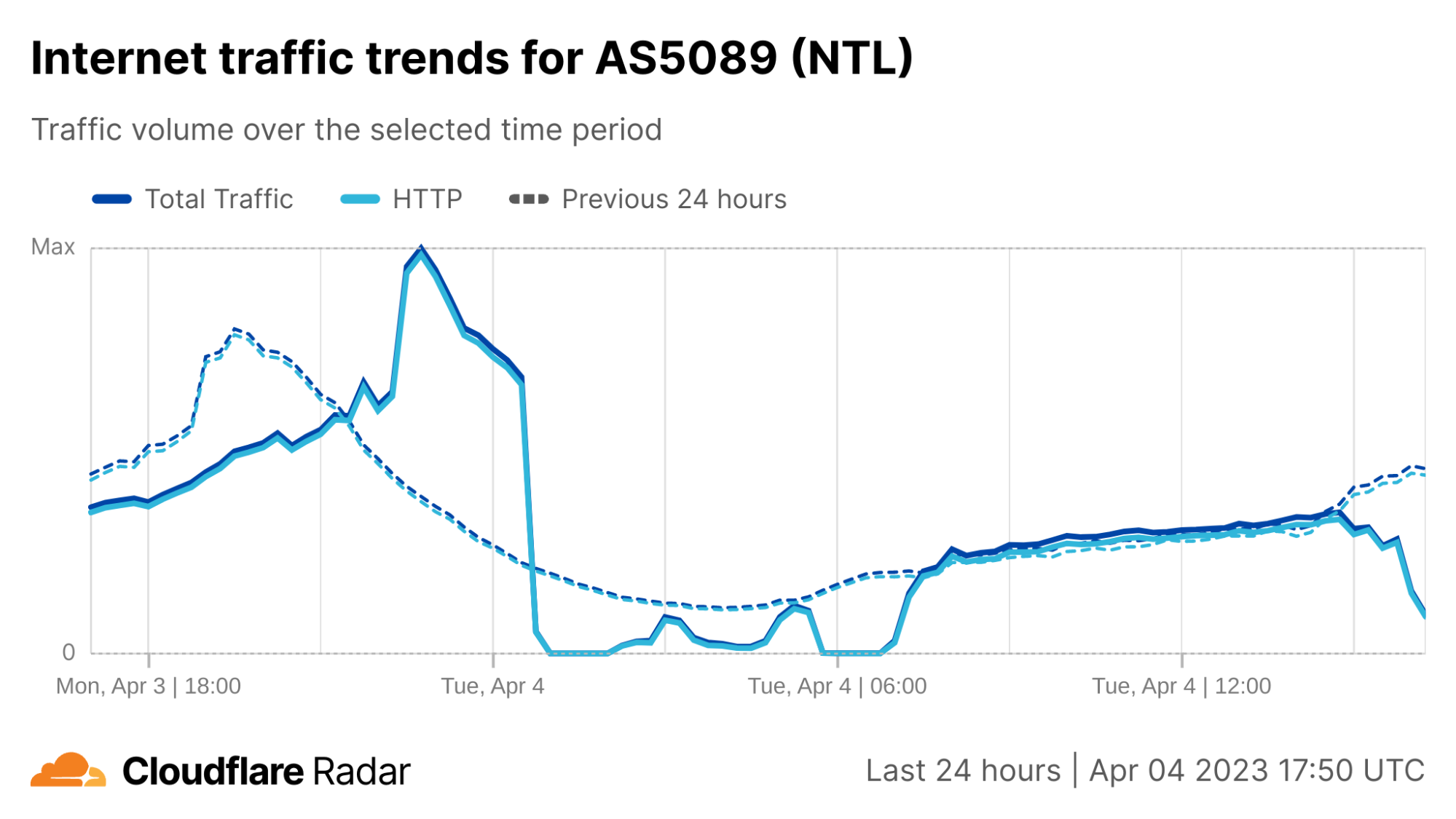
Just after midnight (UTC) on April 4, subscribers to UK ISP Virgin Media (AS5089) began experiencing an Internet outage, with subscriber complaints multiplying rapidly on platforms including Twitter and Reddit.

Cloudflare Radar data shows Virgin Media traffic dropping to near-zero around 00:30 UTC, as seen in the figure below. Connectivity showed some signs of recovery around 02:30 UTC, but fell again an hour later. Further nominal recovery was seen around 04:45 UTC, before again experiencing another complete outage between around 05:45-06:45 UTC, after which traffic began to recover, reaching expected levels around 07:30 UTC.

After the initial set of early-morning disruptions, Virgin Media experienced another round of issues in the afternoon. Cloudflare observed instability in traffic from Virgin Media’s network (called an autonomous system in Internet jargon) AS5089 starting around 15:00 UTC, with a significant drop just before 16:00 UTC. However in this case, it did not appear to be a complete outage, with traffic recovering approximately a half hour later.

Virgin Media’s Twitter account acknowledged the early morning disruption several hours after it began, posting responses stating “We’re aware of an issue that is affecting broadband services for Virgin Media customers as well as our contact centres. Our teams are currently working to identify and fix the problem as quickly as possible and we apologise to those customers affected.” Further responses after service restoration noted “We’ve restored broadband services for customers but are closely monitoring the situation as our engineers continue to investigate. We apologise for any inconvenience caused.”

However, the second disruption was acknowledged on Virgin Media’s Twitter account much more rapidly, with a post at 16:25 UTC stating “Unfortunately we have seen a repeat of an earlier issue which is causing intermittent broadband connectivity problems for some Virgin Media customers. We apologise again to those impacted, our teams are continuing to work flat out to find the root cause of the problem and fix it.”

At the time of the outages, www.virginmedia.com, which includes the provider’s status page, was unavailable. As seen in the figure below, a DNS lookup for the hostname resulted in a SERVFAIL error, indicating that the lookup failed to return a response. This is because the authoritative nameservers for virginmedia.com are listed as ns{1-4}.virginmedia.net, and these nameservers are all hosted within Virgin Media’s network (AS5089) and thus are not accessible during the outage.

Although Virgin Media has not publicly released a root cause for the series of disruptions that its network has experienced, looking at BGP activity can be instructive.

BGP is a mechanism to exchange routing information between networks on the Internet. The big routers that make the Internet work have huge, constantly updated lists of the possible routes that can be used to deliver each network packet to its final destination. Without BGP, the Internet routers wouldn't know what to do, and the Internet wouldn't exist.

The Internet is literally a network of networks, or for math fans, a graph, with each individual network a node in it, and the edges representing the interconnections. All of this is bound together by BGP, which allows one network (Virgin Media, for instance) to advertise its presence to other networks that form the Internet. When Virgin Media is not advertising its presence, other networks can’t find its network and it becomes effectively unavailable.

BGP announcements inform a router of changes made to the routing of a prefix (a group of IP addresses) or entirely withdraws the prefix, removing it from the routing table. The figure below shows aggregate BGP announcement activity from AS5089 with spikes that align with the decreases and increases seen in the traffic graph above, suggesting that the underlying cause may in fact be BGP-related, or related to problems with core network infrastructure.

We can drill down further to break out the observed activity between BGP announcements (dark blue) and withdrawals (light blue) seen in the figure below, with key activity coincident with the loss and return of traffic. An initial set of withdrawals are seen just after midnight, effectively removing Virgin Media from the Internet resulting in the initial outage.

A set of announcements occurred just before 03:00 UTC, aligning with the nominal increase in traffic noted above, but those were followed quickly by another set of withdrawals. A similar announcement/withdrawal exchange was observed at 05:00 and 05:30 UTC respectively, before a final set of announcements restored connectivity at 07:00 UTC.

Things remained relatively stable through the morning into the afternoon, before another set of withdrawals presaged the afternoon’s connectivity problems, with a spike of withdrawals at 15:00 UTC, followed by additional withdrawal/announcement exchanges over the next several hours.

Conclusion

Track ongoing traffic trends for Virgin Media on Cloudflare Radar, and follow us on Twitter and Mastodon for regular updates.

OutageRadarTrendsTrafficUnited Kingdom

Related posts