

惯性聚合 高效追踪和阅读你感兴趣的博客、新闻、科技资讯
阅读原文 在惯性聚合中打开

推荐订阅源

S
Securelist
Schneier on Security
Cloudbric
Cloudbric
S
Security @ Cisco Blogs
Webroot Blog
Webroot Blog
Attack and Defense Labs
G
GRAHAM CLULEY
cs.CL updates on arXiv.org
S
Schneier on Security
cs.AI updates on arXiv.org
Latest news
Latest news
C
CXSECURITY Database RSS Feed - CXSecurity.com
D
Darknet – Hacking Tools, Hacker News & Cyber Security
H
Heimdal Security Blog
I
Intezer
GbyAI
GbyAI
T
The Blog of Author Tim Ferriss
罗磊的独立博客
O
OpenAI News
D
Docker
Cisco Talos Blog
Cisco Talos Blog
S
Secure Thoughts
S
Security Affairs
CTFtime.org: upcoming CTF events
钛媒体:引领未来商业与生活新知
钛媒体:引领未来商业与生活新知
The Last Watchdog
The Last Watchdog
L
LINUX DO - 热门话题
AI
AI
B
Blog
C
Cybersecurity and Infrastructure Security Agency CISA
让小产品的独立变现更简单 - ezindie.com
H
Help Net Security
爱范儿
爱范儿
博客园 - 司徒正美
Scott Helme
Scott Helme
博客园_首页
Recent Commits to openclaw:main
Blog — PlanetScale
Blog — PlanetScale
Simon Willison's Weblog
Google DeepMind News
N
News and Events Feed by Topic
A
About on SuperTechFans
T
Threat Research - Cisco Blogs
P
Proofpoint News Feed
Y
Y Combinator Blog
C
CERT Recently Published Vulnerability Notes
T
Tenable Blog
cs.CV updates on arXiv.org
V
V2EX - 技术
The Register - Security

Blog

This year we celebrate a decade of Ubuntu Server support on the s390x architecture: marking a long-standing collaboration between Canonical and IBM that began at LinuxCon 2015. The first release happened on April 21, 2016, bringing Ubuntu 16.04 LTS (Xenial Xerus) to IBM Z and IBM LinuxONE platforms.  A first for Ubuntu on IBM That […] AI at the edge: simplifying infrastructure with Cisco and Canonical | Canonical The next era of telco clouds: get open infrastructure choice with Sylva and Canonical Kubernetes | Canonical What is RDMA over Converged Ethernet (RoCE)? | Canonical Beyond tokens per watt – using Ubuntu 26.04 LTS for AI Beyond tokens per watt – using Ubuntu 26.04 LTS for AI | Canonical A look into Ubuntu Core 26: Deploying AI models on Renesas RZ/V series for production | Canonical RISC-V profiles – why is RVA23 significant? | Canonical AI with AMD ROCm on Ubuntu: your questions answered | Canonical When distributed workloads stall because nodes cannot exchange small messages quickly and consistently, the network is the limiting factor. How do you solve that problem? InfiniBand offers one solution. InfiniBand is an interconnect, meaning the end-to-end communication system that links compute, storage, and accelerator nodes. It is impl […] Microsoft has announced the preview of Azure Cobalt 200, its second-generation custom Arm silicon. Learn how Ubuntu and Ubuntu Pro support these new VMs from day one, offering seamless deployment, long-term security maintenance, and Kernel Livepatch without requiring engineering or platform changes […] Securing AI agent workflows on Ubuntu with the new NVIDIA OpenShell snap | Canonical Canonical announces optimized Ubuntu images for TPU virtual machines by Google Cloud | Canonical VMware hypervisor deployment using MAAS | Canonical Migrating from Apache Spark 3 to Spark 4 | Canonical Introducing Workshop: launch sandboxed development environments on Ubuntu with a single command | Canonical Run agentic workloads on Arm and Ubuntu | Canonical Decoding design: How design and engineering thrive together in open source | Canonical Developing web apps with local LLM inference | Canonical A local privilege escalation (LPE) security vulnerability in the Linux kernel, codename “PinTheft,” was publicly disclosed on May 19, 2026. The vulnerability was fixed in the mainline Linux kernel tree. A proof-of-concept exploit was published along with public disclosure. This has been assigned the CVE ID CVE-2026-43494; other discoverin […] Canonical has announced the general availability of Managed Kubeflow on the Microsoft Azure Marketplace. This fully managed MLOps platform allows enterprise AI teams to deploy a production-ready environment in under an hour, eliminating infrastructure maintenance. […] A look into Ubuntu Core 26: Cloud-powered edge computing with AWS IoT Greengrass and Azure IoT Edge | Canonical CVE-2026-46333 (ssh-keysign-pwn) Linux kernel vulnerability mitigations | Canonical Finding the blind spot: How Canonical hunts logic flaws with AI | Canonical A local privilege escalation (LPE) vulnerability affecting the Linux kernel has been publicly disclosed on May 13, 2026. The vulnerability does not have a CVE ID published, but is referred to as “Fragnesia.” The vulnerability affects multiple Linux distributions, including all Ubuntu releases. The affected components are the Linux kernel […] Rethinking BYOD security: protecting data without trusting devices | Canonical Two local privilege escalation (LPE) vulnerabilities affecting the Linux kernel have been publicly disclosed on May 7, 2026. The vulnerabilities have been assigned the IDs CVE-2026-43284 and CVE-2026-43500 and are referred to as “Dirty Frag.” The affected components are Linux kernel modules. The first vulnerability impacts the modules tha […] Three weeks to go: A sneak peek of the Ubuntu Summit 26.04 experience | Canonical How to use Ubuntu on Windows | Canonical A local privilege escalation (LPE) vulnerability affecting the Linux kernel has been publicly disclosed on April 29, 2026. The vulnerability has been assigned CVE ID CVE-2026-31431 and is referred to as Copy Fail. The affected component is a kernel module that provides hardware-accelerated cryptographic functions: algif_aead. The vulnerab […] Run NVIDIA Nemotron 3 Nano Omni locally in a single command | Canonical Why Web Engineering is great | Canonical Ubuntu 16.04 LTS (Xenial Xerus) reached the end of its five-year Expanded Security Maintenance (ESM) window in April 2026. If you are still running 16.04, it is critical to address your support status to ensure continued security and compliance. Your support options Now that 16.04 is in its Legacy phase, you have two primary paths: […] Understanding disaggregated GenAI model serving with llm-d | Canonical From Jammy to Resolute: how Ubuntu’s toolchains have evolved | Canonical Hybrid search and reranking: a deeper look at RAG | Canonical Canonical expands Ubuntu support to next-generation MediaTek Genio 520 and 720 platforms | Canonical In this article, Keirthana TS, a Senior Technical Author at Canonical, breaks down what leadership means to her and how she understood the power of intentional leadership through her journey at Canonical. […] Ubuntu Pro comes to Nutanix bare-metal Kubernetes | Canonical RISC-V 101 – what is it and what does it mean for Canonical? | Canonical Ubuntu Summit 26.04 is coming: Save the date and share your story! | Canonical How to manage Ubuntu fleets using on-premises Active Directory and ADSys | Canonical Simplify bare metal operations for sovereign clouds | Canonical How to Harden Ubuntu SSH: From static keys to cloud identity | Canonical The “scanner report has to be green” trap | Canonical Modern Linux identity management: from local auth to the cloud with Ubuntu | Canonical Canonical welcomes NVIDIA’s donation of the GPU DRA driver to CNCF | Canonical Hot code burns: the supply chain case for letting your containers cool before you ship | Canonical
How Canonical Support solves hard Linux performance bugs  – even in 12-year old code | Canonical
Lidia Luna Puerta · 2026-06-01 · via Blog

Some support cases are straightforward. Others lead deep into legacy code, where a single logic bug can quietly turn a routine command into a major performance problem. This series looks at how Canonical Support and Sustaining Engineering work together to investigate, patch, and upstream difficult issues that standard troubleshooting alone cannot solve. In this second post, a 12-year-old bug in libnss-db caused getent enumeration to slow to a crawl – and showed how far expert support can go when a customer brings the right evidence and the right question.
What went wrong

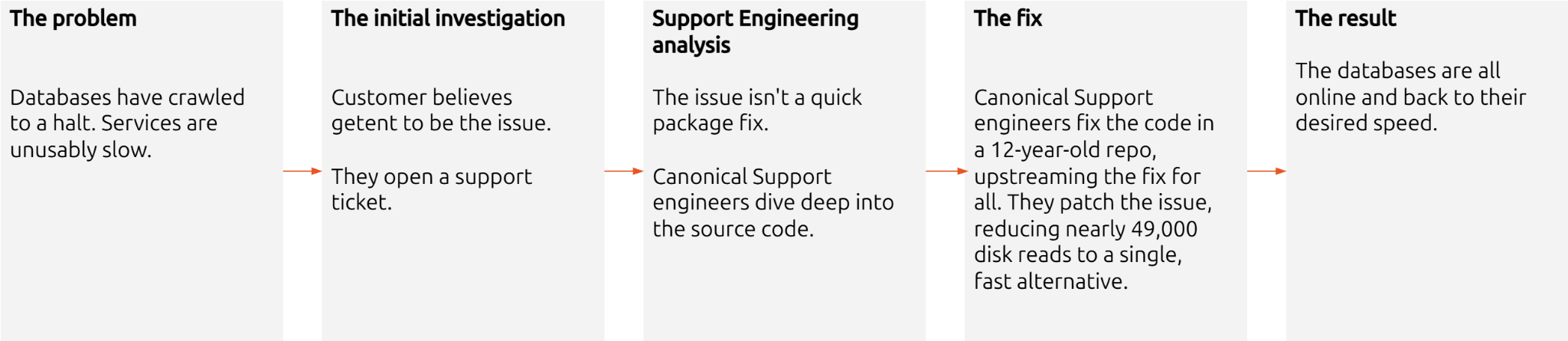
Getent is a standard Linux command used to query the system’s name service for information such as users, groups, hosts, and services. In this case, it was being used to enumerate groups on Ubuntu, and a customer reported severe performance problems when using the `nssdb` backend. The `nssdb` backend is one way Linux can provide that information, by reading account and group data from Berkeley DB files instead of from LDAP, local flat files, or other identity sources. 

In an environment with more than 24,000 user and group entries, enumeration had become so slow that the backend was effectively unusable. The slowdown was severe enough to block practical use of the system for the customer’s workload. The customer had already tested alternatives and found they did not deliver the performance profile they needed.

Starting with the evidence

Solving frequent issues in new packages is hard enough, but this investigation was made harder by something different: the problem lived in an older component that had not been actively touched in more than 12 years . 

The customer had already narrowed the issue to libnss-db: a component behind the nssdb backend, a legacy name service library that implements nssdb. They also pointed to one small but important piece of logic: stayopen.

Reproducing the slowdown

The Canonical support engineer soon determined that stayopen handling was the likely source. Stayopen is a flag that determines whether the database connection remains open across repeated lookups or is reopened for each operation.

The support engineer reproduced the issue and confirmed that the performance degradation was both real and severe. However, what initially looked like a generic lookup slowdown turned out to be repeated database activity during enumeration, with the cost of each operation compounding across a very large directory. At that scale, the result was a system that could no longer complete the work in a reasonable time.

To truly understand the problem, the next step required a closer inspection of the software’s source code. That result shifted the investigation from surface-level troubleshooting to source-level analysis. Solving the problem meant examining libnss-db itself: an independent package whose C source had remained largely unchanged for more than a decade.

Digging into legacy C code

At that point, the work became a code-level deep dive for our Support team. Our engineer traced how libnss-db handled Berkeley DB access during enumeration and followed the control flow through code that, in some places, was roughly 12 years old.

Our engineer soon found the source of all the problems: a logic bug in how the library handled database connections during enumeration. This was not the kind of issue that can be solved with a quick setting change or a routine package update. The library was repeatedly opening and closing the database files instead of keeping the connection open throughout the enumeration sequence.

The line of code that mattered

That open-close cycle had a dramatic effect at scale. During a single enumeration, it triggered 48,422 repeated disk reads, creating a major performance bottleneck and slowing the system far beyond what the customer could accept.  The cost was large enough to overwhelm the lookup path entirely.

The customer’s suspicion about stayopen turned out to be exactly right. Once that behavior was confirmed in the code, our engineer created a patch to force the database connection to remain open during enumeration.

How performance was restored

The fix improved the lookup behavior immediately. By keeping the database open across the full enumeration sequence, it eliminated the repeated disk reads and restored performance for the customer.

After validating the patch provided by a member of our Support team, the case was escalated to Canonical Sustaining Engineering so the issue could be tracked formally and moved toward a broader fix. A Launchpad bug was then created to document the problem and propose the change upstream, including for newer Ubuntu releases such as Noble.

Why this case stands out

This case is a good example of what technical support looks like when the answer is deeper than a package upgrade, a configuration change, or a standard workaround. Those are usually faster options because they can solve problems without changing the software itself. Here, however, the issue lived in the code, so a deeper investigation was required. The resolution depended on careful reproduction, close collaboration with a technically knowledgeable customer, and a willingness to read through old source code until the underlying behavior was fully understood.

It also highlights the practical value of long-term support. Even though this issue lived in an old component that had long since fallen outside the attention of most of the broader community, it was still possible to investigate, patch, and escalate it because the customer had an Ubuntu Pro with Support subscription. That combination of long-term security maintenance and direct engineering expertise made it possible to solve a problem that otherwise might have remained unresolved.

If you’re looking to understand how Canonical Support works, or explore the value, stability, and reliability it can bring to your organization and systems, we recommend you visit our dedicated Support page.

And if you’re looking for help with a custom project, or just want to find out what your available support options are, please don’t hesitate to contact us

More from this series

When an upstream change broke smartcard FIPS authentication and how we fixed it 

Related posts