


惯性聚合 高效追踪和阅读你感兴趣的博客、新闻、科技资讯
阅读原文 在惯性聚合中打开

推荐订阅源

V
V2EX
爱范儿
爱范儿
Martin Fowler
Martin Fowler
T
The Blog of Author Tim Ferriss
B
Blog RSS Feed
博客园 - 聂微东
G
GRAHAM CLULEY
Engineering at Meta
Engineering at Meta
Threat Intelligence Blog | Flashpoint
WordPress大学
WordPress大学
Scott Helme
Scott Helme
AI
AI
S
Security Affairs
T
Threat Research - Cisco Blogs
M
MIT News - Artificial intelligence
T
Troy Hunt's Blog
H
Hackread – Cybersecurity News, Data Breaches, AI and More
人人都是产品经理
人人都是产品经理
AWS News Blog
AWS News Blog
T
Threatpost
Cyberwarzone
Cyberwarzone
www.infosecurity-magazine.com
U
Unit 42
V
Vulnerabilities – Threatpost
J
Java Code Geeks
博客园 - Franky
月光博客
月光博客
Blog — PlanetScale
Blog — PlanetScale
NISL@THU
NISL@THU
D
Docker
小众软件
小众软件
N
News and Events Feed by Topic
Microsoft Security Blog
Y
Y Combinator Blog
A
Arctic Wolf
D
DataBreaches.Net
云风的 BLOG
云风的 BLOG
Forbes - Security
Forbes - Security
量子位
PCI Perspectives
PCI Perspectives
美团技术团队
K
KPMG report finds enterprise disconnect between AI and its ROI | CIO
I
InfoQ
Security Archives - TechRepublic
有赞技术团队
有赞技术团队
腾讯CDC
P
Proofpoint News Feed
S
Security @ Cisco Blogs
G
Google Developers Blog
C
Cisco Blogs

Blog

MAAS installation: bare metal provisioning is easier than ever | Canonical Januscape vulnerability CVE-2026-53359 mitigations available | Canonical Managing Ubuntu on bare metal at scale | Canonical Ubuntu Server: a platform made for enterprise scale | Canonical Building an open source chain of trust: new research uncovers key blockers and ways forward | Canonical Beyond safety and security: Why automotive open source demands dependability  | Canonical DirtyClone Linux kernel local privilege escalation vulnerability fixes available | Canonical pedit COW kernel local privilege escalation vulnerability mitigations | Canonical Canonical becomes Gold Sponsor of Trifecta Tech Foundation | Canonical Hunting a 16-year-old SQLite bug with TLA+: is dqlite affected? | Canonical Anbox Cloud on C4A metal: Android, at scale, without friction | Canonical Canonical announces live kernel patching for Arm64 | Canonical How to use RISC-V custom instructions with Ubuntu | Canonical Ubuntu Summit 26.04: connected by open source | Canonical So you need to add microcontrollers to your fleet: now what? | Canonical Validating real-world skills through Canonical Academy | Canonical Virtualized Android comes to Anbox Cloud | Canonical Template: Streamlining open source design contributions | Canonical Beyond Mythos: responding to a new threat landscape | Canonical A look into Ubuntu Core 26: Building a local AI inference appliance in a virtual machine | Canonical This year we celebrate a decade of Ubuntu Server support on the s390x architecture: marking a long-standing collaboration between Canonical and IBM that began at LinuxCon 2015. The first release happened on April 21, 2016, bringing Ubuntu 16.04 LTS (Xenial Xerus) to IBM Z and IBM LinuxONE platforms.  A first for Ubuntu on IBM That […] AI at the edge: simplifying infrastructure with Cisco and Canonical | Canonical The next era of telco clouds: get open infrastructure choice with Sylva and Canonical Kubernetes | Canonical What is RDMA over Converged Ethernet (RoCE)? | Canonical Beyond tokens per watt – using Ubuntu 26.04 LTS for AI Beyond tokens per watt – using Ubuntu 26.04 LTS for AI | Canonical A look into Ubuntu Core 26: Deploying AI models on Renesas RZ/V series for production | Canonical RISC-V profiles – why is RVA23 significant? | Canonical AI with AMD ROCm on Ubuntu: your questions answered | Canonical When distributed workloads stall because nodes cannot exchange small messages quickly and consistently, the network is the limiting factor. How do you solve that problem? InfiniBand offers one solution. InfiniBand is an interconnect, meaning the end-to-end communication system that links compute, storage, and accelerator nodes. It is impl […] Microsoft has announced the preview of Azure Cobalt 200, its second-generation custom Arm silicon. Learn how Ubuntu and Ubuntu Pro support these new VMs from day one, offering seamless deployment, long-term security maintenance, and Kernel Livepatch without requiring engineering or platform changes […] How Canonical Support solves hard Linux performance bugs  – even in 12-year old code | Canonical Securing AI agent workflows on Ubuntu with the new NVIDIA OpenShell snap | Canonical Canonical announces optimized Ubuntu images for TPU virtual machines by Google Cloud | Canonical VMware hypervisor deployment using MAAS | Canonical Migrating from Apache Spark 3 to Spark 4 | Canonical Introducing Workshop: launch sandboxed development environments on Ubuntu with a single command | Canonical Run agentic workloads on Arm and Ubuntu | Canonical Decoding design: How design and engineering thrive together in open source | Canonical Developing web apps with local LLM inference | Canonical A local privilege escalation (LPE) security vulnerability in the Linux kernel, codename “PinTheft,” was publicly disclosed on May 19, 2026. The vulnerability was fixed in the mainline Linux kernel tree. A proof-of-concept exploit was published along with public disclosure. This has been assigned the CVE ID CVE-2026-43494; other discoverin […] Canonical has announced the general availability of Managed Kubeflow on the Microsoft Azure Marketplace. This fully managed MLOps platform allows enterprise AI teams to deploy a production-ready environment in under an hour, eliminating infrastructure maintenance. […] A look into Ubuntu Core 26: Cloud-powered edge computing with AWS IoT Greengrass and Azure IoT Edge | Canonical CVE-2026-46333 (ssh-keysign-pwn) Linux kernel vulnerability mitigations | Canonical Finding the blind spot: How Canonical hunts logic flaws with AI | Canonical A local privilege escalation (LPE) vulnerability affecting the Linux kernel has been publicly disclosed on May 13, 2026. The vulnerability does not have a CVE ID published, but is referred to as “Fragnesia.” The vulnerability affects multiple Linux distributions, including all Ubuntu releases. The affected components are the Linux kernel […] Rethinking BYOD security: protecting data without trusting devices | Canonical Two local privilege escalation (LPE) vulnerabilities affecting the Linux kernel have been publicly disclosed on May 7, 2026. The vulnerabilities have been assigned the IDs CVE-2026-43284 and CVE-2026-43500 and are referred to as “Dirty Frag.” The affected components are Linux kernel modules. The first vulnerability impacts the modules tha […] Three weeks to go: A sneak peek of the Ubuntu Summit 26.04 experience | Canonical How to use Ubuntu on Windows | Canonical A local privilege escalation (LPE) vulnerability affecting the Linux kernel has been publicly disclosed on April 29, 2026. The vulnerability has been assigned CVE ID CVE-2026-31431 and is referred to as Copy Fail. The affected component is a kernel module that provides hardware-accelerated cryptographic functions: algif_aead. The vulnerab […] Run NVIDIA Nemotron 3 Nano Omni locally in a single command | Canonical Why Web Engineering is great | Canonical Ubuntu 16.04 LTS (Xenial Xerus) reached the end of its five-year Expanded Security Maintenance (ESM) window in April 2026. If you are still running 16.04, it is critical to address your support status to ensure continued security and compliance. Your support options Now that 16.04 is in its Legacy phase, you have two primary paths: […] Understanding disaggregated GenAI model serving with llm-d | Canonical From Jammy to Resolute: how Ubuntu’s toolchains have evolved | Canonical Hybrid search and reranking: a deeper look at RAG | Canonical Canonical expands Ubuntu support to next-generation MediaTek Genio 520 and 720 platforms | Canonical In this article, Keirthana TS, a Senior Technical Author at Canonical, breaks down what leadership means to her and how she understood the power of intentional leadership through her journey at Canonical. […] Ubuntu Pro comes to Nutanix bare-metal Kubernetes | Canonical RISC-V 101 – what is it and what does it mean for Canonical? | Canonical Ubuntu Summit 26.04 is coming: Save the date and share your story! | Canonical How to manage Ubuntu fleets using on-premises Active Directory and ADSys | Canonical Simplify bare metal operations for sovereign clouds | Canonical How to Harden Ubuntu SSH: From static keys to cloud identity | Canonical The “scanner report has to be green” trap | Canonical Modern Linux identity management: from local auth to the cloud with Ubuntu | Canonical Canonical welcomes NVIDIA’s donation of the GPU DRA driver to CNCF | Canonical Hot code burns: the supply chain case for letting your containers cool before you ship | Canonical
Challenges designers face in open source (and how to fix them) | Canonical
Kola Ojoodide · 2026-06-26 · via Blog

Open source software (OSS) is a cornerstone of modern technology. According to the Linux Foundation, it powers up to 90% of software tools used today. Unlike proprietary software, OSS is developed collaboratively, meaning its code is available for anyone to use, change, and distribute.  

Because OSS projects have historically been driven by developers, they tend to be highly flexible and functional, but they can lack critical usability considerations. This often makes them difficult for everyday users to navigate and adopt. To bridge this gap, there is a need for more designers to contribute to open source and improve user experiences.  

With this in mind, Canonical’s Design team conducted a survey exploring the real-world experiences of people contributing design work to open source projects. We received 115 responses from a diverse group: UX/UI designers, graphic designers, accessibility specialists, researchers, and design system experts, as well as open source maintainers who work with designers. We followed this up with qualitative interviews with 11 participants from around the world, ranging from OSS newcomers to veterans with over a decade of experience.  

While our full research report will be published soon, we wanted to share some key insights. Here are four primary challenges that designers face in the open source ecosystem, and how communities can address them. 

1. Finding OSS projects that accept design contributions is difficult
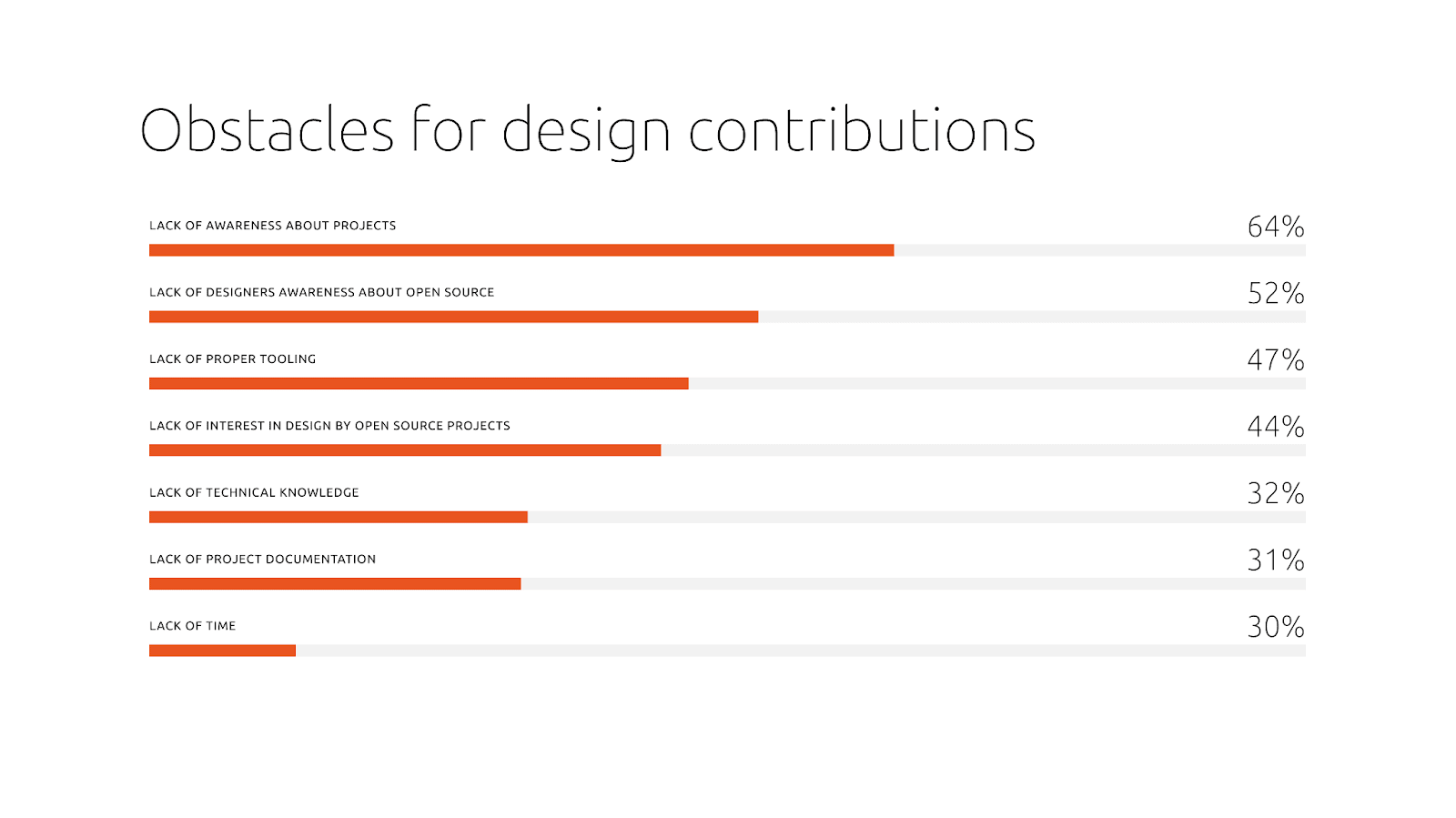
OSS design survey: What prevents you from contributing design to OSS projects?

The challenges receiving the most mention from our respondents were visibility and awareness. Many designers are unfamiliar with OSS so simply do not know where to look for projects. Even those who are familiar with open source still struggle to find projects that welcome non-code contributions.

A major factor contributing to this issue is confidence. While project maintainers are experienced in requesting code contributions, many admit they are less confident about requesting design work. Some are unsure how to structure the design contribution request or effectively engage with creative communities.

Initiatives like Open Source Design and Contribute.design are doing an excellent job of curating design-related contribution requests. However, there is still a lot that can be done to increase OSS awareness among designers, and to help maintainers use these platforms effectively.

2. Onboarding and documentation don’t support designers

Many OSS projects lack clear documentation for design contributions. While they often feature robust onboarding materials for developers, there is typically little to no guidance for designers.

This gap is partly due to a lack of design awareness among maintainers. 53% of those surveyed admitted they don’t understand how design fits into their project, leaving them struggling to document a design contribution workflow.

Without this infrastructure, designers lack critical project context. They may not know the target audience, scope of work, brand guidelines, or technical constraints. This makes starting a project stressful, and many give up before making their first meaningful contribution.

However, some communities are successfully tackling this issue. Projects like Bitcoin Design and Layer5 attract and retain non-code contributors by implementing proactive strategies like:

  • Publishing dedicated “Get Started” guides for designers.
  • Establishing structured mentorship systems for new contributors.
  • Hosting regular AMA (Ask Me Anything) sessions and community syncs.
  • Maintaining transparent design documentation logs.
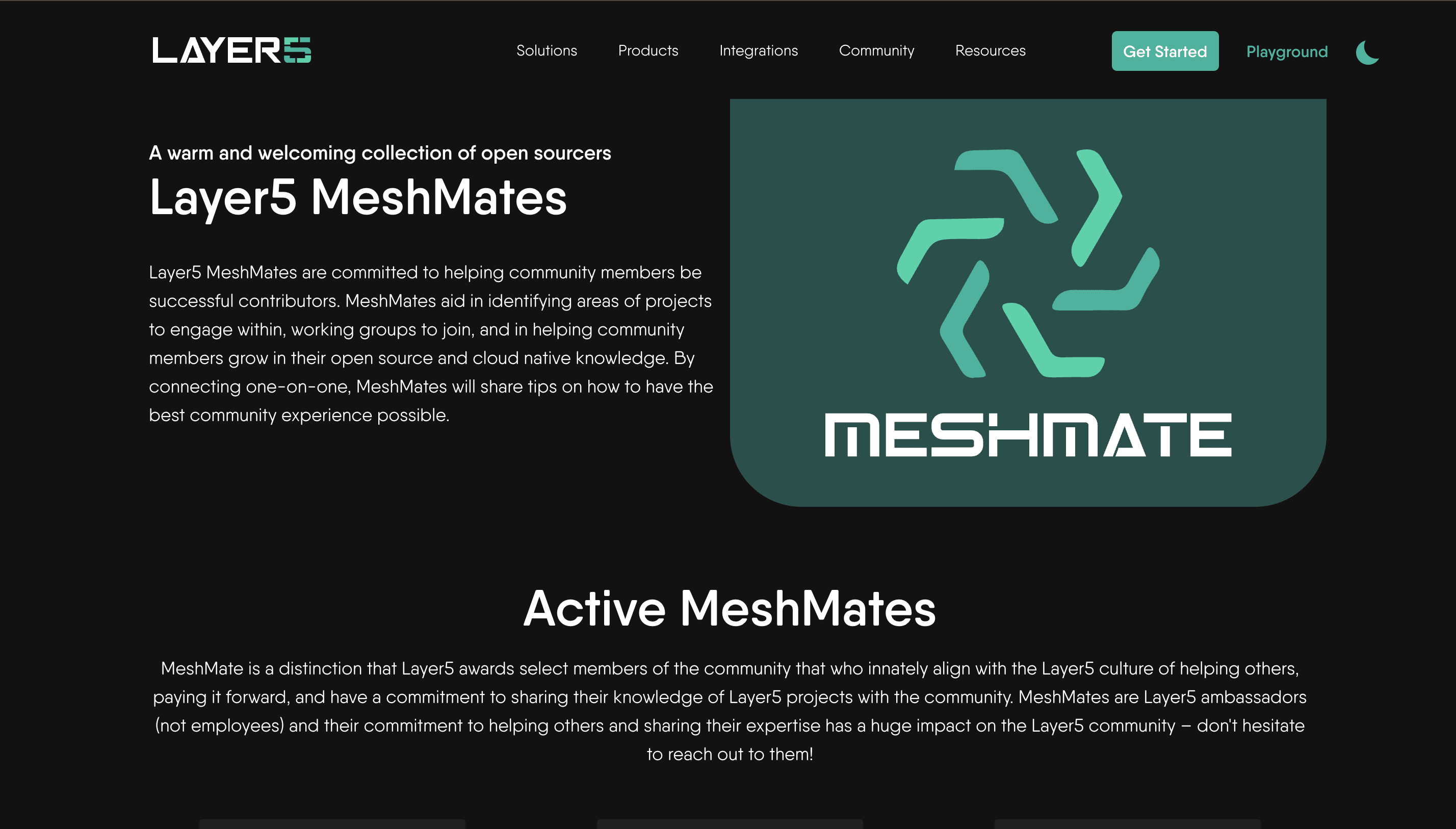
Layer 5’ mentorship program for new contributors

This lowers the barrier to entry and creates a genuinely welcoming environment. At Canonical, we have created a contribution brief template to give maintainers a clear framework for the information designers might need before they begin contributing.

3. Contribution platforms have steep learning curves

Open source collaboration primarily happens on Git-based platforms like GitHub, GitLab and Launchpad. While these tools are second nature to developers, they are rarely used by designers. New OSS designers frequently find it difficult to navigate issues, pull requests, repositories, and version control workflows. 

The technical nature of these platforms acts as a significant barrier that might deter talented visual and UX contributors from getting involved.

This is another area where better onboarding materials make a massive difference. Beginner-friendly guides can demystify these platforms and simplify workflow setup. At Canonical, we have started addressing this hurdle by creating educational resources, like our recent “Getting Started with GitHub” video tutorial.

4. Designers face more pushback on non-visual contributions

One of the more surprising findings was that designers face significantly more friction when making non-visual contributions. Over the last decade, digital design has matured from just traditional “visual work” into research, product strategy, information architecture, specification writing, accessibility audits, and more. 

However, designers reported getting a lot more pushback when trying to contribute in these non-visual areas. They frequently have to spend extra time justifying methods and defending fundamental UX decisions to maintainers. 

OSS communities can address this by educating maintainers on the holistic role of design in software development. Additionally, maintainers can provide guidelines on how they review and accept non-code contributions. This transforms feedback into a more objective, structured, and transparent process.

The path forward

Overcoming these barriers requires a collaborative effort from both designers and OSS maintainers:

  • Designers can bring immense value to OSS projects by improving accessibility and usability, but need to remain patient with an evolving ecosystem. 
  • Maintainers need to find clearer ways to signal openings for design, improve non-code onboarding, and formally recognize the value non-code contributors bring.

Fortunately, pioneering communities are already proving that design-friendly onboarding, structured documentation, and active mentorship works. By adopting these strategies, more OSS projects can attract and retain design talent, ultimately making open source software more inclusive, user-friendly, and widely adopted.

Keep an eye on our blog for the full research report, dropping in the coming weeks!


Join the Canonical design team

We’re looking for designers who care about craft and how systems work under the hood. At Canonical, design sits at the intersection of UX, engineering, and open source where we shape cohesive, accessible experiences across cloud, desktop, and IoT products.

If you enjoy solving complex problems and turning technical depth into clarity, explore our open roles: canonical.com/careers

Related posts


Template: Streamlining open source design contributions

Design Ubuntu tech blog

As designers working at Canonical, we’re always thinking about open source. We believe that encouraging more designers to contribute to open source  benefits everyone, from the project maintainers to the end users themselves.   In the 2025 edition of FOSSBackstage conference, we presented our research findings on  why designers don’t get ...


Decoding design: How design and engineering thrive together in open source

Design Ubuntu tech blog

Open source thrives on engineering-driven processes. Fast feedback loops, terminal tools, Git workflows: they’re the lifeblood of how we build software in the open. But for software to truly excel, we need to create user experiences that empower people to use them. I wanted to bring this conversation into the spotlight as part of Canonica ...