
惯性聚合 高效追踪和阅读你感兴趣的博客、新闻、科技资讯
阅读原文 在惯性聚合中打开

推荐订阅源

U
Unit 42
GbyAI
GbyAI
人人都是产品经理
人人都是产品经理
T
Tor Project blog
Google DeepMind News
The Register - Security
爱范儿
爱范儿
雷峰网
雷峰网
MongoDB | Blog
MongoDB | Blog
Vercel News
Vercel News
美团技术团队
博客园 - 三生石上(FineUI控件)
D
DataBreaches.Net
L
LangChain Blog
IT之家
IT之家
博客园_首页
Cyber Security Advisories - MS-ISAC
Last Week in AI
Last Week in AI
博客园 - 【当耐特】
T
Tailwind CSS Blog
M
MIT News - Artificial intelligence
P
Proofpoint News Feed
Hacker News: Ask HN
Hacker News: Ask HN
Threat Intelligence Blog | Flashpoint
量子位
Project Zero
Project Zero
钛媒体:引领未来商业与生活新知
钛媒体:引领未来商业与生活新知
博客园 - 聂微东
T
Tenable Blog
aimingoo的专栏
aimingoo的专栏
P
Proofpoint News Feed
T
Threat Research - Cisco Blogs
D
Darknet – Hacking Tools, Hacker News & Cyber Security
Cyberwarzone
Cyberwarzone
C
CERT Recently Published Vulnerability Notes
Microsoft Azure Blog
让小产品的独立变现更简单 - ezindie.com
博客园 - 叶小钗
Know Your Adversary
Know Your Adversary
L
Lohrmann on Cybersecurity
C
Cisco Blogs
cs.AI updates on arXiv.org
Schneier on Security
I
InfoQ
P
Privacy & Cybersecurity Law Blog
Spread Privacy
Spread Privacy
Martin Fowler
Martin Fowler
腾讯CDC
S
Security @ Cisco Blogs
F
Fortinet All Blogs

Blog

Canonical announces the Enterprise Store as part of Ubuntu Pro | Canonical Tracing a memory leak bug in PID 1 and contributing an upstream fix: a Linux support story | Canonical MAAS installation: bare metal provisioning is easier than ever | Canonical Januscape vulnerability CVE-2026-53359 mitigations available | Canonical Managing Ubuntu on bare metal at scale | Canonical Ubuntu Server: a platform made for enterprise scale | Canonical Building an open source chain of trust: new research uncovers key blockers and ways forward | Canonical Beyond safety and security: Why automotive open source demands dependability  | Canonical DirtyClone Linux kernel local privilege escalation vulnerability fixes available | Canonical pedit COW kernel local privilege escalation vulnerability mitigations | Canonical Canonical becomes Gold Sponsor of Trifecta Tech Foundation | Canonical Challenges designers face in open source (and how to fix them) | Canonical Hunting a 16-year-old SQLite bug with TLA+: is dqlite affected? | Canonical Anbox Cloud on C4A metal: Android, at scale, without friction | Canonical Canonical announces live kernel patching for Arm64 | Canonical How to use RISC-V custom instructions with Ubuntu | Canonical Ubuntu Summit 26.04: connected by open source | Canonical So you need to add microcontrollers to your fleet: now what? | Canonical Validating real-world skills through Canonical Academy | Canonical Virtualized Android comes to Anbox Cloud | Canonical Template: Streamlining open source design contributions | Canonical Beyond Mythos: responding to a new threat landscape | Canonical A look into Ubuntu Core 26: Building a local AI inference appliance in a virtual machine | Canonical This year we celebrate a decade of Ubuntu Server support on the s390x architecture: marking a long-standing collaboration between Canonical and IBM that began at LinuxCon 2015. The first release happened on April 21, 2016, bringing Ubuntu 16.04 LTS (Xenial Xerus) to IBM Z and IBM LinuxONE platforms.  A first for Ubuntu on IBM That […] AI at the edge: simplifying infrastructure with Cisco and Canonical | Canonical The next era of telco clouds: get open infrastructure choice with Sylva and Canonical Kubernetes | Canonical What is RDMA over Converged Ethernet (RoCE)? | Canonical Beyond tokens per watt – using Ubuntu 26.04 LTS for AI Beyond tokens per watt – using Ubuntu 26.04 LTS for AI | Canonical A look into Ubuntu Core 26: Deploying AI models on Renesas RZ/V series for production | Canonical RISC-V profiles – why is RVA23 significant? | Canonical AI with AMD ROCm on Ubuntu: your questions answered | Canonical When distributed workloads stall because nodes cannot exchange small messages quickly and consistently, the network is the limiting factor. How do you solve that problem? InfiniBand offers one solution. InfiniBand is an interconnect, meaning the end-to-end communication system that links compute, storage, and accelerator nodes. It is impl […] Microsoft has announced the preview of Azure Cobalt 200, its second-generation custom Arm silicon. Learn how Ubuntu and Ubuntu Pro support these new VMs from day one, offering seamless deployment, long-term security maintenance, and Kernel Livepatch without requiring engineering or platform changes […] How Canonical Support solves hard Linux performance bugs  – even in 12-year old code | Canonical Securing AI agent workflows on Ubuntu with the new NVIDIA OpenShell snap | Canonical Canonical announces optimized Ubuntu images for TPU virtual machines by Google Cloud | Canonical VMware hypervisor deployment using MAAS | Canonical Migrating from Apache Spark 3 to Spark 4 | Canonical Introducing Workshop: launch sandboxed development environments on Ubuntu with a single command | Canonical Run agentic workloads on Arm and Ubuntu | Canonical Decoding design: How design and engineering thrive together in open source | Canonical Developing web apps with local LLM inference | Canonical A local privilege escalation (LPE) security vulnerability in the Linux kernel, codename “PinTheft,” was publicly disclosed on May 19, 2026. The vulnerability was fixed in the mainline Linux kernel tree. A proof-of-concept exploit was published along with public disclosure. This has been assigned the CVE ID CVE-2026-43494; other discoverin […] Canonical has announced the general availability of Managed Kubeflow on the Microsoft Azure Marketplace. This fully managed MLOps platform allows enterprise AI teams to deploy a production-ready environment in under an hour, eliminating infrastructure maintenance. […] A look into Ubuntu Core 26: Cloud-powered edge computing with AWS IoT Greengrass and Azure IoT Edge | Canonical CVE-2026-46333 (ssh-keysign-pwn) Linux kernel vulnerability mitigations | Canonical Finding the blind spot: How Canonical hunts logic flaws with AI | Canonical A local privilege escalation (LPE) vulnerability affecting the Linux kernel has been publicly disclosed on May 13, 2026. The vulnerability does not have a CVE ID published, but is referred to as “Fragnesia.” The vulnerability affects multiple Linux distributions, including all Ubuntu releases. The affected components are the Linux kernel […] Rethinking BYOD security: protecting data without trusting devices | Canonical Two local privilege escalation (LPE) vulnerabilities affecting the Linux kernel have been publicly disclosed on May 7, 2026. The vulnerabilities have been assigned the IDs CVE-2026-43284 and CVE-2026-43500 and are referred to as “Dirty Frag.” The affected components are Linux kernel modules. The first vulnerability impacts the modules tha […] Three weeks to go: A sneak peek of the Ubuntu Summit 26.04 experience | Canonical How to use Ubuntu on Windows | Canonical A local privilege escalation (LPE) vulnerability affecting the Linux kernel has been publicly disclosed on April 29, 2026. The vulnerability has been assigned CVE ID CVE-2026-31431 and is referred to as Copy Fail. The affected component is a kernel module that provides hardware-accelerated cryptographic functions: algif_aead. The vulnerab […] Run NVIDIA Nemotron 3 Nano Omni locally in a single command | Canonical Why Web Engineering is great | Canonical Ubuntu 16.04 LTS (Xenial Xerus) reached the end of its five-year Expanded Security Maintenance (ESM) window in April 2026. If you are still running 16.04, it is critical to address your support status to ensure continued security and compliance. Your support options Now that 16.04 is in its Legacy phase, you have two primary paths: […] Understanding disaggregated GenAI model serving with llm-d | Canonical From Jammy to Resolute: how Ubuntu’s toolchains have evolved | Canonical Hybrid search and reranking: a deeper look at RAG | Canonical In this article, Keirthana TS, a Senior Technical Author at Canonical, breaks down what leadership means to her and how she understood the power of intentional leadership through her journey at Canonical. […] Ubuntu Pro comes to Nutanix bare-metal Kubernetes | Canonical RISC-V 101 – what is it and what does it mean for Canonical? | Canonical Ubuntu Summit 26.04 is coming: Save the date and share your story! | Canonical How to manage Ubuntu fleets using on-premises Active Directory and ADSys | Canonical Simplify bare metal operations for sovereign clouds | Canonical How to Harden Ubuntu SSH: From static keys to cloud identity | Canonical The “scanner report has to be green” trap | Canonical Modern Linux identity management: from local auth to the cloud with Ubuntu | Canonical Canonical welcomes NVIDIA’s donation of the GPU DRA driver to CNCF | Canonical Hot code burns: the supply chain case for letting your containers cool before you ship | Canonical
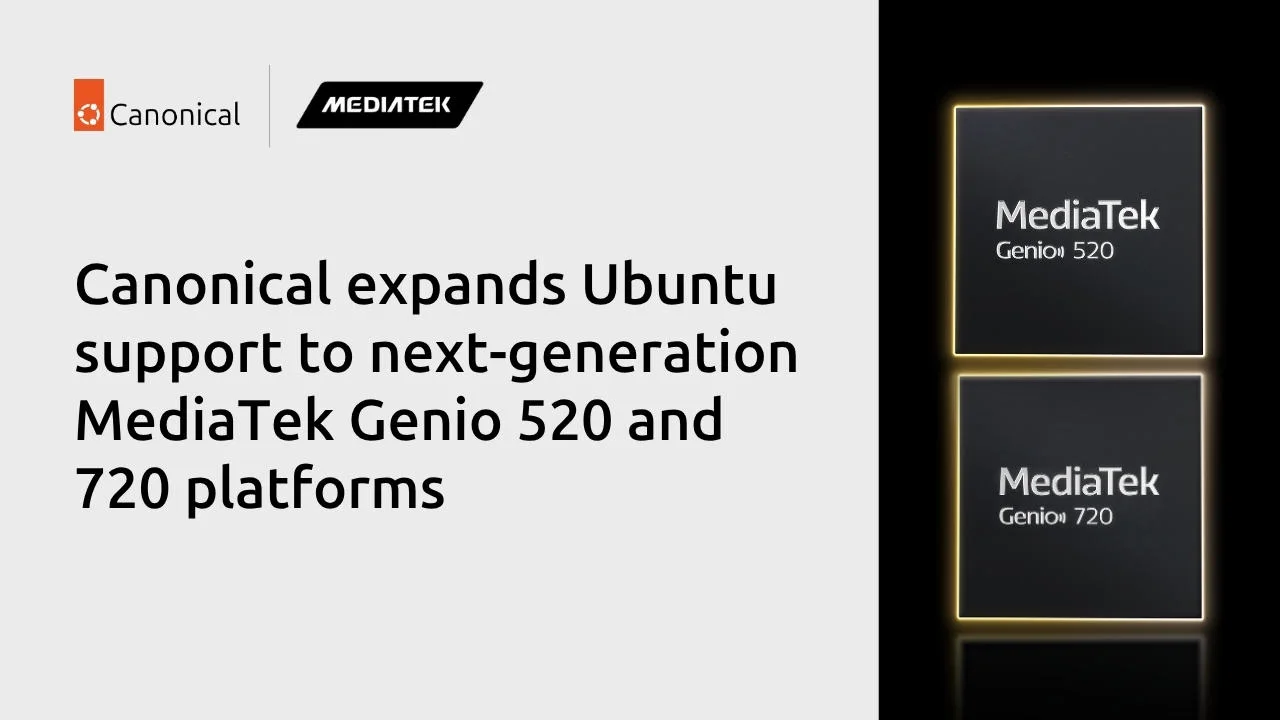
Canonical expands Ubuntu support to next-generation MediaTek Genio 520 and 720 platforms | Canonical
Canonical (C · 2026-04-20 · via Blog

Canonical is pleased to announce the early access launch of Ubuntu 24.04 LTS for MediaTek’s Genio IoT platforms. Building on the companies’ strategic partnership, this release introduces optimized Ubuntu images for the brand-new Genio 520 and 720, while continuing to provide robust support for the Genio 350, 510, 700, and 1200. 

The collaboration makes it easy for developers to combine the latest advancements in open source software with the latest MediaTek hardware to power modern edge AI workloads. Organizations can get to market faster with the new Genio platforms by utilizing an optimized OS that delivers full feature support out of the box, and simultaneously benefit from enterprise-grade security and compliance.

This Ubuntu image is open to the public and anyone will be able to download and flash the image on MediaTek’s Genio development kits by following instructions available on ubuntu.com

Powering the next generation: MediaTek Genio 520 and 720

The addition of the MediaTek Genio 520 and 720 provides developers with highly efficient mid-range and high-performance platforms tailored for demanding AI-edge environments. Genio 520 is optimized for power-efficient IoT applications, offering enhanced processing for smart home hubs, interactive kiosks, and industrial gateways. Genio 720 targets advanced multimedia and on-device AI workloads featuring improved NPU performance for advanced robotics, medical imaging, and smart retail analytics. 

“By bringing Ubuntu support to the MediaTek Genio 520 and 720 platforms, developers will now have access to a mature, open, and developer-friendly ecosystem,” said CK Wang, General Manager of MediaTek’s IoT Business Unit. “Ubuntu’s long‑term maintenance and edge‑optimized capabilities make it an ideal platform for building next‑generation industrial, robotics, and smart‑device solutions.”

“The addition of the new Genio 520 and 720 platforms underscores Canonical’s continued collaboration with MediaTek to expand choice and innovation at the edge,” said Cindy Goldberg, Vice President of Cloud and Silicon Partnerships at Canonical. “By combining MediaTek’s advanced AI‑edge silicon with Ubuntu’s enterprise‑grade manageability and lifecycle support, enterprises can confidently deploy and scale IoT solutions globally.”

Accelerating the journey from prototype to production

This collaboration is designed to help developers and enterprises reduce time to market and improve return on investment. By using a widely adopted, full-featured OS with integrated libraries that work out of the box, teams can move rapidly from initial prototyping to global production. Access to the Canonical ecosystem allows for faster scaling thanks to an enabled ecosystem of OEM/ODMs and professional services that support commercial deployments. Additionally, Ubuntu 24.04 LTS images are specifically optimized for MediaTek Genio platforms, ensuring that developers can get the most out of MediaTek’s silicon from day one.

Enterprise-grade security and the path towards CRA compliance

With Ubuntu, developers gain access to an enterprise-ready operating system that is built to help streamline compliance with evolving cybersecurity standards such as the EU Cyber Resilience Act (CRA). Canonical’s recent decision to extend Ubuntu LTS coverage from 12 years to 15 years reinforces the company’s long term commitment to deliver timely fixes for critical vulnerabilities, ensuring customers can rely on Ubuntu as a trusted, securely designed foundation for their products.

Together with MediaTek and Advantech, Canonical is making it easier for organizations to comply with CRA requirements. The companies recently announced that Advantech’s first Arm-based industrial single board computer, the RSB‑3810, powered by the MediaTek Genio 1200 platform and running Ubuntu Pro, has achieved IEC 62443‑4‑2 certification, one of the key standards recognized under the CRA. This collaboration highlights Ubuntu’s role as the preferred platform for vendors seeking to meet stringent CRA requirements and build certified, secure industrial devices.

A trusted foundation for commercial IoT projects

Canonical partners with silicon vendors, board manufacturers, and leading enterprises to shorten time to market. Organizations looking to deploy Ubuntu on MediaTek Genio can access ongoing bug fixes, security maintenance, and fast tracked compliance.

For any questions about the platform or further information about Canonical’s certification program, [contact us].

About Canonical

Canonical, the publisher of Ubuntu, provides open source security, support and services. Our portfolio covers critical systems, from the smallest devices to the largest clouds, from the kernel to containers, from databases to AI. With customers that include top tech brands, emerging startups, governments and home users, Canonical delivers trusted open source for everyone. 

Learn more at https://canonical.com/ 

Related posts


Fast-tracking industrial and AI deployment on Renesas RZ platforms 

Canonical announcements Article

Certified Ubuntu 24.04 LTS images now available Canonical is pleased to announce the general availability (GA) of certified Ubuntu 24.04 LTS and Ubuntu Core 24 images for the Renesas RZ/G2L and RZ/G2LC 64-bit microprocessors (MPUs) platforms. With a production-ready Ubuntu version, users can benefit from enterprise-grade security, long-te ...


Ubuntu Summit 26.04 is coming: Save the date and share your story!

Ubuntu Article

Following the incredible success of Ubuntu Summit 25.10, we are thrilled to announce that Ubuntu Summit 26.04 is officially on the horizon. If you are new to the Ubuntu community, every new release of Ubuntu comes with an Ubuntu Summit – an event that takes place twice a year and serves as a showcase of ...


How to manage Ubuntu fleets using on-premises Active Directory and ADSys

Cloud and server Article

The “hybrid fleet” is today’s reality: organizations diversify operating systems while Microsoft Active Directory (AD) remains the dominant identity “source of truth.” IT administrators must ensure Linux machines, like Ubuntu desktops and servers, behave as first-class citizens in this environment. Efficient Linux management demands unifi ...