



惯性聚合 高效追踪和阅读你感兴趣的博客、新闻、科技资讯
阅读原文 在惯性聚合中打开

推荐订阅源

Stack Overflow Blog
Stack Overflow Blog
V2EX - 技术
V2EX - 技术
Microsoft Azure Blog
I
InfoQ
Blog — PlanetScale
Blog — PlanetScale
MyScale Blog
MyScale Blog
The Register - Security
Threat Intelligence Blog | Flashpoint
CTFtime.org: upcoming CTF events
Y
Y Combinator Blog
N
News and Events Feed by Topic
SecWiki News
SecWiki News
U
Unit 42
T
Threat Research - Cisco Blogs
TaoSecurity Blog
TaoSecurity Blog
Webroot Blog
Webroot Blog
GbyAI
GbyAI
C
Cyber Attacks, Cyber Crime and Cyber Security
V
Vulnerabilities – Threatpost
Vercel News
Vercel News
A
About on SuperTechFans
P
Proofpoint News Feed
F
Fortinet All Blogs
T
The Blog of Author Tim Ferriss
M
MIT News - Artificial intelligence
H
Hackread – Cybersecurity News, Data Breaches, AI and More
H
Hacker News: Front Page
云风的 BLOG
云风的 BLOG
Schneier on Security
阮一峰的网络日志
阮一峰的网络日志
H
Help Net Security
T
The Exploit Database - CXSecurity.com
K
Kaspersky official blog
Security Archives - TechRepublic
P
Palo Alto Networks Blog
Help Net Security
Help Net Security
cs.AI updates on arXiv.org
MongoDB | Blog
MongoDB | Blog
Jina AI
Jina AI
L
LangChain Blog
博客园 - 三生石上(FineUI控件)
爱范儿
爱范儿
The GitHub Blog
The GitHub Blog
aimingoo的专栏
aimingoo的专栏
Project Zero
Project Zero
Engineering at Meta
Engineering at Meta
S
Schneier on Security
C
CXSECURITY Database RSS Feed - CXSecurity.com
B
Blog RSS Feed
Cyber Security Advisories - MS-ISAC

Blog

Tracing a memory leak bug in PID 1 and contributing an upstream fix: a Linux support story | Canonical MAAS installation: bare metal provisioning is easier than ever | Canonical Januscape vulnerability CVE-2026-53359 mitigations available | Canonical Managing Ubuntu on bare metal at scale | Canonical Ubuntu Server: a platform made for enterprise scale | Canonical Building an open source chain of trust: new research uncovers key blockers and ways forward | Canonical Beyond safety and security: Why automotive open source demands dependability  | Canonical DirtyClone Linux kernel local privilege escalation vulnerability fixes available | Canonical pedit COW kernel local privilege escalation vulnerability mitigations | Canonical Canonical becomes Gold Sponsor of Trifecta Tech Foundation | Canonical Challenges designers face in open source (and how to fix them) | Canonical Hunting a 16-year-old SQLite bug with TLA+: is dqlite affected? | Canonical Anbox Cloud on C4A metal: Android, at scale, without friction | Canonical Canonical announces live kernel patching for Arm64 | Canonical How to use RISC-V custom instructions with Ubuntu | Canonical Ubuntu Summit 26.04: connected by open source | Canonical So you need to add microcontrollers to your fleet: now what? | Canonical Validating real-world skills through Canonical Academy | Canonical Virtualized Android comes to Anbox Cloud | Canonical Template: Streamlining open source design contributions | Canonical Beyond Mythos: responding to a new threat landscape | Canonical A look into Ubuntu Core 26: Building a local AI inference appliance in a virtual machine | Canonical This year we celebrate a decade of Ubuntu Server support on the s390x architecture: marking a long-standing collaboration between Canonical and IBM that began at LinuxCon 2015. The first release happened on April 21, 2016, bringing Ubuntu 16.04 LTS (Xenial Xerus) to IBM Z and IBM LinuxONE platforms.  A first for Ubuntu on IBM That […] AI at the edge: simplifying infrastructure with Cisco and Canonical | Canonical The next era of telco clouds: get open infrastructure choice with Sylva and Canonical Kubernetes | Canonical What is RDMA over Converged Ethernet (RoCE)? | Canonical Beyond tokens per watt – using Ubuntu 26.04 LTS for AI Beyond tokens per watt – using Ubuntu 26.04 LTS for AI | Canonical A look into Ubuntu Core 26: Deploying AI models on Renesas RZ/V series for production | Canonical RISC-V profiles – why is RVA23 significant? | Canonical AI with AMD ROCm on Ubuntu: your questions answered | Canonical When distributed workloads stall because nodes cannot exchange small messages quickly and consistently, the network is the limiting factor. How do you solve that problem? InfiniBand offers one solution. InfiniBand is an interconnect, meaning the end-to-end communication system that links compute, storage, and accelerator nodes. It is impl […] Microsoft has announced the preview of Azure Cobalt 200, its second-generation custom Arm silicon. Learn how Ubuntu and Ubuntu Pro support these new VMs from day one, offering seamless deployment, long-term security maintenance, and Kernel Livepatch without requiring engineering or platform changes […] How Canonical Support solves hard Linux performance bugs  – even in 12-year old code | Canonical Securing AI agent workflows on Ubuntu with the new NVIDIA OpenShell snap | Canonical Canonical announces optimized Ubuntu images for TPU virtual machines by Google Cloud | Canonical VMware hypervisor deployment using MAAS | Canonical Migrating from Apache Spark 3 to Spark 4 | Canonical Introducing Workshop: launch sandboxed development environments on Ubuntu with a single command | Canonical Run agentic workloads on Arm and Ubuntu | Canonical Decoding design: How design and engineering thrive together in open source | Canonical Developing web apps with local LLM inference | Canonical A local privilege escalation (LPE) security vulnerability in the Linux kernel, codename “PinTheft,” was publicly disclosed on May 19, 2026. The vulnerability was fixed in the mainline Linux kernel tree. A proof-of-concept exploit was published along with public disclosure. This has been assigned the CVE ID CVE-2026-43494; other discoverin […] Canonical has announced the general availability of Managed Kubeflow on the Microsoft Azure Marketplace. This fully managed MLOps platform allows enterprise AI teams to deploy a production-ready environment in under an hour, eliminating infrastructure maintenance. […] A look into Ubuntu Core 26: Cloud-powered edge computing with AWS IoT Greengrass and Azure IoT Edge | Canonical CVE-2026-46333 (ssh-keysign-pwn) Linux kernel vulnerability mitigations | Canonical Finding the blind spot: How Canonical hunts logic flaws with AI | Canonical A local privilege escalation (LPE) vulnerability affecting the Linux kernel has been publicly disclosed on May 13, 2026. The vulnerability does not have a CVE ID published, but is referred to as “Fragnesia.” The vulnerability affects multiple Linux distributions, including all Ubuntu releases. The affected components are the Linux kernel […] Rethinking BYOD security: protecting data without trusting devices | Canonical Two local privilege escalation (LPE) vulnerabilities affecting the Linux kernel have been publicly disclosed on May 7, 2026. The vulnerabilities have been assigned the IDs CVE-2026-43284 and CVE-2026-43500 and are referred to as “Dirty Frag.” The affected components are Linux kernel modules. The first vulnerability impacts the modules tha […] Three weeks to go: A sneak peek of the Ubuntu Summit 26.04 experience | Canonical How to use Ubuntu on Windows | Canonical A local privilege escalation (LPE) vulnerability affecting the Linux kernel has been publicly disclosed on April 29, 2026. The vulnerability has been assigned CVE ID CVE-2026-31431 and is referred to as Copy Fail. The affected component is a kernel module that provides hardware-accelerated cryptographic functions: algif_aead. The vulnerab […] Run NVIDIA Nemotron 3 Nano Omni locally in a single command | Canonical Why Web Engineering is great | Canonical Ubuntu 16.04 LTS (Xenial Xerus) reached the end of its five-year Expanded Security Maintenance (ESM) window in April 2026. If you are still running 16.04, it is critical to address your support status to ensure continued security and compliance. Your support options Now that 16.04 is in its Legacy phase, you have two primary paths: […] Understanding disaggregated GenAI model serving with llm-d | Canonical From Jammy to Resolute: how Ubuntu’s toolchains have evolved | Canonical Hybrid search and reranking: a deeper look at RAG | Canonical Canonical expands Ubuntu support to next-generation MediaTek Genio 520 and 720 platforms | Canonical Ubuntu Pro comes to Nutanix bare-metal Kubernetes | Canonical RISC-V 101 – what is it and what does it mean for Canonical? | Canonical Ubuntu Summit 26.04 is coming: Save the date and share your story! | Canonical How to manage Ubuntu fleets using on-premises Active Directory and ADSys | Canonical Simplify bare metal operations for sovereign clouds | Canonical How to Harden Ubuntu SSH: From static keys to cloud identity | Canonical The “scanner report has to be green” trap | Canonical Modern Linux identity management: from local auth to the cloud with Ubuntu | Canonical Canonical welcomes NVIDIA’s donation of the GPU DRA driver to CNCF | Canonical Hot code burns: the supply chain case for letting your containers cool before you ship | Canonical
In this article, Keirthana TS, a Senior Technical Author at Canonical, breaks down what leadership means to her and how she understood the power of intentional leadership through her journey at Canonical. […]
Keirthana T S (Keirthana T S) · 2026-04-09 · via Blog

In this article, Keirthana TS, a Senior Technical Author at Canonical, breaks down what leadership means to her and how she understood the power of intentional leadership through her journey at Canonical.

My colleague, Maksim Beliaev, recently wrote about our hiring principles. In this article, I want to build on his points by talking more about what leadership means at Canonical, and how the different kinds of leadership roles complement each other.

Setting expectations right

My journey at Canonical taught me that leadership is not earned just by tenure. It is a discipline that can be developed and embodied through intent. What do I mean by this? I’m not saying that Canonical doesn’t have specialized leadership or management positions: we do, and they play a vital role. What I mean is that there is nothing holding individuals back from being leaders in their own domains, and having a positive impact on others. In fact, this is actively encouraged, and it is what I call intentional leadership.

Career progression at Canonical is based on our leveling framework, which groups contributors into specialists, seniors, and managers. In each of these tracks, there is scope to lead and be impactful: through technical depth (for specialists), driving people to achieve outcomes (senior), and shaping and steering organizational plans (manager). The question is: what brings out the spark in you? And what happens when these different leadership types exist in the same team dynamic?

Understanding and identifying the right role

Which of the three roles was right for me? Well, it took me some time to understand. When I first became a Senior Technical Author, I thought about it just in terms of how the role was defined for me and what others expected of me. 

As I worked towards my aspiration, I realized that I should also look inward: I needed to be deliberate with my intent, and reflect on what change I wanted to bring about in my team and how I could work with other leaders in the team. So I set about observing the different leadership dynamics within Canonical. As I learnt the basics, I was curious how these roles would compete with each other for influence. I want to share a couple of experiences that piqued my curiosity. 

Accelerating efficiency: when Seniors and Specialists lead together

I’ve noticed a consistent “compounding effect” on team output that only happens when a Senior and a Specialist work together. Think of it as a bridge: the Senior builds the structure and ensures the path is clear, while the Specialist paves the road and guides the traffic.

Take our recent push to overhaul documentation analytics. We had a tight six-month window to hit our SEO targets. This required leadership on two fronts:

A Senior’s strategic leadership
I focused on the “macro” environment. My role was to advocate for the team’s needs, standardize tool access, and build a foundational knowledge base. By leveling the playing field, I ensured no team member was left behind by technical barriers or a lack of context.

A Specialist’s technical leadership
While I provided the infrastructure, the Specialists became the “boots on the ground” leaders. They translated high-level marketing goals into “day-one” workflows, clearing technical ambiguities and demonstrating exactly how SEO best practices looked in practice.

I provided the macro environment and bootstrapping and the Specialist provided precision. Neither of us could have reached the objective alone; it was the overlap of our distinct leadership styles that turned a daunting goal into a team-wide success.

Influencing team culture: when Managers and Seniors lead together

Let’s take another example. While Seniors and Specialists compound their skills to deliver efficiency, when Manager and Seniors collaborate, it’s about culture. 

I saw this dynamic transform our team culture during a critical shift in our release cycles. We were shipping frequently, but our process was fragile: a “single point of failure” where one person owned everything, from testing to release notes. It wasn’t scalable, and it was high-risk. Fixing this required leadership at two different levels:

A Senior’s operational leadership
I focused on the “how.” I designed a new, robust execution model that moved us away from individual dependency toward team-wide participation. I introduced a team roster and failsafe automation, ensuring every team member gained the hands-on experience needed to ship with confidence. My leadership was about technical resilience and mentoring the team through the transition.

A Manager’s strategic leadership
While I overhauled the internal mechanics, my Manager focused on the “when” and the “why.” He provided the essential timeline that allowed us to implement these changes without missing a single existing commitment. By filtering customer requests and aligning our new capacity with Canonical’s business priorities, he ensured the team wasn’t overwhelmed by the shift.

I led the internal transformation, but my Manager led the external alignment. By leading together, we didn’t just fix a broken process; we matured the team’s culture, proving we could deliver higher quality without sacrificing our promises to the business.

Intentional leadership doesn’t compete, it compounds
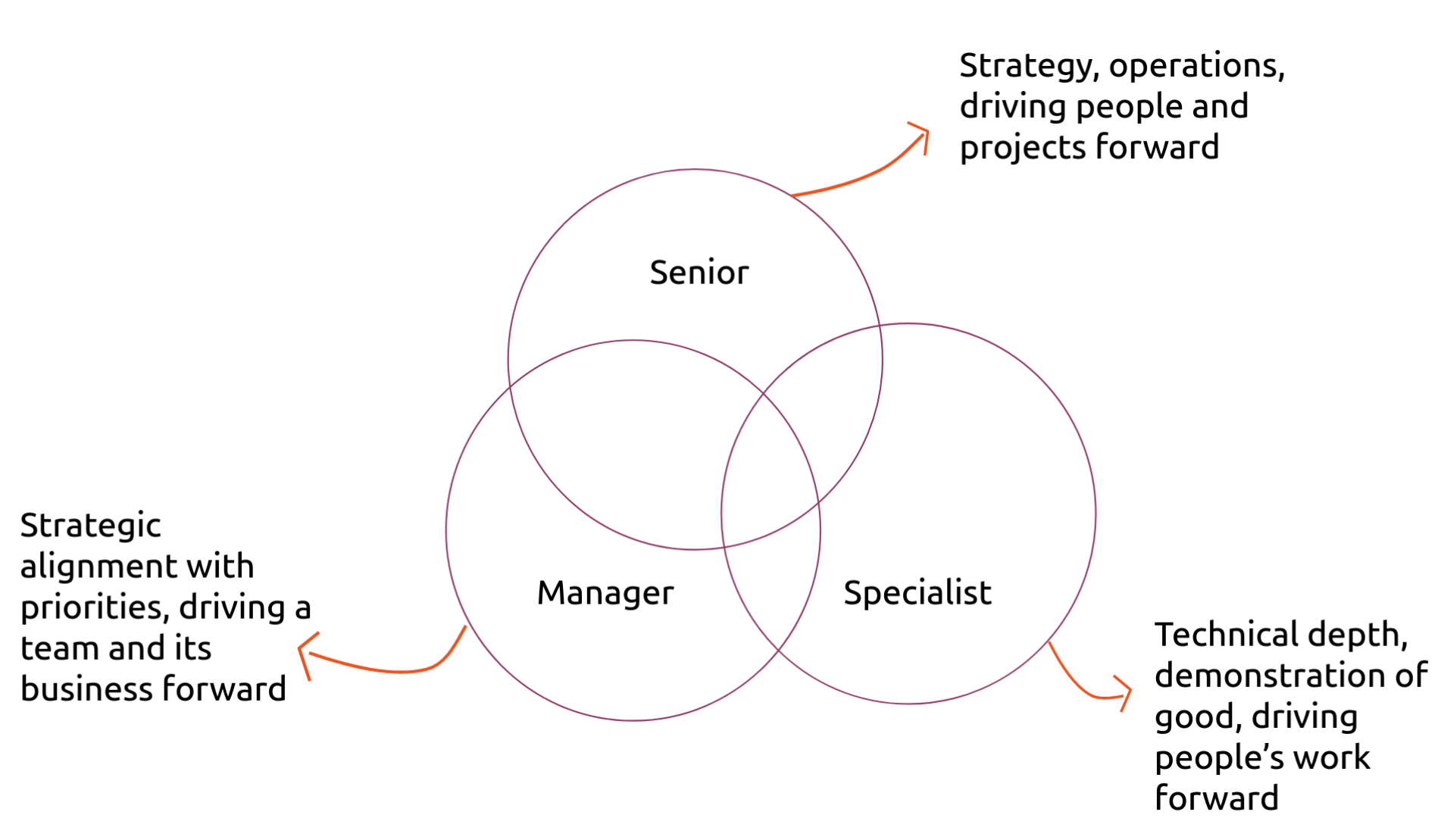
These experiences helped me understand the circle of influence for my role. I realized that having different kinds of leadership roles at Canonical was quite intentional. These roles are not designed to compete for influence, instead to compound it. With that epiphany, I found myself changing the way I work to influence key decisions. I realized that I was being invited to take a seat at the table and demonstrate how to bring about a lasting change, using my strengths, and that has been the most fulfilling part of my journey.

I invite you to try intentional leadership as part of your career aspirations. It removes ambiguity. It replaces hierarchy with purpose. It sends an unmistakable message to professionals aspiring to grow at Canonical:

Leadership is not a title you wait for, but a responsibility you choose.

Further reading

Related posts


How to get a job at Canonical

People and culture Article

If you’re interested in applying for a role at Canonical, it can help to have some insider guidance. This article offers practical advice for candidates and some explanation to provide context. A lot has been written on social media about Canonical and our hiring processes. Some of it is even true. I share responsibility for ...


From product management to engineering leadership: Jon’s career progression at Canonical

Ubuntu Article

Career progression is crucial to employee engagement and retention. Canonical encourages employees to develop their own  personal development journeys, giving them the chance to apply internally for roles they are passionate about even if they come from different technical backgrounds. We have many great examples. Today we will be featuri ...