


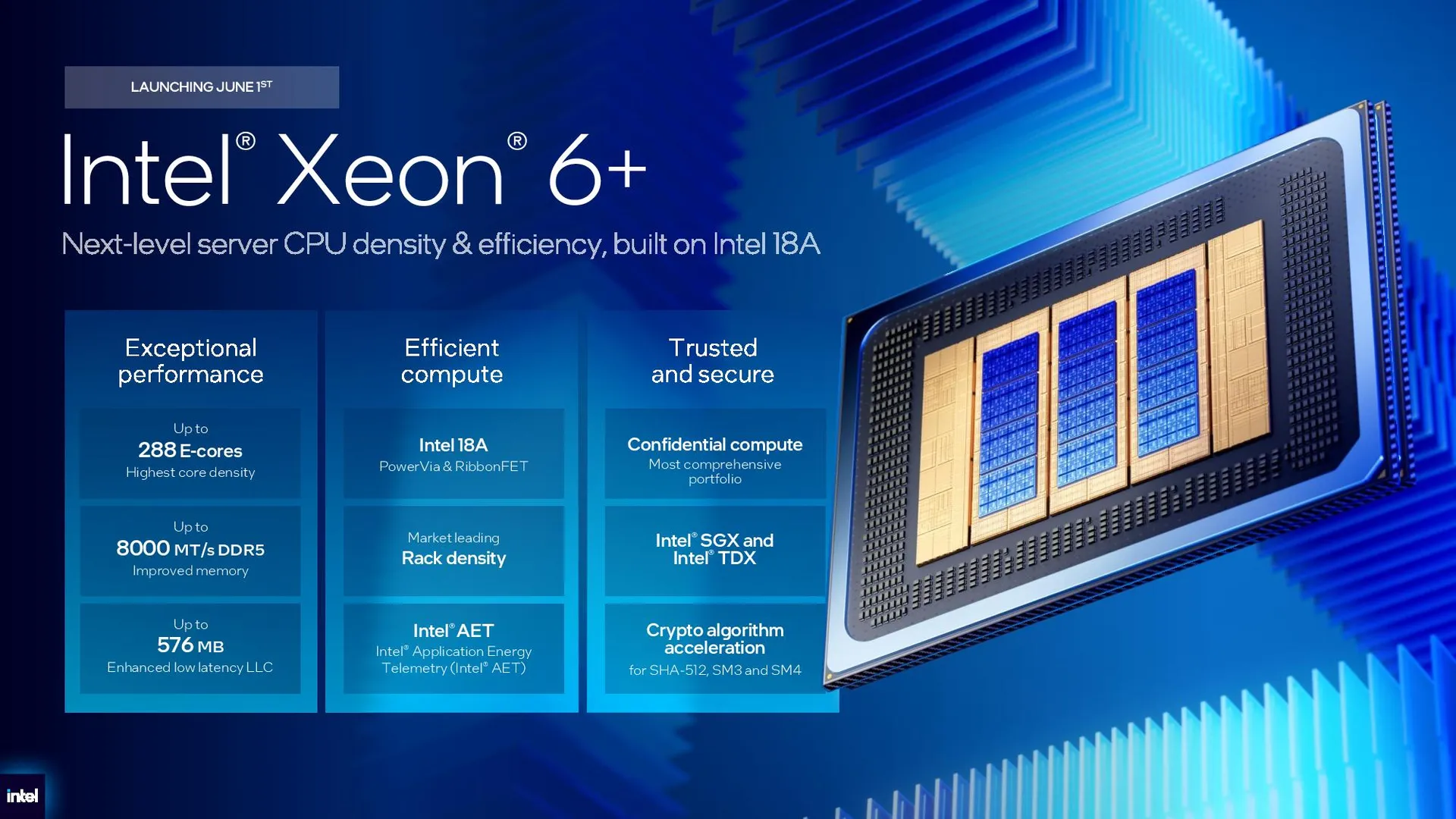
Intel is returning to the data center with Xeon 6+, now harnessing the power of Intel 18A. After revealing Xeon 600 chips for workstations earlier in the year, Intel is turning back to the data center with Xeon 6+, an E-core-only design previously known as Clearwater Forest. The flagship Xeon 6990E+ is designed for compute density, packing in 288 Darkmont cores with 576 MB of L3 cache, with support for dual-socket systems, taking the core count up to 576. Intel claims the 6990E+ delivers an average 30% performance per thread improvement compared to AMD’s 192-core Epyc 9965, as well as up to 30% better power efficiency.
We’ve heard a lot about Clearwater Forest leading up to this launch, including a full architectural deep dive from Intel last year. As a refresher, Xeon 6+ is the culmination of Intel’s disaggregated approach to processor design over the past several generations, using a mixture of nodes and packaging techniques to achieve such high core density. On top of the silicon stack are 12 CPU chiplets built on Intel 18A, each packing 24 Darkmont E-cores without Hyper-Threading. They sit on three base tiles that hold the L3 cache and memory, which are built using Intel 3. Sandwiching this stack are two I/O chiplets built on Intel 7. Bringing the chiplets together are 12 EMIB 2.5D tiles, which are silicon bridges built directly into the substrate.
Outside of the chips, Xeon 6+ chips work with existing Xeon 6 platforms on the LGA 7529 socket (the same as Granite Rapids-AP). Intel supports both single and dual-socket systems, and with support for up to 12 channels of DDR5, running at up to 8000MT/s and 96 lanes of PCIe 5.0 (64 lanes of CXL). Those platform specs are for a single-socket system.
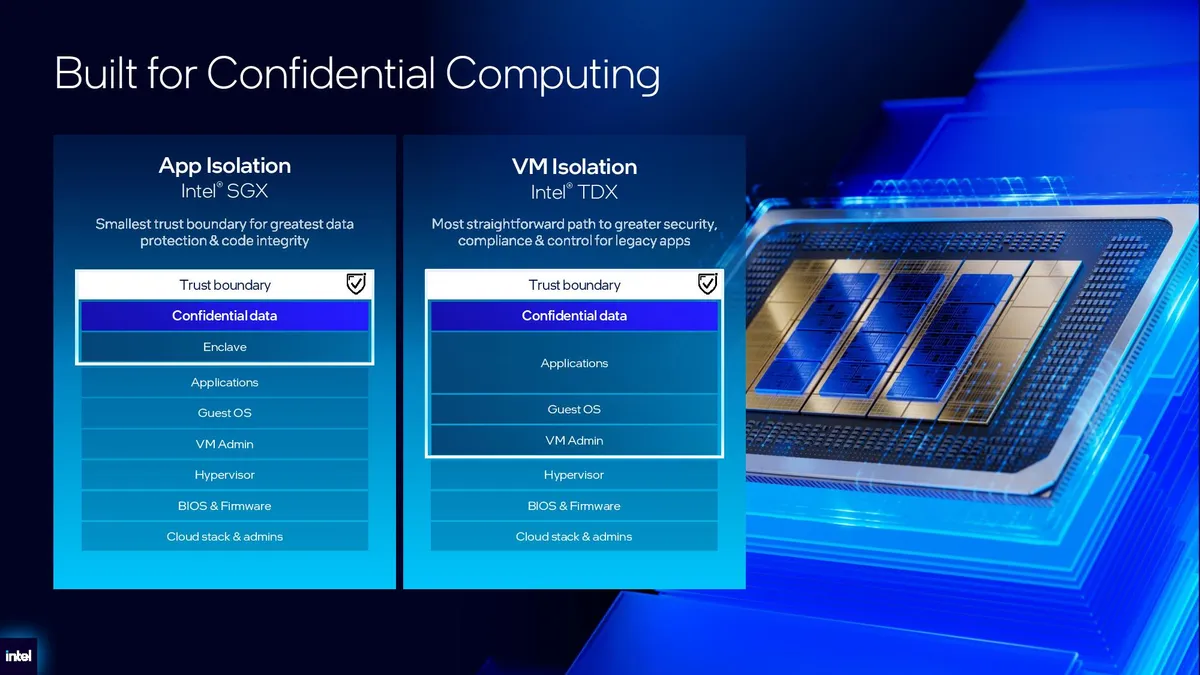
The chips come with a range of acronym-adorned hardware accelerators, including Intel QAT (QuickAssist Technology), DLB (Dynamic Load Balancer), DSA (Data Streaming Accelerator), and IAA (In-memory Analytics Accelerator). The flagship 6990E+ comes with 16 total accelerators, four for each type included in the architecture. Intel also expanded the chips with instructions to accelerate the SHA-512, SM3, and SM4 cryptographic algorithms, along with more robust confidential computing capabilities through Intel SGX for application isolation and Intel TDX for VM isolation.
Image 1 of 5
New for Xeon 6+ CPUs is Intel Application Energy Telemetry, or AET. It’s a hardware-based telemetry tool that Intel says can provide insight on energy usage for “workloads, microservices, containers, VMS, applications and even on an individual software thread-level when desired.” Xeon 6+ CPUs are the first to support AET, and Intel says it will be available on Xeon processors going forward, specifically targeting data center providers.
Although there was some hope we’d see Intel’s long-awaited AVX10.2 with Xeon 6+, that isn’t the case. The CPUs don’t support any form of AVX10, or even AVX-512. They top out at AVX2, an Intel spokesperson confirmed to Tom’s Hardware.
Intel Xeon 6+ ‘Clearwater Forest’ specs
Intel has four Xeon 6+ designs and six SKUs total, with the top two models in the stack coming in power-limited configurations with lower base and all-core turbo speeds, but otherwise identical specs.
Swipe to scroll horizontally
| Row 0 - Cell 0 | Cores / Threads | Base / Turbo Clock (GHz) | All-Core Turbo (GHz) | L3 cache | TDP |
6990E+ | 288 / 288 | 2.2 / 3.2 | 2.8 | 576MB | 450W |
| Row 2 - Cell 0 | 288 / 288 | 1.7 / 3.2 | 2.4 | 576MB | 330W |
6980E+ | 264 / 264 | 2.1 / 3.2 | 2.7 | 528MB | 400W |
| Row 4 - Cell 0 | 264 / 264 | 1.6 / 3.2 | 2.2 | 528MB | 300W |
6970E+ | 192 / 192 | 2.3 / 3.2 | 3.0 | 480MB | 400W |
6960E+ | 144 / 144 | 2.4 / 3.2 | 3.0 | 432MB | 330W |
Before getting into the individual processors, there are some specs shared across the entire range:
- 12-channel memory at up to DDR5-8000
- Single- or dual-socket compatibility
- 96 PCIe 5.0 lanes, 64 CXL 2.0 lanes, and 6 UPI 2.0 lanes
- 1024 Intel TDX keys per CPU
- Up to 16 accelerators (four each for Intel QAT, DLB, DSA, and IAA)
- Intel AET
Compared to last-gen Sierra Forest chips, the spec that immediately stands out is TDP. With Sierra Forest, Intel topped out at 330W on the Xeon 6780E and went down as low as 205W on the 6710E. Now, 300W is the floor and 450W is the ceiling, bringing it into closer alignment with top-end TDPs from AMD’s EPYC range. As usual, however, TDP only hints at real-world power consumption, which can vary widely depending on numerous factors.
Core counts have jumped massively, as expected, but so has the amount of L3 cache. The 6990E+ has more than five times the amount of L3 cache as the 6780E. Even the 6960E+, which has 144 cores like the 6780E, has four times as much L3 cache. L2 cache remains unchanged, however. Intel is using 4MB of L2 cache per cluster of four cores. That cache is technically shared among those cores in a cluster, but you can think of it as 1MB of L2 cache per core.
Intel Xeon 6+ ‘Clearwater Forest’ performance and benchmark claims
Intel shared a variety of benchmarks for Xeon 6+, comparing the new flagship Xeon 6990E+ to last-gen Intel chips, as well as AMD’s current EPYC offerings. Overall, Intel claims a generational improvement of 2.26x compared to the Xeon 6780E, as well as 30% higher performance per thread compared to AMD’s EPYC 9965.
Starting with the generational improvement, it’s no surprise to see such a massive uplift in performance. After all, Intel is comparing the Xeon 6990E+ to a CPU that has half the threads and a 120W haircut on TDP. The Xeon 6780E that Intel is comparing its latest Xeon 6+ chip to is the flagship from the last-gen Sierra Forest range, however. On average, Intel claims a 2.26x uplift, and as you can see from Intel’s internal benchmarks, the Xeon 6990E+ offered more than double the performance of the Xeon 6780E across every workload Intel tested.
Image 1 of 4
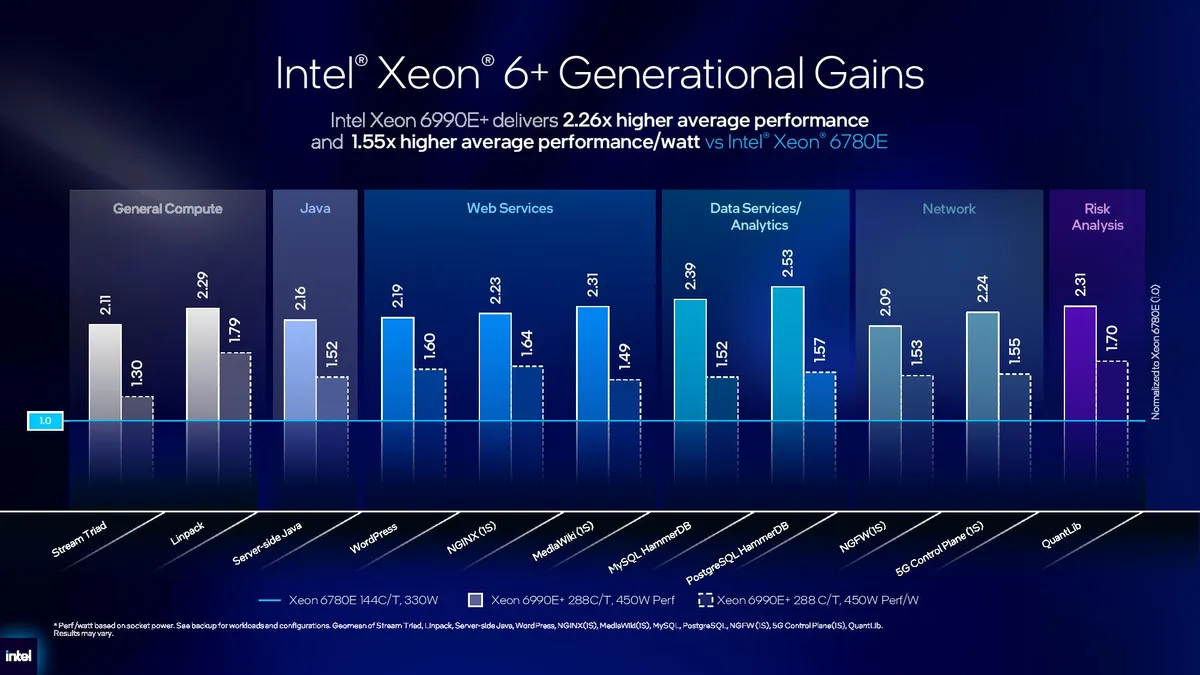
The more important metric here is performance per watt, however. The Xeon 6990E+ has a much higher TDP and denser compute, but Intel still claims an average efficiency improvement of 55%, ranging from a 30% uplift in the Stream Triad memory bandwidth benchmark up to a 79% improvement in Linpack. For these benchmarks, Intel used a mixture of dual-socket and single-socket systems, matching the configuration for the specific test (i.e. using two dual-socket or two single-socket systems rather than mixing and matching). You can see the exact configuration details in the full slide deck at the end of this article.
Given Team Red’s inroads into the data center over the last several generations, the competitive performance is perhaps more important. Intel says that the Xeon 6990E+ delivers 30% higher performance per thread, on average, compared to the EPYC 9965, as well as 30% higher average performance per thread per watt. Per-thread performance is important, absolutely, but Intel doesn’t have any data comparing average performance across the entire die to AMD’s offerings.
That’s likely due to overall thread count. Although Intel packs 288 cores in the Xeon 6990E+ compared to the EPYC 9965’s 192, AMD uses simultaneous multithreading, while Intel doesn’t. A per-thread advantage usually doesn’t directly translate to an overall performance advantage. It’s just one metric that could be important depending on the workloads you’re running. According to Intel’s benchmarks, Xeon 6+ holds around a 30% advantage in integer and floating-point throughput, and around a 38% improvement in efficiency.
Although Intel restricted hard numbers to the performance-per-thread metric, it provided a small glimpse at overall efficiency compared to the competition. At 40% CPU utilization, Intel claims the 6990E+ is up to 30% more efficient than the EPYC 9965. Assuming this chart is accurate and not some skewed visualization (that’s possible), you can see efficiency get much tighter as utilization increases.
Intel doesn’t have benchmarks comparing Xeon 6+ to designs based on the ARM instruction set, which is becoming an important comparison point. Just recently, we saw the first benchmarks of Nvidia’s Vera CPU break cover. The company, however, says that it thinks “[Xeon 6+] compares very favorably" to ARM-based options.
Full Intel Computex 2026 Xeon 6+ presentation
Image 1 of 71

Follow Tom's Hardware on Google News, or add us as a preferred source, to get our latest news, analysis, & reviews in your feeds.