







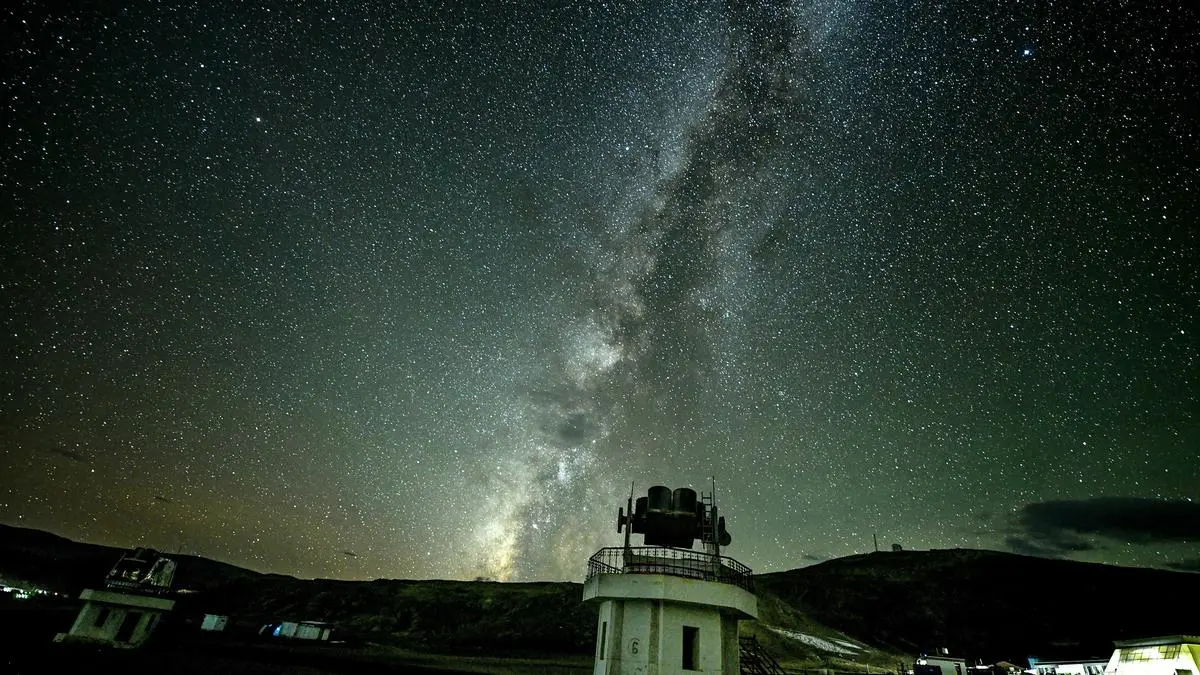
Hanle Dark Sky Reserve, India’s first Dark Sky Reserve and home to the Indian Astronomical Observatory | Photo Credit: MOORTHY RV
Under the vast, ink-dark skies of the Himalayan cold desert, Ladakh is preparing to turn itself into a giant natural observatory as it hosts “Ladakh Astro Week 2026” from May 20-26, blending science, travel and culture in one of the world’s highest inhabited regions.
From the high-altitude plains of Hanle to the dunes of Nubra Valley, the rugged mountains of Kargil, and the moonlike landscape of Lamayuru, astronomers, photographers, students and travellers will gather for a week of stargazing, astrophotography, science talks and night-sky observations under some of the clearest skies on Earth.
Organised by the Department of Tourism, Ladakh, in collaboration with the Indian Institute of Astrophysics, Bengaluru and the Indian Astronomical Observatory, Hanle, the festival reflects Ladakh’s growing ambitions to position itself as a global astro-tourism destination.
At the centre of the experience is Hanle Dark Sky Reserve, India’s first Dark Sky Reserve and home to the Indian Astronomical Observatory, one of the world’s highest astronomical observatories.
But organisers say the spectacle extends far beyond Hanle.
“With minimal light pollution and endless open horizons, almost every corner of Ladakh transforms into a natural planetarium after sunset,” a senior official at Ladakh’s Tourism Department said.
During the day, visitors will attend solar observation sessions, science exhibitions and astrophotography galleries, while experts decode cosmic mysteries through talks on black holes, exoplanets, solar activity and the search for life in the universe.
As darkness falls, the festival shifts into its most immersive phase.
“Between 7:30 and 11 pm each evening, guided observation sessions will allow participants to view constellations, planets and deep-sky objects with the naked eye and through telescopes in remote locations largely untouched by artificial light," said the official.
Film screenings, including “Nomads Under the Stars”, and sessions on cultural astronomy will also explore how Himalayan communities historically looked to the skies for guidance and meaning.
Local tourism players say the initiative could help diversify Ladakh’s tourism sector beyond its traditional summer appeal.
Namgayal, who runs a travel agency in Leh, said that he expected the festival to increase tourist footfall in the coming years.
“The authorities must promote the event more and conduct it around the same dates every year to attract people interested in stargazing,” he added.
Officials say the initiative is aimed not only at promoting astronomy but also at encouraging sustainable tourism, supporting local livelihoods and raising awareness about preserving dark skies in the fragile mountain ecosystem.
Published on May 13, 2026
此内容由惯性聚合(RSS阅读器)自动聚合整理,仅供阅读参考。 原文来自 — 版权归原作者所有。