



惯性聚合 高效追踪和阅读你感兴趣的博客、新闻、科技资讯
阅读原文 在惯性聚合中打开

推荐订阅源

WordPress大学
WordPress大学
A
About on SuperTechFans
小众软件
小众软件
Hugging Face - Blog
Hugging Face - Blog
奇客Solidot–传递最新科技情报
奇客Solidot–传递最新科技情报
博客园 - 叶小钗
博客园 - 聂微东
博客园 - Franky
Apple Machine Learning Research
罗磊的独立博客
量子位
博客园 - 三生石上(FineUI控件)
Recent Announcements
The GitHub Blog
The GitHub Blog
B
Blog RSS Feed
T
The Blog of Author Tim Ferriss
GbyAI
GbyAI
云风的 BLOG
云风的 BLOG
Last Week in AI
Last Week in AI
宝玉的分享
宝玉的分享
B
Blog
钛媒体:引领未来商业与生活新知
钛媒体:引领未来商业与生活新知
Stack Overflow Blog
Stack Overflow Blog
Cyber Security Advisories - MS-ISAC

Education news India, Government education schemes, Department of education | The HinduBusinessLine

Karnataka gets 1,122 additional medical seats with Rs 1,090 crore support CBSE makes three-language study compulsory for Classes 9 and 10, exempts third language from Board exams CBI arrests NTA biology expert in NEET-UG 2026 paper leak investigation NEET paper leak case: Pune professor held as alleged kingpin by CBI Schaeffler India opens new facility at IISC deepening industry and science ties NEET-UG re-exam on June 21; computer-based test from next year, says Dharmendra Pradhan NEET-UG re-exam to be held on June 21 Scaler bets on AI-led upskilling for 25% online growth amid edtech slowdown CBSE results: Over 85% students clear class 12 board exams; pass percentage dips Kejriwal calls on Gen Z to demand accountability on NEET paper leak Medical association moves Supreme Court, seeks overhaul of NEET-UG exam system over 'paper leak' Nalanda Police bust NEET solver gang, MBBS student among arrested Plan for PMIS: Final year diploma students to be eligible Cos can go to campus to pick up interns NEET-UG 2026 cancelled after paper leak allegations, CBI probe ordered Teacher training in AI will be primary focus in next 3-4 months: Official Chhattisgarh’s Rungta University gets NAAC accreditation NCERT to launch postgraduate, doctoral programmes in education soon Tamil Nadu Class 12 results 2026: State records 95.03% pass percentage Maritime India Foundation formalises agreements with IITs and IMU 18% GST on coaching services upheld by Gujarat AAR, no exemption for institutes NEET 2026: Over 1 lakh students appear for exam across Tamil Nadu Tamil Nadu CM Stalin launches help desk to guide class 12 students to higher studies AIU centenary conference in Pune focuses on self-reliant Bharat through education Edtech pivots to AI-first learning, compresses coding modules Medical college SMSIMSR receives NABH entry-level accreditation MAHE, TENVIC launch academic programmes to strengthen sports ecosystem Ramaiah Group to invest ₹850 crore in setting up interdisciplinary STEM institute SASTRA signs MoU with Tata Advanced Systems Symbiosis launches Asia’s first UNESCO chair on gender inclusion in skills UPES Dehradun to focus on tech-driven learning for Kerala students
India sees 15% jump in education loans, touches decade-hi...
By Yashaswani Chauhan · 2026-05-26 · via Education news India, Government education schemes, Department of education | The HinduBusinessLine
Banks continue expanding lending beyond traditional institutions, while overseas loans see higher ticket sizes despite domestic dominance.

Banks continue expanding lending beyond traditional institutions, while overseas loans see higher ticket sizes despite domestic dominance.

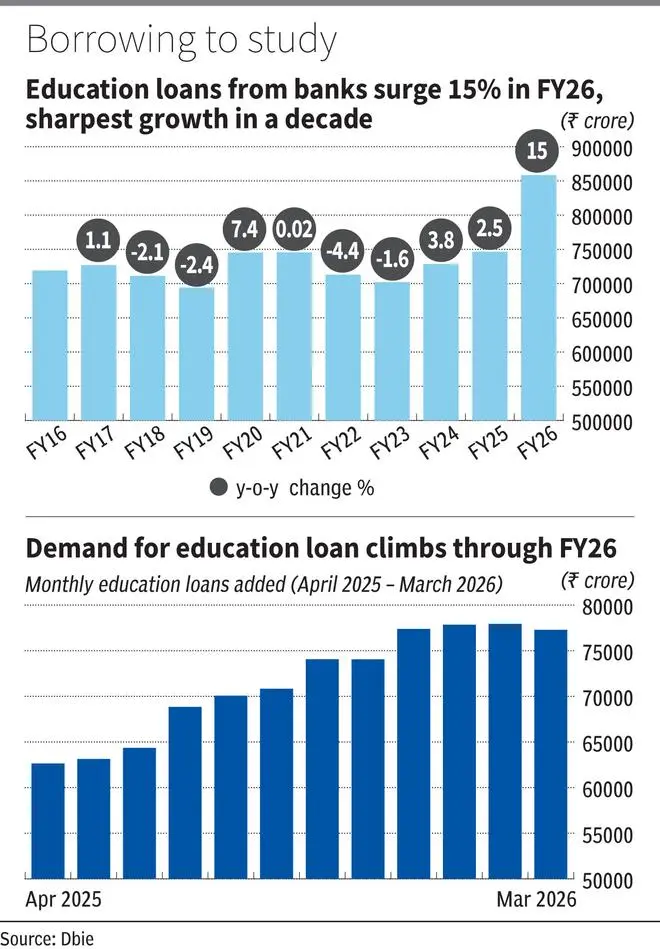
Rising tuition fees, growing overseas education aspirations, and wider lender participation pushed education loans from banks to their sharpest annual growth in a decade in FY26.

Outstanding education loans from banks rose nearly 15 per cent year-on-year to ₹8.58 lakh crore in FY26 from ₹7.46 lakh crore in FY25, according to data from Reserve Bank of India’s latest bulletin. The loan book had contracted in FY22 and FY23 before recovering in the last two fiscals.

Rising costs, rupee depreciation drive demand

Experts attributed the rise to increasing education costs, rupee depreciation, and a growing willingness among families to finance higher education through borrowings.

“There’s been a tendency for banks to reach out to more educational institutions where loans are being provided,” said Madan Sabnavis, Chief Economist, Bank of Baroda, adding that lenders are expanding beyond a limited set of institutions and professional courses as fees rise across the education sector.
Weak rupee boosts overseas education borrowing

The depreciating rupee has also significantly contributed to loan growth, particularly for overseas education.

“The same university, the same course, and the same student may now require a larger INR loan simply because the rupee is weaker,” said Sonal Kapoor, Global Chief Business Officer, Prodigy Finance.

Ramkumar Subramanian, Partner - Financial Services, Grant Thornton Bharat, said the weaker rupee has pushed families to rely more on external financing as savings increasingly fall short of covering education expenses abroad.

Overseas demand rises, US remains top destination

While domestic education loans continue to dominate by volume, overseas education loans account for larger ticket sizes. Experts noted that although the US remains the preferred destination for Indian students, countries such as Australia, New Zealand, and South Africa are also gaining traction.

Seasonal disbursals reflect admission cycles

Monthly data also reflected sustained demand through the year. Education loans added by lenders increased from ₹62,637 crore in April 2025 to ₹77,935 crore in February 2026 before moderating slightly to ₹77,289 crore in March.

The sharp rise in education loan additions during the second half of FY26 was largely driven by admissions cycles and fee payment schedules. Domestic course fees are generally paid around March-April ahead of the academic year, while international programme disbursals tend to pick up later in the year.

Banks dominate education loan market despite risks

Subramanian also mentioned that banks continue to dominate the education loan market with an 80 per cent share, while NBFCs account for the remaining 20 per cent, with some 5 per cent variation. He attributed this to the largely collateralised nature of education loans, unlike unsecured retail lending segments.

Sabnavis cautioned that repayment risks remain, particularly if students fail to secure employment after graduation, especially in overseas education loans due to larger borrowing sizes.

Published on May 26, 2026