



惯性聚合 高效追踪和阅读你感兴趣的博客、新闻、科技资讯
阅读原文 在惯性聚合中打开

推荐订阅源

博客园 - 三生石上(FineUI控件)
月光博客
月光博客
S
SegmentFault 最新的问题
有赞技术团队
有赞技术团队
Stack Overflow Blog
Stack Overflow Blog
Engineering at Meta
Engineering at Meta
T
The Blog of Author Tim Ferriss
The GitHub Blog
The GitHub Blog
小众软件
小众软件
Hugging Face - Blog
Hugging Face - Blog
IT之家
IT之家
宝玉的分享
宝玉的分享
A
About on SuperTechFans
Vercel News
Vercel News
P
Proofpoint News Feed
freeCodeCamp Programming Tutorials: Python, JavaScript, Git & More
博客园 - 【当耐特】
钛媒体:引领未来商业与生活新知
钛媒体:引领未来商业与生活新知
V
Visual Studio Blog
Jina AI
Jina AI
Y
Y Combinator Blog
T
Tailwind CSS Blog
奇客Solidot–传递最新科技情报
奇客Solidot–传递最新科技情报
Last Week in AI
Last Week in AI

Latest from Live Science in News

Artemis II heat shield aced its blistering reentry, ghostly underwater photo reveals Scientists invent artificial neurons that 'talk' to real brain cells, paving way to better brain implants 'What are the odds': Superbright comet and exploding fireball meteor form near-perfect X over European castle Meet AGI CPU — a specialist processor that engineers believe will power the next wave of AI Egyptian mummy has part of the 'Iliad' in its abdomen, archaeologists discover Artemis moon landing could face long delay while NASA waits for next-generation spacesuits Gene therapy improves hearing in 90% of patients with inherited deafness in largest trial of its kind Oil spills from Iran war may contaminate water and food supply and threaten protected wildlife refuge NASA's Curiosity rover finds a surprising number of giant 'dragon scales' littered across Mars Watch an AI-powered table tennis robot beat elite players NASA shuts off another Voyager 1 instrument as humanity Florida is facing its most intense drought in 15 years. Here's how it got so bad and how long it will last. Neanderthal toddlers grew faster than modern humans, probably because of the harsh environment they evolved in 'Nations need to prepare now': Key Atlantic ocean current is much closer to collapse than scientists thought New blood test aims to spot liver scarring before it paves the way to cancer A giant 'shadow' has been creeping across Mars for 50 years — and scientists aren't sure why Bruce the parrot is missing his upper beak —‬ but that hasn't stopped him from becoming an undefeated… Scientists identify main cause of extreme nausea and vomiting in pregnancy Naked mole rats wage bloody wars of succession to choose a new queen — but one colony did something scientists… Lyrid meteor shower 2026: See spring's first rain of 'shooting stars' peak in moonless skies $3 million prize goes to duo whose research led to first sickle cell CRISPR therapy 700-year-old mummy from Bolivia contains earliest confirmed evidence of strep throat bacteria in the Americas New pain-relief opioid could be much less addictive than morphine, rodent study finds Experimental drug doubles one-year survival in pancreatic cancer Science news this week: Physicists witness faster-than-light darkness pinpricks, humans are still evolving, and some… Archaeologists discover perfectly circular ancient Egyptian temple that may have been used for sacred water rituals 2 supermassive black holes may collide 100 years from now ‪—‬ and Earth would feel it Anglo-Saxon burial holds an older sister cradling her little brother after they both died 1,400 years ago, possibly of… Colorado River may have pooled and spilled over to form the Grand Canyon, solving a long-standing mystery ‪—‬… 'We all screamed when it happened': Bright-green fireball meteor caught exploding over famous Viking raid site…
Astronomers just mapped one of the largest structures in ...
Harry Baker · 2026-04-26 · via Latest from Live Science in News
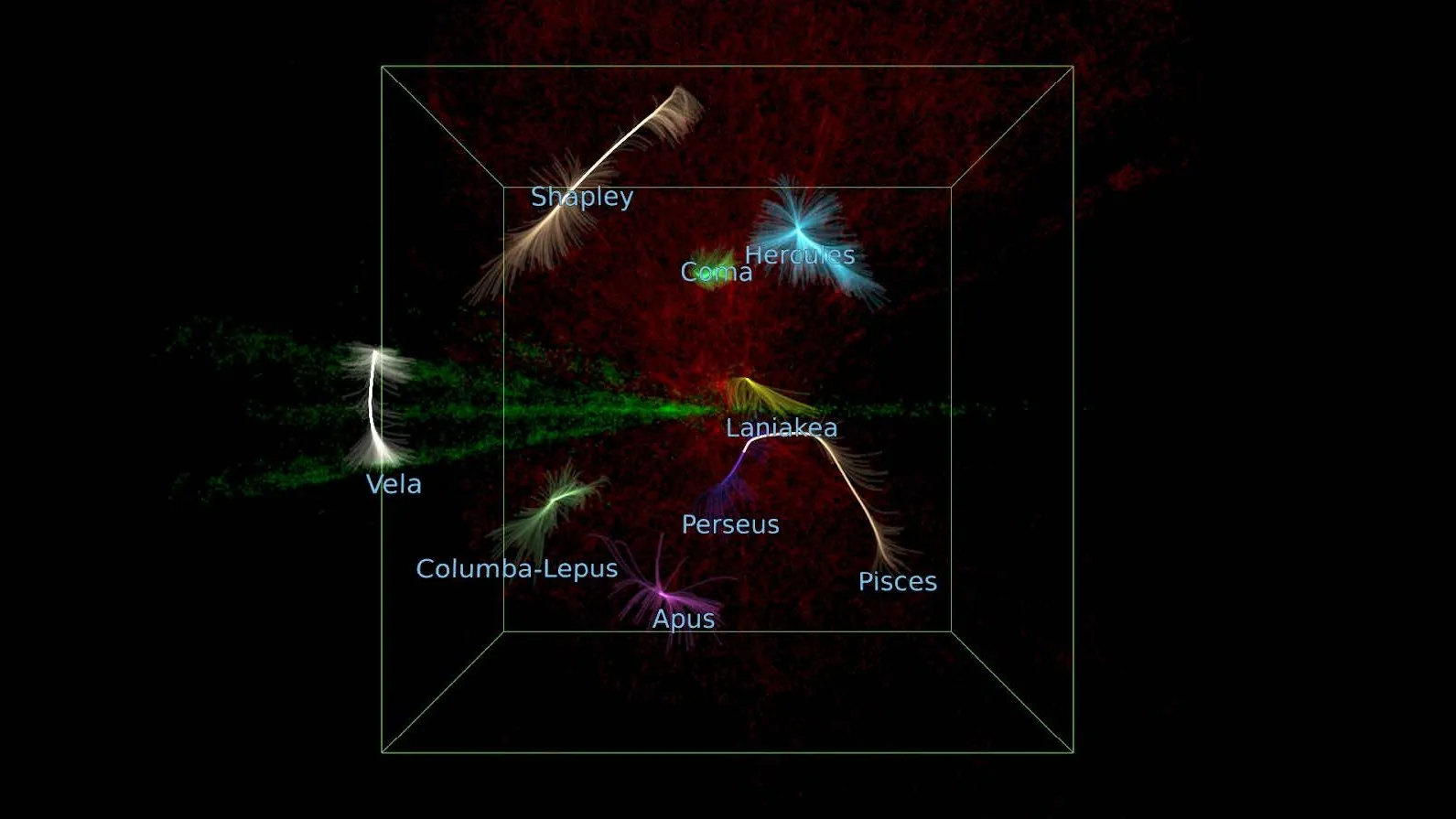
Blobs of light on a black background, corresponding to superclusters of galaxies in space
A map showing the relative sizes of galaxy superclusters in the universe. Vela, recently mapped for the first time, is at the far left. (Image credit: Jérôme Léca, RSA Cosmos)

Astronomers have finally mapped out a mysterious galactic "supercluster" that has been almost completely hidden from Earth since it was discovered 10 years ago. The results reveal that the structure is far larger than we realized, and it now ranks among some of the most massive objects in the known universe.

The Vela Supercluster is a collection of at least 20 galaxy clusters, each of which contains hundreds or thousands of galaxies, all gravitationally bound into a single entity. Despite its immense size, the supercluster was just discovered in 2016 because of its location: It lies around 800 million light-years from Earth within a region that experts call the "Zone of Avoidance" — the part of the night sky where we see the Milky Way, which is so full of stars and dust that it's almost impossible to view anything behind it.

But in a new study, uploaded March 10 to the preprint server arXiv, researchers loosely mapped the Vela Supercluster by measuring the movements of galaxies within and around the galactic swarm's edge.

Their findings revealed that the structure is around 300 million light-years across — about 3,000 times wider than the Milky Way — and contains an enormous amount of matter equivalent to about 30 quadrillion suns, the researchers wrote in a statement. The new map also shows that most of this mass is distributed into two cores that are moving toward each other.

The team was "delighted" to confirm that the supercluster is "a coherent large-scale structure comparable in size and mass to some of the largest and well-known superclusters in the local universe," study co-author Renee Kraan-Korteweg, an astronomer at the University of Cape Town who specializes in the Zone of Avoidance, told Live Science in an email.

The Vela Supercluster now ranks as more massive than Laniākea, the supercluster that contains Earth and the rest of our galaxy, and is "a close second" to the Shapley Supercluster, which is widely considered the largest supercluster of galaxies, Kraan-Korteweg said. (Other structures, such as the Hercules-Corona Borealis Great Wall and the recently discovered "Quipu," are even larger, but they are considered a step above a supercluster — essentially, clusters of superclusters.)

Get the world’s most fascinating discoveries delivered straight to your inbox.

The researchers also gave the supercluster a new nickname: Vela-Banzi, which means "revealing widely" in the Xhosa language used by Indigenous people in South Africa, where most of the telescopes used in the study are based.
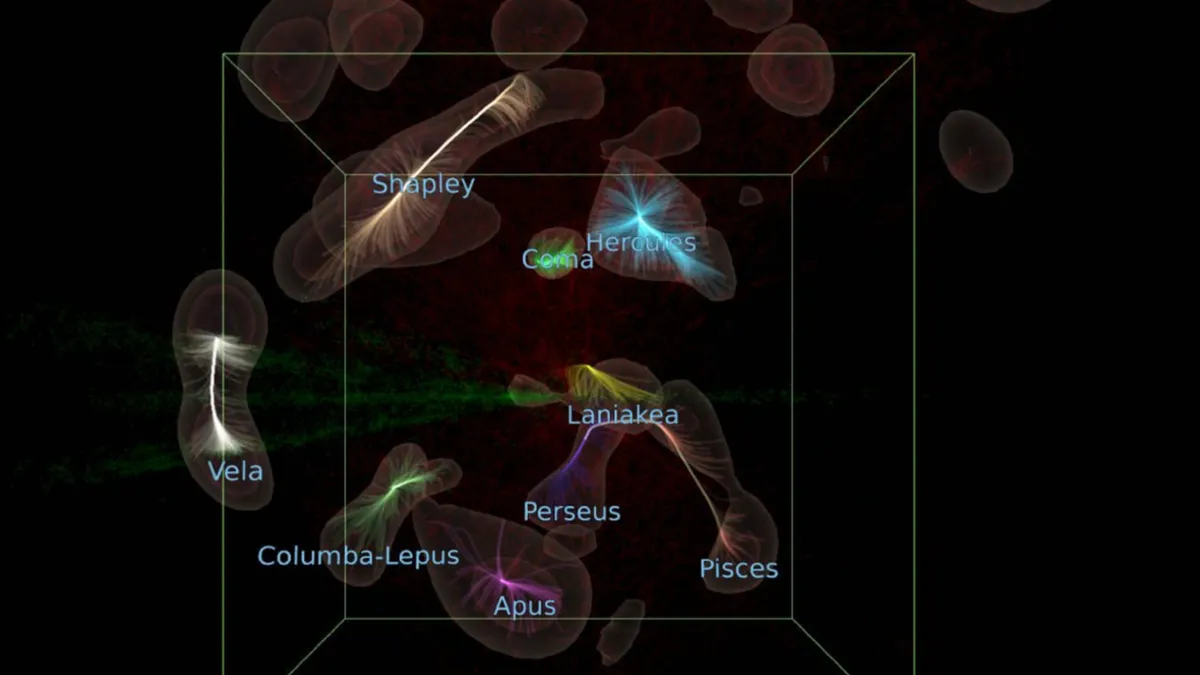
An illustration showing the size of the Vela Supercluster compared to other galaxy clusters

A 3D illustration showing the size of the Vela Supercluster compared to other galaxy clusters (Image credit: Dr Jérôme Léca/RSA Cosmos/SARAO)

Peering through the Milky Way

The Zone of Avoidance has long frustrated astronomers who want to know what lies behind the thick disk of stars, gas and dust of the Milky Way, which covers up to 20% of the visible night sky.

"The millions/billions of stars forming the disk are so dense [and so] close to the galactic plane that we cannot easily see through it," Kraan-Korteweg wrote. "Moreover, where we have stars, we also have lots of minuscule dust particles, and like the stars, this dust layer gets thicker and thicker as you approach the plane."

To get around this, the researchers combined 65,000 existing galaxy distance measurements with around 8,000 new redshift observations of other galaxies. (Redshift measures how fast something is moving away from Earth by calculating how much its light has been stretched by the expansion of the universe.)

Of these observations, the most important were around 2,000 redshift measurements captured by South Africa's MeerKAT telescope, which detects infrared radiation shining from the giant clouds of hydrogen gas that permeate most galaxies. This allowed the team to take direct measurements of galaxy movements within Vela that had never been seen in visible light.
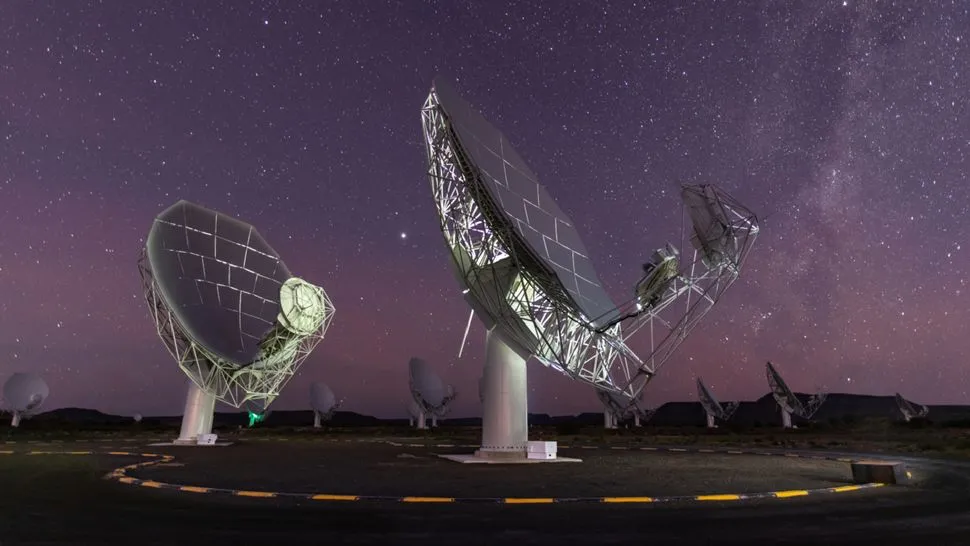
A group of satellite dishes under a starry sky

South Africa's MeerKAT telescope is made up of an array of 64 radio dishes and was able to spot clouds of hydrogen within galaxies obscured by the Milky Way. (Image credit: SARAO/MeerKAT)

The researchers think it may be possible to create more accurate maps of the Vela Supercluster with more powerful radio telescopes in the future. However, not all galaxies contain large amounts of hydrogen that we can see, so parts of the structure will likely always "remain partly shrouded to us," Kraan-Korteweg said.

RELATED STORIES

A better understanding of the largest structures in the universe will help astronomers confirm their models of cosmology. However, to do this, they need to know both the size and the speed of these objects, which is why the new findings are so exciting.

"To understand the one, we need to know the other," Kraan-Korteweg said. "And if we have both, we will be [able] to check if we can reconcile these observations with the models of the universe."

Article Sources

Hollinger, A. M., Courtois, H. M., Kraan-Korteweg, R. C., Mould, J., & Rajohnson, S. H. A. (2026, March 10). Hidden Vela Supercluster revealed by first Hybrid Redshift & Peculiar Velocity Reconstruction. arXiv.org. https://arxiv.org/abs/2603.09339

Harry is a U.K.-based senior staff writer at Live Science. He studied marine biology at the University of Exeter before training to become a journalist. He covers a wide range of topics including space exploration, planetary science, space weather, climate change, animal behavior and paleontology. His recent work on the solar maximum won "best space submission" at the 2024 Aerospace Media Awards and was shortlisted in the "top scoop" category at the NCTJ Awards for Excellence in 2023. He also writes Live Science's weekly Earth from space series.

You must confirm your public display name before commenting

Please logout and then login again, you will then be prompted to enter your display name.