



惯性聚合 高效追踪和阅读你感兴趣的博客、新闻、科技资讯
阅读原文 在惯性聚合中打开

推荐订阅源

博客园_首页
博客园 - Franky
大猫的无限游戏
大猫的无限游戏
博客园 - 三生石上(FineUI控件)
量子位
博客园 - 聂微东
OSCHINA 社区最新新闻
OSCHINA 社区最新新闻
S
SegmentFault 最新的问题
Apple Machine Learning Research
爱范儿
爱范儿
V
Visual Studio Blog
雷峰网
雷峰网
T
Tailwind CSS Blog
宝玉的分享
宝玉的分享
Blog — PlanetScale
Blog — PlanetScale
有赞技术团队
有赞技术团队
博客园 - 叶小钗
Microsoft Azure Blog
T
The Blog of Author Tim Ferriss
U
Unit 42
钛媒体:引领未来商业与生活新知
钛媒体:引领未来商业与生活新知
小众软件
小众软件
阮一峰的网络日志
阮一峰的网络日志
Y
Y Combinator Blog

Latest from Live Science in News

Artemis II heat shield aced its blistering reentry, ghostly underwater photo reveals Scientists invent artificial neurons that 'talk' to real brain cells, paving way to better brain implants 'What are the odds': Superbright comet and exploding fireball meteor form near-perfect X over European castle Meet AGI CPU — a specialist processor that engineers believe will power the next wave of AI Egyptian mummy has part of the 'Iliad' in its abdomen, archaeologists discover Artemis moon landing could face long delay while NASA waits for next-generation spacesuits Gene therapy improves hearing in 90% of patients with inherited deafness in largest trial of its kind Oil spills from Iran war may contaminate water and food supply and threaten protected wildlife refuge NASA's Curiosity rover finds a surprising number of giant 'dragon scales' littered across Mars Watch an AI-powered table tennis robot beat elite players NASA shuts off another Voyager 1 instrument as humanity Florida is facing its most intense drought in 15 years. Here's how it got so bad and how long it will last. Neanderthal toddlers grew faster than modern humans, probably because of the harsh environment they evolved in 'Nations need to prepare now': Key Atlantic ocean current is much closer to collapse than scientists thought New blood test aims to spot liver scarring before it paves the way to cancer A giant 'shadow' has been creeping across Mars for 50 years — and scientists aren't sure why Bruce the parrot is missing his upper beak —‬ but that hasn't stopped him from becoming an undefeated… Scientists identify main cause of extreme nausea and vomiting in pregnancy Naked mole rats wage bloody wars of succession to choose a new queen — but one colony did something scientists… Lyrid meteor shower 2026: See spring's first rain of 'shooting stars' peak in moonless skies $3 million prize goes to duo whose research led to first sickle cell CRISPR therapy 700-year-old mummy from Bolivia contains earliest confirmed evidence of strep throat bacteria in the Americas New pain-relief opioid could be much less addictive than morphine, rodent study finds Experimental drug doubles one-year survival in pancreatic cancer Science news this week: Physicists witness faster-than-light darkness pinpricks, humans are still evolving, and some… Archaeologists discover perfectly circular ancient Egyptian temple that may have been used for sacred water rituals 2 supermassive black holes may collide 100 years from now ‪—‬ and Earth would feel it Anglo-Saxon burial holds an older sister cradling her little brother after they both died 1,400 years ago, possibly of… Colorado River may have pooled and spilled over to form the Grand Canyon, solving a long-standing mystery ‪—‬… 'We all screamed when it happened': Bright-green fireball meteor caught exploding over famous Viking raid site…
Mystery of golden orb found in depths of ocean off Alaska...
Chris Simms · 2026-04-27 · via Latest from Live Science in News

Mysterious Golden Orb Identified! - YouTube Mysterious Golden Orb Identified! - YouTube
Watch On

A years-long mystery about a shiny blob found at the bottom of the ocean has finally been solved.

There were many theories about what it could be. Perhaps it was an egg, a sponge or a mat of microbes.

"Everyone was like, 'What the heck? What is that?,'" Allen Collins, a zoologist at the Smithsonian National Museum of Natural History in Washington, D.C., told Live Science.
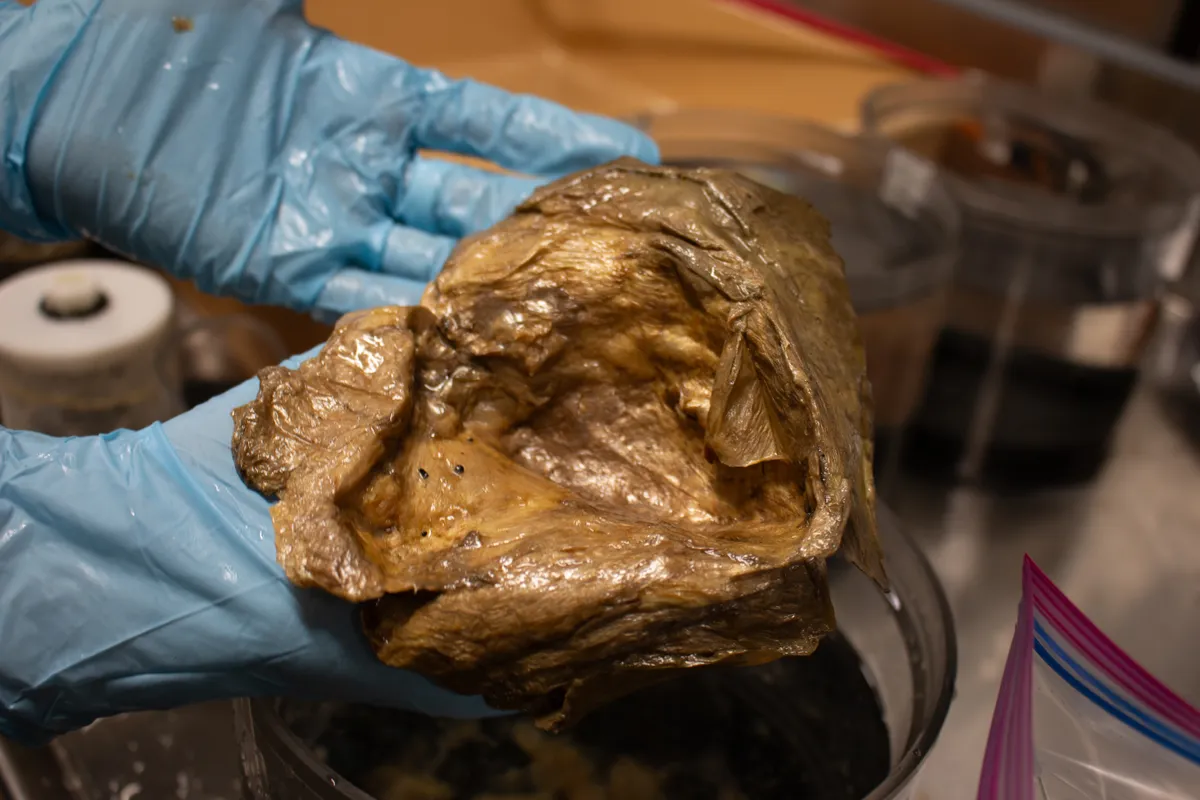
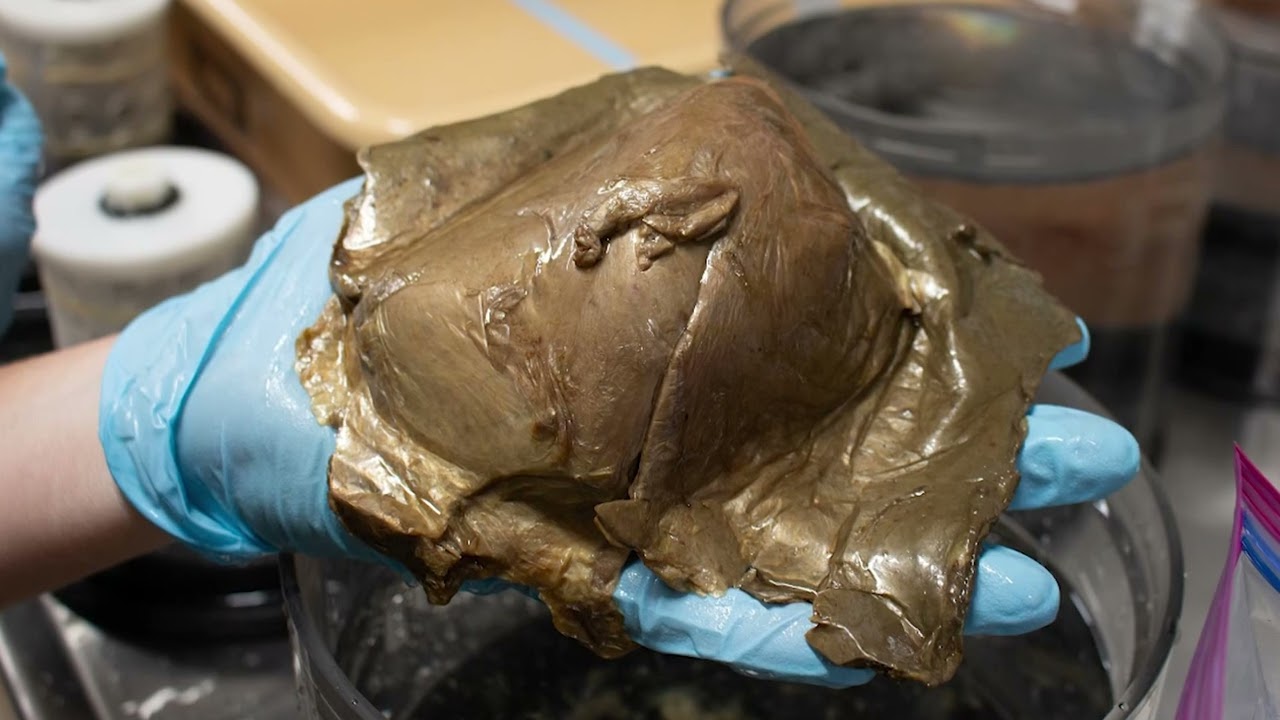
a blob of gold with someone with blue plastic gloves holding it

A close up image of the “golden orb” in the lab of the Smithsonian Institution. The orb was found on the seafloor off Alaska in 2023. (Image credit: NOAA Fisheries)

Now, he's led an analysis that has finally revealed what the orb is ‪—‬ and it turns out that it's something secreted by a mysterious deep-sea creature called Relicanthus daphneae.

"The first thing we were looking for was gross anatomy," he said. "Is there a mouth somewhere? Can we find muscles? The sort of thing that would tell us that it's some particular kind of an animal. And we didn't find any of that.”

The next step was to put it under a microscope. This inspection revealed that the tissue contained nematocysts ‪—‬ the stinging cells that define the Cnidaria phylum, which includes more than 11,000 species of aquatic invertebrates, such as jellyfish, hydroids, sea anemones and corals.

Get the world’s most fascinating discoveries delivered straight to your inbox.

These stinging cells were spirocysts, which Collins said are unique to the Hexacorallia class. That cut it down to 4,000 or so species.

Next, the team tried genetic tests and detected DNA from lots of microbes, as well as from an anemone-like organism ‪—‬ R. daphneae.

This is when co-author Estefanía Rodríguez, curator of marine invertebrates at the American Museum of Natural History in New York, who had been studying R. daphneae specimens for many years, got involved. She recognized the tissue as a cuticle, which means the golden orb is the structure that an anemone secretes beneath it to cement itself to rock. The work is posted on the bioRxiv preprint server and hasn't been peer-reviewed yet.
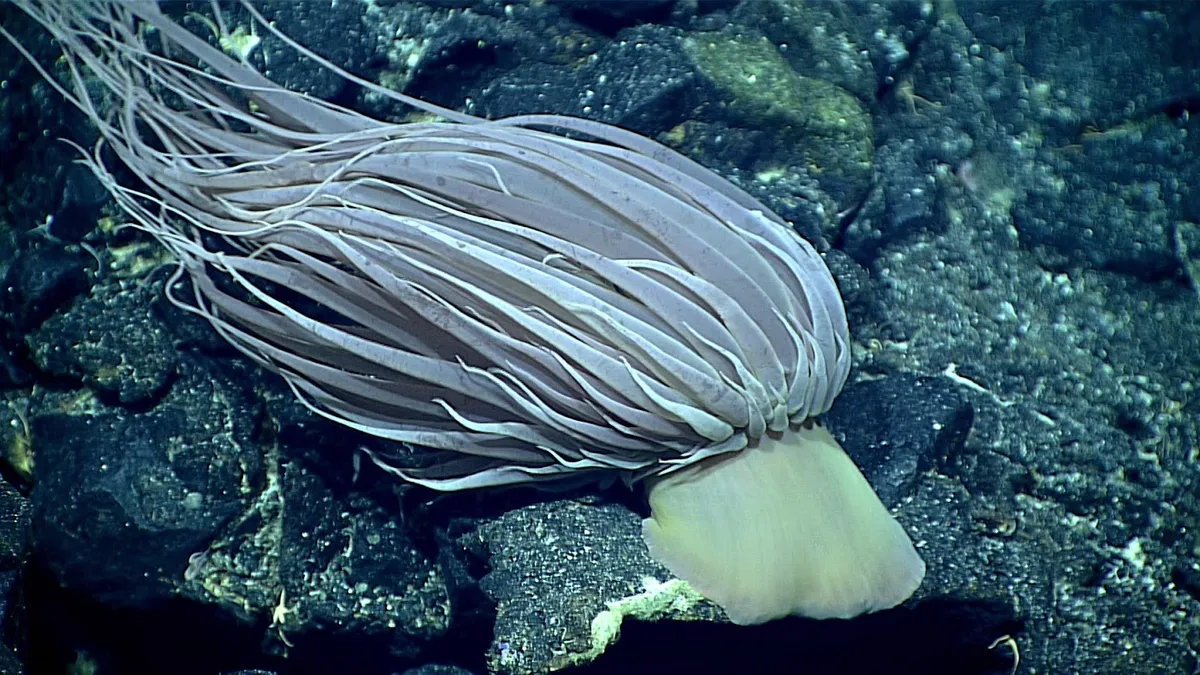
an anenome with threads attached to a rock in the sea

The "orb" was secretions from the deep-sea anemone-like creature, Relicanthus daphneae. (Image credit: NOAA Ocean Exploration, Deepwater Exploration of the Marianas)

"It is wonderful that the authors were able to gather enough evidence from the sample to identify it, even though it was actually a remnant not a whole specimen," Tammy Horton, a deep-sea taxonomist at the National Oceanography Centre in Southampton, U.K., told Live Science in an email.

She said the work demonstrates the importance of both DNA identification and obtaining specimens, because physical samples are needed to confirm the identity of little-known marine species.

"It's great to have an answer to what the 'golden orb' is, and as is often the case in the deep sea, it's a surprise," said Jon Copley, a marine ecologist at the University of Southampton in the U.K. "From its looks alone, we didn't guess it would be the remnants of an anemone-like animal."

Scientists haven't agreed on which group R. daphneae fits into yet. Genetic data from a 2019 study indicates it doesn't sit in current taxonomic groups and is in a sister group to true anemones, so it should be called "anemone-like," Copley said.

However, Rodríguez, who was part of the 2019 study's team, is still convinced it is an anemone, she told Live Science. "Morphologically it is an anemone, and I do believe it's an anemone," Rodríguez said. "We just don't have enough samples to show that yet." She suspects it might be from an ancient line of anemones, which is why it is hard to place.

related stories

Regardless of which group it fits into, R. daphneae probably secretes a cuticle to attach to rock but can detach from it to move to a better location and then attach in the new place by creating a new cuticle, Collins explained. That is why the golden orb was left there.

"In some videos, you can see cuticle on the rock adjacent to where the anemone is," he said, adding that in one case, you can spot a long trail along a rock where the anemone appears to have repeatedly started secreting a cuticle before moving on.

R. daphneae has mainly been seen near hydrothermal vents in the Pacific, Southern and Indian oceans, but that may be because scientists visit vents more often than other deep-ocean habitats, Copley said. He suspects the bizarre creatures may be more widespread, and now that we know they leave behind golden orbs, we may get a better idea of how far they spread.

Article Sources

Auscavitch, S. R., Reft, A., Collens, A. B., Mah, C., Best, M., Benedict, C., Rodríguez, E., Daly, M., & Collins, A. G. (2026). The Curious Case of the Golden Orb – Relict of Relicanthus daphneae (Cnidaria, Anthozoa, Hexacorallia), a deep sea anemone. bioRxiv (Cold Spring Harbor Laboratory). https://doi.org/10.64898/2026.04.17.719276

Chris Simms is a freelance journalist who previously worked at New Scientist for more than 10 years, in roles including chief subeditor and assistant news editor. He was also a senior subeditor at Nature and has a degree in zoology from Queen Mary University of London. In recent years, he has written numerous articles for New Scientist and in 2018 was shortlisted for Best Newcomer at the Association of British Science Writers awards. 

You must confirm your public display name before commenting

Please logout and then login again, you will then be prompted to enter your display name.