



Yellowstone's famous supervolcano is likely being fueled in a completely different way from what many scientists assumed. New research suggests that Yellowstone's volcanic activity is actually driven by shifts in Earth's crust, rather than a deep well of magma underground as previously thought.
This finding could help scientists predict future volcanic activity and better understand how the volcano will behave.
The Yellowstone area, where Earth's crust is relatively thin, is a hotbed of volcanic activity. In the last 2.1 million years, Yellowstone has seen three major eruptions, with the most recent taking place 631,000 years ago. The last supereruption created the Yellowstone caldera, which is more than 30 miles (50 kilometers) wide. A caldera is the bowl-shaped depression left in the ground after the volcano's molten rock has exploded to the surface.
There is a long-standing debate about the origin of Yellowstone's volcanics. Some scientists think there is a deep mantle plume beneath its surface. A mantle plume is a column of very hot rock that travels from Earth's core-mantle boundary, which heats material in the crust. But others argue that Yellowstone's volcanic activity is due to pressures within the crust and mantle.
"The consequences of these differing hypotheses is what we would expect in the future for the Yellowstone volcanic system," Jamie Farrell, chief seismologist of the Yellowstone Volcano Observatory who was not involved in the new research, told Live Science.
In the new study, published April 9 in the journal Science, the researchers argued that tectonics alone can heat the magma reservoirs underneath Yellowstone without the need for a deep mantle plume.
They created a 3D model, which incorporated past tectonic plate movements around western North America, the present-day mantle structure under Yellowstone, and data about the lithosphere, which is Earth's hard rocky crust.
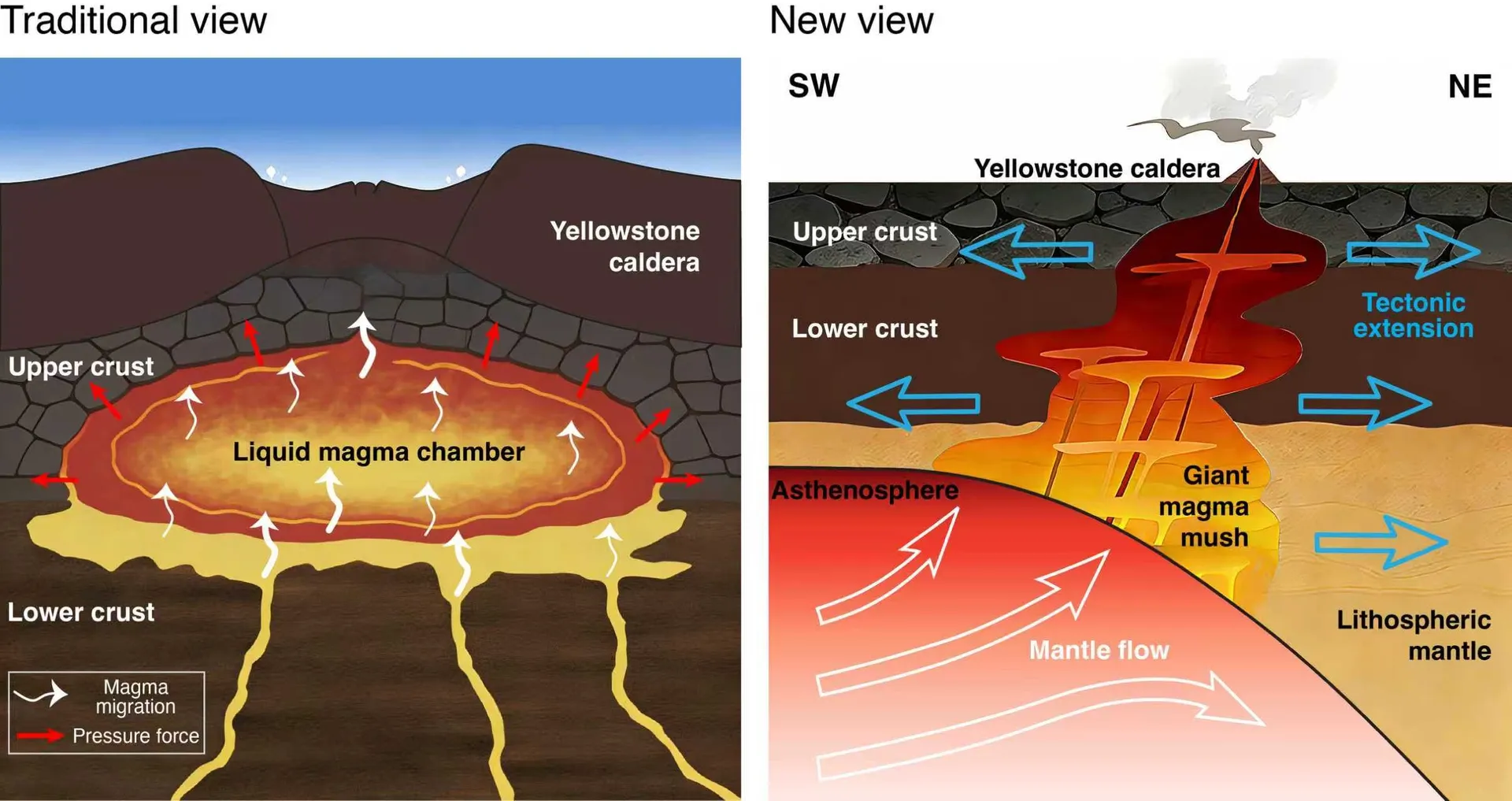
The traditional view of buoyant magma rising to form a liquid crustal chamber, seen on the left. And the new plumbing system suggested shown on the right.
(Image credit: Dr. Zebin Cao)
The team found that Yellowstone's magma plumbing was controlled by tectonics, rather than a mantle plume, and that two opposing forces are pulling at the system, Liu said.
The lithosphere underneath Yellowstone has different densities, making some parts of it heavier than others. This causes the outer crust to stretch towards the west coast of the U.S., Liu said. It is a bit like dough being stretched.
At the same time, an old tectonic plate — the Farallon slab — is sinking below central-eastern North America, dragging the bottom of the crust downward and tilting the volcanic plumbing system, he said.
At Yellowstone, these two forces compete directly with each other. "This competition pulls open the lithosphere below Yellowstone," Liu said, adding that the plumbing system connects the surface of Yellowstone with layers below Earth's crust and draws the magma upwards.
Ninfa Bennington, a volcano seismologist at the Hawaiian Volcano Observatory who wasn't involved in the research, told Live Science that a recent geophysical study showed that Yellowstone's magma originates in the southwest of the complex in the upper mantle, just below the lithosphere. From there, the magma migrates to the northeast, underneath the crust below the Yellowstone caldera. The new study shows how the magma could follow this route.
"Before this paper, to my knowledge, there has not been a study explaining why the magmas that fuel the Yellowstone volcanic system follow this path of migration," she said.
Understanding how the magma gets heated will help scientists to more accurately predict future activity in the area. It "will allow for a better estimation of what we can expect in the future", Farrell said. Over the last 17 million years, the active volcanics have been "burning" through relatively warm and thin crust, but fairly soon — in geologic terms, at least — it will start burning through the much colder, harder and thicker crust that lies just to the east of current Yellowstone, he said.
"Depending on what the source is — mantle plume or tectonics — the resulting activity may be different," Farrell said.
Yellowstone is not the only volcanic system that could benefit from this type of modeling, Liu said. It could also be used to better understand Toba in southeast Asia, Taupo in New Zealand and the active volcanoes in northeastern China, he said.
Bennington agreed that the new study and the accumulated knowledge about Yellowstone could help scientists explain other volcano systems. "This same type of analysis can be applied to improve our understanding of how magma migrates into high hazard caldera systems around the world," she said.
Article Sources
Cao, Z., Liu, L., Wan, B., Chen, L., & Lundstrom, C. (2026). Tectonic origin of Yellowstone’s translithospheric magma plumbing system. Science, 392(6794), eady2027. https://doi.org/10.1126/science.ady2027
What do you know about the US's first national park? Test your smarts with our Yellowstone quiz!