
惯性聚合 高效追踪和阅读你感兴趣的博客、新闻、科技资讯
阅读原文 在惯性聚合中打开

推荐订阅源

Martin Fowler
Martin Fowler
V
Visual Studio Blog
有赞技术团队
有赞技术团队
T
Tailwind CSS Blog
B
Blog
I
InfoQ
博客园 - 三生石上(FineUI控件)
阮一峰的网络日志
阮一峰的网络日志
F
Fortinet All Blogs
H
Help Net Security
博客园 - Franky
宝玉的分享
宝玉的分享
博客园 - 司徒正美
C
Check Point Blog
G
Google Developers Blog
Cyber Security Advisories - MS-ISAC
Jina AI
Jina AI
T
The Blog of Author Tim Ferriss
MongoDB | Blog
MongoDB | Blog
云风的 BLOG
云风的 BLOG
A
About on SuperTechFans
罗磊的独立博客
大猫的无限游戏
大猫的无限游戏
IT之家
IT之家

Latest from Live Science in News

Artemis II heat shield aced its blistering reentry, ghostly underwater photo reveals Scientists invent artificial neurons that 'talk' to real brain cells, paving way to better brain implants 'What are the odds': Superbright comet and exploding fireball meteor form near-perfect X over European castle Meet AGI CPU — a specialist processor that engineers believe will power the next wave of AI Egyptian mummy has part of the 'Iliad' in its abdomen, archaeologists discover Artemis moon landing could face long delay while NASA waits for next-generation spacesuits Gene therapy improves hearing in 90% of patients with inherited deafness in largest trial of its kind Oil spills from Iran war may contaminate water and food supply and threaten protected wildlife refuge NASA's Curiosity rover finds a surprising number of giant 'dragon scales' littered across Mars Watch an AI-powered table tennis robot beat elite players NASA shuts off another Voyager 1 instrument as humanity Florida is facing its most intense drought in 15 years. Here's how it got so bad and how long it will last. Neanderthal toddlers grew faster than modern humans, probably because of the harsh environment they evolved in 'Nations need to prepare now': Key Atlantic ocean current is much closer to collapse than scientists thought New blood test aims to spot liver scarring before it paves the way to cancer A giant 'shadow' has been creeping across Mars for 50 years — and scientists aren't sure why Bruce the parrot is missing his upper beak —‬ but that hasn't stopped him from becoming an undefeated… Scientists identify main cause of extreme nausea and vomiting in pregnancy Naked mole rats wage bloody wars of succession to choose a new queen — but one colony did something scientists… Lyrid meteor shower 2026: See spring's first rain of 'shooting stars' peak in moonless skies $3 million prize goes to duo whose research led to first sickle cell CRISPR therapy 700-year-old mummy from Bolivia contains earliest confirmed evidence of strep throat bacteria in the Americas New pain-relief opioid could be much less addictive than morphine, rodent study finds Experimental drug doubles one-year survival in pancreatic cancer Science news this week: Physicists witness faster-than-light darkness pinpricks, humans are still evolving, and some… Archaeologists discover perfectly circular ancient Egyptian temple that may have been used for sacred water rituals 2 supermassive black holes may collide 100 years from now ‪—‬ and Earth would feel it Anglo-Saxon burial holds an older sister cradling her little brother after they both died 1,400 years ago, possibly of… Colorado River may have pooled and spilled over to form the Grand Canyon, solving a long-standing mystery ‪—‬… 'We all screamed when it happened': Bright-green fireball meteor caught exploding over famous Viking raid site…
1,900-year-old souvenir cup featuring Hadrian's Wall and ...
kkillgrove@l · 2026-04-29 · via Latest from Live Science in News
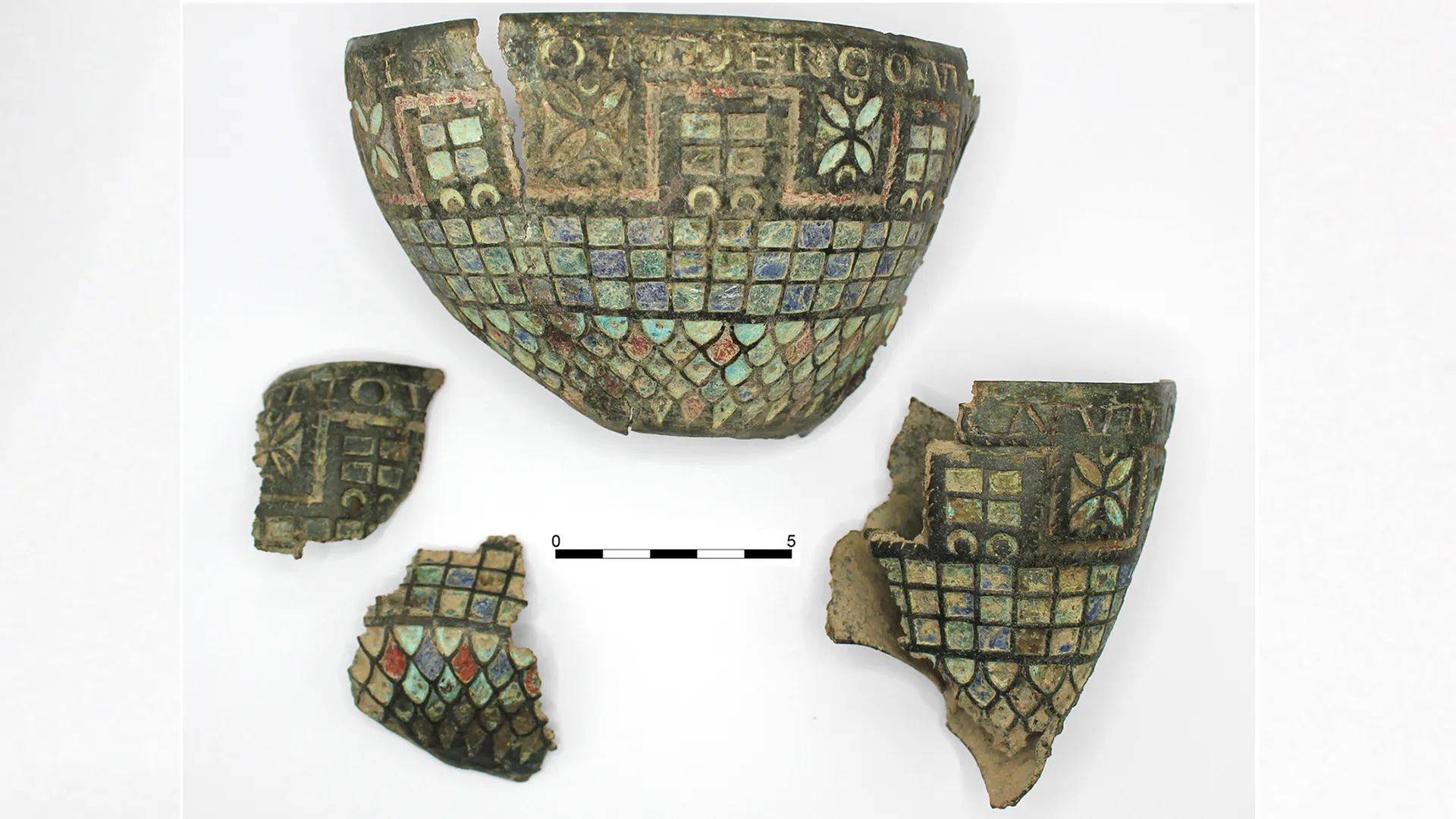
four fragments of a polychrome enameled bronze cup
The Berlanga Cup was found in four pieces. (Image credit: Roberto De Pablo)

A chance discovery of a broken bronze cup in Spain has revealed a 1,900-year-old depiction of Hadrian's Wall and forts in England, a new study reports. The multicolored vessel was likely crafted as a memento of a soldier's time defending the frontiers of the Roman Empire, the study authors said.

The cup was discovered in Berlanga de Duero, a municipality in central Spain, nearly 1,200 miles (2,000 kilometers) from the storied Roman defensive wall that protected the northern frontier of the empire in the second century. The hemispheric "Berlanga Cup" is about 4.5 inches (11.4 centimeters) wide and around 3.2 inches (8.1 cm) tall. It features colorful enameled designs and a Latin inscription that mentions four forts.

"The cup is a small representation of a functional vessel called a Roman trulla — a bronze or clay cup with a handle used to drink water," Jesús García Sánchez, an archaeologist at the Archaeological Institute of Mérida in Spain and co-author of the new study, told Live Science in an email. "It is not only crafted with metals, but also expensive enamels, and later on customized. It is definitely not an industrial product."

In the study, published April 23 in the journal Britannia, García Sánchez and colleagues wrote that, while similar cups have been discovered in the past, the Berlanga Cup is the only one that refers to forts on the eastern side of Hadrian's Wall. The four forts mentioned in the inscription are Cilurnum (now called Chesters), Onno (now called Halton Chesters), Vindobala (now called Rudchester), and Condercom (now called Benwell). Each fort is depicted on the cup as a series of four squares and two half-moons that represent either turrets or the fort's gateway. Below the schematic forts are two bands of designs inset with red, green, turquoise and navy-blue enamel.

An analysis of the cup revealed it was bronze — largely copper and tin — with a substantial addition of lead that likely came from mines in northernEngland. These findings strongly suggest the cup was made by a local artisan near Hadrian's Wall between A.D. 124 and 199, the researchers said. But how the cup ended up in Spain is a bit of a mystery.

The modern municipality of Berlanga de Duero was likely the ancient settlement of Valeranica in Roman times. Archaeological excavation in the area revealed fragments of Roman pottery and masonry walls, which were potentially part of a rural villa used between the first and fourth centuries. The Berlanga Cup may have been acquired by someone who lived in Valeranica and was a soldier in a Roman auxiliary unit of Hispanic origin known in historical records as the Cohors I Celtiberorum.

RELATED STORIES
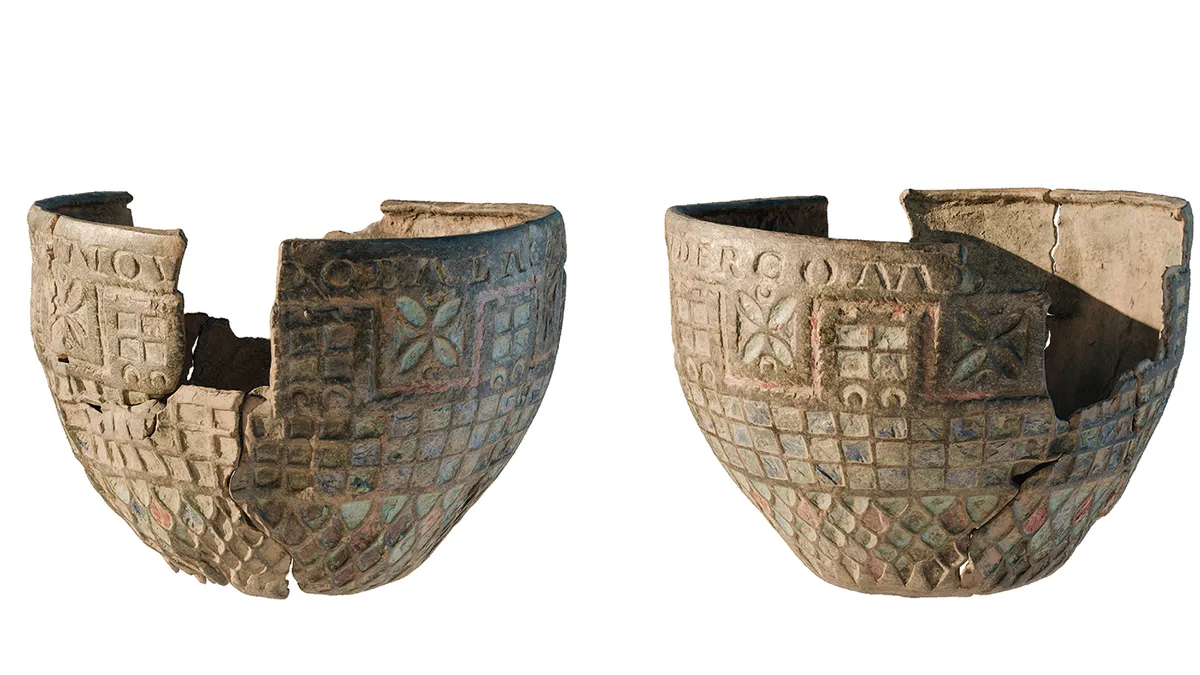
two views of a reconstructed bronze cup from Roman times

Archaeologists created a reconstruction of the Berlanga Cup by 3D scanning and virtually mending the fragments. (Image credit: 3D Stoa - Archaeology and Heritage)

"This contingent was made up of troops from Celtiberia, precisely the area where the piece in question was found," the researchers wrote in the study, and "was stationed near Hadrian's Wall during the reign of Emperor Trajan" (who ruled from A.D. 98 to 117). After soldiers served in the Roman military, many returned to their original homes and brought back mementos of their time in service.

Get the world’s most fascinating discoveries delivered straight to your inbox.

The Berlanga Cup "could have been a souvenir acquired by a veteran before his return home, purchased with the aim of remembering his time and service at one of the monumental forts of the Empire," the researchers wrote. Alternatively, the cup may have been bestowed on a soldier as recognition of distinguished service or a particularly brave act.

Either way, the fact that the memento was shaped like a simple trulla — an object soldiers used every day for eating and drinking — and not like a weapon suggests it was meant to remind veterans of the camaraderie they experienced while living along Hadrian's Wall, the researchers wrote.

Article Sources

De Pablo Martínez, R., De Luis Mariño, S., Garcia Sanchez, J., Montero Ruiz, I., Aparicio Resco, P. (2026). The Berlanga Cup. New evidence of Hadrian's Wall pans found in Hispania Citerior (Spain). Britannia. https://doi.org/10.1017/S0068113X26100701


What do you know about the Empire's conquest of the British Isles? Find out with our Roman Britain quiz!

Kristina Killgrove is a staff writer at Live Science with a focus on archaeology and paleoanthropology news. Her articles have also appeared in venues such as Forbes, Smithsonian, and Mental Floss. Kristina holds a Ph.D. in biological anthropology and an M.A. in classical archaeology from the University of North Carolina, as well as a B.A. in Latin from the University of Virginia, and she was formerly a university professor and researcher. She has received awards from the Society for American Archaeology and the American Anthropological Association for her science writing.