





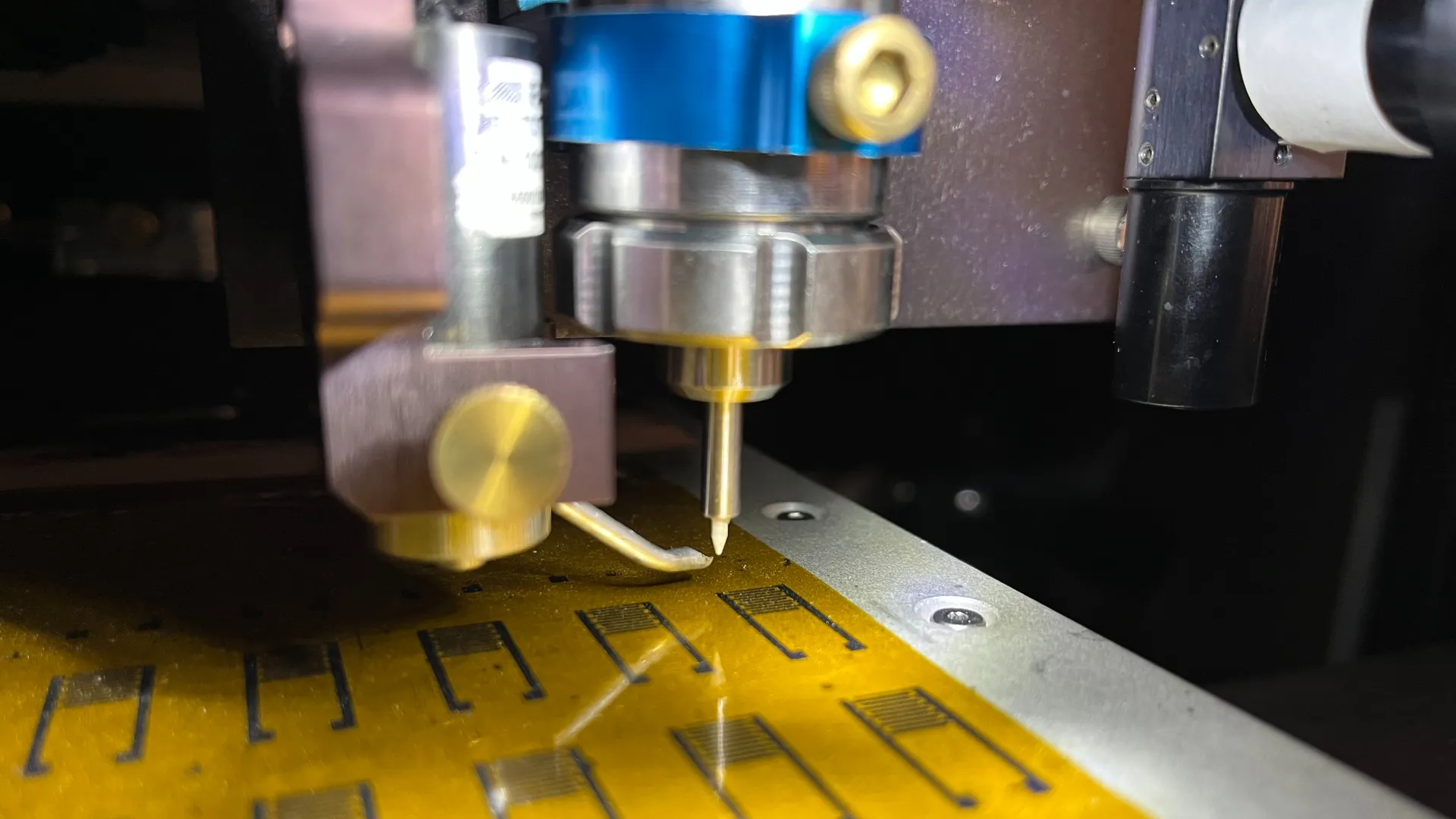
Engineers have printed tiny, artificial neurons that can "talk" to mouse brain cells, and the development could pave the way to innovations in computing and medicine.
The work, published April 15 in the journal Nature Nanotechnology, adds to a growing field that aims to build computers that mimic the inner workings of the brain.
"We are trying to mimic the brain as faithfully as possible," said study co-author Mark Hersam, a professor of materials science and engineering at Northwestern University. "What motivates us is to come up with an alternative to conventional digital computing to handle large amounts of data in a more energy-efficient way," he told Live Science.
The work could also usher in new brain-computer interfaces, which enable electronic devices to be controlled with brain activity. Brain-computer interfaces can be used to control prosthetic limbs or assistive communication devices, for example.
Because neuromorphic computers are designed to emulate the brain, they should be well suited to interact with brain tissue. Additionally, some scientists have suggested that artificial neurons could replace damaged nerve cells or restore lost brain function in degenerative diseases such as Alzheimer's.
Bottling the brain in a chip
To recapitulate brain tissue, you can't use traditional silicon chips, which are rigid and built from repeating transistors arranged in two-dimensional structures. They have fixed connections that can't evolve.
That's a far cry from the delicate infrastructure of the brain. Brain cells are physically flexible, vary depending on their location, and communicate in a 3D matrix that changes over time. Connections between neurons can grow stronger if they are used consistently, or they can fade if they are underused. All of these properties are necessary to create the intricate processors that are constantly making sense of the complex world around us.
Because of these discrepancies between the brain and machinery, most brain-computer interfaces fail to slot seamlessly into the brain; instead, they rely on relatively crude pulses to communicate with neurons. Making efficient artificial neurons means finding materials that feel and act like neurons, in that they mimic neural firing patterns and adjust those signals as needed.
Artificial neurons designed prior to the new study tend to use either soft, organic materials, such as gels or tissues that can pass electricity and chemical signals, or hard metal oxides. Each approach has drawbacks: While the soft materials' spiking patterns tend to be too slow, the hard materials' tend to be too fast, Hersam explained.
To better replicate neurons, Hersam and his team used printable inks laced with tiny flakes of molybdenum disulfide, an inorganic compound that acts as a semiconductor, and graphene, an electrical conductor. The inks are printed on a flexible polymer substrate.
We can achieve all different types of spiking responses that mimic biology.
Mark Hersam, professor of materials science and engineering at Northwestern University
Historically, such substrates have been viewed as a hindrance because the polymers interfere with electrical currents. But as Hersam and his colleagues discovered, this can be a boon for artificial neurons, as the team found that the polymers can be manipulated to control how electricity flows through the lab-made brain cell.
"The key innovation was this partial decomposition of the polymer," Hersam said.
By carefully tailoring how the polymer heats up and breaks down, the engineers can create tiny filaments of energy. Rather than increasing steadily, the current running through the neuron increases and then falls back, enabling a sudden release of energy akin to a neuron spiking. That action is called a "snap back negative differential resistance."
And by tuning the parameters of the device, the team was able to generate more complex signaling patterns, including a series of spikes spaced out in time or sudden flurries of spikes. "We can achieve all different types of spiking responses that mimic biology," Hersam said.
To prove this, the scientists placed their artificial neurons next to slices of a mouse's brain in a lab dish. They found that the mouse neurons fired at the same pace as the artificial neurons, suggesting the tissue could decode the artificial signal as if it were born from real tissue.
Artificial neurons of the future
Timothée Levi, a professor of bioelectronics who works on artificial neurons at the University of Bordeaux in France, praised the new type of artificial neuron, noting that it can "fit the normal frequency of neurons," he said.
Levi, who was not involved in the research, said the work adds to a series of recent studies showing that artificial neurons can communicate with biological neurons. These developments have unfolded alongside a slew of advances improving how artificial neurons are built, how they connect with each other, and how they are programmed, Levi said.
Related Stories
He emphasized, however, that artificial neurons are still far from fully communicating with biological neurons in a significant manner. "We can control them for a short time but not yet for a long time," he said, so they're not yet fit to be permanent additions to a human brain, for instance.
There's still a lot of work to be done in understanding how the brain works so it can be faithfully reproduced by a computer, Levi and Hersam noted. Moreover, artificial neurons aren't enough — you need to link them together at artificial synapses.
"The frontier problem," Hersam said, "is that we have a series of devices that mimic different elements of the brain, but we need to integrate them together into circuits that achieve the full functionality."
Article Sources
Hadke, S.S., Klingler, C.N., Brown, S.T. et al. Printed MoS2 memristive nanosheet networks for spiking neurons with multi-order complexity. Nature Nanotechnology. (2026). https://doi.org/10.1038/s41565-026-02149-6
See how much you know about the most complex organ in the human body with our brain quiz!