
惯性聚合 高效追踪和阅读你感兴趣的博客、新闻、科技资讯
阅读原文 在惯性聚合中打开

推荐订阅源

C
Cisco Blogs
爱范儿
爱范儿
有赞技术团队
有赞技术团队
博客园 - 【当耐特】
Jina AI
Jina AI
Project Zero
Project Zero
宝玉的分享
宝玉的分享
Martin Fowler
Martin Fowler
WordPress大学
WordPress大学
Simon Willison's Weblog
钛媒体:引领未来商业与生活新知
钛媒体:引领未来商业与生活新知
T
Tenable Blog
F
Fortinet All Blogs
大猫的无限游戏
大猫的无限游戏
Last Week in AI
Last Week in AI
月光博客
月光博客
雷峰网
雷峰网
G
Google Developers Blog
V
V2EX
T
Tor Project blog
罗磊的独立博客
Schneier on Security
Know Your Adversary
Know Your Adversary
W
WeLiveSecurity
freeCodeCamp Programming Tutorials: Python, JavaScript, Git & More
P
Privacy International News Feed
S
Securelist
奇客Solidot–传递最新科技情报
奇客Solidot–传递最新科技情报
P
Proofpoint News Feed
Blog — PlanetScale
Blog — PlanetScale
Threat Intelligence Blog | Flashpoint
小众软件
小众软件
Scott Helme
Scott Helme
I
Intezer
T
Threat Research - Cisco Blogs
The GitHub Blog
The GitHub Blog
N
Netflix TechBlog - Medium
C
CERT Recently Published Vulnerability Notes
Security Archives - TechRepublic
酷 壳 – CoolShell
酷 壳 – CoolShell
L
LINUX DO - 最新话题
N
News | PayPal Newsroom
L
Lohrmann on Cybersecurity
T
Troy Hunt's Blog
Google DeepMind News
P
Proofpoint News Feed
人人都是产品经理
人人都是产品经理
Latest news
Latest news
AWS News Blog
AWS News Blog
Apple Machine Learning Research

Latest from Live Science in Space-exploration

www.livescience.com Secretive Chinese probe snaps first photo of Earth Superintelligent AI in space could explain the Fermi Paradox NASA just launched a bold mission to rescue a falling space telescope before it crashes to Earth Scientists propose launching a giant China China www.livescience.com Earth-based telescope shares image of Artemis II capsule near the moon — one of the farthest photos of humans ever taken Artemis II crew captures rare double auroras on the dark side of Earth as they zoom toward the moon — Space photo… NASA's experimental X-59 jet breaks sound barrier for 1st time in step toward 'quiet supersonic'… This 'crawling' robot rolled around the moon and took a historic photo Artemis III crew revealed: NASA announces astronauts for 'one of history's most complex missions' NASA astronauts briefly shelter in 'safe haven' procedure following worsening leaks on International Space… 'In an unrecoverable state': NASA confirms MAVEN spacecraft is officially dead after loss of signal behind… China launches new Long March 12B rocket, reportedly without any safety warning Astronauts could use lightning-like plasma jets to kill germs on the moon and Mars, demo hints 'Very rough day': Blue Origin's New Glenn rocket explodes in gigantic fireball, days after being selected… NASA administrator hails 'Golden Age' of lunar exploration as Moon Base plans unveiled 'The sun would all but disappear, and the moon would always look full': A radio astronomer shares her… China launches 'human artificial embryos' to space in bid to see whether reproduction is possible off-world 'I heard gasps' and 'oh my God': Artemis II astronauts reveal inside story of their mind-bending… 'There are 4 people in those pixels': Earth-based telescope snapped Artemis II crew orbiting the moon SpaceX prepares to launch next-generation Starship, the tallest and most powerful rocket ever built 'I was not looking for this': Scientist accidentally finds shortcut to Mars that could slash travel time in… NASA just released 12,000 more Artemis II photos ‪—‬ here are a dozen of our favorites A SpaceX rocket is going to hit the moon, scientist says Can NASA and SpaceX really build a moon base in the next 10 years? NASA rover uncovers rock with 7 new organic molecules on Mars — the www.livescience.com Artemis II heat shield aced its blistering reentry, ghostly underwater photo reveals Artemis moon landing could face long delay while NASA waits for next-generation spacesuits NASA shuts off another Voyager 1 instrument as humanity Can the US be trusted with the moon? A law scholar raises concerns after Artemis II Artemis II quiz: Is your knowledge of NASA 73 moon landings? NASA www.livescience.com 10 Artemis II photos that define humanity's return to the moon 'I'm at a loss for words': Artemis II mission comes home to joy and cheers after historic 10-day mission There are 'reasons to be confident' about faulty Artemis II heat shield ahead of 25,000 mph reentry, space… There's an issue with the Artemis II heat shield, but NASA isn't worried. Here's why. The Artemis II astronauts have just flown farther from Earth than any humans in history Artemis II moon flyby begins: How to watch and what to know I've witnessed nearly 100 rocket launches. Artemis II was like nothing I've ever experienced. www.livescience.com Artemis II officially leaves Earth In photos: Artemis II Chinese satellite with robotic Artemis II blasts off: Humans are on their way back to the moon Astronauts can face 'nearly lethal doses' of solar radiation — so why launch Artemis II during the sun's peak of activity? Space scientist Patricia Reiff explains. How to watch NASA www.livescience.com Artemis II timeline: 12 key steps that will take NASA astronauts to the moon and back www.livescience.com www.livescience.com 6 major records the Artemis II astronauts will smash as NASA returns to the moon Mystery medical episode that left NASA astronaut unable to speak highlights major space risk Chinese moon lander reveals giant NASA announces Live Science Today: NASA announces $20 billion moonbase as unprecedented wildfires spread Artemis II: News, features, and facts about the NASA moon mission Russian rocket en route to ISS suffers major antenna glitch, triggering remote-control astronaut 'backup plan' NASA's Artemis II rocket rolls to launch pad in final bid to meet April deadline Artemis II: NASA is preparing for a return to the moon, but why is it going back? 1,300-pound spacecraft will crash to Earth today following intense solar activity, NASA warns NASA fixes Artemis II rocket for April launch to take astronauts around moon NASA announces sweeping overhaul of Artemis return to moon, targeting two 2028 landings and a 2027 in-orbit docking… Fresh look at Apollo moon rocks solves decades-old mystery about the moon's magnetic field Chinese astronauts describe moment a crack was discovered on Shenzhou-20 spacecraft NASA set to roll Artemis rocket back for urgent repairs after yet another delay Artemis II update: NASA targets March 6 for launch of historic moon mission following successful 'wet dress… Bungled Boeing Starliner mission was the highest order of mishap that put stranded astronauts at risk, report says NASA starts countdown clock for second Artemis II wet dress rehearsal after rocky first attempt Supercomputers simulated the orbits of 1 million satellites between Earth and the moon — and less than 10%… 'The brain consistently moved upward and backward': Astronauts' brains physically shift in their heads… Hydrogen leak derails Artemis II wet rehearsal, pushing launch date back by weeks Artemis II simulated launch window opens tonight as NASA delays mission due to 'rare Arctic outbreak' 50-year-old NASA jet crashes in flames on Texas runway — taking it out of the Artemis II mission NASA is preparing for simulated launch of Artemis II mega moon rocket — and it could happen as early as Saturday Artemis 2 update: NASA to wheel historic, 11 million-pound rocket to the launch pad this weekend NASA's powerful new Roman Space Telescope is complete — and will soon begin mission to find 100,000 alien… NASA astronauts back on Earth after unprecedented medical emergency on ISS Artemis 2 mission update: Rollout imminent as NASA prepares first crewed Artemis mission to the moon NASA announces unprecedented return of sick ISS astronaut and crew Orbiting satellites could start crashing into one another in less than 3 days, theoretical new 'CRASH Clock'… Should humans colonize other planets?
Astronauts will 'absolutely be test subjects': NASA's moon plans pose big questions — and big risks
2026-03-27 · via Latest from Live Science in Space-exploration
An astronaut wearing a white spacesuit kneels in front of a computer that is connected to a rover on the dusty surface of the moon with a clear circular ball behind them
An artist's interpretation of an astronaut on the moon. The lunar environment is full of dangers, like razor-sharp plumes of dust and constant cancer-causing radiation. Scientists warn that, before we rush to colonize it, we need to understand the moon better. (Image credit: gorodenkoff via Getty Images)

Mars is out; the moon is in. And this time, we may be going there to stay.

On Tuesday (March 24), NASA administrator Jared Isaacman announced new plans to build a "sustained human presence" on the moon, complete with a permanent lunar base. Construction of humanity's new home away from Earth could begin as soon as 2027, Isaacman said.

It's an exciting prospect — but scientists say lunar colonization won't be as simple as packing up and lifting off. The moon's environment is harsh: think razor-sharp, electrified dust and a constant stream of radioactive particles travelling at light speed. Scientists still aren't sure how this increased dose of cosmic radiation, coupled with the moon's weaker gravitational pull, relative to Earth, will affect the human body in the medium- to long-term.

And then there's technological feasibility: Where will astronauts live, and with what resources? At the moment, these big questions are still awaiting answers that may not arrive in time for NASA and Musk's proposed plans.

"I don't think we're quite ready," Caitlin Ahrens, a researcher at University of Maryland and NASA's Goddard Space Flight Center who studies the lunar environment, told Live Science. "A decade may seem far away to some people. To a scientist, it's the blink of an eye."

An illustration showing various circular moon bases on the gray lunar surface.

3D-printed launch pads and living quarters, as shown in this concept art, could be a possibility for long-term lunar colonization, NASA says. (Image credit: SEArch+)

Satellite of horrors

Moondust is rather different from what we call dust on Earth. Without wind and liquid water, the moon's dust doesn't soften over time. "We're talking very, very sharp little pollen[-size] shards here," Ahrens said.

Get the world’s most fascinating discoveries delivered straight to your inbox.

It's also easily electrified. Simply walking on the moon kicks up dust clouds, and rovers traversing the lunar landscape shoot up "rooster tails" of electrically charged, levitating dust, which sticks to anything in its path, Ahrens said. Energized dust can clog breathing vents in potential living quarters, scratch up spacesuits and coat solar panels, potentially overheating and breaking them. (Dust clogs have already spelled doom for several Mars rovers).

Without the soft blankets of Earth's atmosphere and magnetic shield, moon inhabitants would also be constantly blasted by radiation. Cosmic radiation is "pretty much omnipresent anywhere you go into space," including on the moon, Dr. Emmanuel Urquieta, an aerospace medicine researcher at the University of Central Florida, told Live Science. "It's incredibly difficult to shield."

Cancer is a potential risk, but because health effects of radiation take time to develop, we wouldn't know for certain if this is a major risk factor until potentially decades after landing human settlers on the moon. "Every person that goes to space… will absolutely be test subjects," Urquieta said.

We're not ready for self-defense

We have to be very careful not to sell something which [we] don't have

Giuseppe Reibaldi, president of the Moon Village Association

Humans on the moon would need hefty building materials to protect lunar habitats against these hazards. Metal or glass domes, subterranean habitats and housing made of 3D-printed moon soil are all potential options being investigated.

But Ahrens, who also works on lunar risk assessment, doesn't think we're ready to plan construction. For example, if NASA decides to invest in an underground habitat — perhaps the most surefire way to avoid radiation — scientists still have no idea how to dig on the moon, she said.

Even with sufficiently protective living quarters, the moon's weaker gravitational pull — just one-sixth that of Earth — may pose health risks. From previous space travel we know that, without the gravitational force humans evolved with, our bones and muscles need significant amounts of exercise to prevent them from withering away. But it wouldn't be practical to lug heavy treadmills, like those used on the International Space Station, to the moon, Urquieta said.

A lack of gravity may also redistribute the body's natural balance of fluids, with potentially disastrous effects. Normally, due to the downward tug of gravity, up to 80% of our blood is in our legs at any given time, Urquieta said. But on the moon, more fluids would flow to the body's upper half, causing loss of blood as the body attempts to rebalance itself, as well as potential swelling at the back of the eye and jugular vein thrombosis, a condition that causes potentially fatal blood clots in the neck. Compared to zero gravity, lunar partial gravity may or may not pose similar health risks. Urquieta said researchers won't know until people spend some time there.

The future of lunar settlement

Ultimately, Ahrens said, these challenges boil down to the need for more data, which scientists are hoping to gather with missions like NASA's Artemis campaign to return humans to the lunar surface as soon as 2028. But she envisions a much slower timeline than Musk's and Isaacman's plans; scientists haven't even taken a sample of the moon's ice yet — a resource lunar settlement planners are banking on.

Depending on its depth and composition, lunar ice could provide water, rocket fuel and rare earth metals. But until scientists get a physical sample of ice, they can't rely on its usefulness or economic prospects. For now, scientific knowledge of the ice's actual chemical composition is very limited: "We know it's cold, and we kind of know where it is," Ahrens said.

When it comes to the moon and its offerings, "we have to be very careful not to sell something which [we] don't have," said Giuseppe Reibaldi, president of the Moon Village Association, a non-profit group focused on international collaboration in lunar activities.
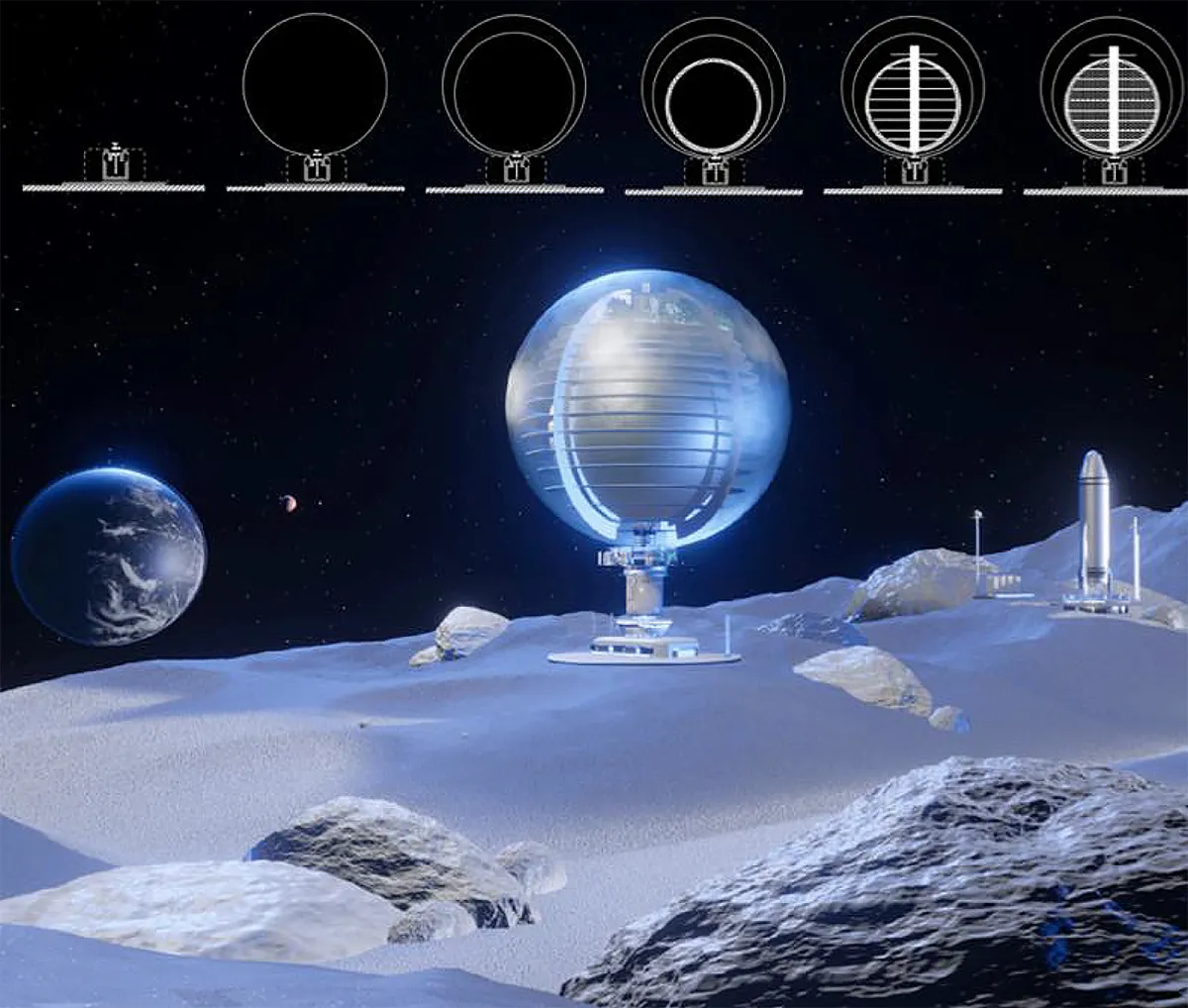
An illustration of a circular lunar base sitting on the moon's surface with the Earth in the background.

NASA concept art showing a possible lunar living structure made of glass. The logistics of large-scale construction on the moon remain one of many open questions. (Image credit: NASA/Martin Bermudez)

RELATED STORIES

Reibaldi told Live Science that what we find in the moon's ice could be the difference between the lunar equivalent of California's gold rush boomtowns — where settlements sprang up in response to mining opportunities — and Antarctica, where a small number of scientists come and go for solely research purposes.

But even if permanent settlement doesn't happen as soon as hoped, Ahrens said she is optimistic about the forecast for lunar development. "I think it's not all sunshine and rainbows, but it's also not dark rainy clouds either," she said.


Moon landing quiz: How quickly can you name all 12 Apollo astronauts that walked on the moon?

Georgia Michelman is a freelance science and health journalist based in New York City. She holds a B.S. in physics and history from Yale University and is currently enrolled in NYU's Science, Health, and Environmental Reporting Program. Before going into journalism, she worked across the pond for two years at the U.K.-based Science Media Centre, an independent press office focused on controversial science stories. She has strong interests in writing about physics, astronomy, psychiatry, drugs, and public health.

You must confirm your public display name before commenting

Please logout and then login again, you will then be prompted to enter your display name.