惯性聚合 高效追踪和阅读你感兴趣的博客、新闻、科技资讯
阅读原文 在惯性聚合中打开

推荐订阅源

I
InfoQ
H
Heimdal Security Blog
罗磊的独立博客
B
Blog RSS Feed
WordPress大学
WordPress大学
The Register - Security
N
Netflix TechBlog - Medium
美团技术团队
量子位
GbyAI
GbyAI
Recent Announcements
博客园 - 叶小钗
D
DataBreaches.Net
S
SegmentFault 最新的问题
Hacker News - Newest:
Hacker News - Newest: "LLM"
T
Troy Hunt's Blog
The Last Watchdog
The Last Watchdog
O
OpenAI News
钛媒体:引领未来商业与生活新知
钛媒体:引领未来商业与生活新知
酷 壳 – CoolShell
酷 壳 – CoolShell
Webroot Blog
Webroot Blog
OSCHINA 社区最新新闻
OSCHINA 社区最新新闻
Last Week in AI
Last Week in AI
V
V2EX
N
News and Events Feed by Topic
Jina AI
Jina AI
Y
Y Combinator Blog
T
The Blog of Author Tim Ferriss
IT之家
IT之家
C
Check Point Blog
H
Hacker News: Front Page
爱范儿
爱范儿
Schneier on Security
Apple Machine Learning Research
P
Privacy & Cybersecurity Law Blog
L
LINUX DO - 最新话题
Forbes - Security
Forbes - Security
人人都是产品经理
人人都是产品经理
cs.CL updates on arXiv.org
Microsoft Azure Blog
C
Cyber Attacks, Cyber Crime and Cyber Security
D
Darknet – Hacking Tools, Hacker News & Cyber Security
S
Secure Thoughts
The Cloudflare Blog
Simon Willison's Weblog
Stack Overflow Blog
Stack Overflow Blog
腾讯CDC
MongoDB | Blog
MongoDB | Blog
V2EX - 技术
V2EX - 技术
AI
AI

Tech

Kimi K3: China’s latest AI is turning heads – and set to make bank CBA chief economist Luke Yeaman talks down risk of ‘AI bubble’ at Australian Defence Industry Accelerator Summit The Industry Speaks, Part 1: AI Appreciation Day 2026 Open banking expands as non-bank lenders join Consumer Data Right Telstra CEO says she is ‘deeply sorry’ for nationwide outage Army uses AI-enabled recon drones in Exercise Southern Jackaroo Telstra finds secondary outage issue impacting 000 as government notes a Telstra finds secondary outage issue impacting 000 Telstra outage: Ministers, experts, and academics respond; ACMA to conduct full investigation 000 calls and Melbourne trains impacted by Telstra outage Kinetic IT launches AI engineering division to accelerate enterprise AI deployment US government lifts access controls on Anthropic’s Claude Fable 5 and Mythos 5 WA announces data science, artificial intelligence training program with industry, UK’s Faculty Civil liberties org rails against deployment of facial recognition tech by WA Police CrowdStrike expands QuiltWorks alliance with Amazon Web Services Vodafone urgently investigating outage impacting millions of Aussies Space Centre Australia debuts ASTRIS mission artificial intelligence at Australian Space Summit Is AI profitable yet? One website seeks to answer that question Report: Australians' faith in AI is almost non-existent Report: AI-based data incidents on the rise in Australia Anthropic launches dedicated Claude Security platform to public beta Ukrainian official advocates for artificial intelligence, autonomous drones for battlefield deployment CrowdStrike launches Project QuiltWorks to tackle skyrocketing AI-discovered vulnerabilities Outsiders are already accessing Anthropic’s new AI model, but is Claude Mythos really that powerful? Report: Data collection by school-backed apps in Australia is out of control and a risk to kids Kinetic IT appoints Kishore Jayaram in new chief transformation officer role Anthropic launches Claude Opus 4.7 as researchers reveal fake Claude installer spreading malware US Federal Communications Commission announces ban on foreign-made consumer routers Australian arm of clothing retailer Lululemon fined $702k over spam breaches Not on our watch: Coles, Palantir respond to GetUp anti-surveillance campaign Kinetic IT earns fifth Deloitte Best Managed Companies award Inside Genetec: How a once-hardware-centric sector has become a software battleground Rubrik reveals Agent Cloud to secure agentic AI in the enterprise Sausage watch: What are the implications of this week’s Bunnings facial recognition ruling? Kinetic IT appoints Jeremy O’Donohue to lead state government and critical infrastructure portfolio Kinetic IT awarded ICT contract with Department of Defence Send nudes: SecDef Hegseth announces Grok rollout at the Pentagon UNSW lands $3m next-gen AI defence contract ServiceNow announces acquisition of Armis Axonius denies reports of Cisco acquisition
Monash researchers unveil breakthrough photonic chip for next-generation AI and quantum computing
David Hollingworth · 2026-05-27 · via Tech

Researchers at Monash University have developed a nanoscale photonic circuit capable of generating, directing, and reading light-based information on a single chip.

Wed, 27 May 2026 Tech

Monash researchers unveil breakthrough photonic chip for next-generation AI and quantum computing

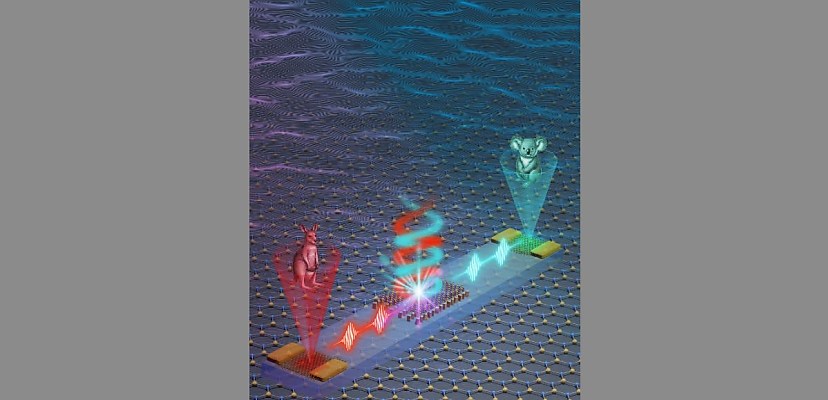
Researchers from Monash University have developed a breakthrough chip-based photonic system that can generate, route, and detect light-based information within a single integrated device, paving the way for faster and more energy-efficient computing technologies.

The technology, developed by scientists from the university’s School of Physics and Astronomy, addresses a longstanding challenge in the field of valleytronics, which uses quantum properties of materials to encode and process information in new ways.

You’re out of free articles for this month

To continue reading the rest of this article, please log in.

Published in Nature Photonics, the research demonstrates what the team says is the first fully integrated valleytronic system capable of generating specialised light signals, directing them with precision, and converting them back into electrical signals on a compact chip.

The system uses a quantum property known as the “valley degree of freedom”, which allows information to be encoded using electron energy states inside advanced materials.

Chi Li, lead author of the study, said the development overcomes a major technical barrier that has limited the field for years.

“Until now, we could generate or detect these signals, but not do everything in one integrated device,” Li said.

“What we’ve built is a complete on-chip system that can create, route, and read this information with very high precision.”

The device combines ultra-thin two-dimensional materials, only a few atoms thick, with engineered nanostructures known as metasurfaces that manipulate light at extremely small scales.

Kaijian Xing, co-first author and research fellow at Monash University, said the team developed a new stacking technique that overcame previous manufacturing limitations.

“We employ a straightforward stacking approach to integrate ultra-thin materials with metasurfaces, overcoming the technical challenges of direct material growth on photonic structures, and enabling further advances in valleytronics,” Xing said.

Unlike many experimental quantum technologies that require extreme cooling, the Monash system operates at room temperature, significantly improving its commercial and practical potential.

Haoran Ren, ARC Future Fellow and leader of the Monash NanoMeta Group, said the research could enable a new generation of programmable photonic devices for computing, communications, and advanced sensing.

“This is a significant step toward scalable, chip-based technologies that use light instead of electricity to process information,” Ren said.

“Photonic devices use light to achieve massive bandwidths, ultra-fast data transmission speeds, and lower energy consumption, so what we have achieved has strong potential for applications in quantum computing, advanced imaging, and next-generation optical communication systems.”

As part of the demonstration, researchers successfully encoded and processed two separate images simultaneously using the device, highlighting its ability to manage multiple information streams at once.

Stefan A. Maier said the breakthrough represented an important step towards commercially viable valleytronic systems.

“By combining light and quantum materials on a chip, we can access new ways of encoding and processing information,” Maier said.

The project involved collaboration between researchers in Australia, China, Singapore, Germany, and Japan, including contributions from the Singapore University of Technology and Design, LMU Munich, and the University of Technology Sydney.

Cyber DailyWant to see more stories from trusted news sources?
Make Cyber Daily a preferred news source on Google.

David Hollingworth

David Hollingworth has been writing about technology for over 20 years, and has worked for a range of print and online titles in his career. He is enjoying getting to grips with cyber security, especially when it lets him talk about Lego.