





Two masks. One smiling. One weeping. The comedy and tragedy masks are among the oldest symbols in theatre. They appear everywhere, from stage logos to award ceremonies. But they are not just decorative. They represent the two core forms of drama. Comedy and tragedy are not simply about humour or sadness. They are dramatic forms with distinct structures, rules, and outcomes.
One moves toward resolution. The other moves toward irreversible loss. Every piece of drama sits somewhere between them.
This article defines both forms, explains the comedy and tragedy masks meaning, and breaks down the key difference between comedy and tragedy with examples from theatre, film, and television.
THE FOUNDATIONS
Comedy and tragedy are the two foundational forms of Western drama. They began in the Greek theatre of ancient Greece, where performances were staged as part of religious festivals.
The pairing of tragedy and comedy is as old as theatre itself. The festival of Dionysus (the ancient Greek god of wine) presented them side by side, often in the same week.
Aristotle addressed both tragedy and comedy in Poetics, outlining how each form works as a dramatic form. His analysis of tragedy is more complete, but the contrast between the two forms runs through the entire text.
At their simplest:
This distinction still shapes storytelling. Most films, plays, and TV shows follow one of these forms, or blend them into tragicomedy.
Inspire Education helps immerse you in the Ancient Greek origins of comedy and tragedy masks:

THE HUMOR
Comedy is about repair.
Things fall apart at the start. People lie. Identities blur. Relationships strain. But by the end, something holds.
Not perfectly. But enough.
Comedy is not just about being funny. It is a structure that moves toward resolution and social harmony.
Comedy is often mistaken for humour. But humour is only the surface. Underneath, comedy is a dramatic form defined by structure. It moves toward resolution.
That resolution does not erase conflict. It absorbs it.
A better way to think about comedy: it allows disorder to exist, but refuses to let it define the ending.
This is why comedy can handle chaos. It can include conflict, embarrassment, even pain. But it always moves toward a point where those tensions are released or reconfigured.
That release is what the audience feels.
Let's dive into what the key elements of comedy include:
1. Reversal and restoration
Chaos becomes order. Misunderstandings fall away. Weddings are common endings for a reason. They do not just restore society. They restore connection. Love, after all the delay.
2. Upward resolution
The protagonist ends in a better position than they started. The gain may be emotional, social, or romantic.
3. Misunderstanding and recognition
Comedy runs on confusion. Characters misread situations until the truth arrives and resolves everything at once. This is a structural form of irony.
4. Social harmony
The ending brings people together. The world feels stable again. Comedy opens doors. Even if it takes the entire story to get there.

In Some Like It Hot, disguise drives the entire narrative.
Two musicians pretend to be women to escape danger. This creates constant misunderstanding. Every scene adds pressure. Identities overlap. Romantic stakes build.
The famous final line, "Nobody's perfect," works because the structure has earned it. The truth is revealed. Instead of collapse, the story absorbs it. The world holds.
That is comedy. The system bends. It does not break.
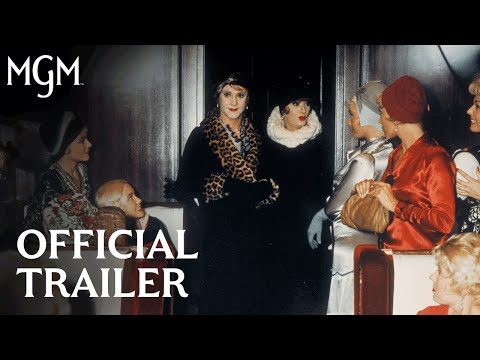
Comedy is one of the oldest genre categories in film. See how it breaks into subgenres and overlaps with other forms, and ultimately creates comedy and tragedy masks.
THE CONFLICT
Tragedy is about loss.
Not temporary loss. Not delay. Loss that cannot be undone.
The story does not resolve. It exposes something final.
Tragedy is often described as a fall. That is true, but incomplete.
A tragedy is a process of recognition.
The protagonist moves toward an outcome they cannot avoid. What matters is not just the fall, but the moment they understand it.
That is what separates tragedy from simple misfortune.
In a tragedy, the character participates in their own destruction. Not always knowingly. Not always willingly. But their choices matter.
This is why Aristotle places such emphasis on hamartia. The tragic flaw is not just a weakness. It is a pattern of thinking or behaviour that leads to collapse.
Modern stories still follow this structure. The setting changes, but the mechanism does not.
Tragedy does not comfort. It clarifies. When you get comedy and tragedy masks, there's an inherent balance.
Downward arc
The story moves from stability to collapse.
Hamartia
A fatal flaw or error in judgement. The tragic flaw is what initiates the fall and cannot be undone.
Catharsis
The audience experiences pity and fear, followed by emotional release. Aristotle considered catharsis the defining emotional effect of tragedy — the pathos that makes it worth watching.
Peripeteia
The turning point where the outcome becomes irreversible.
Anagnorisis
Recognition. The character understands the truth too late.
The Tragic Hero
The tragic hero sits at the centre of the fall.
Elevated status
The fall must carry weight. A tragic hero begins with something worth losing.
Defined by a flaw
The hero contributes to their own downfall. This is what distinguishes a tragic hero from a victim. The tragic flaw is not passive — it drives every key decision.

In Chinatown, the structure is relentlessly tragic.
Jake Gittes believes he can uncover the truth and restore order. Each discovery brings him closer. But the closer he gets, the less control he has.
The final scene makes the structure clear. The truth is exposed. A character dies. Power remains untouched.
"Forget it, Jake. It's Chinatown."
Recognition arrives. Too late. Nothing is repaired.
That is tragedy. The system does not bend. It holds, and the character breaks against it.
You can read the Chinatown screenplay online. The ending lands differently on the page.
The comedy and tragedy masks meaning reflects the two directions of drama. One smiling. One weeping.
The tragedy and comedy masks are Greek in origin, but they have outlasted every other symbol in Western theatre.
But the questions is where did they come from?
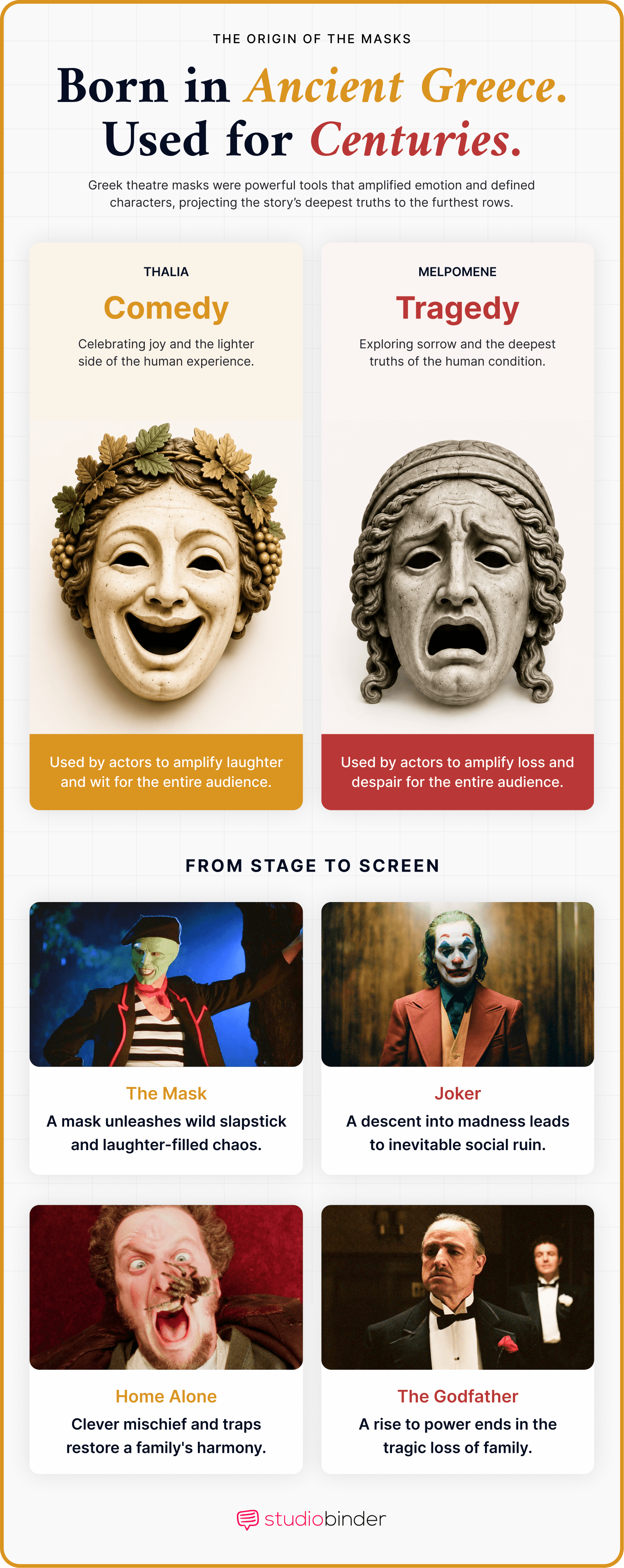
In Greek theatre, actors wore masks for every performance.
They amplified expression and allowed performers to play multiple roles. The design signalled genre.
Together, they represent the full emotional range of drama.

Actors wore masks for practical reasons. Facial expressions would not carry across an amphitheatre. The mask made emotion visible from a distance. It also allowed a single actor to play multiple roles within the same production.
But the masks did more than amplify expression. They communicated genre.
A smiling mask signalled comedy. A weeping mask signalled tragedy. Before a word was spoken, the audience already understood the direction of the story.
That clarity mattered. Greek audiences were not just watching a play. They were watching a form. The mask told them how to read it. Most notably, the comedy and tragedy masks.
The smiling mask represents comedy. Resolution. Connection.
The weeping mask represents tragedy. Loss. Finality.
The tragedy and comedy masks meaning goes deeper than decoration. They encode the two structural possibilities of drama into a single image.
Thalia and Melpomene
The comedy and tragedy masks are often associated with two figures from Greek mythology.
Thalia is the Muse of comedy. Her name suggests flourishing and abundance. She represents growth, renewal, and the upward movement of comic stories.
Melpomene is the Muse of tragedy. She is often depicted holding the tragic mask. Her association is with song, but also with gravity and loss.
Together, they personify the two forces that shape dramatic form.
The comedy and tragedy masks are sometimes described as their faces. That connection reinforces the idea that comedy and tragedy are not just genres, but fundamental ways of understanding experience.
Thalia represents comedy and abundance.
Melpomene represents tragedy and gravity.
The smiling mask does not just represent joy. It represents movement. The sense that things are still in motion, still capable of change.
The weeping mask represents finality. Not just sadness, but completion. The moment when change is no longer possible.
Together, they form a complete system.
Every story exists somewhere between the binary of the comedy and tragedy masks.
That is why the image persists. It is not decorative. It is structural.

The comedy and tragedy masks have outlived the theatre that created them.
They appear in logos, awards, drama schools, and film institutions. Even people who have never seen a Greek play recognise the comedy and tragedy masks immediately.
That recognition comes from what they represent. Not just theatre, but storytelling itself.
If a story ends with restoration, it belongs closer to the comic mask.
If it ends with irreversible loss, it belongs closer to the tragic one.
This is why the image of comedy and tragedy masks persist. It communicates structure instantly.
If you reduce the comedy and tragedy masks to their core idea, they become a tool.
Ask one question: does this story move toward repair or toward loss?
If it repairs, it leans toward comedy.
If it cannot be repaired, it leans toward tragedy.
That distinction is what the tragedy and comedy masks have always represented.
And it is why they are still used.
The features of the comedy and tragedy masks are deliberately extreme.
The smile is wider than any real smile. The grief is deeper than any natural expression.
This is not accidental. The exaggeration reflects how each form works.
Comedy stretches reality. It exaggerates behavior, misunderstanding, and coincidence until they become visible. The mask mirrors that exaggeration.
Tragedy does something similar, but in the opposite direction. It intensifies suffering. It strips away comfort. The expression becomes absolute.
The comedy and tragedy masks are not subtle because the forms are not subtle.
The masks work because of what they make immediately visible. Imagery in writing does the same thing on the page.
THE CONTRAST
There are two fundamental dramatic arcs when it comes to stageplays, films and TV shows. Take a look at our graphic below to get a comprehensive understanding of both of them.
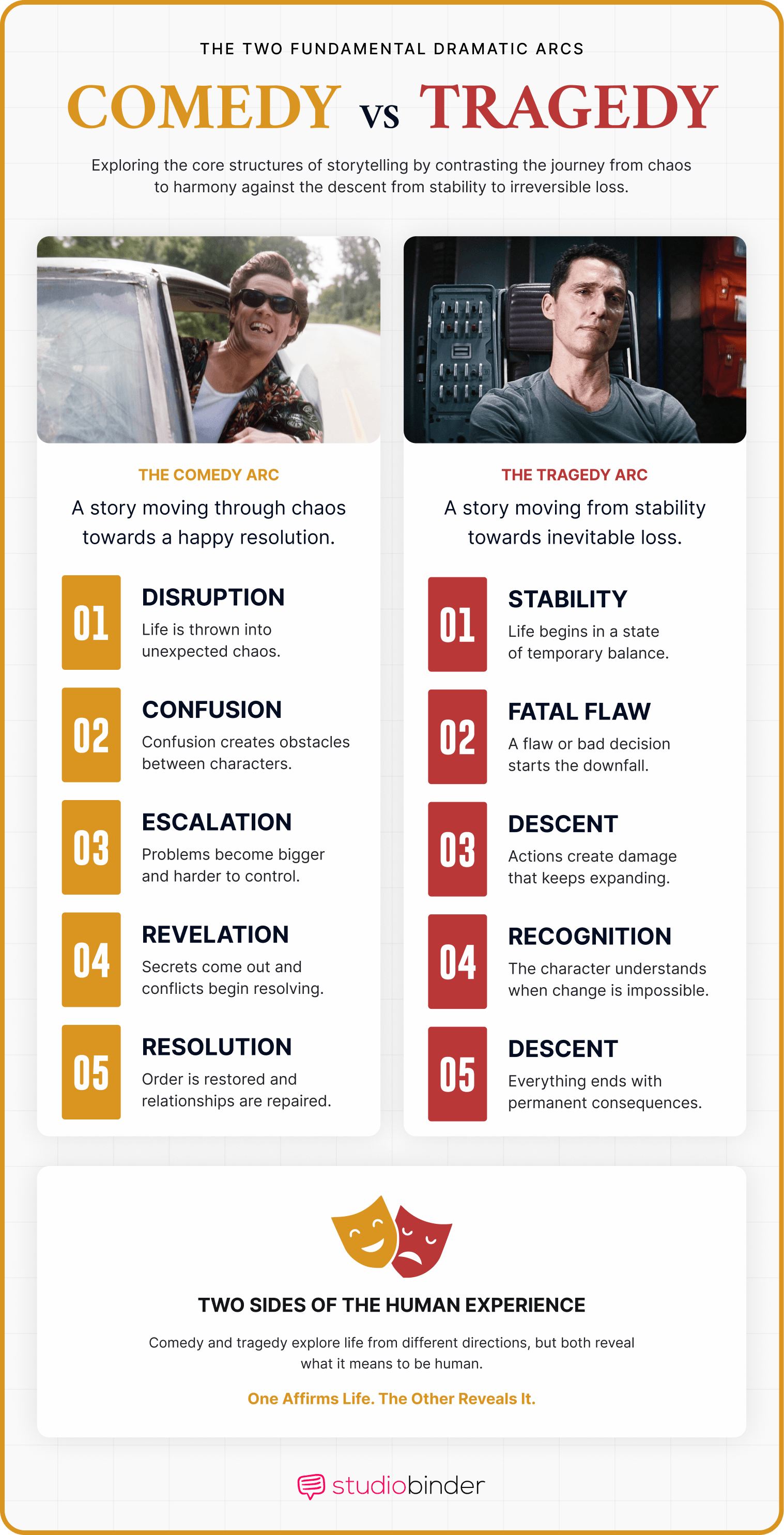
Understanding the difference between comedy and tragedy starts with structure, not tone.
Element | Comedy | Tragedy |
|---|---|---|
Dramatic arc | Upward — ends in gain | Downward — ends in loss |
Protagonist outcome | Better position than start | Worse position than start |
Conflict | Temporary, resolvable | Irreversible |
Emotional response | Relief, laughter | Catharsis, pity, fear |
Ending | Harmony, reunion, marriage | Death, exile, recognition |
Misunderstanding role | Source of plot, resolved | Reveals fatal truth |
Social status focus | All levels | High-status figures |
Trajectory
Comedy ends in gain. Tragedy ends in loss.
Emotion
Comedy produces relief. Tragedy produces catharsis.
Status
Tragedy often centres on high-status figures. Comedy includes all levels.
Resolution
Comedy resolves misunderstanding. Tragedy reveals irreversible truth.
Tone vs outcome
Tone can overlap. The ending determines the form.
The difference between comedy and tragedy is often reduced to tone. That is misleading.
Both forms can contain humour. Both can contain pain.
The distinction lies in outcome and structure.
In comedy, conflict is temporary. It exists to be resolved. Even when the stakes feel high, the structure guarantees some form of repair.
In tragedy, conflict is irreversible. The outcome is fixed. The tension comes from watching the character move toward it.
Another way to frame it:
Comedy asks:
how can this be fixed?
Tragedy asks:
what happens when it cannot be?
That shift changes everything.

THE CLASSICS
There are many great examples of comedy and tragedy being used in films. We've put together some of our favorites ones in the list below.
The play is built entirely on misdirection. Lovers are mismatched. Identities are confused. Magic interferes with perception. The final act resolves every thread at once. Couples are restored. Order returns. The chaos is not erased. It is reorganised.
If you want to study how these are built at the script level, many are available to read online.

At first, the show feels closer to tragedy. The protagonist is isolated, grieving, and self-destructive. But structurally, it moves toward resolution. The final moment, where she stops looking at the audience, signals change. She no longer needs the performance. That shift is the resolution.

This is the clearest example of classical tragedy. The protagonist seeks the truth. Each discovery brings him closer to it. Oedipus Rex is also one of the earliest examples of dramatic irony in Western drama — the audience knows the truth before the character does. The recognition scene completes the structure. Knowledge does not save him. It destroys him.
![Oedipus Rex (1967) Original Trailer [FHD]](https://i.ytimg.com/vi/_UTLcz47uf8/hqdefault.jpg)
Walter White's arc is gradual but precise. Each decision solves an immediate problem while creating a larger one. His tragic flaw is not indecision, but justification. He always has a reason. The final episodes confirm what the structure has been building toward. He is the source of the destruction. The ending does not restore balance. It confirms collapse.

Comedy and tragedy masks are both defined by their plot arc. And the plot arcs of all the above stories are filled with comedy and tragedy in abundance.
Comedy ends with improvement. Tragedy ends with irreversible loss. The difference between comedy and tragedy is structural, not tonal. Both forms can contain humour. Both can contain pain. What separates them is how the plot resolves.
The smiling mask represents comedy. The weeping mask represents tragedy. Together, they represent the full range of drama. The comedy and tragedy masks meaning is structural — they communicate whether a story ends in resolution or in loss.
Yes. This is tragicomedy. Neither structure fully dominates. The story holds tension between resolution and loss without fully committing to either.
The masks come from ancient Greek theatre. Actors wore them in performances staged at religious festivals, including the festival of Dionysus. A smiling mask signalled comedy. A weeping mask signalled tragedy. The tragedy and comedy masks later became associated with two Greek Muses — Thalia (comedy) and Melpomene (tragedy).
Tragicomedy is a dramatic form that blends elements of both tragedy and comedy without fully resolving into either. Anton Chekhov's plays are the classic literary examples. Joker (2019) is a modern film example. The result is a story where neither the comic nor the tragic mask fully applies.
The structural difference is the same in both. Comedy arcs upward. Tragedy arcs downward. What changes is the medium. Film compresses the arc across roughly two hours. Theatre presents it in real time, in the same physical space as the audience. The emotional intensity differs — but the structural logic is identical.
Comedy promises that things will come together. Tragedy suggests they will fall apart. Both offer clear directions, clear outcomes. That's how the comedy and tragedy masks work.
But many of the most memorable stories resist that clarity. They move between humor and loss, allowing both to exist at once without fully resolving either. Let's take a look at this and many more aspects of story structure in the next article.
此内容由惯性聚合(RSS阅读器)自动聚合整理,仅供阅读参考。 原文来自 — 版权归原作者所有。