


Ever wonder how the host of your favorite podcast always has something to talk about every episode? It’s most likely because they have a podcast script. Podcasting is a powerful storytelling medium, as Alex Blumberg, co-founder of Gimlet Media, claims that audio is best at “creating empathy.” So how do you leverage the power of the medium for your show? Having a clear plan.
Even the most popular podcasts have a format or outline they follow, which is why in this post we’re going to break down what podcast scripts are, what they do for your show, and why they matter. We’ll also provide templates for each type of podcast script, equipping you with everything you need to craft one that works for your show. Now let's learn how to write a podcast script!
A podcast script is a document that guides the host(s) through a podcast episode. It outlines what will be said, in what order, and how the conversation will flow from start to finish. The purpose of a podcast script is to keep the episode focused, on time, and polished — while still sounding natural and engaging to listeners. Having a podcast script matters since it allows you to make the most of their recording session while with a clear-cut plan of action for every episode.
How to make a podcast script
Not all podcast scripts are created equally. There’s a variety of different ways to format your podcast script given your show’s style and needs.
A fully scripted podcast means that every sentence of the episode is pre-written for the host(s) to read when recording. While scripting the entire episode beforehand cuts down on tangents, ensures accuracy, and makes for easier editing in post-production, without a strong delivery, the script can sound robotic.
Therefore, the full script approach is best for documentary-style podcasts, educational series, or audio dramas. Check out this example of a fully scripted audio drama:

Rather than writing out everything the host will say, an outline-only script provides the skeleton of the episode. Generally, only bulleting out the key topics, questions, transitions, means less prep time and a more authentic energy in your podcast. However, going off-topic becomes a risk with this style of podcast script, thus requiring more editing. So, determine how much you want to stick to your show notes.
Outline-only scripts best suit interview and chat shows, along with panel-style podcasts. Talk shows with longtime interviewers like Howard Stern likely work off of outlines when talking to their guests:

A hybrid podcast script combines scripted segments with outlined ones to strike a balance between structure and spontaneity. Typically, the intro, outro, sponsor reads, and key transitions are fully scripted for consistency and professionalism, while the main segments such as guest or panel discussions are more loosely outlined to feel natural and authentic.
While hybrid scripts utilize the best of both worlds, this type of podcast script requires discipline in knowing where and how much to script as opposed to when to allow for more space. Check out how the talk show The Ladygang uses scripting to introduce their guest before they dive into a looser conversation:

Sample podcast script
There’s a podcast about everything nowadays. No, really. As of March 2026, there are 4.6 million podcasts worldwide in the Podcast Index. Yet no matter how unique your topic or niche, there are key elements that every good podcast script includes. Let's go over how to write a podcast script with a clean structure.
The intro welcomes your listener, introduces (or re-introduces) the host, as well as hooks the reader into the episode’s main topic. Whether it’s through an interesting fact or compelling statement, the intro draws the listener and gives them an overview of what they can expect from the episode.
If your podcast is an interview-based talk show or panel discussion, your guest introduction comes next. Outlining, if not full-on scripting, guest introductions is a good idea. It prevents you from making mistakes on key information about your guest(s), as well as shows your respect that they’re here.
This is where the interview, panel discussion, storytelling, or lesson of the episode takes place.
If you’re scripting a show based on conversation, it’s best to outline your questions to allow the discussion to evolve naturally. Yet your podcast is an educational deep-dive or documentary, a more tightly scripted main segment will serve you better.
Segues are the spoken bridges that carry your listener from one topic or segment to the next. Usually, they consist of a sentence or two of dialogue that logically and intentionally shift your episode into a new talking point.
A transition, on the other hand, is a broader device that signals a shift in the episode. It can be spoken dialogue, but musical stings, sound effects, or even a few seconds of silence signals a change in the episode. Segues are a form of a transition.
Sponsors messages are promotional spots where brands pay a podcast to mention their products or services. Unlike traditional radio ads, podcast sponsor messages are typically read by the show’s hosts to boost the ad’s feeling of trustworthiness and reliability.
A summary provides a brief recap of the key takeaways from the episode. Meanwhile, the outro doesn’t need to contain much more than thanking any guests or sponsors, crediting contributors, teasing the next episode, and using a consistent, branded sign-off.
A call to action (CTA) is a short, straightforward message that offers value to the audience. Common examples include asking for your audience to subscribe to your show, leave a review, follow on social media, or directing listeners to engage with your business.
How to start a podcast script
Now that you know which format of podcast script is best for your show, it’s time to get scripting. A/V scripting is ideal for scripted formats, such as narrative-driven interviews, documentaries, fiction, etc., in which word count and runtime become critically important. StudioBinder’s A/V scripting software is the perfect place to get started for this process.
Preparation is the key to success. So before you start scripting, bullet out any ideas about your podcast episode’s topic, or research your guest to begin planning the podcast’s script.
Ask yourself: what's the one thing a listener should know or feel after this episode? That single answer shapes every section of your show.
From there, jot down three to five brief talking points, hooks, transitions, questions, or examples for every section of your podcast. The A/V script outline inside StudioBinder makes it easy to build a script outline.
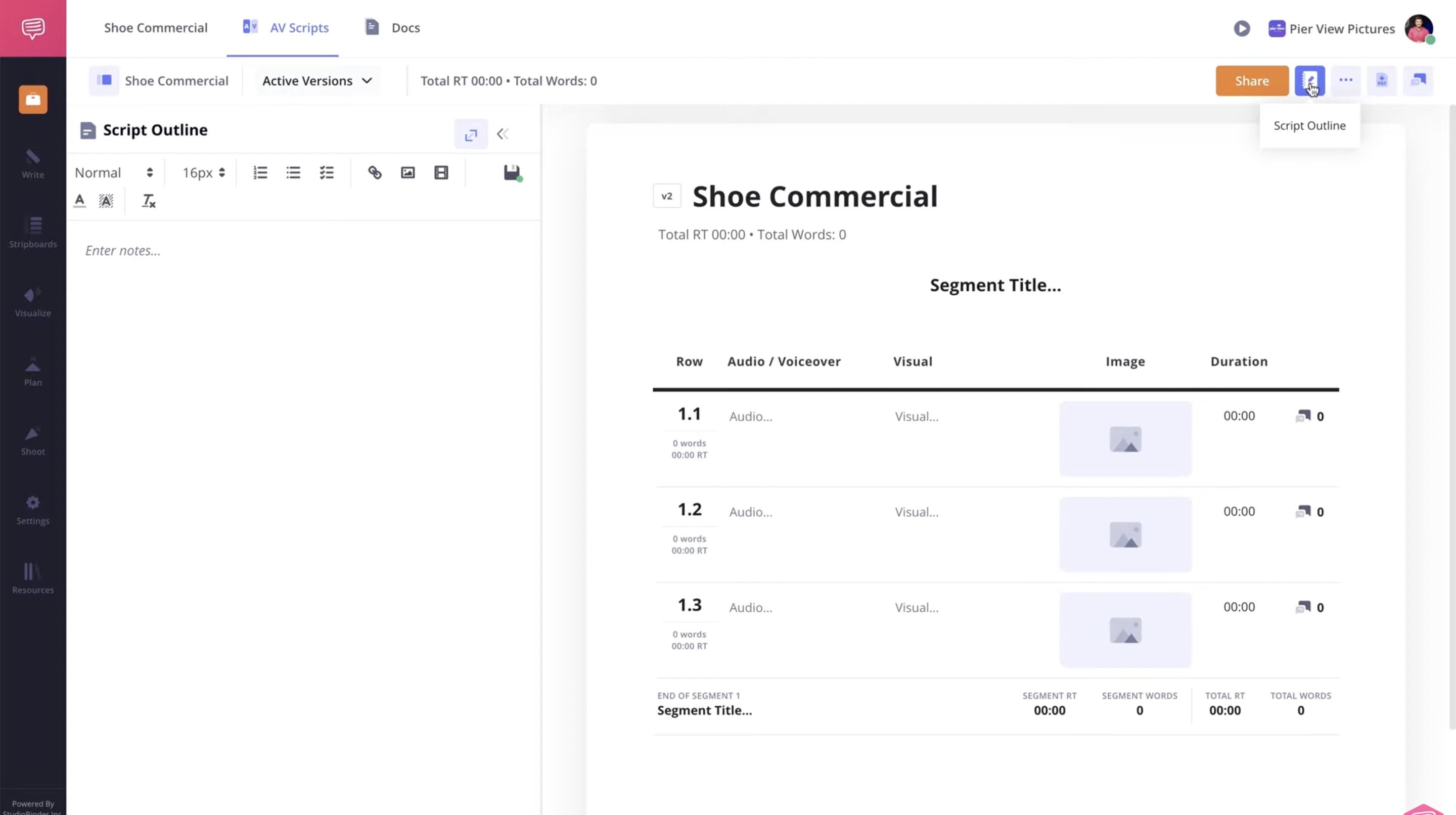
Podcast speaking should be natural while also keeping aware of overall performance. Even if your podcast is about robots, you don’t want your script to sound robotic. Whether it's for a commercial break, skit, or the intro/outro, strive to write how you speak.
In StudioBinder's AV script, you can use a stopwatch to time yourself as you read your copy aloud to ensure it stays within your allotted runtime.
Incorporating the important technical aspects of the episode turns your podcast scripts into more – it makes it a full-on production guide that a producer, host, and editor (or perhaps someone acting as all three roles) can easily follow.
It also gives you a more accurate idea of the show flow and runtime of the episode. Knowing how to script for podcasting with these key details will really tighten your work load.
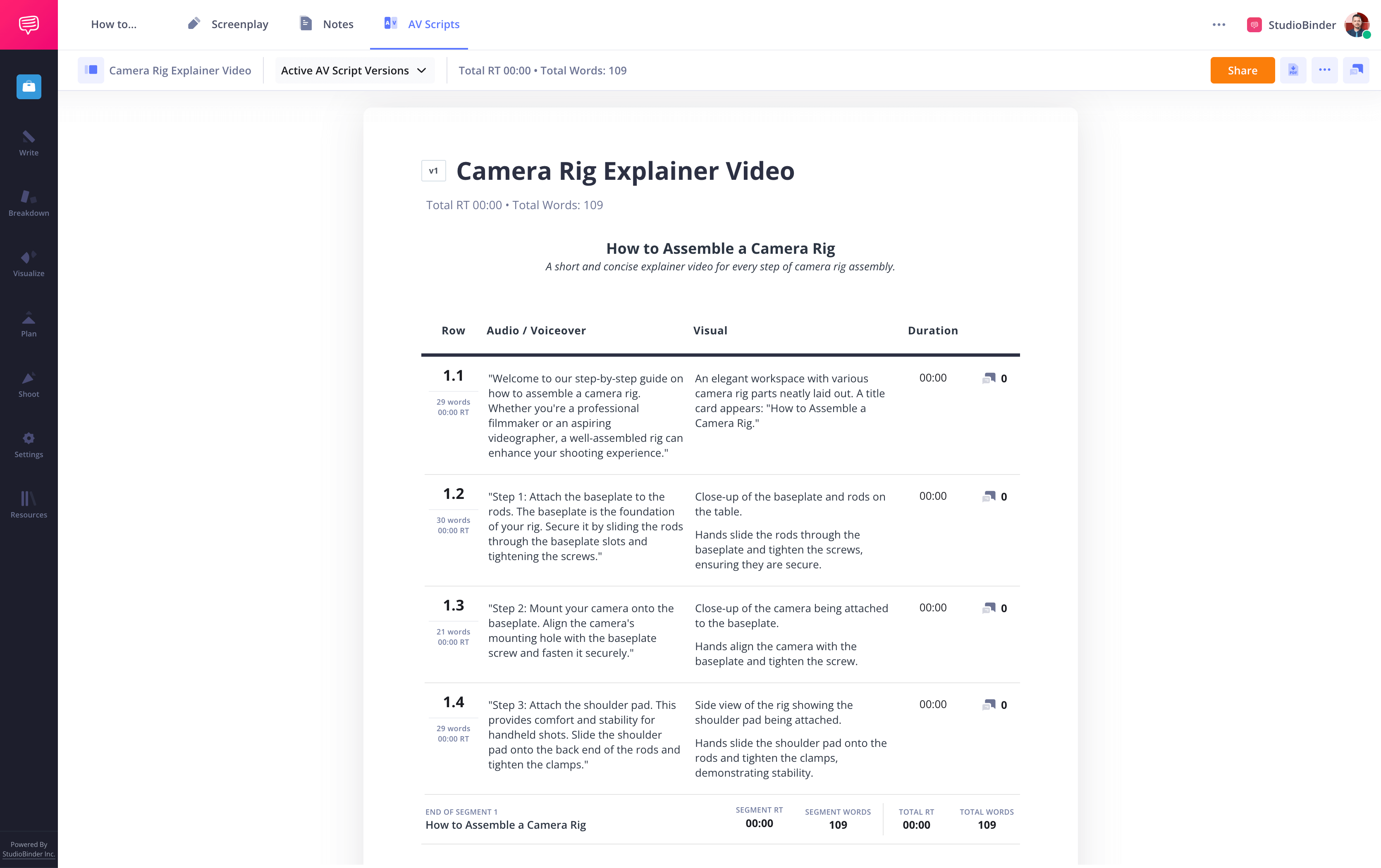
Reading your script out loud for any clunky or confusing phrasing is a great way to catch where you need to polish.
You can invite your team to add notes to your AV script. Each line has a comments feature so the feedback you receive can be precise.
How to write a podcast script
No matter what format your podcast is – a roundtable, solo show, or interview – your show can benefit from scripting. Check out the table below to inform which style of podcast script is best for you:
Script Style | Best For | Structure Level | Pros | Cons |
|---|---|---|---|---|
Minimalist Outline | Casual shows, experienced hosts | Low | Natural, flexible, fast to produce | Can ramble or lose focus |
Fully Scripted Narrative | Storytelling, branded podcasts | High | Polished, tight storytelling | Time-consuming to write |
Solo Host | Educational or opinion content | Medium | Clear voice, controlled pacing | Requires strong delivery |
Interview | Guest-driven shows | Medium | Engaging, dynamic conversations | Can go off-topic |
Q&A | Audience-driven content | Medium | Interactive, easy to plan | Depends on audience input |
How-To / Tutorial | Educational podcasts | High | Clear, actionable structure | Can feel rigid |
Roundtable | Panel discussions | Medium | Multiple perspectives, lively | Harder to manage flow |
Even the most experienced podcaster and the most casual, conversational show can do with a bit of structure to prevent the discussion from rambling. It's all about knowing how to write a podcast script that stays on its own tracks. Check out the template below for how to craft a minimalist outline:
This template gives you the barebones that may be enough for an old pro host, or provide a jumping off point for further scripting.
For podcasts that require a full script, keep in mind that your goal is to build tension across scenes with tight and purposeful dialogue. Using sound effects and music can also be effective tools to replace exposition and keep the story moving.
Check out the template below that allows you to combine dialogue with runtime and effects all in one place.
How do you keep listeners returning to your podcast episode-after-episode? Leave them wanting more.
While every narrative podcast episode should advance the story, ending your episode on a cliffhanger or revelation entices your audience to keep tuning in.
While solo-hosted shows don’t have to worry about cross-talk or rambling guests, having a script with clearly defined lead in across the sections of your podcast script allows your recording session to be smooth and focused.
Check out how those details were applied with StudioBinder's AV scripting below.
While it’s wise to script your questions for an interview podcasts, prioritize storytelling and allow for natural conversation over rapid-fire questions. Alternating the depth of questions – a superficial choice with an exploration of process or craft, for example – keeps the interview’s pace dynamic.
Notice how the AV script example below showcases a rough outline that allows for new conversation paths to open up.
When scripting a Q&A podcast where listeners call in or submit written questions, aim to vary questions across beginner and advanced levels on a specific topic, as it helps an episode remain organized and evergreen.
The Q&A AV script example below will give you an idea of how this can be applied.
Unless you’re a longtime expert in your field, how-to/tutorial podcasts tend to require tighter scripting in order to ensure accuracy. Let's dive further into podcasting scripts when it comes to tutorials. Here’s a template to explore with these types of scripts:
A roundtable podcast script requires clearly structured, scripted questions that allow for panelists to provide insightful answers and share their expertise. Here’s a podcast script example to help you maintain a balance between scripting and allowing for natural discussion:
Trusted by over 1M creatives
AV scripts with built-in timing
Write in two-column format, track runtime, and share with version control
Podcast script length example
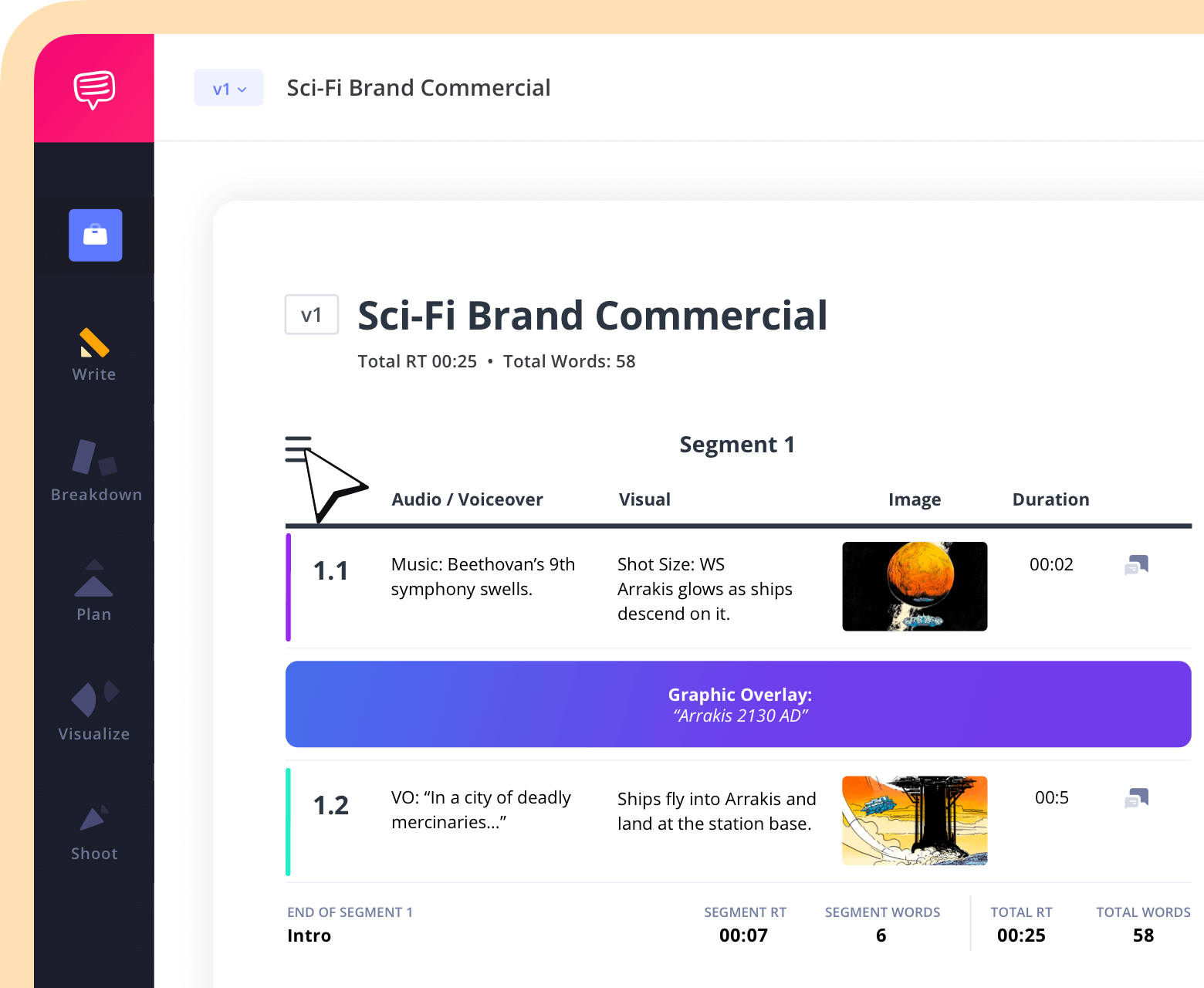
There’s no one magic length that a podcast script should be. While MarketingLTB reports that the average podcast length is 38 minutes, your script length depends on factors like format, topic, and audience expectations.
That being said, keep in mind that most podcast scripts run about 100–150 words per minute of audio (accounting for natural pauses, pacing, and emphasis).
You can use the below conversion from word count to runtime as a rule of thumb when writing a podcast script:
~1,000–1,500 words → 10-minute episode
~3,000–4,500 words → 30-minute episode
~6,000–9,000 words → 60-minute episode
Though there’s no hard and fast rule, format plays a role in how long a podcast script should be. Narrative and storytelling podcasts require fully scripted episodes, and audiences generally expect them to run anywhere between 30 to 60 minutes.
Meanwhile, interview-style chat shows or roundtables may work better off a detailed outline and can run up to two hours. Educational/how-to shows tend to function best with a hybrid podcast script to come in at the 20-40 minute mark that listeners expect.
Remember, these are all guidelines. As the award-winning podcaster Sarah Rhea Werner says, “There is no such thing as a podcast that’s too long, only too boring.”
No matter what your target runtime for your episode is, try to have your podcast script come in shorter.
Filler words, stumbles, and spontaneous asides almost always occur when recording, and they add time to your podcast script.
Podcast script generator
Now that you know how to write a podcast script, follow these practices to take your script to the next level. Most importantly, keep in mind that you want to write for the ear, not the eye. Using short sentences, contractions, and conversational language helps you to do this, along with reading your script aloud while you write.
It’s also wise to format your script for performance instead of reading. Using signposting liberally in your script with phrases like “here's the key takeaway," "let's back up for a second," or "so what does that mean?" guides.
Here are a few practical formatting tips to optimize your podcast script for performance:
Use double spacing
Mark pauses with [PAUSE] or em dashes —
Add emphasis cues like [stress this word]
Break long paragraphs into short breath-sized chunks
Write out pronunciations, like Aoife [pronounced ee-fuh]
Maximize your runtime by keeping your intro script short. Most listeners will skip an overly long intro anyway, therefore, leading with a hook and quick introduction that mentions the episode’s value within the 60-90 seconds is a good rule of thumb.
The same goes for outro scripts. Asking your listeners to subscribe, follow, leave a review, visit your website, AND share with a friend can overwhelm them. Pick one action per episode and make it specific.
Lastly, script your transitions explicitly. Sure, you want to leave room in your podcast script for conversations to flow naturally. Yet writing out clear transitions between segments and sponsor message placements takes the pressure off improvising a smooth transition and cuts down on the chance of slip-ups or needing multiple takes.
It's always best to check things off as you expand your knowledge on how to write a podcast script. Use the checklist below to ensure you’re following the podcast script best practices:
Structure & Planning
☐ Identify a clear topic and goal
☐ Define distinct segments (intro, hook, main, CTA, outro)
☐ Make a logical show flow with smooth, scripted transitions
Hook & Engagement
☐ Lead with a strong hook in first 30–45 seconds
☐ Identify a lear listener value/pain point
Clarity & Delivery
☐ Use conversational, concise language
☐ Focus on one idea at a time with clear transitions/signposts
☐ Format the script for performance
Audience Connection
☐ Speak directly to the listener
☐ Maintain consistent tone
CTA & Outro
☐ One clear, simple call to action
☐ Close with a clear, concise outro
Final Check
☐ Edit for clarity and brevity
☐ Read time matches intended runtime
☐ Flows naturally when read aloud
Podcast script writer
Now that you know the basics of how to write a podcast script, let’s cover what not to do when writing a podcast episode script. Steer clear of the following common mistakes:
Check out the below comparison of how scripting these moments serves your show:
Podcast Element | Good Script | No Script |
|---|---|---|
Call to Action | HOST: If this helped, follow the podcast and share it with another filmmaker. | HOST: Uh… yeah, follow if you want, I guess. |
Outro | HOST: Thanks for listening. Now go open your timeline—and start cutting smarter. | HOST: Alright… that’s it… bye. |
How to write a podcast script
We’ve taken you step-by-step through the process of how to write a script for a podcast and the various script types (narrative, interview, solo) you may encounter. In addition to our podcast scripting guide, we’ve also organized the ultimate cheatsheet of tools and resources for below:
These are our top tools for writing your actual podcast script:
Sharpen your skills with these platforms that specialize in audio storytelling.
To ensure a smoother delivery of your script, check out these teleprompter apps before you hit record:
To optimize your podcast’s SEO and reach, providing a transcript of your podcast along with the audio file is now standard. These are the best tools to save yourself hours of transcribing. Even if your podcast was already fully scripted, these apps help bridge the gap between what was on the page, and what was actually said:
Script detail depends on your comfort level and format. Some hosts, especially beginners, or those making audio drama or solo narrative documentary shows, prefer full word-for-word scripts. Others, especially experienced hosts, or those hosting interview or chat shows, work from bullet points or outlines to keep delivery natural yet structured. A hybrid podcast script tends to be one’s best option. Script the episode hook, key introductions/conclusions, transitions, and sponsor messages. Using bullet points or notes for the main segments allows your podcast to retain a more natural, conversational flow.
Yes. A script should guide, not confine you. Leave room for natural conversation and ad-libs, especially in interviews or co-hosted shows. However, improvising too much can lead to tangents and make editing more difficult.
There are some key differences in a podcast outline vs. script. An outline lists the sequence and main points of an episode, while a script includes complete dialogue, cues, and audio notes for recording and editing. Again, many shows use a hybrid script that fully writes some sections out word-for-word, and leaves others in outline form as bullet points.
If you have sponsors, then yes. It is best to plan their placement in your podcast script, as well as script transitions into sponsor messages and copy. Therefore, the message sounds natural and matches your episode flow.
The easiest way is to write like you speak. Use short sentences, natural phrasing, and read aloud during drafting to ensure your script flows as spoken audio. However, avoid scripting in filler phrases like "um," "you know," "kind of," or "sort of" into the script itself. These creep into delivery on their own — you don't need to write them in.
You’ve learned the basics of how to write a podcast script, read the sample podcast scripts, and used our templates to write your own engaging script for your show. So what’s next? Recording! Take a look at our post that is the ultimate guide on the best podcast recording software for all budgets and operating systems.
此内容由惯性聚合(RSS阅读器)自动聚合整理,仅供阅读参考。 原文来自 — 版权归原作者所有。