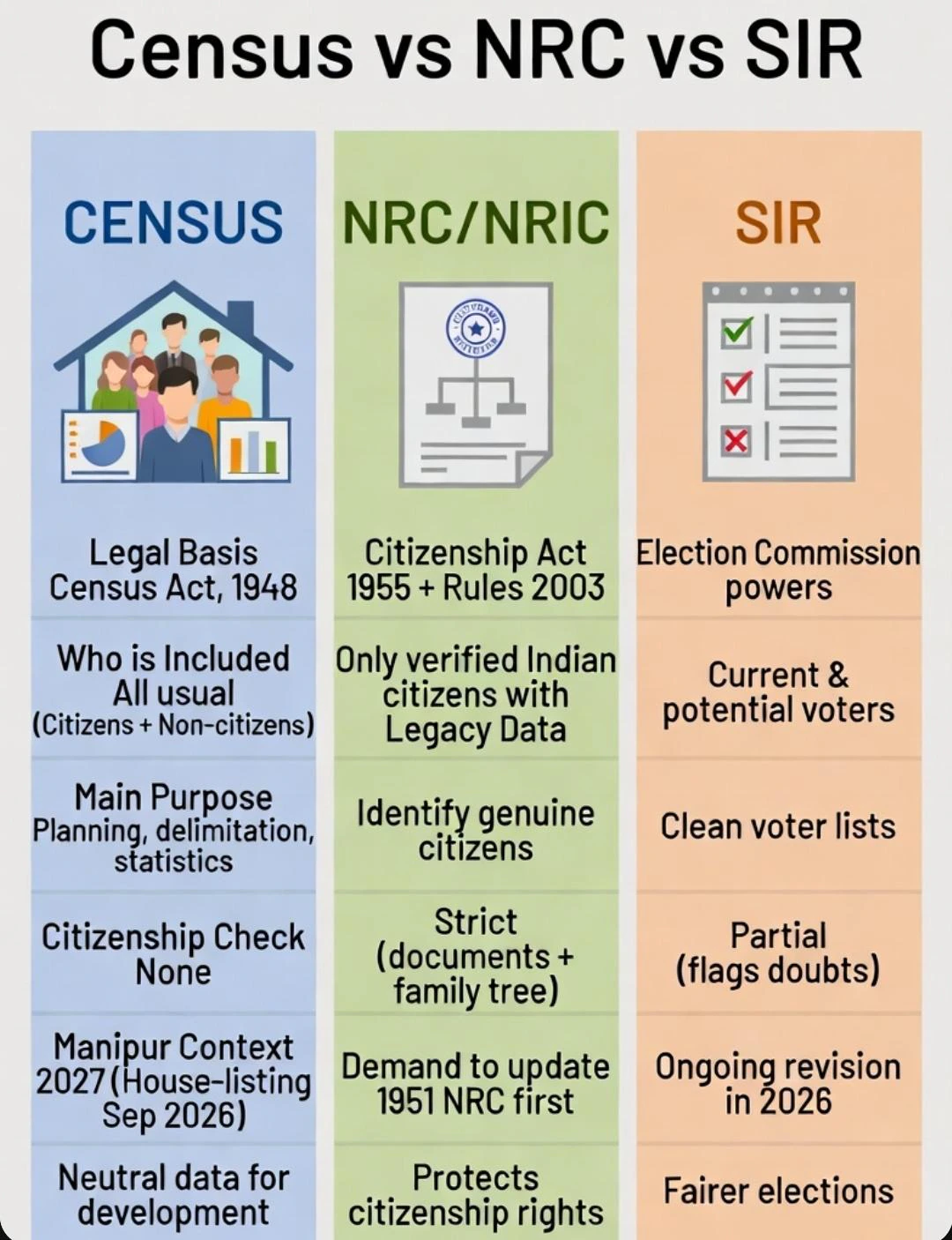








In Manipur, a state grappling with complex issues of illegal immigration, demographic shifts, ethnic tensions, and the preservation of indigenous rights, updating this 1951 NRC emerges not merely as an administrative option but as a pressing necessity that can be effectively coordinated with the upcoming Census 2027.
NRC updation alongside the Census 2027 offers a clear win-win solution for the present BJP government under Chief Minister Yumnam Khemchand as well as the civil society organisations (CSOs) who have been consistently demanding NRC in Manipur.
For the government, it provides a practical, legally sound pathway to address long-standing public concerns without derailing essential developmental data collection.
And for the CSOs and indigenous groups, it ensures that citizenship verification happens meaningfully before numbers are locked in, safeguarding demographic balance and identity. This coordinated approach can bridge divides and deliver concrete results on the ground.
The National Register of Citizens (NRC) prepared in 1951 stands as one of the earliest systematic attempts in independent India to document its citizenry. Compiled right after the 1951 Census, this register captured vital particulars of individuals — including name, relationship to head of household, nationality, religion, age, birthplace, mother tongue, occupation, literacy, and sex.
It served as the foundational record of Indian citizens in the immediate post-independence era, rooted in the constitutional framework of citizenship as defined under Article 5 of the Indian Constitution, which came into force on 26 January 1950.
However, a common misconception is that the NRC and Census are inextricably linked in a fixed chronological order. In reality, there is no mandatory legal provision that binds the updation of the NRC to the conduct of the Census in a rigid sequence.
While the original 1951 NRC drew data from the simultaneous 1951 Census exercise, the governing laws today allow significant flexibility. The Census operates under the Census Act, 1948, whereas the NRC falls under the Citizenship Act, 1955, and the Citizenship Rules, 2003 (as amended).
Both exercises are overseen by the Office of the Registrar General and Census Commissioner under the Ministry of Home Affairs (MHA), but they pursue fundamentally different objectives.
The distinction enables states like Manipur to sequence or run them in a coordinated manner — for instance, initiating a targeted updation of the 1951 NRC as a dedicated phase, proceeding with the neutral Census for statistical purposes, and then preparing a refined NRC 2027.
This coordinated approach respects the distinct roles of each exercise:
(a) Census for inclusive population statistics and planning;
(b) NRC for accurate citizenship identification and protection of indigenous demographics;
(c) SIR for clean electoral rolls; and Foreigners Tribunals for fair adjudication.
Former Chief Minister N. Biren Singh deserves recognition for his bold and consistent stand on the implementation of NRC in Manipur to detect and address illegal immigration. Under his leadership, the Manipur Legislative Assembly passed a resolution on 5 August 2022 urging the Central Government to implement the NRC in the state. This was further reaffirmed on 1 March 2024, when the House once again resolved to urge the Government of India to implement the National Register of Citizens in the interest of Manipur and the nation at large.
N Biren Singh repeatedly highlighted how the sudden mushrooming of new settlements posed an existential threat to the indigenous population and emphasized that NRC was crucial for safeguarding the state’s demographic balance, security, and future.
His government’s proactive resolutions reflected a firm commitment to protecting indigenous rights amid growing concerns over porous borders and demographic changes.
With the change in leadership, the new government under Chief Minister Yumnam Khemchand Singh, who assumed office on 4 February 2026 following a period of President’s Rule, now carries the responsibility forward.
The battle to update the 1951 NRC alongside the 2027 Census is not an easy task. It demands meticulous planning, inter-departmental coordination, handling of legacy records, stakeholder consultations across communities, and resolution of potential legal and logistical challenges.
Therefore, the new government must promptly consult experts who are authorities in the Census and population domain — including officials from the Office of the Registrar General and Census Commissioner, legal experts on citizenship matters, and experienced administrators who have handled similar exercises elsewhere — to develop a clear, robust, and time-bound framework for this to happen.
Such expert consultation would help design modalities that address concerns like incomplete legacy records, digitization gaps, acceptance of single admissible documents for family-tree linkage, and integration with the Census timeline. It would also ensure transparency, adequate notice periods, provisions for appeal, and full adherence to due process through Foreigners Tribunals.
This, Census, National Register of Citizens (NRC), Special Intensive Revision (SIR), and Foreign Tribunals are important but often misunderstood concepts in the context of India's citizenship and demographic governance.
Many of us tend to confuse one with another due to overlapping objectives and frequent political discussions. Let us clearly understand what each of these terms actually means and how they differ from one another.
The Census
In India, it represents a periodic, comprehensive enumeration of the population, houses, and associated socio-economic details. Governed by the Census Act, 1948, the exercise is conducted by the Registrar General and Census Commissioner whenever the Central Government deems it necessary — traditionally every ten years.
Who is enumerated in the Census?
The Census counts all usual residents in households, irrespective of their citizenship status. This broad inclusion covers:
(a) Individuals who normally reside in the household.
(b) Normal residents who stayed for part of the enumeration period or are expected to return shortly.
(c) Visitors, servants, tenants, and others meeting the usual resident criteria.
(d) Foreign diplomats are excluded, but other foreign nationals residing in India and their Indian staff are generally included.
The Census does not probe questions related to foreigner status, illegal immigration, or require declarations of six-month stay in the manner sometimes conflated with other processes. Its primary character is aggregate and statistical: individual data remains confidential and is used only for broad policy planning, resource allocation, housing and amenity projections, population-based welfare schemes, and the delimitation of parliamentary and assembly constituencies.
In Manipur, the Census 2027 follows a structured timeline. A self-enumeration facility will be available from August 17 to August 31, 2026, allowing residents to submit details online or through designated modes before the intensive house-to-house enumeration begins.
The house-listing phase (Phase I – House Listing and Housing Census) is scheduled for September 1 to September 30, 2026, within the national window of April 1 to September 30, 2026.
This exercise will provide invaluable data for development planning in a state that has faced prolonged ethnic conflicts and needs accurate figures for infrastructure, education, health, and rehabilitation efforts.
However, because the Census is citizenship-neutral, conducting it without addressing underlying citizenship concerns risks distorting demographic statistics and complicating future delimitation and resource distribution.
The NRC (National Register of Citizens / NRIC)
The National Register of Citizens (NRC) — frequently referred to in policy discussions as NRIC (National Register of Indian Citizens) — is not a population count but a verified list of Indian citizens only. It is governed by the Citizenship Act, 1955, and Citizenship Rules, 2003.
Citizenship being a subject on the Union List, the Centre lays down policy and provides funds, while states implement the process under the guidance of the Registrar General of India.
Core Principle of Inclusion in NRC:
(a) Only persons (and their descendants) who can trace their citizenship through legacy data qualify. This includes: Direct appearance in the 1951 NRC, or
(b) Names in electoral rolls up to the cut-off date (midnight of 1 March 1951 at the national level, or state-specific equivalents such as 24 March 1971 in Assam), or
(c) Other admissible legacy documents like land records, birth certificates, passports, or official records issued up to the relevant cut-off.
The verification process emphasizes building a family tree or linkage. Importantly, only one admissible document is generally sufficient to establish the link — not all documents need to be produced. Where digitized records are incomplete or faded, physical verification or alternative proofs can be considered.
In the proposed Manipur-specific framework, this creates a clear categorization:
(a) Citizen of Manipur: Individuals with verifiable legacy in the 1951 NRC, electoral rolls, or admissible documents.
(b) Non-Citizen of Manipur: Others, further divided into (i) Indian citizens who migrated from other parts of India after 1951 (who can continue to reside as per prevailing rules, including Inner Line Permit/ILP regulations where applicable), and (ii) foreigners (born outside India without legacy, who would be referred to appropriate legal processes).
Unlike the Census, which inclusively counts every usual resident for statistical purposes, the NRC is a citizenship verification exercise. Non-citizens are excluded only after due process, not arbitrarily.
A practical and balanced approach for Manipur would involve:
(a) Updating the 1951 NRC as an initial dedicated phase using legacy documents and family-tree linkage.
(b) Conducting the 2027 Census to capture comprehensive population data for planning and delimitation.
(c) Preparing a fresh NRC 2027, potentially leveraging National Population Register (NPR)-style data with additional particulars for cross-verification.
The National Population Register (NPR), often mentioned in this context, is a register of all usual residents (similar in scope to the Census) but with more detailed individual information, including biometrics linked to Aadhaar. Conducted under the Citizenship Rules, NPR serves as a potential feeder database for citizenship verification but remains distinct from the confidential, aggregate nature of the Census.
Special Intensive Revision (SIR)
The Special Intensive Revision (SIR) of electoral rolls is a distinct exercise conducted by the Election Commission of India (ECI). It is neither a Census nor a full-fledged NRC. SIR focuses exclusively on revising and purifying voter lists through intensive house-to-house verification.
Objectives of SIR
(a) Using pre-filled elector-specific enumeration forms and Booth Level Officers (BLOs), the exercise aims to: Delete names of deceased persons, duplicates, permanently shifted voters, and ineligible entries (including those suspected to be non-citizens).
(b) Add eligible new voters who meet the criteria.
In Manipur, preparations for SIR have been ongoing, with phases involving training of officials, distribution of forms, and coordination with political parties. SIR addresses practical challenges arising from urbanization, migration, unreported deaths, and possible infiltration into voter lists.
While it may flag doubtful cases for further scrutiny, its scope remains limited to electoral purposes. It does not substitute for comprehensive citizenship determination under the NRC and operates independently of both the Census and NRC processes.
Foreigners Tribunals
Foreigners Tribunals are quasi-judicial bodies established under the Foreigners Act, 1946, and the Foreigners (Tribunals) Order, 1964. Their primary mandate is to adjudicate whether a specific individual is a foreigner (i.e., not an Indian citizen) or an Indian citizen.
How the Process Works
A case is referred to the Tribunal by a competent authority, typically the district police or border branch, when reasonable doubt arises about a person’s citizenship.
The individual (referred to as the “proceedee”) is served a notice and given a reasonable opportunity to present evidence — documents, witnesses, oral testimony, etc. — to prove Indian citizenship.
The Tribunal examines the material and delivers a finding. If the person is declared a foreigner, further actions such as detention or deportation proceed only in accordance with law.
In Manipur’s proposed framework, individuals identified during NRC updation as lacking legacy documents and appearing to be foreigners (particularly those born outside India with no admissible proof of Indian citizenship) would be referred to Foreigners Tribunals.
This mechanism ensures constitutional safeguards, natural justice, and avoidance of arbitrary exclusion. Powers under the Foreigners Act have been delegated to state governments, including Manipur, enabling local handling of detection, restriction, and deportation processes.
Manipur has witnessed persistent demands from civil society organizations, student bodies, and political parties for NRC updation with 1951 as the base year. These voices, combined with the earlier Assembly resolutions, shows the urgency.
Although the legacy records from 1951 may be incomplete, faded, or not fully digitized. However, these can be mitigated through targeted digitization drives, acceptance of any single admissible document for linkage, physical verification where necessary, and broad stakeholder consultations.
The process need not be punitive; genuine Indian citizens migrating post-1951 from other states would retain their rights, subject to applicable residency rules like ILP in certain hill areas.
A well-coordinated approach — updating the 1951 NRC first or in parallel phases, conducting the 2027 Census for its developmental mandate, and finalizing an updated NRC 2027 — offers multiple advantages.
(a) It protects indigenous demographics without halting essential statistical exercises.
(b) It provides clear data for planning rehabilitation, infrastructure, and welfare in a conflict-affected state.
(c) It strengthens electoral integrity through complementary SIR efforts.
(d) It upholds due process via Foreigners Tribunals, preventing arbitrary actions.
Updating the 1951 NRC alongside preparations for the 2027 Census is not only feasible and legally sound but also logical and essential for Manipur. It balances the imperative of developmental planning with the equally vital need to safeguard indigenous identity, demographic balance, and constitutional citizenship principles.
By building on the bold initiatives of former Chief Minister N. Biren Singh and taking forward the Assembly’s resolutions under the new leadership of Chief Minister Yumnam Khemchand Singh through expert-guided frameworks, the state can chart a path of stability and equitable progress.
A coordinated, time-bound rollout with due process at its core would set a constructive precedent, ensuring that both citizenship security and inclusive growth advance hand in hand.
For a state like Manipur, yearning for normalcy and equitable progress after years of challenges, this approach offers hope grounded in law, history, and practical governance.
此内容由惯性聚合(RSS阅读器)自动聚合整理,仅供阅读参考。 原文来自 — 版权归原作者所有。