

惯性聚合 高效追踪和阅读你感兴趣的博客、新闻、科技资讯
阅读原文 在惯性聚合中打开

推荐订阅源

WordPress大学
WordPress大学
O
OpenAI News
钛媒体:引领未来商业与生活新知
钛媒体:引领未来商业与生活新知
博客园 - 三生石上(FineUI控件)
Webroot Blog
Webroot Blog
GbyAI
GbyAI
S
SegmentFault 最新的问题
Cyberwarzone
Cyberwarzone
Exploit-DB.com RSS Feed
J
Java Code Geeks
Google DeepMind News
cs.CV updates on arXiv.org
博客园 - 【当耐特】
S
Secure Thoughts
酷 壳 – CoolShell
酷 壳 – CoolShell
AWS News Blog
AWS News Blog
Engineering at Meta
Engineering at Meta
S
Security Affairs
H
Help Net Security
Microsoft Security Blog
D
DataBreaches.Net
云风的 BLOG
云风的 BLOG
Hugging Face - Blog
Hugging Face - Blog
Google DeepMind News
Spread Privacy
Spread Privacy
T
Threatpost
Forbes - Security
Forbes - Security
C
Cisco Blogs
Scott Helme
Scott Helme
Attack and Defense Labs
Simon Willison's Weblog
腾讯CDC
The Last Watchdog
The Last Watchdog
Cloudbric
Cloudbric
Last Week in AI
Last Week in AI
Recorded Future
Recorded Future
小众软件
小众软件
V
Vulnerabilities – Threatpost
美团技术团队
人人都是产品经理
人人都是产品经理
有赞技术团队
有赞技术团队
Apple Machine Learning Research
Hacker News - Newest:
Hacker News - Newest: "LLM"
I
Intezer
月光博客
月光博客
C
Cyber Attacks, Cyber Crime and Cyber Security
博客园 - 司徒正美
C
Cybersecurity and Infrastructure Security Agency CISA
Martin Fowler
Martin Fowler
博客园 - 聂微东

The Register - Offbeat: Geek's Guide

Away from Oktoberfest, Munich's museums serve science on tap Getting up close with the Concorde, Concordski, and Buran Geek's Guide to Britain: Newport Transporter Vaccine dreams: A trip to Oxford to see a biscuit tin, some bed pans and ChAdOx1 nCov-19 Western Approaches Museum: WRENs, wargames, and victory in the Atlantic The Eigiau Dam Disaster: Deluges and deceit at the dawn of hydroelectric power The Wight stuff: Marconi and the island, when working remotely on wireless comms meant something very different Rewriting the checklists: 50 years since Apollo 13 reported it 'had a problem' – and boffins saved the day Come kneel with us at UK's Cathedral, er, Oil Rig of the Canal: Engineering masterpiece Anderton Boat Lift German scientists, Black Knights and the birthplace of British rocketry Talking a Blue Streak: The ambitious, quiet waste of the Spadeadam Rocket Establishment Orford Ness: Military secrets and unique wildlife on the remote Suffolk coast The Central Telegraph Office was serving spam 67 years before vikings sang about it on telly What made a super high-tech home in Victorian England? Hydroelectric witchery, for starters Are you aware of the gravity of the situation on Mars? Why yes, say boffins: We rejigged Curiosity to measure it Blueprint of modern construction can be found in a tech cluster... of 19th century England Mirror mirror on sea wall, spot those airships, make Kaiser bawl Take-off crash 'n' burn didn't kill the Concorde, it was just too bloody expensive to maintain Fancy a viaduct? We have a wrought Victorian iron marvel to sell you Life's a beach – then you're the comms nexus of the British Empire and Marconi-baiting hax0rs Worcestershire's airborne electronics warfare wonderland Hotter than the Sun: JET – Earth’s biggest fusion reactor, in Culham Fancy that! Craft which float over everything on a cushion of air Everything you never knew about mail: The Postal Museum opens Reg reader turns Geek's Guides to Britain into Geek's Map of Britain Extreme trainspotting on Britain's highest (and windiest) railway Lochs, rifle stocks and two EPIC sea gates: Thomas Telford's Highland waterway Going underground: The Royal Mail's great London train squeeze Turing, Hauser, Sinclair – haunt computing's Cambridge A-team stamping ground Avoiding Liverpool was the aim: All aboard the world's ONLY moving aqueduct Inside Electric Mountain: Britain's biggest rechargeable battery The field at the centre of the universe: Cambridge's outdoor pulsar pusher Come on kids, let's go play in the abandoned nuclear power station Bletchley Park remembers 'forgotten genius' Gordon Welchman Bookworms' Weston mecca: The Oxford institution with a Swindon secret Rock reboot and the Welsh windy wonder: Centre for Alternative Technology Get thee behind me, Satanic mills! Robert Owen's Scottish legacy The Great Barrier Relief – Inside London's heavy metal and concrete defence act Planet killer: Ex-army officer's Welsh space-rock mission Taming the Thames – The place that plugged London's Great Stink Bridge, ship 'n' tunnel – the Brunels' hidden Thames trip Marconi: The West of England's very own Italian wireless pioneer Suffering satellites! Goonhilly's ARTHUR REBORN for SPAAAACE Kingston's aviation empire: From industry firsts to Airfix heroes Measure for measure: We visit the most applied-physicist-rich building in the UK IBM Hursley Park: Where Big Blue buries the past, polishes family jewels Mosquitoes, Comets and Vampires: The de Havilland Museum How the UK's national memory lives in a ROBOT in Kew TAT-1: Call the cable guy, all I see is a beautiful beach
Saturn's rings, radio waves ... poetry? At home with Scotland's Mr Physics
2015-04-06 · via The Register - Offbeat: Geek's Guide

Geek's Guide to Britain Say the the word “radio” and the mind goes to Guglielmo Marconi, the Italian emigrant whose work on the watershed of Cornwall and the Atlantic Ocean helped turn wireless into the defining medium of the early 20th Century.

But radio wasn’t invented by Marconi – or any one person. Rather, it was discovered, and the man who drove that discovery was James Clerk Maxwell.

Maxwell is essential to physics as we understand it today. He didn't invent radio waves, but he did posit their existence. Without that leap of logic we wouldn't be wandering through the electro-smog in which we now delight.

Yet Maxwell’s contributions are not confined to radio; his theories on the rings of Saturn were born out by 20th Century science; he produced the first colour photo; and he founded and helped build Cambridge University’s Cavendish Laboratory in 1879 where he was the inaugural Cavendish Professor of Physics. The laboratory has since produced 29 Nobel Prize winners.

Oh, he was a poet, too. This was the 1800s, after all, when a chap with a beard could really make something of himself.

Maxwell’s birthplace and early home was a terrace house in Edinburgh New Town, built for James' father in 1820. New Town is a marvel of 19th Century civic thinking, designed to alleviate overcrowding that marries space with elegant architecture.

These days Maxwell's house belongs to the James Clerk Maxwell Foundation, which managed to buy it in 1993. If you want to see the house in person then you'll have to make an appointment, but there's a virtual tour and those interested in learning more about James Maxwell can take an Edinburgh walking tour covering his life.

James was born at 14 India Street on 31 July, 1831, though he only lived there for a couple of years before his family relocated to their 1,500-acre country estate in Galloway. When he was ten he moved back to attend the Edinburgh Academy but lived with his aunt, who resided around the corner from the James' family home – which was, at that point, being let out. In fact, 14 India Street was let to a succession of tenants; James inherited it on his father's death but never lived there again. He went on to study physics at Edinburgh and then at Cambridge University.
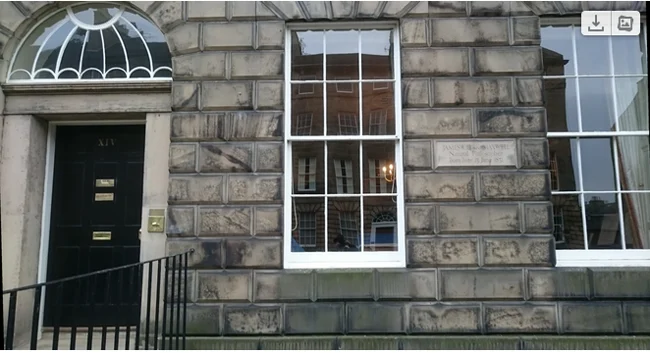
14 India Street, photo: Bill Ray

An unremarkable terrace house? Birth place of James Clerk Maxwell Photo credit: Bill Ray

In 1977 the James Clerk Maxwell Foundation was established to remind the world just what a marvelous chap he was, and in 1993 the opportunity arose to acquire the house in which he was born. That acquisition was largely made possible thanks to one Sydney Ross, who was relocating to the US and took the opportunity to leave some money behind – but also owed much to the increasing use of email, which had devalued local properties.

Being situated about a 30-minute stroll from the courts, the houses had attracted lawyers, whose briefs were delivered by hand. Email enabled them to move further away and so burst a minor property bubble. Professor David Ritchie, director of the James Clerk Maxwell Foundation, was then able to move in and grab the place for the nation.

If you want to look around the house then you need to get in touch with the James Clerk Maxwell Foundation, who will fix a time and day for Professor Ritchie to show you around.
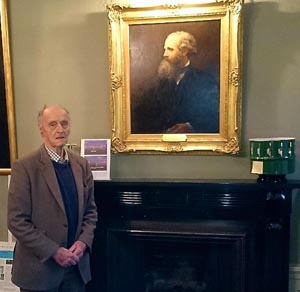
Professor David Richie, photo: Bill Ray

Professor Richie with James' zoetrope and portrait.
Photo credit: Bill Ray

Once bought, the house had to be extensively restored to a state Maxwell would recognise: the dark colours of the late Victorian era were stripped back and door frames returned to their former glory, and various sponsors and donors stumped up the cash to make the place look respectable while others contributed art and objects to furnish a small museum.

Maxwell might be best known for his equations covering the behaviour of an electromagnetic charge – but that was by no means his only contribution to the world. In the dining room we can see the world's first colour photograph. Maxwell set out to prove that three pictures shot through different filters could be combined to create a single image. The image of a tartan ribbon wasn't perfect, but it did work, and thus set in stone the concept of "RGB" – red, green and blue – with which we're so familiar today.