


惯性聚合 高效追踪和阅读你感兴趣的博客、新闻、科技资讯
阅读原文 在惯性聚合中打开

推荐订阅源

L
LINUX DO - 热门话题
T
The Blog of Author Tim Ferriss
IT之家
IT之家
OSCHINA 社区最新新闻
OSCHINA 社区最新新闻
N
Netflix TechBlog - Medium
D
Docker
Engineering at Meta
Engineering at Meta
阮一峰的网络日志
阮一峰的网络日志
Recent Announcements
雷峰网
雷峰网
博客园 - 司徒正美
大猫的无限游戏
大猫的无限游戏
美团技术团队
C
Cisco Blogs
V2EX - 技术
V2EX - 技术
N
News and Events Feed by Topic
Latest news
Latest news
博客园 - 三生石上(FineUI控件)
博客园 - Franky
Attack and Defense Labs
C
CERT Recently Published Vulnerability Notes
S
Secure Thoughts
博客园_首页
奇客Solidot–传递最新科技情报
奇客Solidot–传递最新科技情报
Microsoft Security Blog
The GitHub Blog
The GitHub Blog
Hacker News - Newest:
Hacker News - Newest: "LLM"
V
V2EX
Hugging Face - Blog
Hugging Face - Blog
W
WeLiveSecurity
The Register - Security
T
Tenable Blog
J
Java Code Geeks
The Cloudflare Blog
有赞技术团队
有赞技术团队
博客园 - 聂微东
P
Palo Alto Networks Blog
Security Latest
Security Latest
cs.CV updates on arXiv.org
S
SegmentFault 最新的问题
H
Hacker News: Front Page
L
Lohrmann on Cybersecurity
cs.CL updates on arXiv.org
酷 壳 – CoolShell
酷 壳 – CoolShell
T
The Exploit Database - CXSecurity.com
S
Security @ Cisco Blogs
Cisco Talos Blog
Cisco Talos Blog
Exploit-DB.com RSS Feed
CTFtime.org: upcoming CTF events
Hacker News: Ask HN
Hacker News: Ask HN

The Register - Offbeat: Geek's Guide

Away from Oktoberfest, Munich's museums serve science on tap Getting up close with the Concorde, Concordski, and Buran Geek's Guide to Britain: Newport Transporter Vaccine dreams: A trip to Oxford to see a biscuit tin, some bed pans and ChAdOx1 nCov-19 Western Approaches Museum: WRENs, wargames, and victory in the Atlantic The Eigiau Dam Disaster: Deluges and deceit at the dawn of hydroelectric power The Wight stuff: Marconi and the island, when working remotely on wireless comms meant something very different Rewriting the checklists: 50 years since Apollo 13 reported it 'had a problem' – and boffins saved the day Come kneel with us at UK's Cathedral, er, Oil Rig of the Canal: Engineering masterpiece Anderton Boat Lift German scientists, Black Knights and the birthplace of British rocketry Talking a Blue Streak: The ambitious, quiet waste of the Spadeadam Rocket Establishment Orford Ness: Military secrets and unique wildlife on the remote Suffolk coast The Central Telegraph Office was serving spam 67 years before vikings sang about it on telly What made a super high-tech home in Victorian England? Hydroelectric witchery, for starters Are you aware of the gravity of the situation on Mars? Why yes, say boffins: We rejigged Curiosity to measure it Blueprint of modern construction can be found in a tech cluster... of 19th century England Mirror mirror on sea wall, spot those airships, make Kaiser bawl Take-off crash 'n' burn didn't kill the Concorde, it was just too bloody expensive to maintain Fancy a viaduct? We have a wrought Victorian iron marvel to sell you Life's a beach – then you're the comms nexus of the British Empire and Marconi-baiting hax0rs Worcestershire's airborne electronics warfare wonderland Hotter than the Sun: JET – Earth’s biggest fusion reactor, in Culham Fancy that! Craft which float over everything on a cushion of air Everything you never knew about mail: The Postal Museum opens Reg reader turns Geek's Guides to Britain into Geek's Map of Britain Extreme trainspotting on Britain's highest (and windiest) railway Lochs, rifle stocks and two EPIC sea gates: Thomas Telford's Highland waterway Going underground: The Royal Mail's great London train squeeze Turing, Hauser, Sinclair – haunt computing's Cambridge A-team stamping ground Inside Electric Mountain: Britain's biggest rechargeable battery The field at the centre of the universe: Cambridge's outdoor pulsar pusher Come on kids, let's go play in the abandoned nuclear power station Bletchley Park remembers 'forgotten genius' Gordon Welchman Bookworms' Weston mecca: The Oxford institution with a Swindon secret Rock reboot and the Welsh windy wonder: Centre for Alternative Technology Get thee behind me, Satanic mills! Robert Owen's Scottish legacy The Great Barrier Relief – Inside London's heavy metal and concrete defence act Planet killer: Ex-army officer's Welsh space-rock mission Taming the Thames – The place that plugged London's Great Stink Bridge, ship 'n' tunnel – the Brunels' hidden Thames trip Saturn's rings, radio waves ... poetry? At home with Scotland's Mr Physics Marconi: The West of England's very own Italian wireless pioneer Suffering satellites! Goonhilly's ARTHUR REBORN for SPAAAACE Kingston's aviation empire: From industry firsts to Airfix heroes Measure for measure: We visit the most applied-physicist-rich building in the UK IBM Hursley Park: Where Big Blue buries the past, polishes family jewels Mosquitoes, Comets and Vampires: The de Havilland Museum How the UK's national memory lives in a ROBOT in Kew TAT-1: Call the cable guy, all I see is a beautiful beach
Avoiding Liverpool was the aim: All aboard the world's ONLY moving aqueduct
2016-07-28 · via The Register - Offbeat: Geek's Guide

Geek's Guide to Britain There are several fine examples of Victorian engineering still working in Blighty. Tower Bridge in London is one of my personal favourites. I was surprised to discover that another was on my doorstep. Well, 4.34km (2.7 miles) from my doorstep to be more accurate.

The Grade II-listed Barton Swing Aqueduct in Salford was built to solve the knotty problem of how to get the Bridgewater Canal across the proposed Manchester Ship Canal. And bar some routine maintenance, the odd lick of paint and a change of power source from steam to electricity, it has been doing the same job on a daily basis for over 120 years.

What makes the Barton Aqueduct even more interesting is that not only was it the first swing aqueduct to be built but it was also the last. To this day it is unique. And not just in the UK. Scour the globe and you’ll not find another one.

The aqueduct’s origins form part of the story of the Manchester Ship Canal – or the Big Ditch as it was fondly known – which opened in January 1894.

Straightening and dredging the River Irwell to allow sea-going ships to unload in Manchester and thus avoid the punitive charges being imposed by the port of Liverpool had been kicking around for over a century before work started.

A daunting project on many levels, one significant problem had been what to do about the Bridgewater Canal, which crossed the River Irwell at Barton on a stone aqueduct designed and built by James Brindley, the Duke of Bridgwater’s gifted canal engineer.
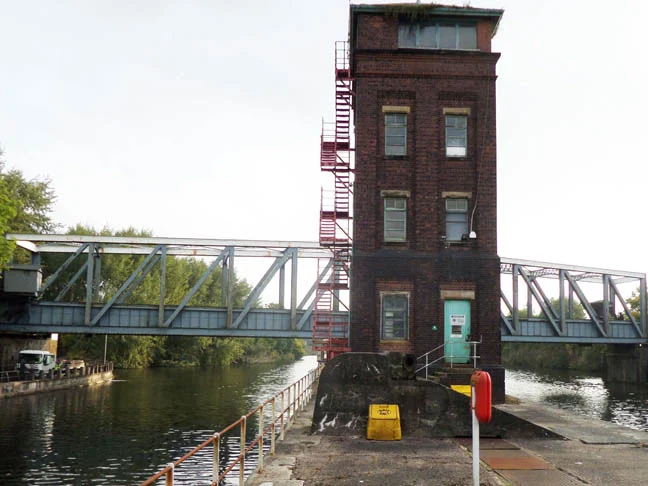
Barton aqueduct tower and island photo Alun Taylor

Heart of operations lies within the control tower. Photo: Alun Taylor

Opened in 1761, the stone aqueduct was a vital link in the north-west’s canal system, so closing it was out of the question. Building a flight of locks to take narrow boats down from the canal level to the Irwell was dismissed too. The speed of the water flow in the Ship Canal on occasion would on make steering a narrowboat across it dicey in the extreme. Brindley himself had dismissed this idea before building his stone aqueduct.

A system of locks and a fixed bridge with enough clearance to allow the size of vessel the Ship Canal could accommodate was a non-starter too.

Both lock-based options would also have caused congestion on the Bridgewater Canal and since the Manchester Ship Canal Company had been obliged to buy the Bridgewater Canal lock, stock and barrel as part of the hugely expensive project (seven years in the building the Ship Canal cost £15m in 1894 or around £1.7bn in 2015 terms) it was keen to maximise income from the Bridgewater waterway.

Luckily the Ship Canal’s ingenious chief engineer, Edward Leader Williams (later Sir), had a plan. The adjoining Barton road bridge was already envisioned as a swing bridge so why not just create a section of canal on a similar pivot and treat it in the same way?

Look at Barton aqueduct today and you see it much as it was when new, the only difference being the removal of the tow-path that once ran above the right hand side of the water trough so horses could pull the barges across.

Measurements, mechanics and how a moving aqueduct actually works

The aqueduct takes the form of a boxed lattice girder frame with an iron water trough made from 0.95cm (3/8 inch) iron plate at the bottom. The trough is 5.4m (18ft) wide by 2.1m (7ft) deep (but only filled to a depth of 1.8m (6ft) and 71.6m (235ft) long. It weighs 1,473 tonnes (1,450 tons) when full of water. Even dry, it weighs a not inconsiderable 660 tonnes (650 tons). The whole enchilada sits on a pivot on an artificial island in the middle of the Ship Canal.

The aqueduct pivot mechanism consists of a 8.2m (27ft) diameter race plate embedded in a series of granite blocks. Sixty-four cast iron taper rollers sit on top of the race plate held in position by a spider ring. On top of that an upper race plate supports the aqueduct and the circular gear ring that connects the hydraulic drive system to the aqueduct superstructure.

Draining the trough before swinging the bridge was originally mooted but was dismissed for two reasons. Firstly due to the time needed to refill the trough and secondly because while the Bridgewater Canal was renowned for the cleanliness of its water - apparently the fishing in it was rather good - the River Irwell was little more than a toilet. Over the previous decades it had developed into a drain for the outflow from the burgeoning industries of Manchester and Salford.

To reduce the pressure of the turning mechanism, a hydraulic press was installed in the pivot. When water was admitted to the press it took up to half the weight. So successful was this system of hydraulic assistance that Leader Williams retrofitted it to several road swing bridges being built over the Ship Canal including the ones at Stockton Heath and Knutsford Road in Warrington.
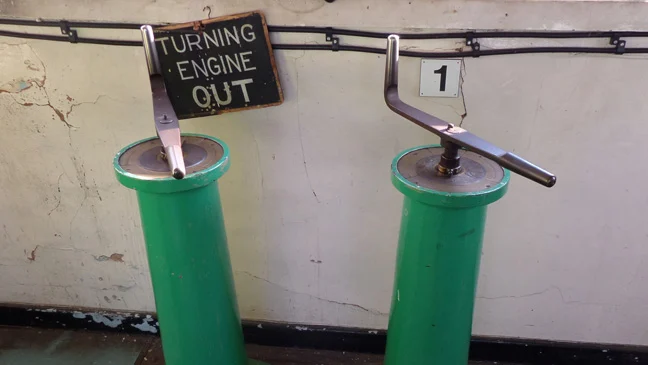
Hydraulic control levers, photo Alun Taylor

Hydraulic control levers used to turn the aqueduct, photo: Alun Taylor