





FEATURE Seagate says it has a clear way forward to 100 TB disk drives using 10 TB per platter technology, but HAMR tech is nearly 25 years old and full mass production is still not underway. What has been taking so long?
HAMR (heat-assisted magnetic recording) technology is used to write data to a granular iron platinum medium that can support stable bit storage at more than 1 Tb/in² area density – but only when the bit areas are heated using a laser. That's 3-3.6 TB per platter with Seagate's ten-platter Exos M drives using Mozaic 3+ HAMR technology.
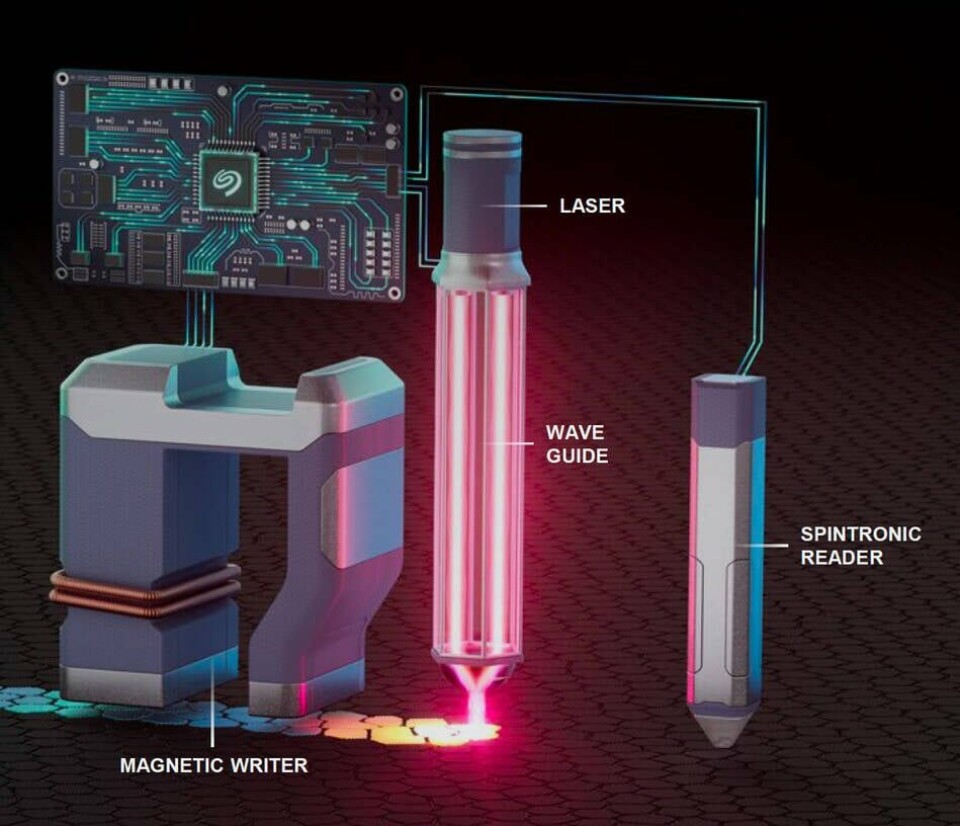
Traditional perpendicular magnetic recording (PMR) uses room-temperature writing and cannot support such extreme areal densities; the bits become unstable. Western Digital has found a way to push PMR's density to 2.9 TB per platter by using microwave-assisted magnetic recording (MAMR), as has Toshiba, the third major disk drive manufacturer. Both Toshiba and Western Digital are positioning HAMR as their next tech transition to increased areal density but are years behind Seagate in developing the technology.
REG AD
Seagate is currently shipping 30 TB conventionally recorded Exos M HAMR drives and both 32 and 36 TB shingled magnetic recording (SMR) drives. These have blocks of partially overlapping write tracks to increase track density and thus overall capacity, but with a slower rewrite speed as entire blocks of tracks have to be rewritten.
REG AD
The company should have a clear drive capacity advantage, but it does not because its HAMR technology has proven extraordinarily difficult to bring into mass production and it has one less platter than competing drives. By 2012, Seagate predicted it could make 1 Tb/in² in HAMR drives after a successful demo. That did not happen but it managed to make 16 TB HAMR drives and was sampling them in 2019. They did not make it to mass production either, and a 20 TB technology was the next development. It too did not last long.
CEO Dave Mosley told investment analysts in 2020 that Seagate was stepping up to 24 TB HAMR drives. By 2023, a 30 TB HAMR drive was said to be coming. This was actually unveiled in January 2024, with the tech branded Mozaic 3+, referring to the 32 and then 36 TB SMR variants.
Even then, qualification by its main hyperscaler customers, the cloud service providers (CSPs), took many months, with the first CSP giving it the all-clear to volume ship almost a year later, in December 2024. Now, five months later, Seagate has announced that three of the top eight CSPs have completed qualification of its drives, with exabyte-scale volume shipments. Mosley says the remaining five are expected to be qualified in a year. Such qualifications have taken an extraordinarily long time.
It is likely that manufacturing yield and drive reliability challenges contributed to the delays to HAMR productization and qualification again and again. Here we are, with general mass production of HAMR drives still in an early phase, almost a quarter of a century after Seagate did its first public HAMR tech reveal, and it is still not ready, even though it has shipped more than 1 million HAMR drives to date. The investment Seagate has made in this enormously complicated technology is huge.
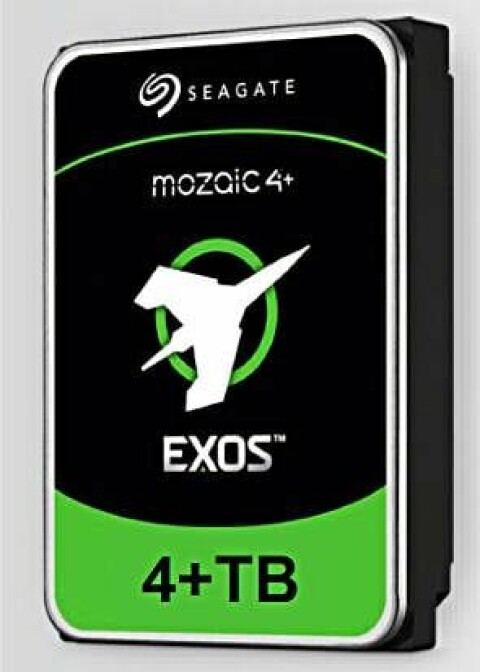
The pace is picking up. Seagate is now saying 40-plus TB drive samples (Mozaic 4+) have been delivered and it aims to produce a 12-44 TB capacity range product. Actual production shipments are expected later this year or early 2026 with increased volume shipping in the first half of 2026. It says a 5-plus TB (Mozaic 5+) generation is expected in late 2027 or early 2028.
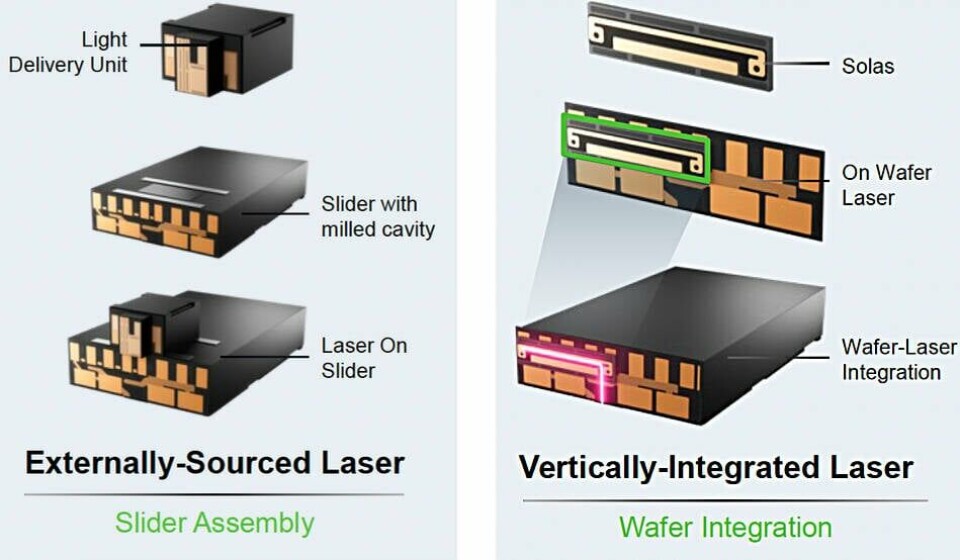
The company has demonstrated a 6.5 TB per platter drive and says it typically takes five years to move from demo to production, meaning Mozaic 6+ product availability in 2030. And it claims it has visibility to 10-plus TB per platter, meaning 100 TB disk drives, which could be productized at some point around 2033, assuming a 2028 demo product.
Seagate believes its HAMR recording medium could even support up to 15 TB per platter, implying 150 TB conventional and potentially 180 TB SMR disk drives, with better patterned recording media. The HAMR capacity marketing continues at full pace.
Seagate now claims that more than 40 percent of its disk drive exabytes will be with HAMR drives by the end of its fiscal 2026, the end of June in calendar 2026. The crossover to majority HAMR exabyte production should be in the first half of fiscal 2027 (by the end of calendar 2026) and more than 70 percent of HAMR exabytes should be shipping six months after that.
REG AD

Of course, as we have just outlined above, Seagate has previously made several predictions about HAMR drive availability that were not ultimately achieved. The tech giant appears to have persistently underestimated how long it will take to productize HAMR technology and so reap the production cost benefit of having fewer platters and sliders at any capacity point than its two competitors.
CEO Mosley aims to use HAMR and its higher areal density to reinvent lower capacity drives with fewer platters and sliders, meaning 10-15 percent lower production costs.
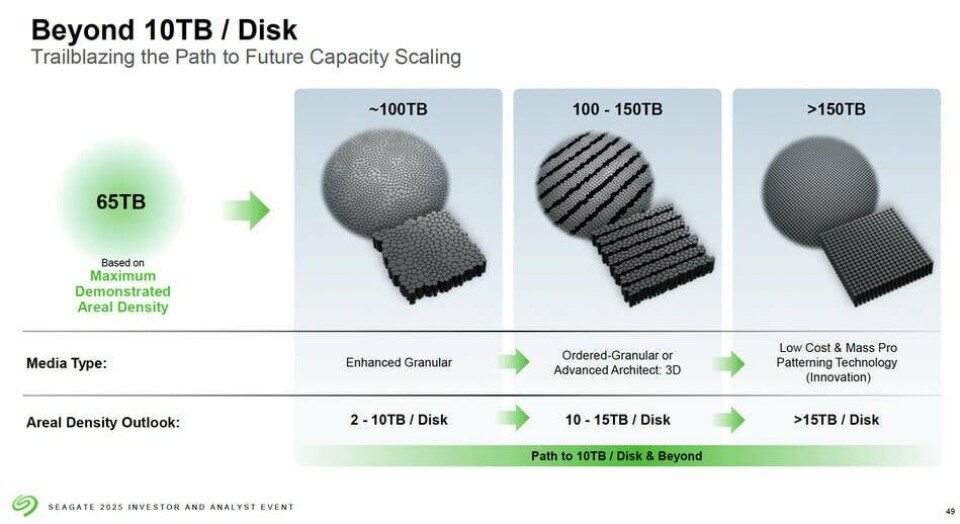
A laser integration tactic should reduce costs further. At present, Seagate ships a HAMR slider with an externally sourced laser attached. The intention is to build the laser itself on its own wafers and then bond it to the slider wafer, before the individual slider dies are cut.
Having such a vertically integrated laser will enable more capital-efficient production at scale.
The HAMR delay and a platter count decision has enabled Seagate's competitors to more or less keep up in terms of capacity.
Seagate opted for a balance of controlling costs and increasing disk capacity with its HAMR technology, sticking with ten platters per drive, while Western Digital has moved to 11. Toshiba has demonstrated an 11-platter drive. WD's move reduced Seagate's capacity advantage and allowed it to offer similar maximum capacity drives even though they have lower areal densities. Seagate gained a production cost advantage by having to put one less platter and slider in its drives, but, since the drives were being qualified and not in mass production, that cost advantage was theoretical, while the limited capacity advantage was real.
As an example, the 30 TB Exos HAMR drives announced for sampling in January 2024, with 3 TB per platter, along with 32 TB shingled drives, then had a 6 TB capacity advantage over Western Digital's 24 TB conventional and 28 TB shingled drives. The WD drives also had ten platters as well, but the company moved to 11-platter technology in November that year with its Ultrastar DC HC690 model, which gave it a 32 TB shingled capacity, at 2.9 TB per platter versus Seagate's 3 TB per platter.
REG AD
Since Seagate's drives were not generally available, WD was able to compensate for its areal density weakness – and remove Seagate's capacity advantage. Were Seagate to move to 11-platter technology then it could have had 33 TB conventional and 35 TB shingled drives. WD's new drives didn't have the prolonged sampling and qualification period needed by Seagate's HAMR drives and WD was able to say it was "shipping the world's highest capacity UltraSMR HDD with up to 32 TB – leveraging the time-tested, reliable energy-assisted PMR (ePMR) recording technology for hyperscalers, CSPs, and enterprises … with the world's first commercially available 11-disk design."
Now WD is sample shipping its own HAMR drives, retaining, as far as we know, its 11-platter design, and so not having to push the HAMR areal density technology envelope as far as Seagate.
With ten-platter technology at any capacity level, compared to 11-platter tech, the tracks on the platters will be narrower, needing more control of the slider positioning movements, and with less bit area for recording signal detection, meaning the slider signal pickup tech has to be better as well. WD and Toshiba simply have more leeway in developing their less demanding HAMR technology than Seagate.
Wedbush analyst Matt Bryson is "of the view that HAMR is now fully baked" and anticipates "wide-scale HAMR adoption in early 2026."
If both Western Digital and Toshiba face the same level of manufacturing difficulties and extended qualification periods as Seagate, then they will be at a capacity disadvantage and also a production cost disadvantage compared to Mosley's company for some years. Seagate can then hammer away into the distance with a larger market share and more revenue. The signs of this happening should become clearer by the end of the year. ®
此内容由惯性聚合(RSS阅读器)自动聚合整理,仅供阅读参考。 原文来自 — 版权归原作者所有。