

惯性聚合 高效追踪和阅读你感兴趣的博客、新闻、科技资讯
阅读原文 在惯性聚合中打开

推荐订阅源

Forbes - Security
Forbes - Security
The Register - Security
G
Google Developers Blog
罗磊的独立博客
WordPress大学
WordPress大学
L
LangChain Blog
博客园 - 三生石上(FineUI控件)
Recorded Future
Recorded Future
Microsoft Azure Blog
Google DeepMind News
大猫的无限游戏
大猫的无限游戏
MongoDB | Blog
MongoDB | Blog
小众软件
小众软件
Recent Announcements
T
Tailwind CSS Blog
让小产品的独立变现更简单 - ezindie.com
云风的 BLOG
云风的 BLOG
Apple Machine Learning Research
酷 壳 – CoolShell
酷 壳 – CoolShell
钛媒体:引领未来商业与生活新知
钛媒体:引领未来商业与生活新知
F
Full Disclosure
The Cloudflare Blog
B
Blog RSS Feed
S
Schneier on Security
T
Tenable Blog
人人都是产品经理
人人都是产品经理
Engineering at Meta
Engineering at Meta
T
Tor Project blog
N
Netflix TechBlog - Medium
T
Threatpost
NISL@THU
NISL@THU
Stack Overflow Blog
Stack Overflow Blog
N
News | PayPal Newsroom
N
News and Events Feed by Topic
aimingoo的专栏
aimingoo的专栏
博客园 - 叶小钗
P
Privacy & Cybersecurity Law Blog
C
CERT Recently Published Vulnerability Notes
Last Week in AI
Last Week in AI
M
MIT News - Artificial intelligence
C
CXSECURITY Database RSS Feed - CXSecurity.com
P
Privacy International News Feed
博客园 - 【当耐特】
Help Net Security
Help Net Security
The Hacker News
The Hacker News
Hugging Face - Blog
Hugging Face - Blog
TaoSecurity Blog
TaoSecurity Blog
S
Secure Thoughts
C
Cisco Blogs
CTFtime.org: upcoming CTF events

The Register - On-Prem

Ohio hits pause on datacenter tax breaks draining its coffers Europe told to cool its datacenter boom before water and power run short Kyndryl takes employees' pulse while cutting off circulation for some Outlook has an image problem Microsoft says cu l8r to text message security 'Workforce rebalancing' comes for Kyndryl, and delivery teams are in the firing line MAGA's Mace wants to make power bills great again, calls for datacenter moratorium Datacenters slurping up so much juice they boosted prices 75% in largest US energy market Exploited Exchange Server flaw turns OWA inboxes into script launchpads Utah mega datacenter could dump 23 atomic bombs worth of energy per day Rust stalks IBM mainframes, but only in nightly form Iran war hits datacenter building supply chains, upping costs ON CALL: Custom PC worked in the lab, failed on site – and so did the angry client ShinyHunters claims dump puts 119K Vimeo emails in the wild Vodafone dials up full control of VodafoneThree Palantir CEO: 10 percent of world 'professionally hates us' Bad news for OpenClaw stans: Apple’s Mac Mini starts at $799 AWS networking lab tour: Making networking disappear Royal Navy chief backs drones, robot ships Bank of England is gold standard for tech projects, says PAC UK pensions dept shopping for spy-van tech worth up to £2M Microsoft boss tells investors the company is working to 'win back fans' What type of 'C2 on a sleep cycle' do they leave behind? Novel Chinese spy group found in critical networks in Poland, Asia Microsoft levels up Azure Local for sovereign clouds Cloudflare: autocrats, wars, and votes caged the net in Q1 ZTE & XLSMART launch Jakarta AI & 5G-A Innovation Center When robots join the race: 5G-A powers a new kind of marathon 5G-A powers a new kind of marathon Oracle plans to power its New Mexico DC with fuel cell farm DCMS to new CDIO: Microsoft migration, overhaul ERP, survive Document sent Boeing Core Scientific accelerates crypto-to-AI pivot Meta seeking energy from space for earth-bound datacenters Golden Dome gets $3.2B of contractors and an AI sprinkle ICO boss Edwards steps back amid workplace investigation DARPA seeks deep-sea drones for autonomous warfare push ZTE Q1 revenue up 6% to RMB 35B; computing mix hits 27% UK govt shells out £550 for Digital ID panel, bans press TUIT & ZTE launch student internship and tech job programs US farms have new steward for their safety nets: Palantir Tesla stakes AI dreams on Intel's unfinished AI chip Grafana offers AI assistant for free, warns users not to go mad Right to repair champ Framework punts modular 13in laptop with Core Ultra Series 3 Scotland Yard can keep using live facial recognition on Londoners, say judges Phone-to-satellite use goes into orbit, growing 25% in 8 months FAA grounds Blue Origin's New Glenn as it probes missed satellite delivery 'mishap' AMD's Ryzen 9 9950X3D2 Dual Edition tested: Gratuitous overkill with a price to match Crook claims to leak 'video surveillance footage' of companies Met police trials snoop tech platform in push to cuff more London shoplifters England's school phone ban gets teeth, just in time to bite no one Panasonic creates device-locked QR codes to speed facial biometric capture NASA Inspector fears new spacesuits won’t be ready for Moon landing Trump-branded datacenter project fails to make itself great, again World's blandest man steps down from CEO job to spend more time in tastefully appointed home Chase got a spiff of $77 million to create one job with New York datacenter AI is reshaping Britain's datacenter map away from London HP's remote desktop push retreats as Anyware heads for end of life 'Invisible mouse' made a mess of PC rebuild Indonesia’s game rating system paused amid claims it leaked developer creds and glimpses of major new titles Intel eases reliance on TSMC with 'Merica-made Core Series 3 processors Attention data hoarders: Alexa loses its Plex appeal as voice feature gets canned Locked-out iPhone user tells The Reg that Apple is scrambling to fix character flaw passcode bug Capita won disastrous UK pensions gig after acing performance checks Maine to pause big bit barns as local opposition spreads Iran has something America can only dream of: cheap broadband Guide to GPU virtualization: passthrough, vGPU, and MIG Brussels tells Google to hand rivals its search crown jewels as privacy row brews Cops hand Motorola £25M to keep 2000-era radios alive QUIC will soon be as important as TCP – but it's vastly different Networks not ready for the challenges of AI traffic US states can't account for datacenter tax breaks. Literally UK told its Big Tech habit is now a national security risk The only technology that died more times than VR is AI, and that seems to have worked out Oracle taps Bloom for fuel cells to support datacenter binge Amazon pays $11.5B to satisfy satellite-envy while cowering in Musk's shadow Microsoft raises UK Surface prices as RAM crisis reaches the checkout UK state bank considers lengthening disastrous IT program Japan going back to the future by reviving its chip industry FAA seeking gamers to fill air traffic control ranks Veterans Affairs software licensing under fire in GAO report NHS pays £46K to prep next Microsoft licensing round France’s digital agency dumping Windows desktops for Linux IT manager approved lunch downtime, but made a meal of it China wants AI to prepare school lessons and mark homework Apple update turns Czech mate for locked-out iPhone user Hungary officials used weak passwords exposed in breach dump Amazon rejects AWS climate disclosure proposal Tiny violins as Amazon execs face pay packet pinch John Deere agrees $99m right-to-repair settlement Iran war piles more pain on already battered PC market AWS put a file system on S3; I stress-tested it UK to spend £15M on AI mapping in knife crime crackdown Rebrand automation as 'zero-token architecture' to master AI Supply chain challenges risk delaying Nvidia's Rubin GPUs Amazon thanks loyal Kindle devotees by bricking their kit DXC lands Metropolitan Police contract worth up to £1B NHS Scotland-linked domains push pr0n and illegal streams How to navigate the storage crunch in the AI era Supermicro launches probe after staff charged with China export violations
If malware via monitor cables is a matter of national security, this might be the gadget for you
Connor Jones · 2026-04-23 · via The Register - On-Prem

GCHQ's cyber arm has entered the hardware game with its first device designed to prevent cyberattacks on display devices.

Called SilentGlass, the small gadget's intellectual property is courtesy of the UK's National Cyber Security Centre (NCSC), and the signals intelligence agency licensed it out to UK-based Goldilock Labs to make it commercially available to all businesses and consumers.

SilentGlass is the NCSC's first branded device to hit the market. Announced publicly on Wednesday, the HDMI and DisplayPort-compatible device has already been deployed across "government estates," for several years and is capable of protecting "most high-threat environments."

Naturally, The Register had a bunch of questions, but the NCSC refused to answer any.

Through the powers that be, however, we are reliably informed that beyond the information included in the NCSC's blog, these devices are equipped with hardware that identifies malicious traffic in the data channel, blocking the transfer between computer and display.

We're also told that the SilentGlass gizmos are threat-agnostic, meaning they are capable of detecting any kind of nastiness and preventing it from reaching and ultimately altering or manipulating a display. Anything potentially malicious that travels between HDMI or DisplayPort connections and a monitor is blocked.

You might be thinking "it's not every day we hear about monitors being pwned via HDMI," and you'd be right.

You wouldn't be alone either. Since the NCSC announced SilentGlass, infoseccers have taken to social media to question the need for this device.

However, it is understood there are legitimate attack paths that are both applicable to modern environments and have been abused by known attackers.

Very little exists in the research literature about these kinds of attacks. A team based out of Montevideo's Universidad de la República published findings in 2024 about the potential for highly technical individuals to intercept the electromagnetic radiation emitted from HDMI cables and use deep learning algorithms to reproduce text intended to be displayed on a monitor.

The team called the finding Deep-TEMPEST, an evolution of the TEMPEST analog signal interception phenomenon of yesteryear. But, as with all side-channel attacks, the real-world application is significantly different from a remotely exploitable software bug, for example. 

Most organizations probably don't need to worry about highly motivated foreign spies lurking around their cables looking for electromagnetic emissions. However, for those safeguarding highly sensitive data within the context of critical national infrastructure operators, it's potentially a slightly more credible threat.
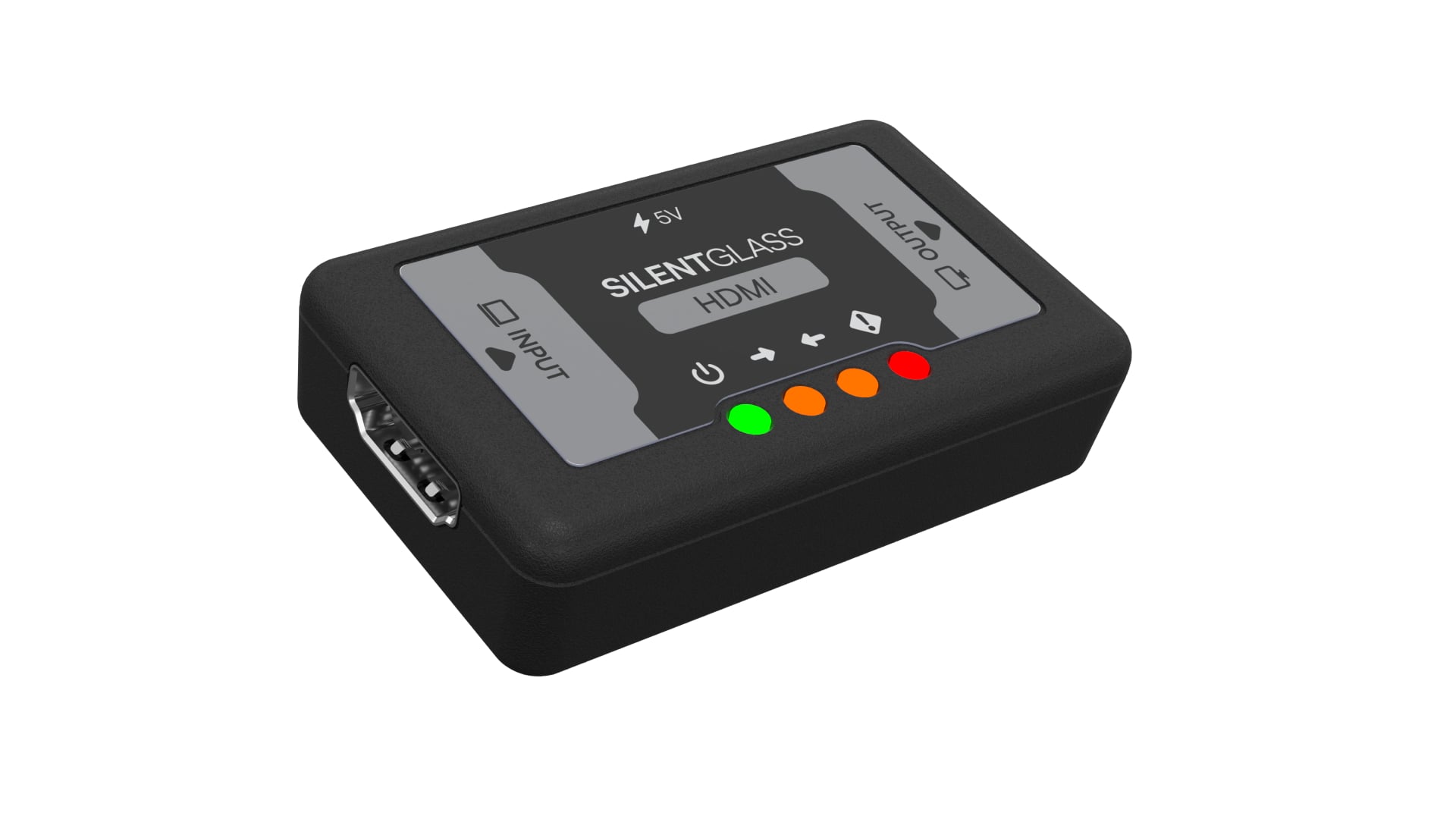
NCSC's SilentGlass HDMI device. Image courtesy of the NCSC.

NCSC's SilentGlass HDMI device – Image courtesy of the NCSC

In any case, SilentGlass devices are available to anyone who wishes to purchase one, starting today.

Attendees of Black Hat or 44con back in 2012 may also remember NCC Group's presentations about the potential for exploiting vulnerabilities in HDMI's EDID and CEC parsers, as well as CDC and NEC protocols.

Again, these are fringe cases of which we hear very little from real-world scenarios, outside a conference keynote.

Despite the lack of published cases of these attacks, the NCSC believes external computer monitors are "a hugely attractive target" for adversaries, particularly those with an espionage focus.

It did not mention China specifically, although that is the country most often associated with cyberespionage, in the context of the UK's four main adversaries - China, Russia, Iran, and North Korea.

The timing of the launch also coincides with the agency's CEO, Richard Horne, declaring China "a peer competitor in cyberspace," within the context of a steady rate of nationally significant cyberattacks directed at the UK by nation-states.

The org also said such attacks can be effective if the people behind them are looking to cause disruption, or generate some financial gains, which essentially implicates each of the other three countries.

Ollie Whitehouse, the NCSC's CTO, said: "Display screens and monitors are everywhere in modern business environments, and the SilentGlass device will help protect previously vulnerable IT infrastructure with unprecedented ease.

"Its development and commercialisation shows the impact that the NCSC can have, alongside industry partners, with an affordable and effective product now globally available. 

"By helping to launch a UK company onto the global market with this world-class innovation, we are breaking new ground and helping to strengthen national prosperity."

NCSC gave Goldilock Labs, in partnership with Sony UK, the license to produce and sell SilentGlass, which comes as separate devices - one for HDMI and another for DisplayPort, each protecting one cable only.

The NCSC wouldn't tell us the price, so we're waiting on Golidlock to tell us more information on that front.

Stephen Kines, co-founder of Goldilock Labs, said the device meets a security problem that to date has been "widely overlooked," as many have not viewed HDMI and DisplayPort connections as a serious security boundary.

"What was once confined to national security environments is now being applied with a low-cost, easy-to-deploy solution for CNI and businesses where the same risks exist," he said.

"SilentGlass is the first step in a wider effort to enforce behaviour at hardware interfaces before it reaches complex software. It reflects a shift toward treating physical connectivity as a point of control rather than an assumed trust boundary." ®