
The president of the International Fellowship of Christians and Jews reflects on leadership, faith, and responsibility in a time of war.
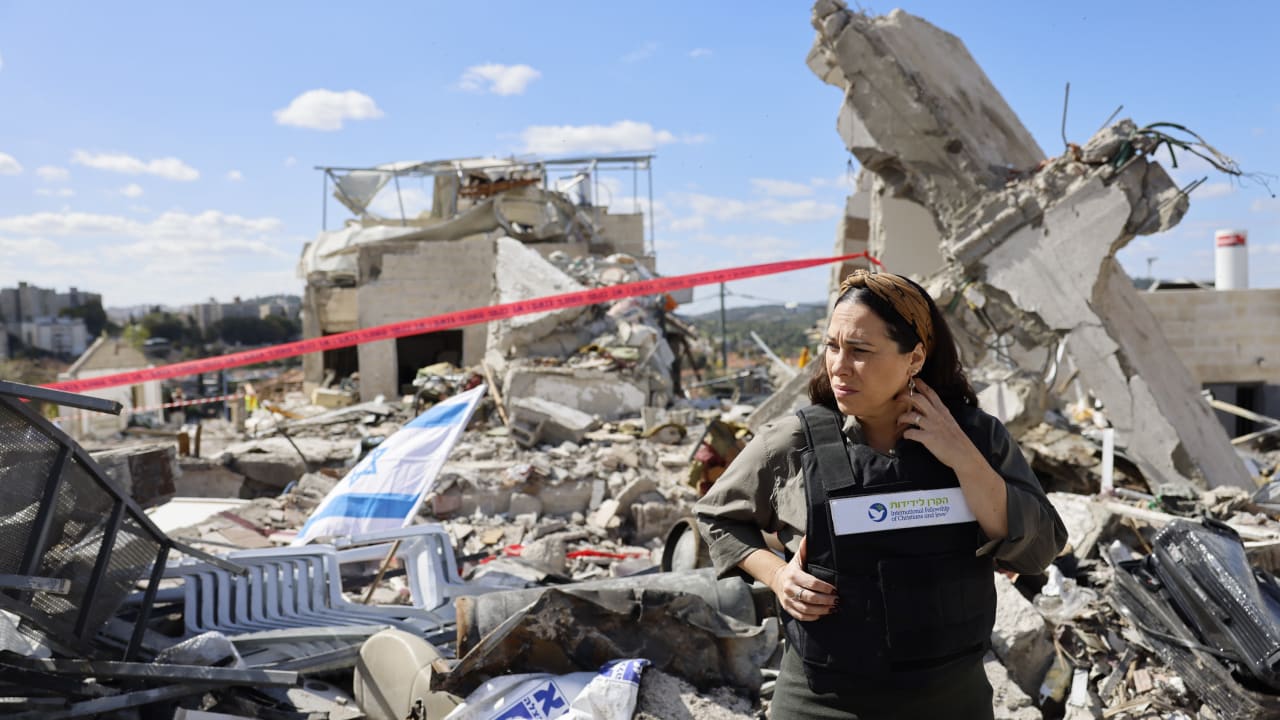





On the morning of Oct. 7, Yael Eckstein did not see the first alerts. Like many observant Jews, the president and global CEO of the International Fellowship of Christians and Jews had set her phone aside for Shabbat, letting the morning pass quietly with her family, the outside world held at a distance.
“I keep Shabbat, so I wasn’t with my phone, I wasn’t watching the news,” Eckstein recalled. “It was only when I got to synagogue around one in the afternoon that I found out what was happening.” Even then, the picture was incomplete. Reports came in pieces – sirens, attacks, and confusion spreading through communities in southern Israel, in a country accustomed to emergencies. The instinct is often to absorb the shock quickly and move forward.

Yet, something about that day felt different to her. “I’ve lived through wars,” she said. “I’ve been in Israel for 20 years. I experienced the Intifada and the Second Lebanon War. But this was the first time in my life I truly wondered: Is Israel going to get through this?” What troubled her most was the feeling that the system itself had broken down, that the societal structures Israelis depend on during crises suddenly seemed fragile. “I’ve never seen anything like it.”
In these moments, a single thought began to take shape in her head, one she described in biblical terms. “It was a call,” Eckstein said, referring to the word Ayeka – “Where are you?” – the question God asks Adam in the Book of Genesis. In Jewish thought, it has often been interpreted less as a question of location and more as a demand for responsibility. “In moments like this, it’s easy to just go into the bomb shelter and stay there, focusing on your own family,” she said. “But every one of us stood up and said, ‘We’re responsible for one another.’”
The organization Eckstein heads – the International Fellowship of Christians and Jews, often called simply The Fellowship – occupies an unusual space in Israel’s philanthropic world. Founded more than four decades ago by her father, Rabbi Yechiel Eckstein, it built a bridge between Israel and millions of Christian supporters around the world, raising funds largely from evangelical communities abroad and directing them toward humanitarian aid, social services, and security infrastructure across the country.

Today, Eckstein noted that The Fellowship allocates hundreds of millions of dollars each year, making it one of Israel’s largest philanthropic bodies. However, crises have a tendency to reshape even the most well-structured organizations. “We are usually very organized,” she explained. “With our work plan, budget, and strategy, we stay very focused. However, when a crisis hits, we must be completely agile.”
On Oct. 7, “Everyone threw their titles out the window,” Eckstein said. “People just asked, ‘What can I do?’” The Fellowship already had employees and partners scattered across Israel, including in communities that soon became synonymous with the attacks, such as Sderot and Ofakim.
Some staff members suddenly found themselves greeting survivors emerging from bomb shelters after hours trapped inside. “In Sderot, when people came out after 30 hours in their shelters, we were the first ones greeting them in the municipal building, even while terrorists were still running around,” she recounted.
We are usually very organized, with our work plan, budget, and strategy, we stay very focused. However, when a crisis hits, we must be completely agile. Everyone threw their titles out the window.
Other employees mobilized relationships built years earlier, and by the night of Oct. 7 they were already distributing bulletproof vests and helmets to people heading south. “I remember watching the news on October 8,” Eckstein said. “There was someone driving south, just an individual who grabbed a gun and went to try to save lives. He was wearing a Fellowship bulletproof vest when he came under fire,” she recalled, “and I’m watching and thinking – our vest is saving this person’s life.”
As the days passed, The Fellowship found itself responding to needs that had never appeared in its strategic planning documents. At the military identification center at the Shura Base, families gathered to identify loved ones killed in the attacks, a process that for some stretched into days or even weeks.
“There were more than 1,200 families there,” Eckstein said. “Some people waited two weeks to identify their loved ones. We brought three meals a day,” she said. “We brought our IFCJ Mobile Command Center with chairs, shade from the sun, things that sound small but make a huge difference when people are going through something unimaginable.” None of it had been planned, and none of it had a line in the organization’s carefully constructed budget. “I told my staff, ‘There is no budget line for this,’” Eckstein said. “‘We’ll deal with the budget later.’”
More than two years into the broader regional conflict, The Fellowship has developed what Eckstein described as a three-stage approach to crisis response. First comes the immediate emergency phase – rapid action before government systems can fully mobilize. “We’re not sitting in a boardroom,” she said. “We’re implementing.”
That might mean distributing emergency cash cards to families who fled their homes with nothing but the clothes they were wearing, or installing protective shelters that are used almost immediately. “In the past few days, we placed shelters that were used within one hour,” she said, and among those most vulnerable are elderly Holocaust survivors living alone. “Many of the poorest survivors don’t have bomb shelters,” Eckstein said. “And their caregivers sometimes stop coming because they’re afraid or stuck in another city. As a result, we are delivering food packages and hot meals directly to Holocaust survivors’ homes to make sure they have the basic necessities. We’re not waiting for bureaucracy,” she stated. “There’s no time.”
The second stage focuses on programs that can be implemented in the near future, while the third stage involves long-term infrastructure projects, such as hospital upgrades or protected medical wards, which will strengthen Israel’s resilience before the next crisis. Even amid that strategic planning, Eckstein insists that small human gestures can matter just as much.
Years ago, The Fellowship, together with the Association for Israel’s Soldiers, launched a fleet of Soldier Appreciation Trucks that drive across Israel offering soldiers snacks, drinks, and Wi-Fi. “They’re often stationed in the middle of nowhere,” she said. “No dining hall, no store. Sometimes they’re there for weeks.”
Today, nine trucks travel across the country, blasting music and handing out coffee, ice cream, and chips. “They also have Wi-Fi,” she added, “so soldiers can call their parents.”
This year, for the first time, Eckstein has a child of hers serving in the military. “This is the first war where my daughter is a soldier,” she said, explaining that seeing the experience through a parent’s eyes has changed her perspective. “You realize how difficult it is – the loneliness, the fear, the responsibility – and then someone shows up with music and ice cream and says, ‘You’re not alone.’ That moment can change everything.”
This year’s International Women’s Day falls during one of the most turbulent periods in Israel’s history, and Eckstein’s own leadership story reflects the evolving role of women in public life. When her father died suddenly in 2019, she stepped into the leadership of the organization he had built. At the time, she was 34, raising four young children, and acutely aware of how different she seemed from the figure she was replacing. “My father was six-foot-two, a rabbi, a public figure,” she said. “He had this enormous presence.”
By contrast, she said, she was a young mother without the same titles or the same gravitas. Some advisers suggested the organization might need a more traditional leader. “People told me, ‘You need an older man,’” she recalled. “‘You need a rabbi or a pastor to be the face.’” But Eckstein said the values she grew up with left little room for doubt. “My parents never told us ‘Girls can do anything,’” she said. “They told us ‘You can do anything.’ My father used to say women are often better leaders,” she said with a smile, explaining that he believed women could multitask and see the core of a problem without getting lost in the surrounding noise.
Today, all of The Fellowship’s international offices, from Chicago to Canada to Korea, are led by women. “People always ask if I was looking specifically for women,” Eckstein said. “No. I was looking for the best person for the job.”
But she believes the result has shaped the organization’s culture in meaningful ways. “There’s a nurturing, passionate force that women bring,” she said. “And when leadership is caring and compassionate, it spreads throughout the organization.” That internal culture, she believes, is not secondary to The Fellowship’s humanitarian work but essential to it.
In moments of crisis, leadership often comes down to a simple decision: step forward or step back. Eckstein prefers to describe that decision in biblical language. “When God asks, ‘Ayeka?’ – ‘Where are you?’ – the answer is ‘Hineni’, here I am,” she said. “And there are so many needs right now. So many calls for help,” she said quietly. “What we all have to ask ourselves,” she added, “is what we can do to bring a little more light.”
This article was written in cooperation with the International Fellowship of Christians and Jews.
此内容由惯性聚合(RSS阅读器)自动聚合整理,仅供阅读参考。 原文来自 — 版权归原作者所有。