
惯性聚合 高效追踪和阅读你感兴趣的博客、新闻、科技资讯
阅读原文 在惯性聚合中打开

推荐订阅源

Security Archives - TechRepublic
Project Zero
Project Zero
K
Kaspersky official blog
G
Google Developers Blog
T
Threat Research - Cisco Blogs
T
The Blog of Author Tim Ferriss
Cyberwarzone
Cyberwarzone
Y
Y Combinator Blog
Recorded Future
Recorded Future
Blog — PlanetScale
Blog — PlanetScale
Threat Intelligence Blog | Flashpoint
Cisco Talos Blog
Cisco Talos Blog
Latest news
Latest news
Microsoft Security Blog
H
Help Net Security
S
Schneier on Security
P
Palo Alto Networks Blog
H
Hacker News: Front Page
N
News and Events Feed by Topic
N
Netflix TechBlog - Medium
博客园 - Franky
OSCHINA 社区最新新闻
OSCHINA 社区最新新闻
SecWiki News
SecWiki News
Cloudbric
Cloudbric
TaoSecurity Blog
TaoSecurity Blog
CTFtime.org: upcoming CTF events
The Hacker News
The Hacker News
C
Check Point Blog
L
LangChain Blog
腾讯CDC
小众软件
小众软件
T
Tenable Blog
Google DeepMind News
GbyAI
GbyAI
L
LINUX DO - 最新话题
A
About on SuperTechFans
Google Online Security Blog
C
Cisco Blogs
Recent Announcements
Hacker News: Ask HN
Hacker News: Ask HN
freeCodeCamp Programming Tutorials: Python, JavaScript, Git & More
Vercel News
Vercel News
雷峰网
雷峰网
美团技术团队
D
DataBreaches.Net
Martin Fowler
Martin Fowler
Help Net Security
Help Net Security
钛媒体:引领未来商业与生活新知
钛媒体:引领未来商业与生活新知
F
Full Disclosure
博客园_首页

JPost.com - Tech | The Jerusalem Post

AI search optimization and the future of local business visibility | The Jerusalem Post 32 startups return to Galilee as new recovery plan takes shape | The Jerusalem Post 63% of roles requiring AI understanding are not in tech at all | The Jerusalem Post intelligence capitalizes on AI frenzy – and raises prices | The Jerusalem Post The dirty trick behind the massive tech layoffs | The Jerusalem Post The great wipeout: Nvidia lost $1 trillion within two months | The Jerusalem Post Kurdistan looks to follow Israel's lead and become the next Start-Up Nation | The Jerusalem Post Israel’s digital wallet boom signals a new era for online payments | The Jerusalem Post This is the company that is the best to work for in Israel | The Jerusalem Post Report: Amazon plans giant fundraise of at least $25 billion | The Jerusalem Post A 2,267% surge in demand for this profession | The Jerusalem Post Severe report: Historical peak in the number of unemployed tech workers | The Jerusalem Post Offshore talent is being used to keep Israeli startups growing | The Jerusalem Post Shay Gal launches line of state | The Jerusalem Post $7.6 billion in half a year: Tech fundraising surged by 52% | The Jerusalem Post AI training program for reserve soldiers launched by tech entrepreneur | The Jerusalem Post Aligned is raising $60 million | The Jerusalem Post Israel's new fund for deep tech startups offers up to NIS 6 million in funding | The Jerusalem Post Tech workers laid off and collapsing under the mortgage burden | The Jerusalem Post Tech Talk: Lightkey, the AI-powered Israeli startup transforming writing | The Jerusalem Post After Wix: Elementor fires about 30% of its employees | The Jerusalem Post The rate of young Haredim in tech has tripled | The Jerusalem Post Cyber security company NewCore raises $66 million | The Jerusalem Post Following two-week US government ban, Anthropic’s Fable 5 to come back online | The Jerusalem Post Record of leading Israeli companies in LGBT equality | The Jerusalem Post Publicis Israel enters the AI arena with a Ddata, media, and creative system | The Jerusalem Post A new fund will invest in defense startups | The Jerusalem Post Elon Musk lost hundreds of billions within a few days | The Jerusalem Post The giant company parted ways with 21,000 employees within a year | The Jerusalem Post $85 billion was not enough for him: Elon Musk launches an insane fundraising campaign | The Jerusalem Post Four giants poured a billion dollars into an Israeli company | The Jerusalem Post Israeli AI firm launches robotaxis in Munich powered by Nvidia and Uber | The Jerusalem Post The Rat Race 2.0: The less glamorous side of the AI revolution | The Jerusalem Post With an investment of NIS 12 million: Shimon Gershon storms the rental market | The Jerusalem Post Three Israeli start-ups win Intel's Edge AI Tech Challenge | The Jerusalem Post Valued at $250 billion: Tel Aviv ranks fourth among world cities | The Jerusalem Post Elon Musk and Altman are generating the future | The Jerusalem Post Nvidia stunned Wall Street with a massive fundraising round | The Jerusalem Post Daniel turned a family tragedy into a lifesaving search engine | The Jerusalem Post SailPoint acquires Israeli startup Entro for approximately $200 million | The Jerusalem Post GMT is acquired by Western Union for NIS 200 million | The Jerusalem Post What lies ahead for next CEO of Israel Innovation Authority | The Jerusalem Post This Israeli startup is using AI to transform cinemas into more than just a place to watch movies Israeli-founded cyber firm A Security emerges from stealth with $37m. to fight weaponized AI 'ChatGPT is dead': OpenAI plans to ditch chatbots for agents in upcoming updates of AI model - FT BloomX: Stepping up to save the crops Moving FourWard: Inside Jerusalem's ambitious bid to reinvent medical innovation IATI connects VC funds with foreign ambassadors and attachés in Israel Amid shekel-dollar crisis: Hi-tech sector gains strength as Israel's main export with 58% in 2025 Israel’s mobility sector forecasts what inventions can actually deploy and when Haredim making headway in hi-tech: Projects to introduce ultra-Orthodox to workforce see success Amdocs to lay off 3,000 employees Wix cuts 20% of its employees citing shekel-dollar exchange rate, AI implementation Why AI could create the next wave of Israeli unicorns UVeye scales automated vehicle‑inspection tech across global automotive markets Company invests in hub to make New Jersey 'new Silicon Valley' for foreign start ups AI and robots will not replace engineers; they will remove the tedious work Israeli start-up Limy develops tools to help brands appear in AI chat engines The rise of deep tech is the north’s opportunity Israeli startup Frame Security raises $50m IDF reservists created 150 new startups during last year, innovation program reveals Trump to regulate AI development after Anthropic's Mythos posed cybersecurity threat - report Israeli-founded AI biotech Immunai expands AstraZeneca cancer collaboration Israeli AI startup cracks code of who is at fault when system fails: What do they do? - interview Decoding the digital pulse: How Prof. Yaniv Dover maps the flow of information and human behavior Israel's high-tech faces unexpected crisis as dollar slides 20% against shekel | The Jerusalem Post From the capital of the Negev to the decision-making tables of the world’s leaders Omer Adam’s AI company signs billion-dollar deal with AI infrastructure giant Crusoe Israeli battery-swapping IP owners demand $250 million from Chinese EV giant | The Jerusalem Post Israeli drone‑detection start-up scores major US commercial breakthrough | The Jerusalem Post New Israeli app tracks disaster victims in real time, speeds emergency response | The Jerusalem Post Q-Factor emerges as Israel’s latest quantum computing developer with $24 million seed investment Can you really trust your ‘private’ AI assistant to keep your secrets? | The Jerusalem Post ‘Perfect storm’: Israel's high-tech faces human capital crisis, lack of new students in age of AI Israeli AI optimization company ScaleOps surpasses $800 million valuation Israeli entrepreneurs raise $11 million to fight vulnerabilities exploited by Iranian hackers Israeli firm CloudZone partners with Anthropic to offer leading AI models in AWS Surf AI raises $57 million for AI platform built for security teams Development from the shelter: Israeli company reveals new AI motor launched amid Iranian missiles As AI agents spread, Onyx raises $40 million to guard them High-tech glass ceiling: Women lead the shift from military command to professional confidence TAU Ventures portfolio company XTEND heads to NASDAQ at $1.5B valuation AI modeling predicts IRGC support for military general to succeed Khamenei AI vibe coding will replace frontend developers within two to three years, experts tell ‘Post’ Nvidia acquires Israeli data co Illumex Technion leads Israel, Europe in AI research in new CSRanking index, ranking 21st worldwide Elon Musk says Tesla's new 'affordable' Cybertruck will only be available for 10 days Israel was world’s top target for geopolitical cyberattacks in 2025, report finds Israeli entrepreneurs create ‘Semantics Engineering,’ aiming to solve enterprise AI context crisis Two senior cybersecurity figures join Cyber 2.0 advisory board Palo Alto Networks becomes Tel Aviv Stock Exchange's most valued company at $115 billion ICON became the backbone of Israeli Tech in Silicon Valley. This is how they did it Dr. Dan Marom: Shaping Israel’s Next Generation of Entrepreneurs Food, beverages giant Prodalim seeks NIS 2-2.5b valuation in TASE IPO Israeli start-up Matia secures $21 million investment to create AI-powered data pipeline platform Israeli security firm SenAI raises $6.2 million in seed round to expand into US market, B2B model Nvidia CEO: 'The implications of building AI infrastructure in Israel are profound' SpaceX acquires xAI for $250 billions, positioning itself for potential IPO worth $1.5 trillion Israeli startup ORION raises $32 million in Series A round, with investments from IBM, Norwest
Turning innovation into impact
ALAN ROSENBAUM · 2026-03-27 · via JPost.com - Tech | The Jerusalem Post

Under CEO Uzi Scheffer’s leadership, SOSA has become a global leader in developing innovation centers for governments, municipalities, corporations, and institutions

Follow us on Google
Global startups at SOSA’s NYC Innovation Center in Chelsea.
(photo credit: SOSA)
ByALAN ROSENBAUM

'SOSA was established to solve a very acute challenge in the technology ecosystem, which is inefficiency in the way technologies reach the market and in the way the market reaches technologies,” says company CEO Uzi Scheffer. Since its founding in 2014 by Israeli innovation pioneers, SOSA has evolved into a multidimensional platform enabling global corporations, government organizations, and start-ups to execute and scale innovation.

“It’s obvious how impactful technology can be in traditional markets,” continues Scheffer, “and yet, it’s difficult to actually take advanced emerging technologies to the finish line and see them deployed in those markets and sectors that affect the lives of all of us. Every large organization in the world today needs to access technologies that will answer its operational needs and successfully integrate these solutions into its daily operations. Over time, we’ve developed a unique expertise in executing proprietary methodologies and innovation activities for governments and large organizations. And with time, we started building innovation centers.”
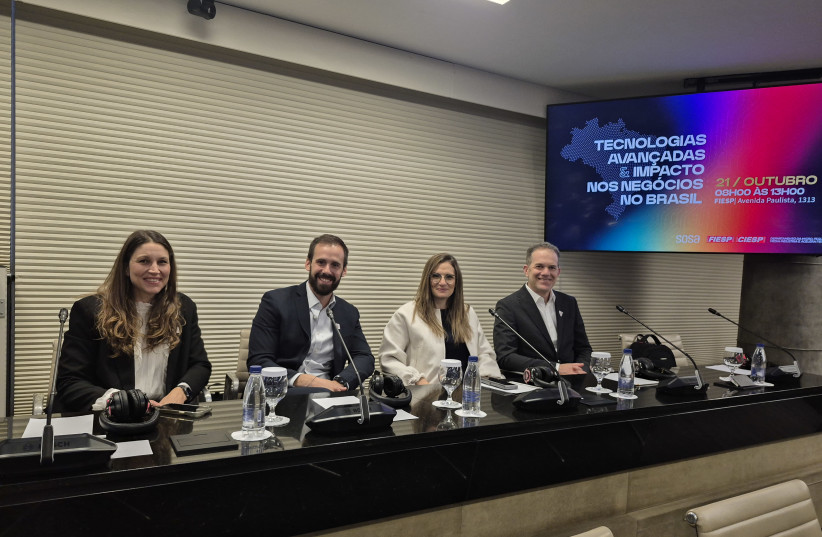
SOSA team in Brazil (L to R): Roni Kenet Harmelin, partner, SOSA Ventures; Dani Forman, associate partner; Lital Ben-Uzi, VP finance; Yinon Masad, chief business officer.
SOSA team in Brazil (L to R): Roni Kenet Harmelin, partner, SOSA Ventures; Dani Forman, associate partner; Lital Ben-Uzi, VP finance; Yinon Masad, chief business officer. (credit: SOSA)

Over the past decade, SOSA has built innovation centers in New York, New Jersey, Brazil, and Israel. SOSA also helped build “the Hatch” in Singapore, established to enhance Singapore’s public safety. In its first year, the Hatch executed more than a dozen proof-of-concept projects, using cutting-edge technologies from around the world. Serving as an innovation hub for Singapore’s national resilience, the Hatch has successfully brought together the local and global ecosystems, fostering collaboration among start-ups, government agencies, corporates, and investors.

“Based on our methodologies, guidance, and support,” explains Scheffer, “we have helped build, together with our partners, one of the world’s leading innovation centers, designed specifically for public safety. It serves the country’s nine homeland security agencies and has become the epicenter of the local technology ecosystem. Today, nearly all technological activity in the region is connected to it, and it has emerged as a globally recognized case study.”

SOSA was recently selected to serve as the operator of the New Jersey Business Acceleration and Softlanding Ecosystem, also known as NJ BASE. The center is focused on attracting international companies in industries critical to New Jersey’s economy. NJ BASE supports businesses seeking to access the broader US market by assisting them in establishing a presence in New Jersey, enabling their expansion, facilitating investment opportunities, and contributing to the creation of high-quality, long-term jobs in the state.

Uzi Scheffer, CEO of SOSA, and Gianna Sagazio, CEO of SOSA Brazil, at the recent opening meeting of the SOSA Leaders Forum in São Paulo, Brazil.
Uzi Scheffer, CEO of SOSA, and Gianna Sagazio, CEO of SOSA Brazil, at the recent opening meeting of the SOSA Leaders Forum in São Paulo, Brazil. (credit: SOSA)

Scheffer describes SOSA’s operational model as a proactive bridge between market demand and global tech solutions. The methodology involves a deep dive into client needs, ranging from corporate giants to national security agencies, followed by a rigorous global search for the most effective technologies.

According to Scheffer, the process goes far beyond a mere exhibition of products. SOSA’s team utilizes global benchmarking to help clients understand emerging possibilities, then curates and validates the best-fit solutions for immediate piloting. This collaborative approach allows the organization to work alongside governments and industry leaders to pinpoint the economic growth drivers of a specific region.

For global corporations and for government organizations, creating innovation centers today, he explains, is almost a necessity to keep up with new developments and technologies. “There is an understanding over the past 10 or 15 years that knowledge is distributed in the world and that you need to look to the outside and have effective operations and methodologies to stay up to date,” Scheffer states. “The cycles of innovation are very, very fast. When you look at software, AI, and Gen AI today, it’s measured in weeks. And with innovation cycles measured in weeks, whether in government or private companies, the strategy of vertical growth and scaling is becoming increasingly challenging.”

SOSA CEO Uzi Scheffer
SOSA CEO Uzi Scheffer (credit: SOSA)

Scheffer adds that the creation of innovation centers helps turn the region where the innovation center is located into a hub for advanced technologies and, in effect, helps create a technology ecosystem for the area. “When we establish an innovation center and bring in global talent to collaborate with the local ecosystem, it elevates the entire environment – driving foreign direct investment, boosting GDP, strengthening education systems, creating jobs, and attracting venture capital.”

Companies, organizations, and governments seeking SOSA’s counsel benefit from a rigorous methodology that prioritizes the definition of concrete use cases. By utilizing its proprietary databases and global networks, SOSA identifies and matches the most effective technology solutions to these specific needs. “We always start the process with the actual end user at the table,” Scheffer explains. “By doing so, we secure engagement and commitment from day one. Most innovation projects fail precisely because they lack this level of involvement from the end user.”
Scheffer highlights an urgent and growing demand for innovation centers dedicated to national resilience, a sector undergoing a fundamental shift in how critical technology is developed. Historically, defense R&D was a closed loop, funded and managed almost exclusively by state defense budgets. Today, that landscape has been upended by venture capital, private grants, and commercial enterprises, leading to a vast, decentralized dissemination of specialized knowledge.

“The modern battlefield, and by extension, national security, now features an unprecedented mix of offensive and defensive tools sourced from a diverse array of sources – armies, prime manufacturers, and tech companies,” Scheffer explains. “To maintain national resilience, a state needs an agile operation capable of sourcing across every tier, from global defense giants to lean private start-ups.”

He concludes that the boundaries between public safety, internal security, and traditional defense are blurring into a single, critical vertical. “Establishing a national resilience innovation center is no longer a luxury; it is a strategic necessity. These hubs are the most effective way to ensure that a nation maintains both the up-to-the-minute knowledge and the rapid access required to secure these disparate, critical technologies.”

Scheffer says that sensors and autonomy are critical components of the current battlefield. “When we speak about the future, or actually, the current battlefield, we speak about autonomy, and autonomy starts with sensing. For example, one of the most important topics today is defense against drones, which starts with detection. There is a need for sensing very small objects from kilometers or miles away. This is where private companies and private start-ups get into the picture.” He cites Makalu Optics, a leading tech company that develops advanced lidar solutions for mission-critical industrial systems, delivering ultra-long object detection range, high 3D resolution, and hyper-fast real-time processing.

According to Scheffer, AI has become a crucial component of defense-tech, for example, in real-time generation and prioritization of targets and passing them to aircraft in the air. He attributes an additional layer of importance to communication. “There’s an entire battlefield, which is not the physical battlefield but a battlefield on the electromagnetic spectrum, such as spoofers [technology that disguises identity], anti-spoofers [systems designed to counter spoofers], and identifying them.”

Over nearly 15 years, SOSA has refined a methodology for identifying and validating thousands of start-ups to address complex industry challenges. This extensive research and matching process allows SOSA to integrate the most advanced technologies directly into its innovation hubs. These include Tenna Systems’ spectrum intelligence technology for real-time detection and mitigation of wireless signal interference. In select cases, SOSA’s investment arm also invests in companies sourced through this work, particularly in defense and national resilience. This investment activity is intended to support the most promising technology companies as they scale in their target markets. Tenna and Makalu Optics are two such examples.

Scheffer says that he entered the field driven by a desire to improve how technology is applied. “When I first entered this space, I recognized a significant gap between what technology is capable of achieving and the profound impact it can have on every aspect of our lives, and, on the other hand, the considerable inefficiencies in how it is actually implemented. The fact that more than 90% of start-ups fail is not due to a lack of strong products or advanced technologies. Rather, they fail because they do not reach the market, and the market, in turn, fails to reach them.

“Over the past 12 years, we have completed more than 1,000 innovation projects, each addressing a specific use case through advanced technologies. This work has a meaningful impact, and it is a privilege to help bring these efforts together. By operating at the intersection of governments, corporations, and start-ups, we leverage insights from one side to de-risk the other, enabling faster execution and stronger strategic outcomes.”

Looking toward the next decade, Scheffer envisions these centers powering a global economy of self-sustaining, scalable ecosystems driven by validated market demand. He emphasizes that for regions to remain competitive, governments and local leaders must integrate into a global network to secure access to the latest knowledge, top talent, and advanced technologies necessary to support their most critical sectors. “This is a must,” he concludes.

This article was written in cooperation with SOSA.

Follow us on Google