惯性聚合 高效追踪和阅读你感兴趣的博客、新闻、科技资讯
阅读原文 在惯性聚合中打开

推荐订阅源

P
Palo Alto Networks Blog
大猫的无限游戏
大猫的无限游戏
Martin Fowler
Martin Fowler
GbyAI
GbyAI
CTFtime.org: upcoming CTF events
量子位
T
The Blog of Author Tim Ferriss
Y
Y Combinator Blog
Microsoft Azure Blog
C
CERT Recently Published Vulnerability Notes
Recent Announcements
A
About on SuperTechFans
aimingoo的专栏
aimingoo的专栏
P
Privacy International News Feed
cs.CL updates on arXiv.org
博客园 - 叶小钗
L
Lohrmann on Cybersecurity
G
GRAHAM CLULEY
T
The Exploit Database - CXSecurity.com
Hugging Face - Blog
Hugging Face - Blog
P
Proofpoint News Feed
NISL@THU
NISL@THU
博客园 - Franky
C
Cybersecurity and Infrastructure Security Agency CISA
The Register - Security
M
MIT News - Artificial intelligence
Know Your Adversary
Know Your Adversary
A
Arctic Wolf
F
Full Disclosure
T
Threat Research - Cisco Blogs
P
Privacy & Cybersecurity Law Blog
The Hacker News
The Hacker News
博客园 - 【当耐特】
D
Docker
T
Tailwind CSS Blog
S
SegmentFault 最新的问题
Cyber Security Advisories - MS-ISAC
Jina AI
Jina AI
Help Net Security
Help Net Security
V
Visual Studio Blog
小众软件
小众软件
B
Blog
Vercel News
Vercel News
云风的 BLOG
云风的 BLOG
N
News and Events Feed by Topic
Forbes - Security
Forbes - Security
N
Netflix TechBlog - Medium
让小产品的独立变现更简单 - ezindie.com
C
Cisco Blogs
Security Archives - TechRepublic

JPost.com - Real Estate | The Jerusalem Post

Empowering olim and international investors to build their future in Israel | The Jerusalem Post Contractors save, workers pay: The new reform in the construction industry | The Jerusalem Post Why rising antisemitism is driving more Jews to invest in Israeli real estate | The Jerusalem Post Amy Group acquires Planet Rishon Lezon for NIS 300 million | The Jerusalem Post The safest place: Why more Jews are buying homes in Israel after October 7 | The Jerusalem Post Israel ranked 8th in JLL's real estate investment report for the US | The Jerusalem Post The Dimona mayor’s ultimatum to the Ministry of Finance | The Jerusalem Post Tzarfati Shimon launches phase 2 of Luria Project in Jerusalem's Moradot Arnona | The Jerusalem Post Shponder Fadlon growth story: From a construction family to a real estate group | The Jerusalem Post BST enters the stock exchange with a dramatic move | The Jerusalem Post End of tax exemption: Tax Authority move will cost property owners dearly | The Jerusalem Post David Hofstedter: From Toronto real estate to global Jewish learning | The Jerusalem Post The answer for jews worldwide who want to own real estate in Israel New construction giant: Shoval acquires Yitzhak Stern in industry-changing deal An ultra-luxury Jerusalem icon Jerusalem’s real estate boom heads to New York for a major expo led by Mayor Moshe Lion It’s all about timing! 2026 is a rare opportunity window for Tel Aviv real estate Luria: A Jerusalem-inspired project with modern boutique design | The Jerusalem Post Meet the Israeli woman using AI to reinvent real estate | The Jerusalem Post Prime Jerusalem – home for Jews worldwide in the capital | The Jerusalem Post Midtown Jerusalem | The Jerusalem Post Fattal Group launches boutique hotel collection in Israel | The Jerusalem Post Kiryat Tivon head on NVIDIA: 'A chance to change the North' | The Jerusalem Post Israel Canada Hotels acquires 50% stake in northern hotels | The Jerusalem Post Four buildings, one home: A new way to live in north Tel Av | The Jerusalem Post High ILA tender response signals developer confidence | The Jerusalem Post Reinventing Zionism, rebuilding national accountability | The Jerusalem Post 3,200 units approved for Yoseftal renewal, Kfar Saba | The Jerusalem Post The grand advantage: High-end within reach | The Jerusalem Post Jaffa emerges as a real estate alternative to Tel Aviv | The Jerusalem Post The domino effect: How "cheap" financing can be costly | The Jerusalem Post Housing market surge: Purchase groups back in spotlight | The Jerusalem Post Yamim Hatze’ira, Netanya: Hedge the dollar with seaside investments | The Jerusalem Post Urban renewal plan approved in Kiryat Eliezer, Haifa | The Jerusalem Post 5 tips for choosing a lawyer in urban renewal projects | The Jerusalem Post Contrary to reports: cancellations under 0.5% of deals | The Jerusalem Post Carmei Gat duplex sets new record at NIS 5.8M | The Jerusalem Post A first-of-its-kind academic degree for contractors | The Jerusalem Post Israel housing prices rise after months of decline | The Jerusalem Post The new law that changes agreements in the real estate world Luxury with roots and a vision for the future Jerusalem construction approvals: Pre-planning impact | The Jerusalem Post Evacuation and reconstruction - opportunity or trap? Boutique renewal: Who said entire neighborhoods must be redeveloped? The education revolution in Acre: Three new schools to open in the upcoming school year Modi'in closes a street: Ten buildings to be built in a row The market awaits a drop: Will it happen in 2026?
Damage to Israel by Iran missiles a fraction of June war | The Jerusalem Post
ELA LEVI-WEINRIB/GLOBES/TNS · 2026-03-11 · via JPost.com - Real Estate | The Jerusalem Post

The most damage reported to the Tax Authority's hotline has been in Tel Aviv where 4,609 damage claims have been filed.

Follow us on Google
Tel Aviv Scene, Operation Roaring Lion, March 2026
(photo credit: MDA SPOKESPERSON)
ByELA LEVI-WEINRIB/GLOBES/TNS, HILIT YANAI-LEVISON/GLOBES/TNS, YUVAL EINHORN/GLOBES/TNS
Updated:

After 11-days of fighting, the Israel Tax Authority has received 9,115 claims for missile damage, including 6,586 for damage to buildings, 1,044 for damage to contents and equipment, and 1,485 for damage to vehicles.

The difference between the extent of damage in the current round of fighting and the war last June is clearly evident. The number of claims after 11 days of fighting was similar to that recorded by the second day of the war last June.

At that time, nearly 10,000 claims were filed with the Tax Authority's compensation fund for property damage. On the fourth day, the number of claims almost doubled, reaching 18,800. By the end of the 12-day round of fighting, 53,409 claims were filed for direct damage, and compensation with NIS 2.9 billion paid out for direct damage.

Less missiles more sirens

The data show that, in relation to last year's fighting, Iran has been firing less missiles but concentrating its efforts on central Israel. According to the Institute for National Security Studies, while in June Iran launched about 1,600 missiles and drones, the number in this round of fighting so far is less than 600.

However, in the current operation the number of alerts has increased significantly. If in June the number of alerts was about 20,000 for missiles fired and infiltration of drones, today this figure has already reached about 42,000.

In addition, last June, there were numerous hits on towers that included many dozens of apartments and as a result dozens of damage claims. In the previous round of fighting against Iran, more buildings had to be demolished and rebuilt following the hits on them.

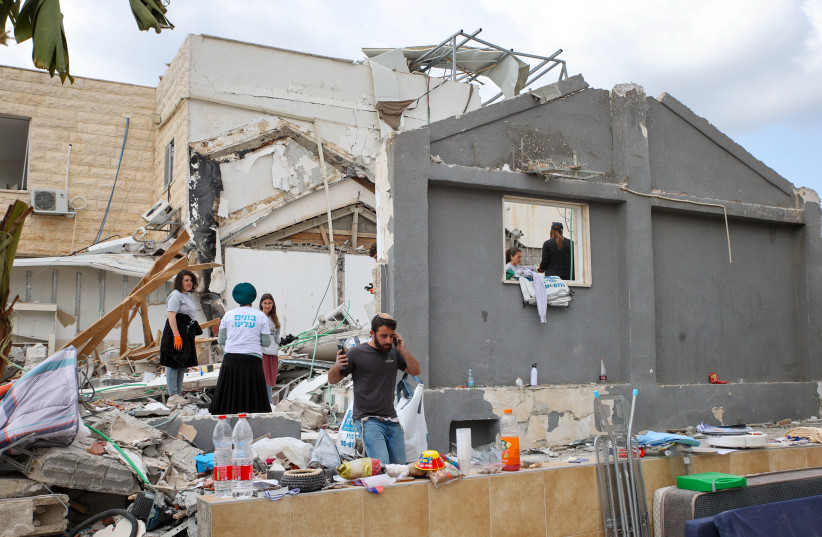
ISRAELIS VOLUNTEER at the site where a missile fired from Iran hit and caused major damage in Beit Shemesh, outside of Jerusalem, March 4, 2026.
ISRAELIS VOLUNTEER at the site where a missile fired from Iran hit and caused major damage in Beit Shemesh, outside of Jerusalem, March 4, 2026. (credit: Dor Pazuelo/Flash90)

Cluster missiles instead of large warheads

Another difference that has been experienced so far between last year's round of fighting and the current war is the extent of the damage. While direct damage from missile hits (as opposed to economic damage to businesses) last year reached about NIS 3 billion shekels. But the damage in the current campaign is estimated at several hundred million shekels (after 11 days of fighting).

The difference in the assessment of the damage lies in the nature of the buildings that were damaged. A number of luxury towers were damaged, the reconstruction of which and the restoration of the situation to their former state cost the state far more than residential towers of a normal or average standard. The restoration procedures for some of them are still in progress.

Yigal Govrin, chairman of the Israel Association of Engineers, explains why this time we saw fewer buildings in need of demolition.

"In the previous campaign, we saw missiles with large warheads of hundreds of kilograms, and each missile that was not intercepted and landed had the potential to destroy an entire building. These were definitely missiles that could take down buildings, and we saw several such hits. In this round, the Iranians are sending cluster missiles, that is, warheads that scatter, each with much less explosives, so the chance of a building being completely destroyed is very small. There could be damage, but not to the level of destruction of buildings that would require demolition and rebuilding."

"On the other hand," Govrin continues, "The large scatter is problematic. The potential for harm to people and property is greater because it reaches more places. If a person is injured by the bomb or shrapnel, it can be very dangerous, as we saw yesterday in Yehud — the building did not collapse, but the workers were injured by shrapnel. But damage that requires demolition will be very rare. In terms of preserving life, it is very important to protect yourself and stay in a protected area because the damage from the shell and shrapnel remains the same."

To date, the most damage reported to the Tax Authority's hotline has been in Tel Aviv, where 4,609 damage claims have been filed. At the Ashkelon office of the Tax Authority, which handles the Beit Shemesh and Beersheva areas, 3,664 claims have been filed. In the Jerusalem office, 181 claims have been filed, in Akko, 494, and in Tiberias, 167.

Follow us on Google