




Picture a capsule propelled at a 15-degree angle by an electromagnetic accelerator carrying supplies such as food for international space stations, satellite fuel, and equipment for colonies on the Moon. It may sound like science fiction, but this Israeli technology is currently being developed in Caesarea at the experimental laboratory of startup Moonshot Space.
The immediate goal is to challenge the way giant organizations like NASA and SpaceX view space launches, using heavy and expensive fuel-powered rockets. The greater goal is to provide humanity with efficient and cheap means of extraterrestrial expansion.
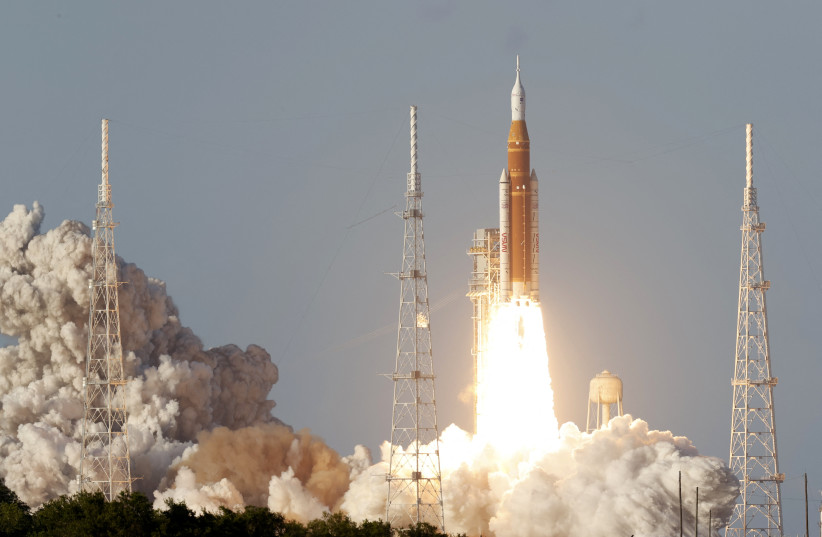
Moonshot is on the ascent, after the Artemis 2 mission earlier this month marked the second stage of the revival of the race to the Moon. The development of new technologies, the understanding that Mars is still out of reach, a Cold War with China, and US President Donald Trump's ambitious plan to successfully to land a man back on the Moon during his term of office — all have led to a renewed comeback of the contest to reach our celestial companion, this time with the aim of staying there.
To make a lunar settlement possible, regular supplies are needed, and this is where Moonshot's technology comes in. The segments that make up the "railway track" it is developing generate an extremely high-powered electromagnetic wave in perfect synchronization, so that the spacecraft traveling along it will be launched into space at the hypersonic speed of eight kilometers per second. Moonshot is not building a launcher for manned spacecraft — humans would not be able to withstand the acceleration of such a violent launch — but it could certainly be well suited for cargo spacecraft.
The company is counting on the development of a permanent lunar mining industry. China has already announced that it will mine helium-3 on the moon. This is a material used in the construction and operation of nuclear reactors. There are other rare metals there as well, such as lithium, which is used in batteries, cobalt for electronic components, and even copper, the basic material for power cables, which is already in short supply. Israeli company Exodigo, which develops and provides underground infrastructure scanning with applications in real estate, transportation and electricity companies, is also looking at space mining.
"Some companies have developed new technologies for mineral discovery in a model that can also be adapted to space operations," says Exodigo co-founder and CEO Jeremy Suard. "All of them are adding exploration and mining in space to their investor presentations, and are raising capital for it "
Moonshot aims to facilitate this future lunar mining industry with spacecraft from Earth delivering supplies to mining crews on the Moon, who will then send back capsules filled with rare metals. Capsules returning from the Moon to Earth will require only about five percent of the electrical power needed for departure.
"We want to be the courier company for space," says Moonshot co-founder and CEO Hilla Haddad-Chmelnik. The American race for space and the Moon in particular has accelerated in recent years, because of Trump's new commitment to establish a lunar colony, and Moonshot has entered the fray. "Even Musk understands that getting to Mars is highly ambitious. The Moon is not only far more accessible, it can also be used, not only as a node for other planets, but also as a location for server farms for AI processing, as well as mining minerals and rare earths."
"Our people made sacrifices to work here"
In the meantime, Moonshot is taking the first steps towards proof of the dream's feasibility. Recently, the lab was able to prove that the track is capable of launching objects at 100 meters per second, and signed a preliminary agreement with the Alaska Aerospace Corporation for a launch site in Alaska. The company is imbued with a sense of mission. Employees love going everywhere wearing a company logo T-shirt. Some were previously employed at cyber companies or were key developers on David's Sling or Iron Dome, and admit giving up on salaries double what they currently receive.
"People who came to work here made sacrifices in order to work in the field they dreamed about when they were children. Each of us dreamt of working with something related to dinosaurs or space," says co-founder Shahar Bahiri.
Bahiri's upbringing was unlike that of most of his employees. He was raised by a single mother, left school at fifteen to work,and taught himself to build improvised vehicles and develop software for them. He co-founded at least three startups, the largest being smart traffic management company Valerann, and eventually decided to leave everything behind and start over.
To demonstrate the feasibility of Moonshot's technology, he invested NIS 1 million of his own money and recruited a team of experts who brought with them technologies developed in the former USSR: contactless electric conduction like that used in monorail systems. Bahiri believed that an electromagnetic "conveyor belt" of this kind, combined with a system capable of synchronizing massive electrical discharges, could create a launcher that would propel an object to an altitude of 70 kilometers above the Earth's surface.
When he realized the product was feasible, he rushed to recruit a partner, someone he terms "the best aeronautical engineer in Israel," who was then the director general of the Ministry of Science and a former member of the Iron Dome team: Hilla Haddad-Chmelnik.
They were joined by Fred Simon, a co-founder of Nasdaq-traded software company JFrog. Simon, who walks around the office wearing a cowboy hat, comes from the software sector but caught the space bug after meeting Bahiri. He left JFrog, invested $6 million in Moonshot out of the family wealth fund he and his wife, Sima, hold, and for the first time in 20 years became a startup founder.
Moonshot is not the only one working on kinetic acceleration. It has competition from Longshot Space Technologies, a young US-based company that is developing a 10 kilometer-long "space cannon" for payload delivery. And the China Aerospace Science and Industry Corporation (CASIC) is building an electromagnetic launch track — a "railgun" — capable of accelerating an object to a speed of up to Mach 1.6 before it separates from the track.
Then there is US-based SpinLaunch, which is developing a suborbital accelerator, a kind of large metal slingshot or centrifuge spinning at high speed that will release spacecraft at 10,000 g (i.e. 10,000 times the acceleration of the earth's gravity) into space. But SpinLaunch has struggled to prove that its technology is able to move from the beta stage into a working product.
The Columbia trauma and NASA's promise
In recent years, Mars has been the center of attention, at the Moon's expense. In 2016, SpaceX founder Elon Musk presented an eye-watering plan for multi-planetary human colonization, including the establishment of a colony on Mars. In the meantime, however, many have come to realize that this is a complicated mission.
"We already have the ability to land on Mars, and research rovers are moving around on the Red Planet, but staying there and making it back is still a major challenge," explains Ran Livne, former CEO of the Ramon Foundation and the recently appointed Director of the Israel Space Agency.
"To take off to Mars, you have to wait for it to get close to Earth in its orbit around the Sun. But to take off back to Earth, you have to generate energy for the launch rocket from Martian soil, and wait about a full year until the next opportunity for it to get close. Given the fact that the flight in each direction takes six months, the journey may take at least two years, and, of course, involves the challenges of existence and subsistence."
With Mars currently out of reach, the previous goal is back in the spotlight. In this first term, Trump announced that a man would land on the Moon by the end of the term. NASA went into high gear, announcing a series of Artemis missions to the Moon. When a Moon landing didn't happen, Trump promised NASA he would not miss the opportunity in his second term.

This past December, new blood flowed into NASA in the form of the appointment of Musk's close associate, Jared Isaacman, as head of the agency. The move accelerated plans to establish a colony at the south pole of the Moon; with that arose the need for annual supply launches to ensure its expansion. The Israel Space Agency also came on board, renewing its contract with NASA for a ten-year period, so that it will be able to participate in future Artemis missions.
"The understanding has dawned that reaching Mars at this stage is difficult, while the Moon is a close neighbor that can be tested and technologies applied there for manned missions, which can be used on our way to Mars," explains Prof. Oded Aharonson, head of the Department of Earth and Planetary Sciences at the Weizmann Institute. Aaronson has made the Moon his main research subject; last week, an article he co-authored was published in the prestigious journal "Nature Astronomy," describing the ice deposits at the Moon's south pole.
The new Cold War heating up the race
It's no coincidence that both China and the United States are focused on the Moon's south pole. The water deposits in the area can be used to produce drinking water, irrigate lunar agriculture, and produce fuel. There is also a geopolitical aspect: the new Cold War between China and the US.
"China sparked the race with its Chang'e mission series, which is intended to land a manned spacecraft on the Moon this year and later build a permanent colony at the South Pole," says Aharonson. "Accordingly, the US has also decided to return to the Moon, this time to remain there with bases where astronauts will stay for a long time, and not just take a selfie and go home."
About a week before the Artemis 2 launch, Isaacman announced a fundamental shift in NASA's plans. The US space agency will invest $20 billion over the next seven years in building a base near the Moon's south pole, which will include residential facilities, patrol vehicles and nuclear power plants. In addition, instead of launching one Artemis mission to the Moon each year, Isaacman is prepared to speed things up and send Artemis spacecraft to the Moon twice a year.
NASA's lunar base will be built in three stages: in the first stage, patrol vehicles, nuclear and solar power generation facilities, communications and navigation equipment, and electronic equipment will be transferred to the base for the purpose of examining prolonged settlement on the Moon; the second phase will consist of short-term manned missions; and the third stage will already facilitate long-term human residence in the colony, including a cellular network, a lunar satellite network, robots for construction of buildings, and even lunar agriculture.
"NASA invested $107 billion. Now it's the private sector's turn."
To implement the program, Isaacman has opened NASA up to a range of contacts with private contractors. The current launch t, vehicle, Space Launch System (SLS), will be replaced by more affordable advanced launchers, such as the reusable SpaceX rockets or Jeff Bezos's Blue Origin launchers. In addition, Isaacman intends to find private contractors for construction of nuclear reactors that will supply electricity to astronauts on the Moon and Mars, so that they won't freeze in temperatures that can fall to minus 200 degrees Celsius.
According to US-based non-profit The Planetary Society, over the past 20 years, NASA has invested $107 billion in various back-to-the-Moon programs, and doesn't intend to fund all of this future activity by itself. "NASA realized that missions are expensive, and decided to allocate some capital to the private sector, to help it reach the Moon," says Livne. "The Israeli spacecraft Beresheet had a significant impact; it was the first to reach the Moon with a budget of less than $100 million."
Isaacman won't have to work hard to find commercial companies for NASA's privatization program. The US Defense Advanced Research Projects Agency (DARPA) had already outlined a plan, titled Lunar Architecture (LunA-10), for the establishment of a space colony through a network of commercial companies a few months before his appointment.
According to LunA-10, a thriving lunar economy will flourish on the Moon by 2035. It will include a solar power plant manufactured by HoneyBee Robotics; a network of railroads manufactured by Northrop-Grumman; space robots capable of performing maintenance tasks from GITAI; cargo spacecraft from Blue Origin, SpaceX and Firefly; and mining facilities by Sierra Space, which will extract oxygen and mines metals from lunar soil, and stores and provides energy.
The only Israeli company on the DARPA LunA-10 list is Helios, which has developed a process for the direct production of oxygen out of lunar soil to create fuel that will enable rockets to be launched back to Earth. "About 80% of a SpaceX Starship launcher's weight is oxygen to burn fuel," explains Bat-Chen Herchkovich Ben Simon, Helios COO and CBO. "Producing oxygen on the Moon will save SpaceX on launches and the enormous expense involved in bringing 800 tons of fuel from Earth, a cargo that costs billions of dollars."
Lunar water or sand can produce hundreds of kilograms of oxygen, according to initial experiments under laboratory conditions. Petah Tikva-based Helios intends to develop a machine that will be on the Moon by 2030. "No one will fly there if they don't know they're coming home, and the way to get astronauts back in a reliable and safe way is to create enough redundancy to refuel the spacecraft on the spot, and not rely on fuel brought from Earth."
"Getting to the Moon is easier than discovering America"
Another Israeli company already in the race is Ramon Space, which enables advanced computing capabilities, such as AI and cloud servers, to migrate to space safely. This is not just a matter of launching computers into space. It involves building a computer that will withstand the deadly electromagnetic radiation levels and extreme temperatures.
The idea is that mass deployment of small satellites into space could create enormous computing power outside the atmosphere, solving the biggest problem facing the tech giants: a shortage of electricity and real estate for building AI server farms here on Earth.