



惯性聚合 高效追踪和阅读你感兴趣的博客、新闻、科技资讯
阅读原文 在惯性聚合中打开

推荐订阅源

Blog — PlanetScale
Blog — PlanetScale
J
Java Code Geeks
月光博客
月光博客
Engineering at Meta
Engineering at Meta
WordPress大学
WordPress大学
Jina AI
Jina AI
小众软件
小众软件
U
Unit 42
云风的 BLOG
云风的 BLOG
Stack Overflow Blog
Stack Overflow Blog
雷峰网
雷峰网
博客园 - Franky
Microsoft Security Blog
罗磊的独立博客
宝玉的分享
宝玉的分享
B
Blog
C
Check Point Blog
爱范儿
爱范儿
奇客Solidot–传递最新科技情报
奇客Solidot–传递最新科技情报
Cyber Security Advisories - MS-ISAC
量子位
阮一峰的网络日志
阮一峰的网络日志
Vercel News
Vercel News
酷 壳 – CoolShell
酷 壳 – CoolShell

JPost.com - Archaeology | The Jerusalem Post

What was the Qumran sect's mysterious calender used for? | The Jerusalem Post Ancient structure near Stonehenge may have inspired its solstice alignment | The Jerusalem Post Ancient tablet found at Roman fort bears Greek curse against enemies | The Jerusalem Post Archaeologists unearth ancient Byzantine-era city in Egypt’s Dakhla Oasis | The Jerusalem Post Ancient mosaics, coins to go on display in new exhibit in northern Israel | The Jerusalem Post Archaeologists find inscriptions of pharaohs, ancient deities in Egyptian temple | The Jerusalem Post Italy buys famed Etruscan tomb, displays it in Rome museum | The Jerusalem Post New AI project aims to uncover origins of the Dead Sea Scrolls | The Jerusalem Post Site of Alexander the Great’s battle with Persians under historic protection | The Jerusalem Post Previously unknown Iron Age grave found ahead of construction in Germany | The Jerusalem Post Collector finds rare Hebrew-inscribed Moroccan mortar in Jerusalem's Old City | The Jerusalem Post Stone from Tel Eton may hold evidence of ancient religious reforms, study claims | The Jerusalem Post Complete text of carbonized Herculaneum scroll unlocked for first time | The Jerusalem Post Study: New identification technique pushes back timeline of human fire use | The Jerusalem Post Over 3,000 artifacts from Stone Age to WWII found in Netherlands valley | The Jerusalem Post American family repatriates four ancient artifacts to Egypt | The Jerusalem Post Remains of Queen Elisenda, 24 others unearthed in Barcelona for study | The Jerusalem Post Two ancient statues uncovered during Israel Railways excavations near Haifa | The Jerusalem Post Marble bust believed to depict Roman goddess of love found during excavations at Alicante beach Ancient Greco-Roman cemetery unearthed at archaeological site in Egypt's Nile Delta Ancient jars unearthed at biblical Shiloh days before annual wine festival WATCH: A Paleolithic time capsule: Rare prehistoric cave discovered near highway outside of Haifa Ancient water reservoirs discovered at Red Sea's Port of Aydhab site near Egypt-Sudan border Collection of ancient Egyptian, Greek, Roman-era artifacts discovered at Egypt’s Heracleopolis First near-complete ancient Egyptian funerary set discovered at Heliopolis necropolis site WATCH: Norway recovers Chinese porcelain, European-made goods from 18th-century shipwreck Neanderthals' ancient toolkit included hammers, blades made from rhino teeth, study finds Evidence of ancient Native American life uncovered near Cape Canaveral Space Force Station Rare, intact ancient Roman burial unearthed during excavations in eastern Croatia - report Plaster-making technique attributed to Romans used at Motza some 8,000 years earlier, study shows
Evidence of lost baptismal rite stage uncovered in Byzant...
2026-04-01 · via JPost.com - Archaeology | The Jerusalem Post

Additional discoveries made a the site included a bronze candelabrum and marble reliquary, both the largest of their kind to ever be found in Israel.

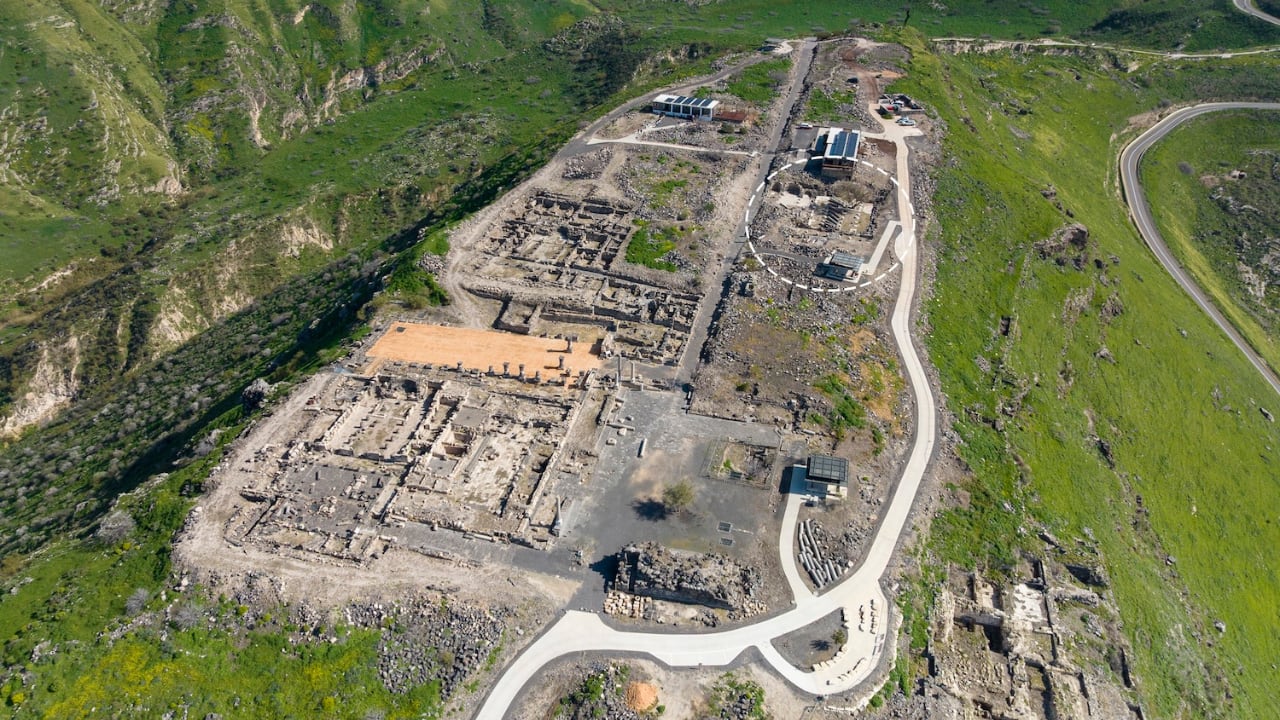
Ancient city of     Hippos looking east, with the cathedral’s location marked within the city, March 31, 2026.
Ancient city of Hippos looking east, with the cathedral’s location marked within the city, March 31, 2026.
(photo credit: MICHAEL EISENBERG)
ByMIRIAM SELA-EITAM

A marble block with three half-sphere depressions was found beside a baptismal font, thought to possibly point to a lost stage of early Christian baptismal rites, was found in the ancient city of Hippos, not far from the Kinneret, according to a recent study.

The artifact, unlike anything previously documented in archaeological record, was discovered during excavations focused on a newly unearthed ceremonial hall annexed to the south of Hippos’s cathedral. Inside, archaeologists found a partially preserved room housing a baptismal font and several other liturgical objects.

“Only after careful research did we realize how unique they are for understanding Christian ritual practices in the cradle of Christianity by the Sea of Galilee,” said Dr. Michael Eisenberg of the Zinman Institute of Archaeology and Haifa University, one of the leaders of the excavation.

Currently, researchers' leading theory regarding the artifact’s use is that it was meant to hold three different oils used during the threefold baptismal immersion ceremony, rather than the two anointings in the pre- and post-baptism.

Evidence further suggests that the ceremonial hall was constructed after 591 CE and later destroyed during an earthquake in 749 CE, which buried the artifacts beneath heavy rubble leading to their preservation.
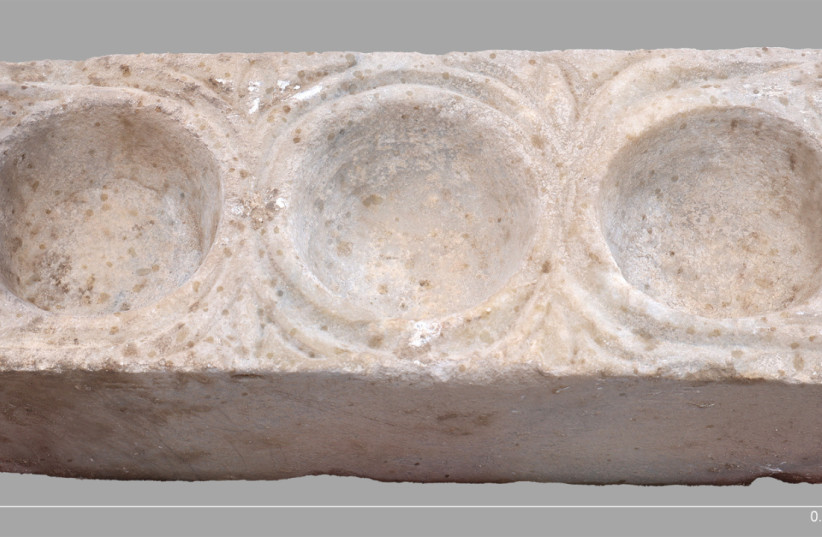
The rectangular marble block with three hemispheric cavities for oils found in the ancient city of Hippos, March 31, 2026.
The rectangular marble block with three hemispheric cavities for oils found in the ancient city of Hippos, March 31, 2026. (credit: MICHAEL EISENBERG)

Additional discoveries made a the site included a bronze candelabrum and marble reliquary, both the largest of their kind to ever be found in Israel.

Ancient Hippos: Only Christian Byzantine city on the Kinneret

Hippos was the only Christian city around the Kinneret during the Byzantine age, controlling a broad swath of territory including the southern Golan and the Kinneret’s eastern shore, an area Christian tradition associates with the ministry of Jesus. 

As such, the cathedral of Hippos, one of approximately seven churches to have operated within the city at the time, became the most prominent ecclesiastical place of worship in the region.

It is also the only known church to have had two designated halls, or photisterion (“hall of illumination”), with baptismal fonts. The photisterion previously excavated at the site is the largest known among Byzantine churches in Israel.

According to researchers, the larger hall was used primarily for adult baptisms, while the second, recently discovered hall was used for the baptisms of infants and children.

“Baptism was one of the central rites of Christian communal life and gradually took shape during the Byzantine period,” Eisenberg concluded. “In different regions, distinct liturgical traditions developed, many of which are not documented in written sources.”

“This find offers a rare glimpse into how the baptismal rite was shaped and practiced in the Byzantine Christian community of Hippos.”

The complete findings were published by Dr. Michael Eisenberg and Dr. Arleta Kowalewska in an early March edition of the Palestine Exploration Quarterly.