
惯性聚合 高效追踪和阅读你感兴趣的博客、新闻、科技资讯
阅读原文 在惯性聚合中打开

推荐订阅源

The Cloudflare Blog
L
LangChain Blog
WordPress大学
WordPress大学
V
V2EX
M
MIT News - Artificial intelligence
H
Hackread – Cybersecurity News, Data Breaches, AI and More
Stack Overflow Blog
Stack Overflow Blog
J
Java Code Geeks
F
Fortinet All Blogs
钛媒体:引领未来商业与生活新知
钛媒体:引领未来商业与生活新知
腾讯CDC
freeCodeCamp Programming Tutorials: Python, JavaScript, Git & More
D
Docker
Recent Announcements
GbyAI
GbyAI
博客园 - 叶小钗
小众软件
小众软件
Hugging Face - Blog
Hugging Face - Blog
T
The Blog of Author Tim Ferriss
人人都是产品经理
人人都是产品经理
Engineering at Meta
Engineering at Meta
Y
Y Combinator Blog
雷峰网
雷峰网
The GitHub Blog
The GitHub Blog

JPost.com - Archaeology | The Jerusalem Post

What was the Qumran sect's mysterious calender used for? | The Jerusalem Post Ancient structure near Stonehenge may have inspired its solstice alignment | The Jerusalem Post Ancient tablet found at Roman fort bears Greek curse against enemies | The Jerusalem Post Archaeologists unearth ancient Byzantine-era city in Egypt’s Dakhla Oasis | The Jerusalem Post Ancient mosaics, coins to go on display in new exhibit in northern Israel | The Jerusalem Post Archaeologists find inscriptions of pharaohs, ancient deities in Egyptian temple | The Jerusalem Post Italy buys famed Etruscan tomb, displays it in Rome museum | The Jerusalem Post New AI project aims to uncover origins of the Dead Sea Scrolls | The Jerusalem Post Site of Alexander the Great’s battle with Persians under historic protection | The Jerusalem Post Previously unknown Iron Age grave found ahead of construction in Germany | The Jerusalem Post Collector finds rare Hebrew-inscribed Moroccan mortar in Jerusalem's Old City | The Jerusalem Post Stone from Tel Eton may hold evidence of ancient religious reforms, study claims | The Jerusalem Post Complete text of carbonized Herculaneum scroll unlocked for first time | The Jerusalem Post Study: New identification technique pushes back timeline of human fire use | The Jerusalem Post Over 3,000 artifacts from Stone Age to WWII found in Netherlands valley | The Jerusalem Post American family repatriates four ancient artifacts to Egypt | The Jerusalem Post Remains of Queen Elisenda, 24 others unearthed in Barcelona for study | The Jerusalem Post Two ancient statues uncovered during Israel Railways excavations near Haifa | The Jerusalem Post Marble bust believed to depict Roman goddess of love found during excavations at Alicante beach Ancient Greco-Roman cemetery unearthed at archaeological site in Egypt's Nile Delta Ancient jars unearthed at biblical Shiloh days before annual wine festival WATCH: A Paleolithic time capsule: Rare prehistoric cave discovered near highway outside of Haifa Ancient water reservoirs discovered at Red Sea's Port of Aydhab site near Egypt-Sudan border Collection of ancient Egyptian, Greek, Roman-era artifacts discovered at Egypt’s Heracleopolis First near-complete ancient Egyptian funerary set discovered at Heliopolis necropolis site WATCH: Norway recovers Chinese porcelain, European-made goods from 18th-century shipwreck Neanderthals' ancient toolkit included hammers, blades made from rhino teeth, study finds Evidence of ancient Native American life uncovered near Cape Canaveral Space Force Station Rare, intact ancient Roman burial unearthed during excavations in eastern Croatia - report Plaster-making technique attributed to Romans used at Motza some 8,000 years earlier, study shows
Collection of pre-revolution coins found under house in R...
MIRIAM SELA-EITAM · 2026-03-27 · via JPost.com - Archaeology | The Jerusalem Post

Based on the melt value of one pre-revolution 10 ruble coin, which is about 90% gold, the entire hoard may be valued at an estimated half a million dollars.
Follow us on Google
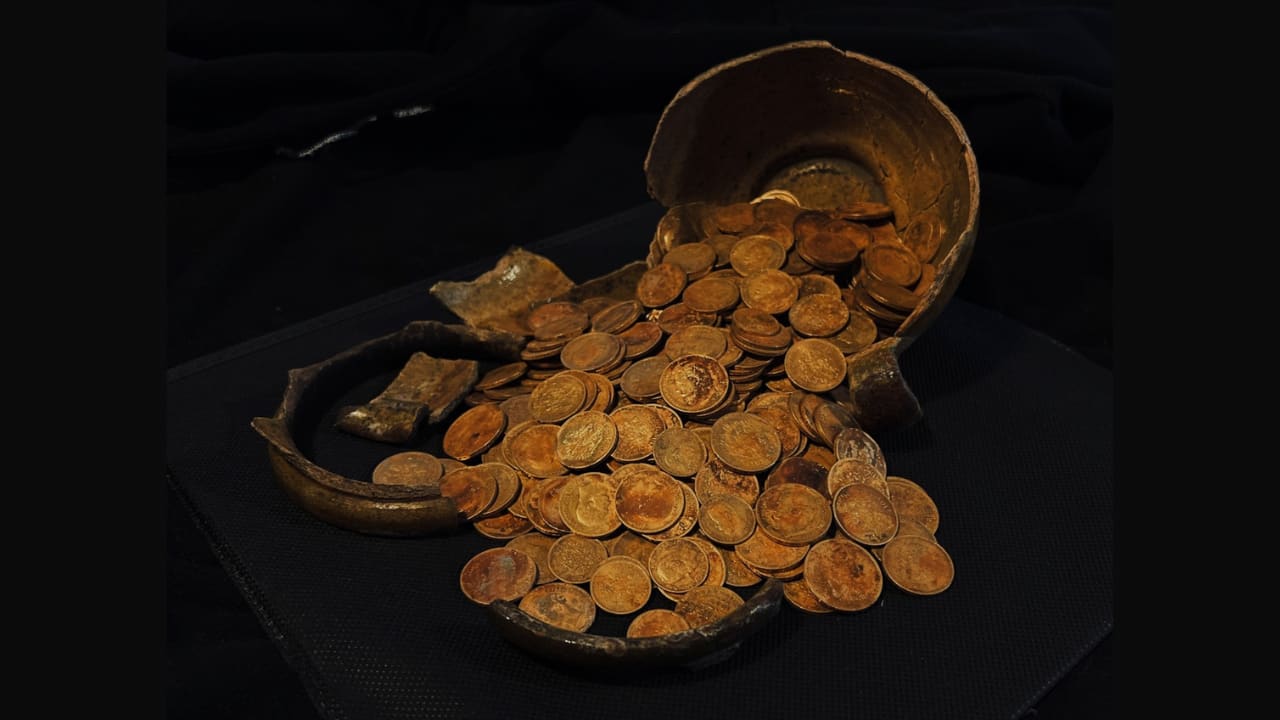
Hoard of gold rubles found under a house in western Russia, March 25, 2026.
(photo credit: The Institute of Archaeology of the Russian Academy of Sciences)
ByMIRIAM SELA-EITAM

A hoard of 409 gold ruble coins dated to over a century ago was discovered underneath a home in Torzhok, Russia, the Institute of Archaeology of the Russian Academy of Sciences shared in early March. 

Discovered during a joint expedition between the Institute and the All-Russian Historical and Ethnographic Museum in 2025, the hoard is one of the largest hoards of late Imperial Russian gold coins ever to be recovered.

Part of the property under excavation contained the foundations of a house believed to have been destroyed during World War II. After the war, the home’s new owners rebuilt the wooden house on the surviving stone foundations.

Found hidden within a broken kandyushka (glazed clay vessel) in a pit under the house’s foundation, the hoard consisted of 387 gold 10-ruble coins, 10 five ruble coins, 10 coins worth 15 rubles, and two seven-and-a-half ruble coins were found. 

Together, the coins add up to about 4,070 rubles, according to the Institute’s statement. Based on the melt value of one pre-revolution 10 ruble coin, which is about 90% gold, the entire hoard may be valued at an estimated half a million dollars.

Hoard of gold coins found in the foundations of a house in western Russia, March 25, 2026.
Hoard of gold coins found in the foundations of a house in western Russia, March 25, 2026. (credit: The Institute of Archaeology of the Russian Academy of Sciences)

The earliest coin, a five ruble piece from the reign of Nicholas I, was minted in 1848, and a second five-ruble coin bears dates back to the reign of Alexander III.

The remaining coins are from the reign of Nicholas II, the last tsar of Russia and father of the famed Anastasia, between 1894 and 1911.

One of the most intriguing finds, however, are the 15 and seven-and-a-half ruble denomination, as they were special-issue coins minted only in 1897, as part of the monetary reform introduced by then finance minister Sergei Witte that put Russia on the gold standard.

Coins belong to a ‘return hoard’

According to the Institute, the discovery has been classified as a “return hoard,” meaning that it had deliberately been concealed by an individual with the intention of recovery at a later date.

Even though the most recent coin found is dated to 1911, archaeologists believe the circumstances of the hoard’s concealment point strongly to the Russian Revolution, when private wealth was nationalized and holding gold became dangerous.

Historical records show that pre-1917, the street housed 24 different properties, including priests from the nearby Church of St. Demetrius, two merchants, a treasurer, a bookkeeper, an overseer, a tailor, a metalworker, a shoemaker, a court official, a secretary, and an unskilled labourer.

These records, however, do not correspond to modern addresses, leaving the precise property, and therefore the precise owner of the hoard, difficult to identify.

While researchers attempt to locate the owner of the coins, the hoard will be transferred to the All-Russian Historical and Ethnographic Museum in Torzhok, where it will eventually go on public display.

Follow us on Google