惯性聚合 高效追踪和阅读你感兴趣的博客、新闻、科技资讯
阅读原文 在惯性聚合中打开

推荐订阅源

博客园 - 聂微东
GbyAI
GbyAI
S
SegmentFault 最新的问题
H
Hackread – Cybersecurity News, Data Breaches, AI and More
V
Visual Studio Blog
WordPress大学
WordPress大学
Hugging Face - Blog
Hugging Face - Blog
B
Blog
宝玉的分享
宝玉的分享
Last Week in AI
Last Week in AI
雷峰网
雷峰网
爱范儿
爱范儿
Vercel News
Vercel News
人人都是产品经理
人人都是产品经理
U
Unit 42
Microsoft Azure Blog
Microsoft Security Blog
Jina AI
Jina AI
P
Proofpoint News Feed
A
About on SuperTechFans
I
InfoQ
F
Fortinet All Blogs
L
LangChain Blog
T
Tailwind CSS Blog

JPost.com - Archaeology | The Jerusalem Post

What was the Qumran sect's mysterious calender used for? | The Jerusalem Post Ancient structure near Stonehenge may have inspired its solstice alignment | The Jerusalem Post Ancient tablet found at Roman fort bears Greek curse against enemies | The Jerusalem Post Archaeologists unearth ancient Byzantine-era city in Egypt’s Dakhla Oasis | The Jerusalem Post Ancient mosaics, coins to go on display in new exhibit in northern Israel | The Jerusalem Post Archaeologists find inscriptions of pharaohs, ancient deities in Egyptian temple | The Jerusalem Post Italy buys famed Etruscan tomb, displays it in Rome museum | The Jerusalem Post New AI project aims to uncover origins of the Dead Sea Scrolls | The Jerusalem Post Site of Alexander the Great’s battle with Persians under historic protection | The Jerusalem Post Previously unknown Iron Age grave found ahead of construction in Germany | The Jerusalem Post Collector finds rare Hebrew-inscribed Moroccan mortar in Jerusalem's Old City | The Jerusalem Post Stone from Tel Eton may hold evidence of ancient religious reforms, study claims | The Jerusalem Post Complete text of carbonized Herculaneum scroll unlocked for first time | The Jerusalem Post Study: New identification technique pushes back timeline of human fire use | The Jerusalem Post Over 3,000 artifacts from Stone Age to WWII found in Netherlands valley | The Jerusalem Post American family repatriates four ancient artifacts to Egypt | The Jerusalem Post Remains of Queen Elisenda, 24 others unearthed in Barcelona for study | The Jerusalem Post Two ancient statues uncovered during Israel Railways excavations near Haifa | The Jerusalem Post Marble bust believed to depict Roman goddess of love found during excavations at Alicante beach Ancient Greco-Roman cemetery unearthed at archaeological site in Egypt's Nile Delta Ancient jars unearthed at biblical Shiloh days before annual wine festival WATCH: A Paleolithic time capsule: Rare prehistoric cave discovered near highway outside of Haifa Ancient water reservoirs discovered at Red Sea's Port of Aydhab site near Egypt-Sudan border Collection of ancient Egyptian, Greek, Roman-era artifacts discovered at Egypt’s Heracleopolis First near-complete ancient Egyptian funerary set discovered at Heliopolis necropolis site WATCH: Norway recovers Chinese porcelain, European-made goods from 18th-century shipwreck Neanderthals' ancient toolkit included hammers, blades made from rhino teeth, study finds Evidence of ancient Native American life uncovered near Cape Canaveral Space Force Station Rare, intact ancient Roman burial unearthed during excavations in eastern Croatia - report Plaster-making technique attributed to Romans used at Motza some 8,000 years earlier, study shows
Over 30 mummified cats, ancient Egyptian tombs, coffins d...
MIRIAM SELA-EITAM · 2026-05-20 · via JPost.com - Archaeology | The Jerusalem Post

According to preliminary studies, four of the coffins date to the 18th Dynasty, including one bearing the name of Merit, believed to be a chantress of Amun.

Follow us on Google
Ancient Egyptian wooden coffin found at  Draʻ Abu el-Naga’s necropolis site near Thebes, Egypt, May 19, 2026.
Ancient Egyptian wooden coffin found at Draʻ Abu el-Naga’s necropolis site near Thebes, Egypt, May 19, 2026.
(photo credit: EGYPTIAN TOURISM AND ANTIQUITIES MINISTRY)
ByMIRIAM SELA-EITAM

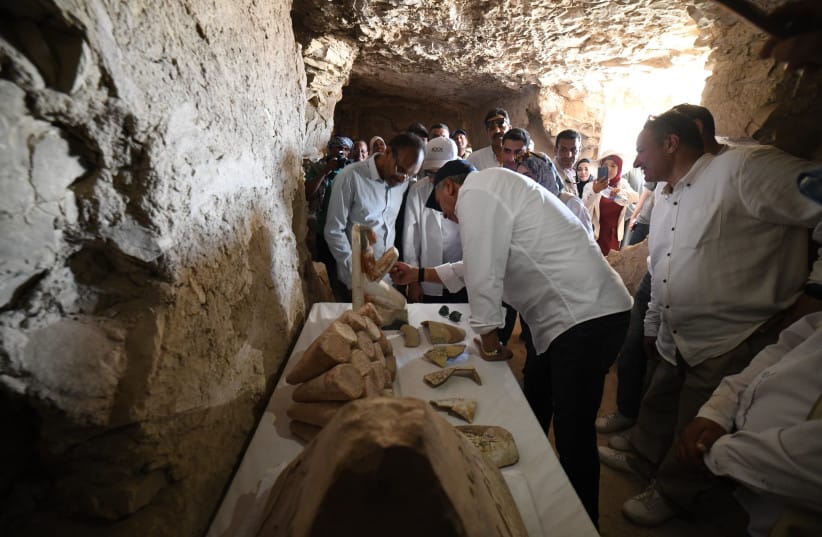
Ongoing archaeological excavations at a necropolis on the Nile River’s west bank have uncovered a plethora of previously unrecorded individuals and ancient Egyptian artifacts, the Egyptian Tourism and Antiquities Ministry announced on Friday.

The excavations, which began in November 2025, are taking place in the area of Draʻ Abu el-Naga’s necropolis, located on the Luxor West Bank in Egypt

It has been focused on the southeastern part of the tomb of Roy, an 18th Dynasty royal scribe and his wife, which has been covered in debris from archaeological missions from over a century ago.

In the courtyard between the tomb of Roy and the nearby tomb of Baki, archaeologists have discovered a collection of 10 wooden coffins hidden within a burial shaft. All 10 were found to be in good condition, bearing a variety of scenes and texts.

According to preliminary studies, four of the coffins date to the 18th Dynasty, including one bearing the name of Merit, believed to be a chantress of Amun.

Collection of finds discovered at Draʻ Abu el-Naga’s necropolis site near Thebes, Egypt, May 19, 2026.
Collection of finds discovered at Draʻ Abu el-Naga’s necropolis site near Thebes, Egypt, May 19, 2026. (credit: EGYPTIAN TOURISM AND ANTIQUITIES MINISTRY)

A second coffin, dating to the Ramesside period (the 19th and 20th Dynasty periods), bears the name Padi-Amun (“he who Amun gave”), who was a priest in the Temple of Amun.

The remaining coffins dated to the Late Period of Egypt, circa 664–332 BCE, which encompassed the 26th-31st dynasties.

Several of the mummies had been damaged ahead of their reburial, indicated that the remains had possibly been disturbed in antiquity. This lead researchers to believe that the burial shaft had been used to protect the coffins after they’d been moved from their original burial places. 

New tomb belonging to priest of Amun found 

The Egyptian mission also discovered a previously unknown tomb belonging to a “purification priest of the Temple of Amun,” named Aa-Shefi-Nakhtu.

The newly unearthed tomb is located in the southern corner of Baki’s courtyard, and includes a small open courtyard, a rectangular shaft, an offering chamber decorated with funerary texts and scnes of offering, and a burial chamber.

Inscriptions inside the tomb detail Aa-Shefi-Nakhtu’s father, named Padi-Amun, who held the same title of purification priest. They also include the names of two women, Isis and Ta-Kaft, who are described as Chantresses of Amun.

In a third tomb, numbered DP91, archaeologists uncovered a sandstone pyramidion bearing the name of its suspected owner, Benji, who was a “scribe and noble,” and depicting him in a devotional pose.

Benji’s original tomb has yet to be found.

Mohamed Abdel Badie, Head of the Egyptian Antiquities Sector at the Supreme Council of Antiquities, explained that the find suggests that Benji’s tomb could be located nearby, and that it had originally been topped by a mudbrick pyramid that was destroyed over time.

The individuals discovered in the tombs haven’t ever been mentioned in historical sources, according to Abdelghaffar Wagdy, director-general of Luxor Antiquities

“The inscriptions uncovered within them have also documented new titles and functions mentioned for the first time,” he said.

Over 30 mummified cats unearthed at necropolis

Buried, mummified animals, including over 30 mummified wild and domestic cats, were also discovered within layers of debris south of the tomb of Baki.

According to researchers, the burial likely dates to the Ptolemaic period, when animal mummies were offered as symbolic offerings for protection, before being buried in small pits upon completion of the religious ritual or celebration.

This discovery “reflects the richness of the archaeological site and the diversity of the finds uncovered, as well as the wide range of periods to which they belong,” the ministry stated.

Wagdy went on to note that the artifacts and tombs are currently being restored and preserved as the excavations are continued.

Follow us on Google