
惯性聚合 高效追踪和阅读你感兴趣的博客、新闻、科技资讯
阅读原文 在惯性聚合中打开

推荐订阅源

WordPress大学
WordPress大学
B
Blog
M
MIT News - Artificial intelligence
OSCHINA 社区最新新闻
OSCHINA 社区最新新闻
P
Proofpoint News Feed
C
Check Point Blog
H
Hackread – Cybersecurity News, Data Breaches, AI and More
J
Java Code Geeks
博客园 - 叶小钗
S
SegmentFault 最新的问题
Last Week in AI
Last Week in AI
T
The Blog of Author Tim Ferriss
Microsoft Security Blog
小众软件
小众软件
钛媒体:引领未来商业与生活新知
钛媒体:引领未来商业与生活新知
博客园 - 【当耐特】
腾讯CDC
博客园 - Franky
博客园 - 聂微东
V
Visual Studio Blog
GbyAI
GbyAI
Martin Fowler
Martin Fowler
罗磊的独立博客
Y
Y Combinator Blog

JPost.com - Archaeology | The Jerusalem Post

What was the Qumran sect's mysterious calender used for? | The Jerusalem Post Ancient structure near Stonehenge may have inspired its solstice alignment | The Jerusalem Post Ancient tablet found at Roman fort bears Greek curse against enemies | The Jerusalem Post Archaeologists unearth ancient Byzantine-era city in Egypt’s Dakhla Oasis | The Jerusalem Post Ancient mosaics, coins to go on display in new exhibit in northern Israel | The Jerusalem Post Archaeologists find inscriptions of pharaohs, ancient deities in Egyptian temple | The Jerusalem Post Italy buys famed Etruscan tomb, displays it in Rome museum | The Jerusalem Post New AI project aims to uncover origins of the Dead Sea Scrolls | The Jerusalem Post Site of Alexander the Great’s battle with Persians under historic protection | The Jerusalem Post Previously unknown Iron Age grave found ahead of construction in Germany | The Jerusalem Post Collector finds rare Hebrew-inscribed Moroccan mortar in Jerusalem's Old City | The Jerusalem Post Stone from Tel Eton may hold evidence of ancient religious reforms, study claims | The Jerusalem Post Complete text of carbonized Herculaneum scroll unlocked for first time | The Jerusalem Post Study: New identification technique pushes back timeline of human fire use | The Jerusalem Post Over 3,000 artifacts from Stone Age to WWII found in Netherlands valley | The Jerusalem Post American family repatriates four ancient artifacts to Egypt | The Jerusalem Post Remains of Queen Elisenda, 24 others unearthed in Barcelona for study | The Jerusalem Post Two ancient statues uncovered during Israel Railways excavations near Haifa | The Jerusalem Post Marble bust believed to depict Roman goddess of love found during excavations at Alicante beach Ancient Greco-Roman cemetery unearthed at archaeological site in Egypt's Nile Delta Ancient jars unearthed at biblical Shiloh days before annual wine festival WATCH: A Paleolithic time capsule: Rare prehistoric cave discovered near highway outside of Haifa Ancient water reservoirs discovered at Red Sea's Port of Aydhab site near Egypt-Sudan border Collection of ancient Egyptian, Greek, Roman-era artifacts discovered at Egypt’s Heracleopolis First near-complete ancient Egyptian funerary set discovered at Heliopolis necropolis site WATCH: Norway recovers Chinese porcelain, European-made goods from 18th-century shipwreck Neanderthals' ancient toolkit included hammers, blades made from rhino teeth, study finds Evidence of ancient Native American life uncovered near Cape Canaveral Space Force Station Rare, intact ancient Roman burial unearthed during excavations in eastern Croatia - report Plaster-making technique attributed to Romans used at Motza some 8,000 years earlier, study shows
British heritage charity constructs replica of 4,500-year...
MIRIAM SELA-EITAM · 2026-05-28 · via JPost.com - Archaeology | The Jerusalem Post

It is expected to be completed and open to the public by summer, before becoming in September a “living-history learning space for school groups."
Follow us on Google
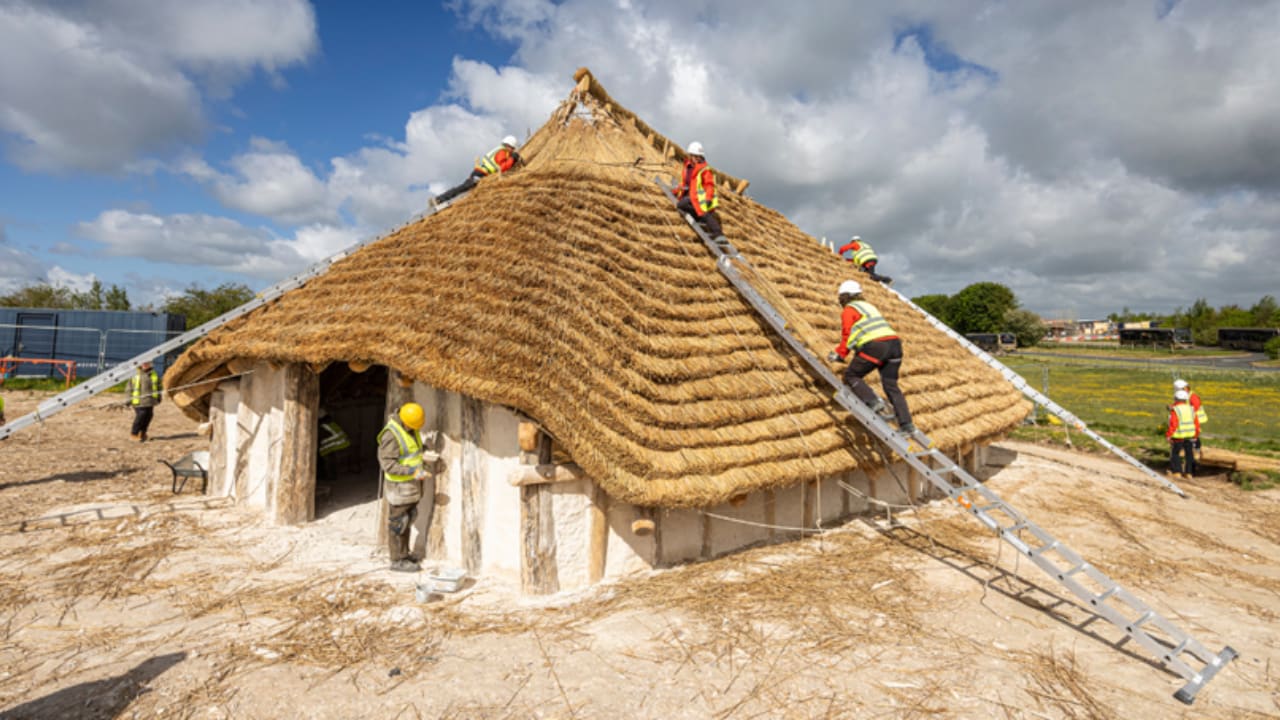
Kusuma Neolithic Hall, replica of prehistoric building, constructed near Stonehenge, May 26, 2026.
(photo credit: English Heritage)
ByMIRIAM SELA-EITAM

The reconstruction of a 4,500-year-old Neolithic building at Stonehenge was unveiled on Friday by the British charity group English Heritage.

Standing at seven meters tall, the Kusuma Neolithic Hall was modeled after a large prehistoric structure found by archaeologists some two miles away from the historic site of Stonehenge.

The hall is being reconstructed using historically authentic methods and locally sourced materials, English Heritage said in its statement, noting that the building is also in the final stages of its construction. 

For nine months, over 100 volunteers - under the guidance of archaeologist Luke Winter - have carefully used historically accurate tools and materials, including thatch, coppiced timber, and chalk daub, to recreate Neolithic building techniques.

It is expected to be completed and open to the public by summer, before becoming in September a “living-history learning space for school groups,” the statement added.

Kusuma Neolithic Hall, replica of prehistoric building, constructed near Stonehenge, May 26, 2026.
Kusuma Neolithic Hall, replica of prehistoric building, constructed near Stonehenge, May 26, 2026. (credit: English Heritage)

Making a positive difference, providing a memorable experience

The entire one million pound project is being funded by the Kusuma Trust, which “grants to causes, organizations and people that are making a positive difference to society,” according to the trust’s website.

Upon completion, the hall will be able to hold groups of up to 30 students at once, in order to transport them back to prehistory as they “gather around the hearth,” getting to handle replicas of Neolithic tools, and try cooking and various crafts from the time period.

“The Kusuma Neolithic Hall is such an exciting project for the charity,” Matt Thompson, Conservation, Curatorial and Learning Director for English Heritage, said, thanking the Kusuma Trust for its generous donation.

“Not only is the hall a wonderful addition to the Stonehenge experience for both visitors and learners, but by using historically accurate techniques and materials in its construction, we have also been able to develop a much keener understanding of the everyday lives of the Neolithic people who came to Stonehenge and settled in the locality.”

Thompson added that one of the charity’s main goals is to provide visitors with memorable and unique learning experiences, and that Kusuma Neolithic Hall will “transform our [English Heritage] ability to do that.”

“With its burning hearth, Neolithic crafts and cookery, the hall is a model for living history – instantaneously transporting you back 4,500 years,” Thompson said. “This summer, visitors to Stonehenge will also have the chance to experience the hall and speak to some of our wonderful volunteers who built it, before it is opened up to educational groups for the new school year”.

Purpose of original structure still unknown

Despite having a very clear idea of what to use the Kusuma Neolithic Hall for, the purpose of the prehistoric structure on which it is based still remains unclear.

The structure was found around two miles northeast of Stonehenge, near the large Neolithic settlement and later henge enclosure of Durrington Walls.

It is the second-largest known Late Neolithic fortified enclosure in the United Kingdom

Excavations at the settlement began in 2004 and have since discovered thousands of animal bones and grooved ware-style pottery, indicating the possibility of large winter feasts.

Additionally, it suggests that the original hall upon which the Kusuma Neolithic Hall is based could have been used as a gathering space for celebrations, rituals, or burial practices.

Follow us on Google
