
惯性聚合 高效追踪和阅读你感兴趣的博客、新闻、科技资讯
阅读原文 在惯性聚合中打开

推荐订阅源

D
Docker
B
Blog RSS Feed
Microsoft Security Blog
Y
Y Combinator Blog
N
Netflix TechBlog - Medium
M
MIT News - Artificial intelligence
奇客Solidot–传递最新科技情报
奇客Solidot–传递最新科技情报
B
Blog
钛媒体:引领未来商业与生活新知
钛媒体:引领未来商业与生活新知
C
Check Point Blog
The GitHub Blog
The GitHub Blog
让小产品的独立变现更简单 - ezindie.com
P
Proofpoint News Feed
Martin Fowler
Martin Fowler
大猫的无限游戏
大猫的无限游戏
GbyAI
GbyAI
博客园_首页
A
About on SuperTechFans
Blog — PlanetScale
Blog — PlanetScale
人人都是产品经理
人人都是产品经理
T
Tailwind CSS Blog
aimingoo的专栏
aimingoo的专栏
T
The Blog of Author Tim Ferriss
The Cloudflare Blog

JPost.com - Archaeology | The Jerusalem Post

What was the Qumran sect's mysterious calender used for? | The Jerusalem Post Ancient structure near Stonehenge may have inspired its solstice alignment | The Jerusalem Post Ancient tablet found at Roman fort bears Greek curse against enemies | The Jerusalem Post Archaeologists unearth ancient Byzantine-era city in Egypt’s Dakhla Oasis | The Jerusalem Post Ancient mosaics, coins to go on display in new exhibit in northern Israel | The Jerusalem Post Archaeologists find inscriptions of pharaohs, ancient deities in Egyptian temple | The Jerusalem Post Italy buys famed Etruscan tomb, displays it in Rome museum | The Jerusalem Post New AI project aims to uncover origins of the Dead Sea Scrolls | The Jerusalem Post Site of Alexander the Great’s battle with Persians under historic protection | The Jerusalem Post Previously unknown Iron Age grave found ahead of construction in Germany | The Jerusalem Post Collector finds rare Hebrew-inscribed Moroccan mortar in Jerusalem's Old City | The Jerusalem Post Stone from Tel Eton may hold evidence of ancient religious reforms, study claims | The Jerusalem Post Complete text of carbonized Herculaneum scroll unlocked for first time | The Jerusalem Post Study: New identification technique pushes back timeline of human fire use | The Jerusalem Post Over 3,000 artifacts from Stone Age to WWII found in Netherlands valley | The Jerusalem Post American family repatriates four ancient artifacts to Egypt | The Jerusalem Post Remains of Queen Elisenda, 24 others unearthed in Barcelona for study | The Jerusalem Post Two ancient statues uncovered during Israel Railways excavations near Haifa | The Jerusalem Post Marble bust believed to depict Roman goddess of love found during excavations at Alicante beach Ancient Greco-Roman cemetery unearthed at archaeological site in Egypt's Nile Delta Ancient jars unearthed at biblical Shiloh days before annual wine festival WATCH: A Paleolithic time capsule: Rare prehistoric cave discovered near highway outside of Haifa Ancient water reservoirs discovered at Red Sea's Port of Aydhab site near Egypt-Sudan border Collection of ancient Egyptian, Greek, Roman-era artifacts discovered at Egypt’s Heracleopolis First near-complete ancient Egyptian funerary set discovered at Heliopolis necropolis site WATCH: Norway recovers Chinese porcelain, European-made goods from 18th-century shipwreck Neanderthals' ancient toolkit included hammers, blades made from rhino teeth, study finds Evidence of ancient Native American life uncovered near Cape Canaveral Space Force Station Rare, intact ancient Roman burial unearthed during excavations in eastern Croatia - report Plaster-making technique attributed to Romans used at Motza some 8,000 years earlier, study shows
Collection of gold beads, amulets discovered during excav...
MIRIAM SELA-EITAM · 2026-05-03 · via JPost.com - Archaeology | The Jerusalem Post

All 32 of the items were found in excellent condition and believed to have belonged to a gold necklace or pendent.
Follow us on Google
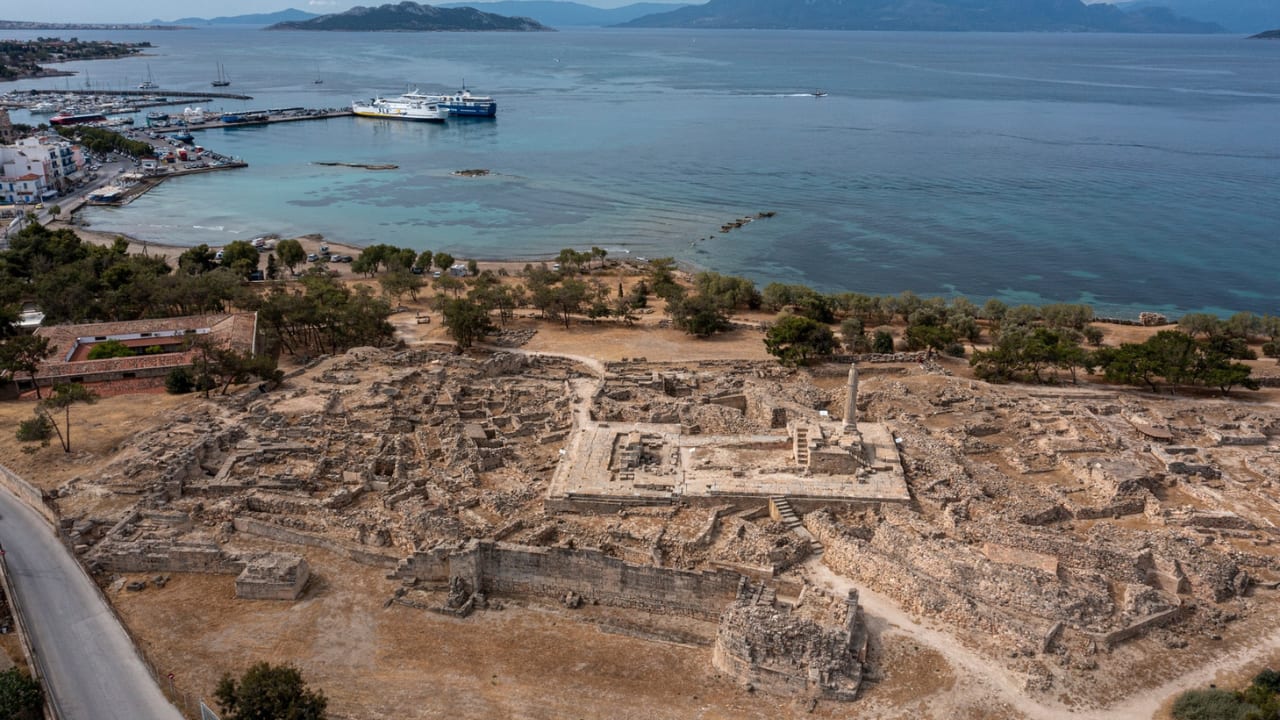
Aerial photograph of the archaeological site of Kolona on Aegina, Greece, April 22, 2026.
(photo credit: Greek Culture Ministry)
ByMIRIAM SELA-EITAM

A collection of gold beads and amulets dating to the first half of the second millennium BCE were found during 2025 excavations at the archaeological site of Kolona on the Greek island of  Aegina.

The discovery, announced last week by the Greek Culture Ministry, was found inside the ruins of a large stone structure, near the remains of a wall that protected the “inner suburb” of the Middle Bronze Age settlement.

Included in the collection were eight gold bilateral disc-shaped amulets, one gold non-bilateral disc-shaped amulet, seven golden biconical beads, one cylindrical gold bead, eight decorative sheets of gold leaf, and seven spherical carnelian beads.

All 32 of the items were found in excellent condition and believed to have belonged to a gold necklace or pendent.

In addition, a needle and twelve copper fragments, likely from small knives, were found at the site.

Gold bilateral discoid periapt found at Aegina, Greece, April 22, 2026.
Gold bilateral discoid periapt found at Aegina, Greece, April 22, 2026. (credit: Greek Culture Ministry)

According to archaeologists, the jewelry may have served as grave offerings, possibly from a Middle Bronze Age burial. However, there has been no evidence of a surviving tomb to support this theory.

Pieces bear similarity to famed 'Aegina Treasure'

The jewelry, and the amulets in particular, bear similarities to pieces from the “Aegina Treasure,” a Minoan gold hoard believed by some to have been found in a tomb on the island in 1891, while others think it to have been taken from the Chryssolakkos necropolis at Malia, Crete.

In 1892, the British Museum purchased the majority of the hoard from British artifact dealers. Further pieces were later bought by the museum in 1914.

The Aegina Treasure has been dated to the Greek Bronze Age between 1850 and 1550 BCE.

It includes two pairs of earrings, three diadems, a chest pendent, bracelet, and gold cup, four rings, ornamented plaques and plain strips. As well, there are five hoops and numerous beads and pendants made out of gold, lapis lazuli, amethyst, quartz, cornelian and green jasper.

The Kolona excavations were conducted by the University of Salzburg through the Austrian Archaeological Institute in Athens, under the direction of Professor Alexander Sokolicek and the supervision of the Ephorate of Antiquities of Piraeus and the Islands.

Follow us on Google
