
惯性聚合 高效追踪和阅读你感兴趣的博客、新闻、科技资讯
阅读原文 在惯性聚合中打开

推荐订阅源

博客园 - 叶小钗
V
Visual Studio Blog
雷峰网
雷峰网
J
Java Code Geeks
博客园 - 三生石上(FineUI控件)
人人都是产品经理
人人都是产品经理
MyScale Blog
MyScale Blog
H
Hackread – Cybersecurity News, Data Breaches, AI and More
freeCodeCamp Programming Tutorials: Python, JavaScript, Git & More
B
Blog RSS Feed
C
Check Point Blog
博客园 - Franky
酷 壳 – CoolShell
酷 壳 – CoolShell
博客园 - 【当耐特】
OSCHINA 社区最新新闻
OSCHINA 社区最新新闻
Cyber Security Advisories - MS-ISAC
V
V2EX
D
Docker
IT之家
IT之家
博客园 - 聂微东
腾讯CDC
U
Unit 42
Microsoft Security Blog
The Cloudflare Blog

JPost.com - Archaeology | The Jerusalem Post

What was the Qumran sect's mysterious calender used for? | The Jerusalem Post Ancient structure near Stonehenge may have inspired its solstice alignment | The Jerusalem Post Ancient tablet found at Roman fort bears Greek curse against enemies | The Jerusalem Post Archaeologists unearth ancient Byzantine-era city in Egypt’s Dakhla Oasis | The Jerusalem Post Ancient mosaics, coins to go on display in new exhibit in northern Israel | The Jerusalem Post Archaeologists find inscriptions of pharaohs, ancient deities in Egyptian temple | The Jerusalem Post Italy buys famed Etruscan tomb, displays it in Rome museum | The Jerusalem Post New AI project aims to uncover origins of the Dead Sea Scrolls | The Jerusalem Post Site of Alexander the Great’s battle with Persians under historic protection | The Jerusalem Post Previously unknown Iron Age grave found ahead of construction in Germany | The Jerusalem Post Collector finds rare Hebrew-inscribed Moroccan mortar in Jerusalem's Old City | The Jerusalem Post Stone from Tel Eton may hold evidence of ancient religious reforms, study claims | The Jerusalem Post Complete text of carbonized Herculaneum scroll unlocked for first time | The Jerusalem Post Study: New identification technique pushes back timeline of human fire use | The Jerusalem Post Over 3,000 artifacts from Stone Age to WWII found in Netherlands valley | The Jerusalem Post American family repatriates four ancient artifacts to Egypt | The Jerusalem Post Remains of Queen Elisenda, 24 others unearthed in Barcelona for study | The Jerusalem Post Two ancient statues uncovered during Israel Railways excavations near Haifa | The Jerusalem Post Marble bust believed to depict Roman goddess of love found during excavations at Alicante beach Ancient Greco-Roman cemetery unearthed at archaeological site in Egypt's Nile Delta Ancient jars unearthed at biblical Shiloh days before annual wine festival WATCH: A Paleolithic time capsule: Rare prehistoric cave discovered near highway outside of Haifa Ancient water reservoirs discovered at Red Sea's Port of Aydhab site near Egypt-Sudan border Collection of ancient Egyptian, Greek, Roman-era artifacts discovered at Egypt’s Heracleopolis First near-complete ancient Egyptian funerary set discovered at Heliopolis necropolis site WATCH: Norway recovers Chinese porcelain, European-made goods from 18th-century shipwreck Neanderthals' ancient toolkit included hammers, blades made from rhino teeth, study finds Evidence of ancient Native American life uncovered near Cape Canaveral Space Force Station Rare, intact ancient Roman burial unearthed during excavations in eastern Croatia - report Plaster-making technique attributed to Romans used at Motza some 8,000 years earlier, study shows
Early humans may have begun eating elephants, large anima...
2026-04-16 · via JPost.com - Archaeology | The Jerusalem Post
ByMIRIAM SELA-EITAM
Updated:

Humans systematically butchered and consumed elephants as early as 1.8 million years ago, marking a shift in human evolution towards hunting large animals, according to a new study published in the journal eLife

Researchers discovered a previously undocumented elephant butchery site at Olduvai Gorge in Tanzania, which has been since named the Emiliano Aguirre Korongo (EAK) site, containing the partial remains of a juvenile elephant of the extinct Elephas recki.

The remains were found near a cache of 80 stone tools, mostly flakes used for cutting. The proximity of the tools to the carcass, the study explained, strongly suggests that the animal was processed on-site by early hominins.

Such a thing seems to represent a fundamental change in the behavior of early humans, moving away from opportunistic scavenging of available carcasses toward a more deliberate strategy of targeting large animals.

According to the study, rather than treating megafauna (animals weighing more than 800 kilograms) as the occasional windfall, early humans appear to have structured their movements and camp sites around reliable access to them.
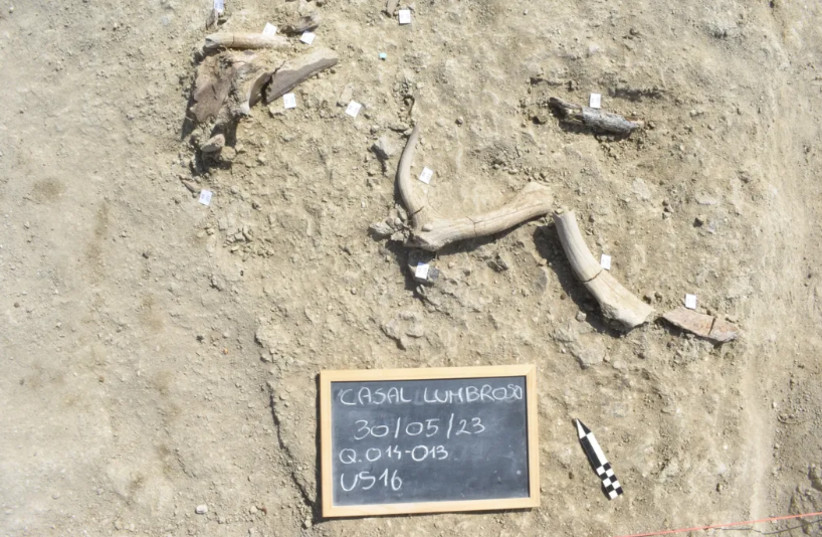
Ancient Roman site reveals early humans butchered straight-tusked elephant and crafted bone tools.
Ancient Roman site reveals early humans butchered straight-tusked elephant and crafted bone tools. (credit: Beniamino Mecozzi, CC-BY 4.0)

May have contributed to early humans' 'large brains'

Elephant bones contain a large amount of nutrition, a resource that has no “modern competition since no carnivore alive today can break open adult elephant limb bones.” However, early hominins, using stone hammers, could. 

The fat stored in elephant bones is thought to have played a role in supporting the growth of larger brains in the Homo erectus lineage.

A wider survey of the area consistently found evidence of elephant and hippopotamus butchery alongside caches of stone tools, a pattern that holds across three separate geological layers spanning hundreds of thousands of years.

This represents "a profound ecological and technological transformation," according to the study, distinguishing the findings from smaller-scale activity seen at other sites.