
惯性聚合 高效追踪和阅读你感兴趣的博客、新闻、科技资讯
阅读原文 在惯性聚合中打开

推荐订阅源

雷峰网
雷峰网
IT之家
IT之家
Last Week in AI
Last Week in AI
J
Java Code Geeks
L
LangChain Blog
Recent Announcements
Martin Fowler
Martin Fowler
H
Hackread – Cybersecurity News, Data Breaches, AI and More
Google DeepMind News
博客园 - Franky
博客园 - 司徒正美
月光博客
月光博客
博客园 - 叶小钗
Vercel News
Vercel News
腾讯CDC
钛媒体:引领未来商业与生活新知
钛媒体:引领未来商业与生活新知
小众软件
小众软件
Cyber Security Advisories - MS-ISAC
GbyAI
GbyAI
B
Blog RSS Feed
人人都是产品经理
人人都是产品经理
H
Help Net Security
G
Google Developers Blog
D
DataBreaches.Net

JPost.com - Archaeology | The Jerusalem Post

What was the Qumran sect's mysterious calender used for? | The Jerusalem Post Ancient structure near Stonehenge may have inspired its solstice alignment | The Jerusalem Post Ancient tablet found at Roman fort bears Greek curse against enemies | The Jerusalem Post Archaeologists unearth ancient Byzantine-era city in Egypt’s Dakhla Oasis | The Jerusalem Post Ancient mosaics, coins to go on display in new exhibit in northern Israel | The Jerusalem Post Archaeologists find inscriptions of pharaohs, ancient deities in Egyptian temple | The Jerusalem Post Italy buys famed Etruscan tomb, displays it in Rome museum | The Jerusalem Post New AI project aims to uncover origins of the Dead Sea Scrolls | The Jerusalem Post Site of Alexander the Great’s battle with Persians under historic protection | The Jerusalem Post Previously unknown Iron Age grave found ahead of construction in Germany | The Jerusalem Post Collector finds rare Hebrew-inscribed Moroccan mortar in Jerusalem's Old City | The Jerusalem Post Stone from Tel Eton may hold evidence of ancient religious reforms, study claims | The Jerusalem Post Complete text of carbonized Herculaneum scroll unlocked for first time | The Jerusalem Post Study: New identification technique pushes back timeline of human fire use | The Jerusalem Post Over 3,000 artifacts from Stone Age to WWII found in Netherlands valley | The Jerusalem Post American family repatriates four ancient artifacts to Egypt | The Jerusalem Post Remains of Queen Elisenda, 24 others unearthed in Barcelona for study | The Jerusalem Post Two ancient statues uncovered during Israel Railways excavations near Haifa | The Jerusalem Post Marble bust believed to depict Roman goddess of love found during excavations at Alicante beach Ancient Greco-Roman cemetery unearthed at archaeological site in Egypt's Nile Delta Ancient jars unearthed at biblical Shiloh days before annual wine festival WATCH: A Paleolithic time capsule: Rare prehistoric cave discovered near highway outside of Haifa Ancient water reservoirs discovered at Red Sea's Port of Aydhab site near Egypt-Sudan border Collection of ancient Egyptian, Greek, Roman-era artifacts discovered at Egypt’s Heracleopolis First near-complete ancient Egyptian funerary set discovered at Heliopolis necropolis site WATCH: Norway recovers Chinese porcelain, European-made goods from 18th-century shipwreck Evidence of ancient Native American life uncovered near Cape Canaveral Space Force Station Rare, intact ancient Roman burial unearthed during excavations in eastern Croatia - report Plaster-making technique attributed to Romans used at Motza some 8,000 years earlier, study shows British heritage charity constructs replica of 4,500-year-old prehistoric building near Stonehenge
Neanderthals' ancient toolkit included hammers, blades ma...
MIRIAM SELA-EITAM · 2026-05-30 · via JPost.com - Archaeology | The Jerusalem Post

Dental microwear analysis, which allows for the microscopic study of surface textures, confirmed that the marks were made after the animals' deaths, ruling out chewing or dietary wear and tear.
Follow us on Google
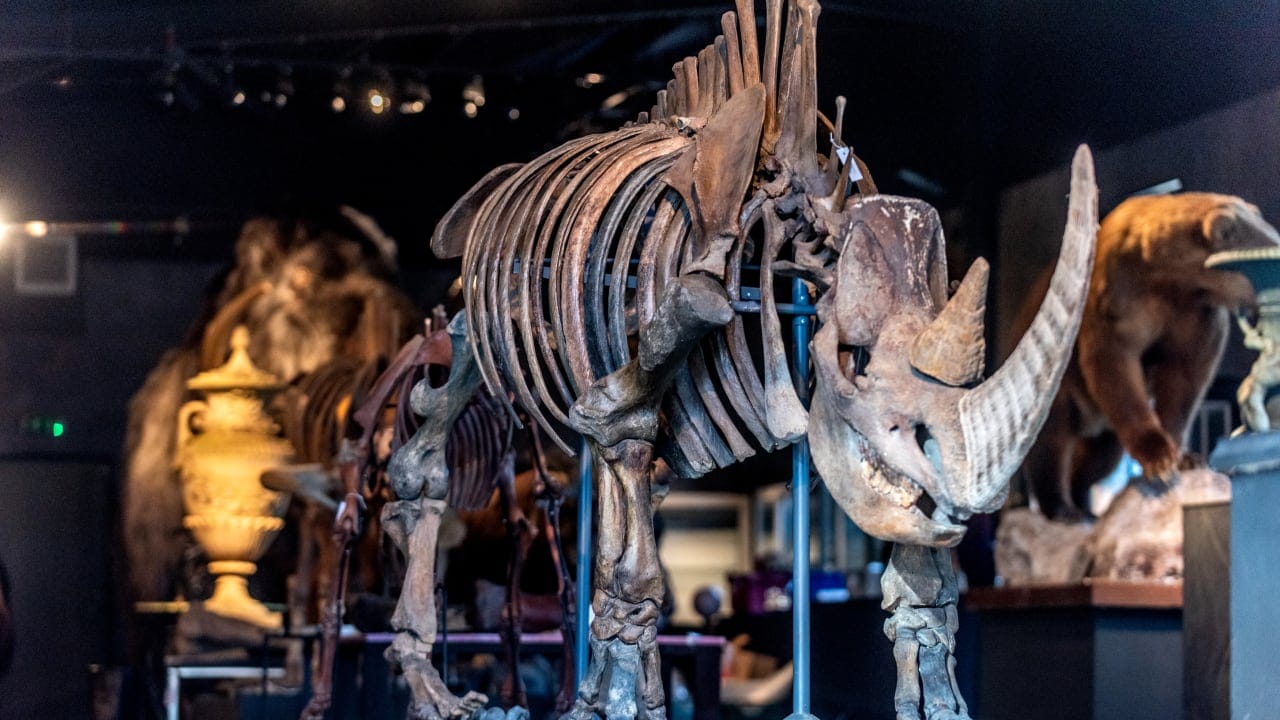
Rupert van Der Werff from Summers Place Auctions with a rare skeleton of a long-extinct woolly rhinoceros in Billingshurst, England, March 5, 2019; file photo.
(photo credit: Andrew Hasson/Getty Images)
ByMIRIAM SELA-EITAM
Updated:

Markings found on fossilized woolly rhinoceros teeth in caves in Europe suggests that they may have been part of the Neanderthal toolkit, according to a study published in May in the Journal of Human Evolution. 

The research, led by Alicia Sanz-Royo and colleagues from the Muséum National d'Histoire Naturelle in Paris, is the first to suggest that Neanderthals deliberately collected and used rhino teeth for tools during the Middle Paleolithic, around 300,000 to 40,000 years ago.

Researchers studied rhino teeth previously discovered in the El Castillo Cave in northern Spain and Pech-de-l'Azé II in southwestern France and noticed that many bore markings consistent with human activity.

Dental microwear analysis, which allows for the microscopic study of surface textures, confirmed that the marks were made after the animals' deaths, ruling out chewing or dietary wear as an explanation.

“I had never found teeth with these types of marks. At first, I was quite skeptical,” Sanz-Royo, of the University of Aberdeen in Scotland, told Science News. “This study is important because it opens the possibility that, in addition to bones and antlers, teeth, which are a superhard material, were also very useful.”

Fossil preparation and restorationist Lauren McClain Lauren McClain works with a woolly rhinoceros jaw in Houston, Texas, April 30, 2024.
Fossil preparation and restorationist Lauren McClain Lauren McClain works with a woolly rhinoceros jaw in Houston, Texas, April 30, 2024. (credit: MARK FELIX/AFP /AFP via Getty Images)

What appears to have allured Neanderthals into using rhino teeth despite their heavy unweildiness was the teeth’s hardness, according to the study, as the enamel coating of rhino teeth is made up of 97% hydroxyapatite, a mineral compound that gives it high resistance to fracture and impact.

Testing hypothesis using white rhino teeth

To test whether Neanderthals actually exploited this quality, the team obtained 18 freshly extracted teeth from white rhinoceroses sourced from three French zoos and hired a specialist knapper to turn them into recreations of tools used by Neanderthals.

Afterward, researchers used the tools as they would have been used by Neanderthals, such as retouching flint and quartz blades, knapping, and using the teeth as flat anvil surfaces to cut plant fibers and leather.

The entire process was filmed and supervised by taphonomists.

During the experiment, several distinct markings similar to those seen on the teeth discovered in France and Spain were created, including areas of overlapping enamel from repeated blows, shallow pitted areas on the inner layers of the teeth, percussion notches, and thin "sliding marks" left when a stone edge scraped across the surface during striking.

Findings indicate Neanderthals could think strategically

The study noted that findings carry broader implications for how we understand Neanderthal intelligence and adaptability, and suggest the possibility of strategic thinking.

Neanderthals’ deliberate choice to target older rhinos may have been “either because they were easier prey, because the advanced wear of their teeth made them more useful and comfortable tools, or both,” according to the study.

“This study shows that [Neandertals] not only ate the animals, but they utilized their remains for their technology,” archaeologist José Ramos-Muñoz of the University of Cadiz in Spain, who was not involved in the new study, told Science News. “It’s a trait of modernity.”

Follow us on Google
