
惯性聚合 高效追踪和阅读你感兴趣的博客、新闻、科技资讯
阅读原文 在惯性聚合中打开

推荐订阅源

Microsoft Security Blog
J
Java Code Geeks
GbyAI
GbyAI
aimingoo的专栏
aimingoo的专栏
L
LangChain Blog
I
InfoQ
D
Docker
F
Fortinet All Blogs
Y
Y Combinator Blog
Martin Fowler
Martin Fowler
月光博客
月光博客
B
Blog
Engineering at Meta
Engineering at Meta
T
Tailwind CSS Blog
罗磊的独立博客
博客园_首页
G
Google Developers Blog
Stack Overflow Blog
Stack Overflow Blog
Recent Announcements
D
DataBreaches.Net
freeCodeCamp Programming Tutorials: Python, JavaScript, Git & More
B
Blog RSS Feed
IT之家
IT之家
V
V2EX

JPost.com - Archaeology | The Jerusalem Post

What was the Qumran sect's mysterious calender used for? | The Jerusalem Post Ancient structure near Stonehenge may have inspired its solstice alignment | The Jerusalem Post Ancient tablet found at Roman fort bears Greek curse against enemies | The Jerusalem Post Archaeologists unearth ancient Byzantine-era city in Egypt’s Dakhla Oasis | The Jerusalem Post Ancient mosaics, coins to go on display in new exhibit in northern Israel | The Jerusalem Post Archaeologists find inscriptions of pharaohs, ancient deities in Egyptian temple | The Jerusalem Post Italy buys famed Etruscan tomb, displays it in Rome museum | The Jerusalem Post New AI project aims to uncover origins of the Dead Sea Scrolls | The Jerusalem Post Site of Alexander the Great’s battle with Persians under historic protection | The Jerusalem Post Previously unknown Iron Age grave found ahead of construction in Germany | The Jerusalem Post Collector finds rare Hebrew-inscribed Moroccan mortar in Jerusalem's Old City | The Jerusalem Post Stone from Tel Eton may hold evidence of ancient religious reforms, study claims | The Jerusalem Post Complete text of carbonized Herculaneum scroll unlocked for first time | The Jerusalem Post Study: New identification technique pushes back timeline of human fire use | The Jerusalem Post Over 3,000 artifacts from Stone Age to WWII found in Netherlands valley | The Jerusalem Post American family repatriates four ancient artifacts to Egypt | The Jerusalem Post Remains of Queen Elisenda, 24 others unearthed in Barcelona for study | The Jerusalem Post Two ancient statues uncovered during Israel Railways excavations near Haifa | The Jerusalem Post Marble bust believed to depict Roman goddess of love found during excavations at Alicante beach Ancient Greco-Roman cemetery unearthed at archaeological site in Egypt's Nile Delta Ancient jars unearthed at biblical Shiloh days before annual wine festival WATCH: A Paleolithic time capsule: Rare prehistoric cave discovered near highway outside of Haifa Ancient water reservoirs discovered at Red Sea's Port of Aydhab site near Egypt-Sudan border Collection of ancient Egyptian, Greek, Roman-era artifacts discovered at Egypt’s Heracleopolis First near-complete ancient Egyptian funerary set discovered at Heliopolis necropolis site WATCH: Norway recovers Chinese porcelain, European-made goods from 18th-century shipwreck Neanderthals' ancient toolkit included hammers, blades made from rhino teeth, study finds Evidence of ancient Native American life uncovered near Cape Canaveral Space Force Station Rare, intact ancient Roman burial unearthed during excavations in eastern Croatia - report Plaster-making technique attributed to Romans used at Motza some 8,000 years earlier, study shows
Lost mosaic shows first visual depiction of women fightin...
2026-04-06 · via JPost.com - Archaeology | The Jerusalem Post

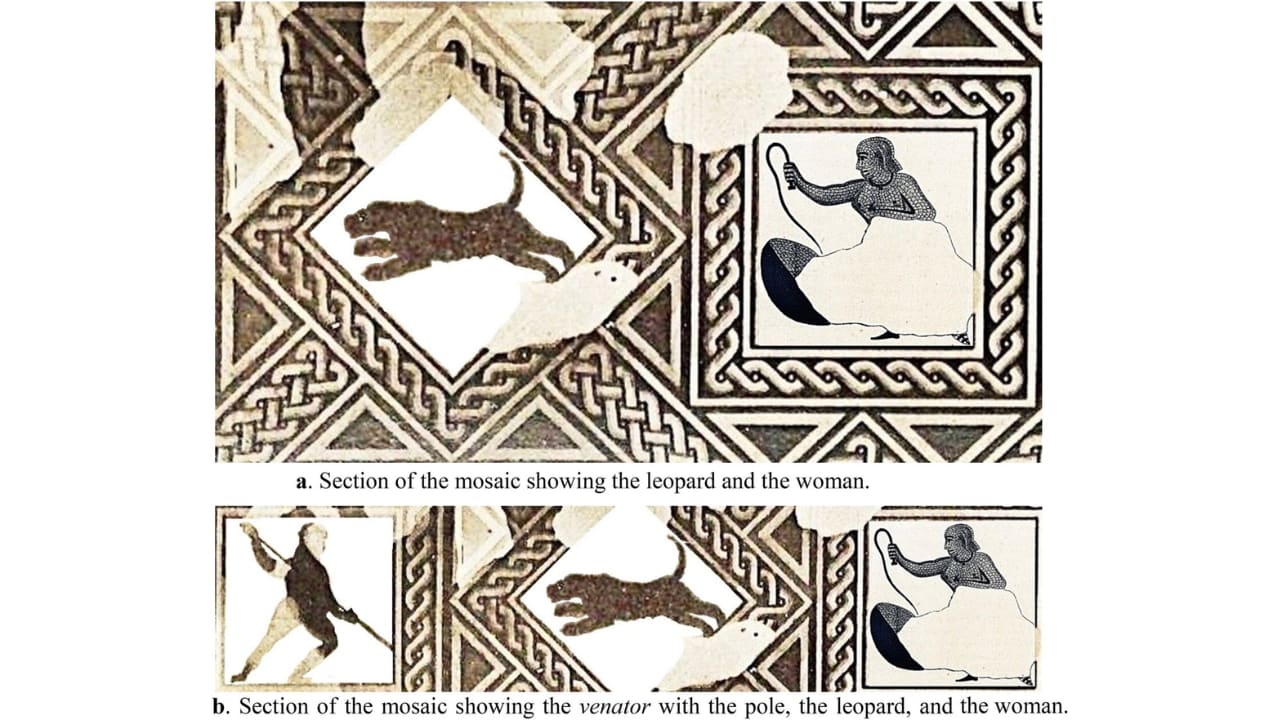
The mosaic, recovered in 1860s Reims, France and dated to the third century CE, shows about 35 different gladiatorial and hunting scenes, each surrounded by diamond or square-shaped decorations.

(a) Section of the mosaic showing the leopard and the woman. (b) Section of the mosaic showing the venator with the pole, the leopard, and the woman.
(photo credit: 2026 Alfonso Manas. Published by Informa UK Limited, trading as Taylor & Francis Group.)
ByMIRIAM SELA-EITAM

A 19th-century mosaic destroyed in World War I may have depicted the only known image of a woman fighting beasts in the Roman arena, according to a new study published in the International Journal of the History of Sport in March.

The mosaic, recovered in 1860s Reims, France and dated to the third century CE, shows about 35 different gladiatorial and hunting scenes, each surrounded by diamond or square-shaped decorations called "medallions."

It was “found in a house that likely belonged to a wealthy individual who sponsored beast-fighting shows held in arenas,” Alfonso Mañas, a sports researcher, told Live Science in an email, further explaining that it had most likely been displayed on the floor of a dining hall "so that the guests of the host could admire the mosaic during the banquet.”

While there are six surviving written texts that say that women fought beasts in the Roman arena, the mosaic, studied and sketched by French archaeologist Jean Charles Loriquet in 1862 before its destruction, provides the first visual account of such a thing.

Previous researchers, such as Loriquet himself, described the woman as an "agitator, an inexistent arena role, or a paegniarius, a kind of clown with a whip," Mañas wrote in the study, though noted that she does not hold the traditional sticks and padding the paegniarius bore.
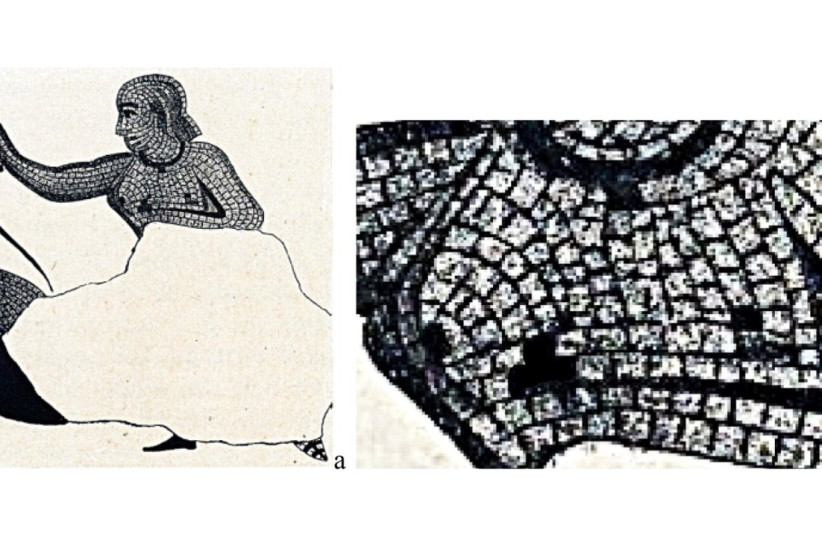
The woman. (a) Drawing from Loriquet 1862: planche IX, n° 11. (b) Detail of the breasts.
The woman. (a) Drawing from Loriquet 1862: planche IX, n° 11. (b) Detail of the breasts. (credit: 2026 Alfonso Manas. Published by Informa UK Limited, trading as Taylor & Francis Group.)

According to Mañas, there is no doubt that the figure is a woman, and pointed to the careful and deliberate depiction of her right breast using pointed tiles, clearly contrasting the other individuals shown in the mosaic as flat chested.

Female fighters would "always fight topless, with bare breasts,” Mañas explained, “because [otherwise] spectators from the stands would have had problems notic[ing] that they were actually women.”

Beast hunter or prisoner?

Regarding the woman's role, Mañas argued that she was a venatrix (beast hunter), as she is armed and unrestrained, unlike others sentenced to death in the arena. However, there were various types of beast hunters, including those trained to perform in the arena as punishment and released if they were alive by the end of their sentence.

But “in practice, visually, it was impossible to distinguish a venator, someone who became an arena hunter voluntarily, from a damnatus ad ludum venatorum, someone who became a venator obliged by sentence,” Mañas wrote, so there is no way of knowing which type of hunter she was.

The accuracy of Loriquet’s drawing also raised questions about Mañas’s conclusion, Thomas Scanlon, a professor emeritus of classics at the University of California who was not involved in the study, shared with Live Science. 

"The article is well documented,” he said, “but my concern is that the actual mosaic is not extant, but was destroyed in WWI, so the images are from an old [drawing] which may not be reliable in detail.”

In the study, Mañas pointed to the surviving fragment of the mosaic housed in a museum in Reims, showing that Loriquet’s portrayal of the medallion is accurate.

"I agree with the author," Arizona University History Professor Alison Futrell told Live Science in an email, adding that "I think that women were regular participants in arena events and that they're underrepresented in surviving textual and visual evidence."