
惯性聚合 高效追踪和阅读你感兴趣的博客、新闻、科技资讯
阅读原文 在惯性聚合中打开

推荐订阅源

Blog — PlanetScale
Blog — PlanetScale
J
Java Code Geeks
N
Netflix TechBlog - Medium
Martin Fowler
Martin Fowler
A
About on SuperTechFans
腾讯CDC
B
Blog RSS Feed
H
Hackread – Cybersecurity News, Data Breaches, AI and More
Microsoft Azure Blog
D
Docker
Y
Y Combinator Blog
Microsoft Security Blog
F
Fortinet All Blogs
I
InfoQ
博客园 - 【当耐特】
美团技术团队
GbyAI
GbyAI
量子位
宝玉的分享
宝玉的分享
爱范儿
爱范儿
有赞技术团队
有赞技术团队
博客园 - Franky
L
LangChain Blog
阮一峰的网络日志
阮一峰的网络日志

JPost.com - Archaeology | The Jerusalem Post

What was the Qumran sect's mysterious calender used for? | The Jerusalem Post Ancient structure near Stonehenge may have inspired its solstice alignment | The Jerusalem Post Ancient tablet found at Roman fort bears Greek curse against enemies | The Jerusalem Post Archaeologists unearth ancient Byzantine-era city in Egypt’s Dakhla Oasis | The Jerusalem Post Ancient mosaics, coins to go on display in new exhibit in northern Israel | The Jerusalem Post Archaeologists find inscriptions of pharaohs, ancient deities in Egyptian temple | The Jerusalem Post Italy buys famed Etruscan tomb, displays it in Rome museum | The Jerusalem Post New AI project aims to uncover origins of the Dead Sea Scrolls | The Jerusalem Post Site of Alexander the Great’s battle with Persians under historic protection | The Jerusalem Post Previously unknown Iron Age grave found ahead of construction in Germany | The Jerusalem Post Collector finds rare Hebrew-inscribed Moroccan mortar in Jerusalem's Old City | The Jerusalem Post Stone from Tel Eton may hold evidence of ancient religious reforms, study claims | The Jerusalem Post Complete text of carbonized Herculaneum scroll unlocked for first time | The Jerusalem Post Study: New identification technique pushes back timeline of human fire use | The Jerusalem Post Over 3,000 artifacts from Stone Age to WWII found in Netherlands valley | The Jerusalem Post American family repatriates four ancient artifacts to Egypt | The Jerusalem Post Remains of Queen Elisenda, 24 others unearthed in Barcelona for study | The Jerusalem Post Two ancient statues uncovered during Israel Railways excavations near Haifa | The Jerusalem Post Marble bust believed to depict Roman goddess of love found during excavations at Alicante beach Ancient Greco-Roman cemetery unearthed at archaeological site in Egypt's Nile Delta Ancient jars unearthed at biblical Shiloh days before annual wine festival WATCH: A Paleolithic time capsule: Rare prehistoric cave discovered near highway outside of Haifa Ancient water reservoirs discovered at Red Sea's Port of Aydhab site near Egypt-Sudan border Collection of ancient Egyptian, Greek, Roman-era artifacts discovered at Egypt’s Heracleopolis First near-complete ancient Egyptian funerary set discovered at Heliopolis necropolis site WATCH: Norway recovers Chinese porcelain, European-made goods from 18th-century shipwreck Neanderthals' ancient toolkit included hammers, blades made from rhino teeth, study finds Evidence of ancient Native American life uncovered near Cape Canaveral Space Force Station Rare, intact ancient Roman burial unearthed during excavations in eastern Croatia - report Plaster-making technique attributed to Romans used at Motza some 8,000 years earlier, study shows
Evidence of what may be world’s oldest cremation found in...
MIRIAM SELA-EITAM · 2026-04-29 · via JPost.com - Archaeology | The Jerusalem Post

The burnt bone fragments were one of three Homo sapien fossils discovered in the sediment of the Faro Daba beds in the Dawaitoli Formation.

Follow us on Google
Furnace of the type to be installed in the Pere la Chaise crematorium, Paris, 1888.
(photo credit: Ann Ronan Pictures/Print Collector/Getty Images)
ByMIRIAM SELA-EITAM

Evidence of what may be the world’s oldest documented cremation, dating back approximately 100,000 years, was found by archaeologists in Ethiopia’s Afar Rift, according to a new study published in the Proceedings of the National Academy of Sciences (PNAS).

The burnt bone fragments were one of three Homo sapien fossils discovered in the sediment of the Faro Daba beds in the Dawaitoli Formation. There, erosion has slowly been revealing previously buried Stone Age artifacts.

Initial inspection of the fragments revealed evidence of intense heat, including "extensive cracking, charring, discoloration, and fragmentation,” according to the study, pointing toward what would be considered today as an “intentional cremation involving fire intensities exceeding what is observed in most bushfires."

However, the study urged caution regarding this theory, given the extensive evidence of “intensive burning documented at this very archaeological locality.”

One of the other two Homo sapien fossils, also dating back 100,000 years, include "the most complete adult human skeleton from the African Middle Stone Age” belonging to a large-bodied male. 
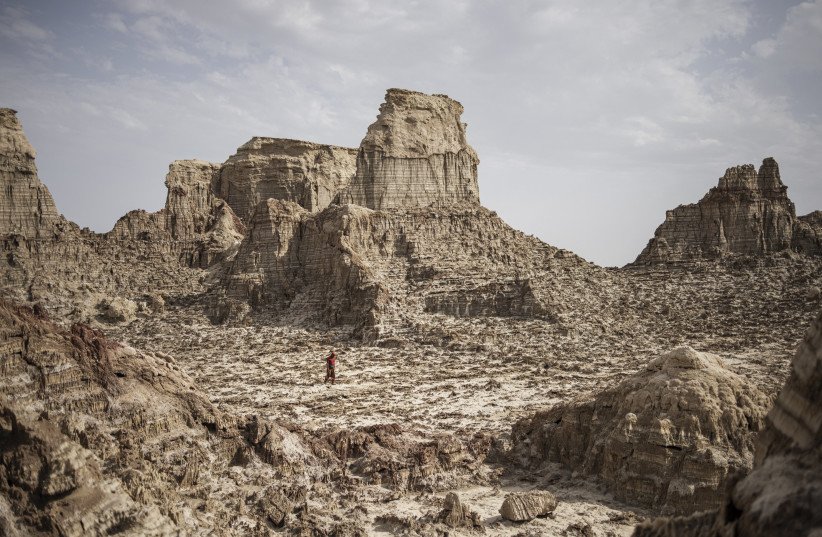
File Photo: A man walks through a salt canyon, near Dallol, in the Danakil Depression of the Afar region, on March 24, 2024.
File Photo: A man walks through a salt canyon, near Dallol, in the Danakil Depression of the Afar region, on March 24, 2024. (credit: MICHELE SPATARI/AFP via Getty Images)

While the remains bear evidence of termite damage, there is no clear indication of scavenging, making researchers consider the possibility that the burial may not have been intentional.

The third skeletal fossil, however, contains a clear indication of having been scavenged by large predators around the time of death, including “ancient pitting, tooth scores, and fractures."

Stone tools, animal fossils also discovered at the site

Also discovered at the site were thousands of stone tools, pieces of charcoal, and the fossilized bones of large rodents, monkeys, hoofed-animals, carnivores, and bovids (members of the cattle family).

However, “no butchery-related, or unambiguously humanly induced bone modifications were found," the study noted. "Only the expected rodent gnawing, insect, and carnivore damage that are normal in such depositional settings."

“We predict that the continued integration of ongoing actualistic investigations of the modern Middle Awash geology and biology will continue to contextualize the geological, paleobiological, and archaeological traces at Halibee,” the researchers concluded.

In the same way, findings from “the Middle Pleistocene evidence lying directly below the Halibee member will contribute to understanding how behaviors, anatomies, and environments of the Middle Awash inhabitants changed across deep time.”

Follow us on Google


