







For many olim, studying or pursuing higher education in Israel is about more than earning a degree. It is often the first step into Israeli society and culture. Academic life in Israel can be challenging – from navigating a new language, culture, and bureaucracy – yet it can also be deeply rewarding.
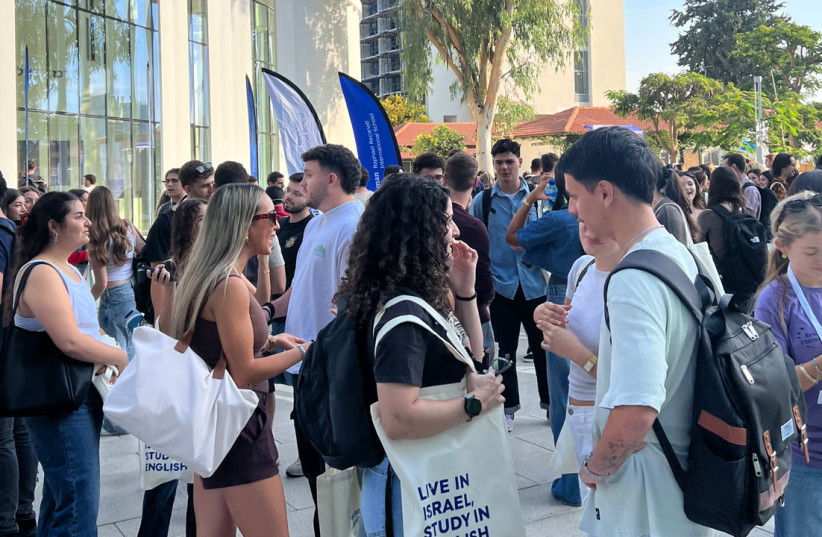
Four olim shared their journeys through Israeli academia, studying at universities including Bar-Ilan University, Ariel University, Hebrew University of Jerusalem, and Reichman University. Each chose their program for different reasons, but nearly all described the experience as both demanding and transformative: a crash course not only in academics, but in building a life in Israel.
Sigalle Rosenburg
Sigalle Rosenburg made aliyah from South Africa in February 2019 and completed a BA in Communications and Sociology–Anthropology at Bar-Ilan University, graduating in 2022.
Although she had always planned to make aliyah eventually, she had not expected to do so at that stage of her life. After returning to South Africa following her gap year in Israel, she began working at the DIJE at King David Victory Park while considering her academic options.
At the same time, friends who had started university in South Africa were struggling with campus politics, including the Fees Must Fall riots, Israel Apartheid Week, and the challenges of being part of a Jewish minority. Seeing their experiences prompted her to move sooner.
“I decided that I want my academic experience to be focused on education and involvement on campus, without the politics and additional stress,” she said.
Making aliyah earlier offered both practical and personal benefits. Her degree would be covered through aliyah benefits, and studying in Israel allowed her to acclimate while continuing to improve her Hebrew. She chose Bar-Ilan because she had friends nearby in Givat Shmuel and was drawn to its religious, relatively apolitical environment. The university’s midrasha scholarship program also enabled her to complete an additional year of seminary.
Her degree was taught in Hebrew, but she took notes in English and was allowed to submit assignments and give presentations in English. She said she received strong academic support as an olah and could communicate with lecturers in English when needed. Completing the TAKA pre-academic program helped prepare her for studying in Hebrew. Because much of her degree took place during COVID, recorded Zoom lectures allowed her to revisit and translate material at her own pace. Her exams were all in Hebrew, though olim received extra time.
She also valued the social and cultural aspects of campus life.
“It is a great way to acclimate and become fluent in Hebrew,” she said, highlighting friendships, student jobs, internships, and the opportunity to witness daily coexistence on a campus shared by Jewish and Arab students. Organized student union events contributed to a positive on-campus atmosphere.
At the same time, studying in Hebrew came with challenges. Group assignments were difficult when classmates did not speak English, often requiring her to complete work in Hebrew, which took significantly more time. Persistent bureaucratic hurdles, Ulpan classes that frequently conflicted with mandatory courses, and adjusting to life in a new country without nearby family support added additional pressure.
Frieda Katz
Frieda Katz made aliyah from Dallas, Texas, in 2019. She completed a BA in Political Science and Middle Eastern Studies at Ariel University and later an MA in Government with a specialization in Diplomacy and Conflict Studies at Reichman University.
Financial considerations strongly influenced her decision. Cheaper tuition and financial aid from the Aliyah Ministry made higher education far more accessible than in the United States. After completing Sherut Leumi, she study her undergraduate degree in Hebrew.
“As far as studying in Israel goes, financial concerns played a big factor,” she said. “Combined with cheaper tuition than the US and financial aid, I was financially able to do university pretty easily compared to the US.”
She appreciated that the Israeli academic calendar is structured around Jewish holidays, meaning she never had to miss exams or classes for religious observance. At Ariel, she was drawn both to the dual-degree program and to a vibrant student life, where she built lasting friendships with Israelis and fellow Anglos. For her master’s degree, she opted for an English-language program in order to fully express herself academically.
“Studying in Hebrew has its pros and cons, but I think there are mostly pros,” she said. “It’s a great way to integrate, make friends with native-born Israelis, and improve your Hebrew.”
Tali Najmanovich
Born and raised in Brazil, Tali Najmanovich made aliyah from Costa Rica in 2019. She enrolled at Hebrew University to study international relations, communications, and journalism entirely in Hebrew.
Tali had always dreamed of making aliyah. “I knew that the best way to integrate into the culture and make friends was to come at a young age and be in Israeli circles,” she said.
Her parents warned that studying in Hebrew would be extremely difficult, but she insisted on coming anyway. “I told them I didn’t care, that it was my dream and that I could manage.”
The experience has indeed been challenging. Although she receives 25% extra time on exams, she described the academic support as limited. Professors rarely translate exams or offer additional guidance, and some have told her, “At this point, if you’re in Hebrew University, you should know Hebrew.”
Academically and socially, this can feel isolating. “You’re one more student. Ok, you are an oleh. Everyone did this. You’re not special,” she said.
Still, she is grateful that her tuition is partially funded through volunteer work, enjoys tiyulim offered through the program, and is happy to be living in Israel.
Katherine Chaleff
Katherine Chaleff made aliyah from Los Angeles in 2021 and recently completed a one-year master’s degree in human-computer interaction at Reichman University. She discovered the program through professional networking in her field of product design and UX.
“I was speaking to people in the field, and they told me this is the place to expand my network, upgrade my skills, and advance my career in Israel,” she said.
Although the degree was taught in English, more than 80% of her classmates were Israeli. Having completed Ulpan Etzion and the TAKA program and worked professionally in Hebrew, she navigated group projects smoothly and built strong connections. At times, she even helped classmates with English while strengthening her own Hebrew.
She was initially disappointed not to be studying in Hebrew after working so hard to improve her language skills, but ultimately felt that the language mattered less than the relationships and professional network she built.
Katherine believes studying alongside Israelis entering the same professional field helped her better understand Israeli society and prepared her for career success.
“It was a really nice, low-pressure environment to acculturate,” she said. “Compared to working, it’s more casual, and you get to meet more people.”
She strongly recommends studying in Israel for those considering aliyah. “It takes time to understand Israelis and different parts of Israeli society,” she said. “If you do a degree with Israelis entering the same career sector, it helps you feel more comfortable.”
As part of her master’s program, Katherine completed a practicum (an apprenticeship at an Israeli company) at Similarweb, a unicorn startup. Unlike the smaller startups she had previously worked for, Similarweb was larger and more globally oriented, giving her a broader introduction to Israeli corporate culture. She was the only American olah on the Product Design team, and her colleagues were both highly professional and exceptionally welcoming.
“Before I made aliyah, I always expected my Jewishness would be something I’d need to minimize or hide in professional settings,” she said. “Getting to share experiences like the Yom Hazikaron ceremony with my colleagues was very moving.”
“Working in Israel with a world-class team at a company like Similarweb represented the fulfillment of my aliyah dreams.”