


When Ariel Wasserstein, aged 22, from Silver Spring, Maryland, first arrived in Israel at 18 years old, he wasn’t planning to stay.
A gap year with Magen David Adom’s overseas volunteer program was supposed to be a short detour before starting college at Rutgers University in New Jersey.
“I came thinking I’d volunteer for a bit and then go back to the US for school,” he said.
Ariel arrived in July 2021, during the peak of COVID. At the time, his Hebrew was shaky despite years in Jewish day school.
“My Hebrew was atrocious,” he said. “I couldn’t really speak or understand.”
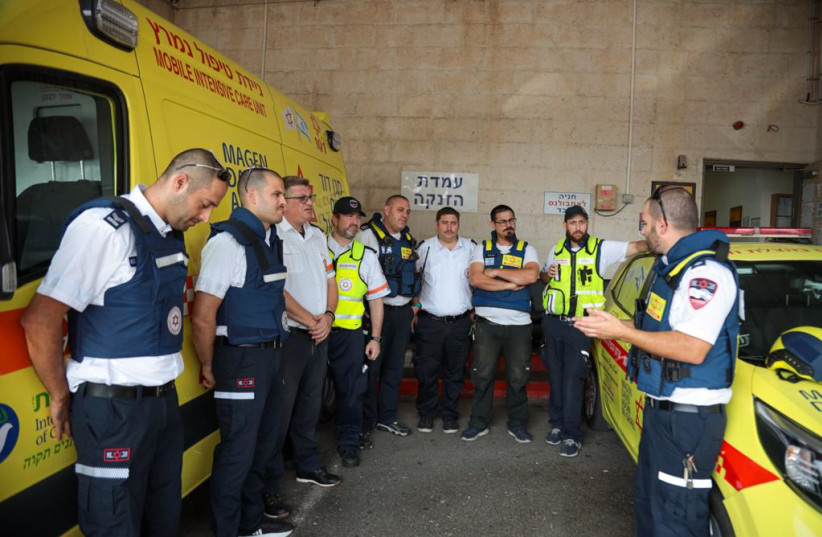
Working on ambulances forced him to adapt quickly. It became a crash course in learning Hebrew and Israeli culture.
“I always just pretended I didn't speak English so that they forcibly had to speak Hebrew to me because that was the only language they would know.”
Through the program, Ariel trained as an Emergency Medical Responder (EMR) and began working regular ambulance shifts. The work was intense, immediate, and often chaotic – a far cry from the campus life he had imagined.
One call in particular stood out. During a shift, he treated an 18-year-old soldier with multiple gunshot wounds who was bleeding heavily. He found himself struck by the contrast between their lives.
“He was shot six times. I just remember sitting there thinking, how could I go back to the States? How could I stay in college when these people are barely my age and they’re dying?”
He had planned to return home and start college. Instead, he decided to make aliyah and do Sherut Leumi (national service) with MDA, starting off as an EMR and then qualifying as an Emergency Medical Technician.
“I was planning on only being here for a year, maybe a year and a half,” he said. “I was never actually planning on making aliyah. And I’m still here.”
Then came October 7.
Ariel was in Jerusalem when his phone rang early that morning. MDA was calling up staff to head south. He packed quickly and left.
“In my opinion, that’s why I was here,” he said. “It wasn’t even a question. I had to go.”
The following day, October 8, he began volunteering, working 16-hour shifts in the South near border communities, moving between towns and hospitals and treating casualties under chaotic and dangerous conditions. At the time, there were reports that ambulances were being targeted. Some vehicles were not yet fully bulletproof, and crews relied heavily on protective vests.
“I wore my vest every single second,” he said. “It wasn’t even a question.”
The experience, he said, changed him both personally and professionally. He feels steadier under pressure now, quicker to assess trauma scenes, and more confident leading others through difficult calls. MDA has also upgraded equipment, including switching to military-style tourniquets that better control severe bleeding.
He also learned to talk openly with colleagues after particularly hard shifts.
From volunteer to paramedic
After a particularly difficult pediatric CPR case, he decided to pursue paramedic training.
“It was hard thinking maybe I could have done something more if I had more training,” he said.
He went on to qualify as a paramedic, taking on greater responsibility and mentoring younger volunteers. Today, he serves as a lead paramedic, helping train and guide newer staff – not only in clinical skills, but also in coping with the emotional toll of the work.
Years after what was meant to be a temporary stay, Ariel no longer thinks about returning to the United States.
“At this point, I don’t really have thoughts about going back,” he said. “I don’t think there’s a better place to be Jewish than in Israel.”
Despite the challenges – bureaucracy, language, and the intensity of the work – he says Israeli society has made him feel at home.
“No one really cares where you’re from,” he said. “You’re just family.”
His one lingering struggle? Hebrew grammar.
“Israeli grammar doesn’t make sense,” he added with a grin. “It just doesn’t.”