








Mabrat, whose name means “light” in Amharic, was born in Gondar, Ethiopia. She came to Netanya with her family at age 14 in 1991, during the largest wave of emigration from Addis Ababa, known as Operation Solomon. In this operation, over 14,000 Ethiopian Jews or Beta Israel were airlifted to Israel.
Mabrat started elementary school near her village in the Wagara region of Ethiopia at age 10, or fifth grade, as was often the norm in rural areas. She remembered seeing trees, flowers, and green grassy fields where cows grazed as she walked the half-hour route to school with her sister.
A frequent chore was bringing water from the river to their hut. Their schooling ended abruptly, however, when the family had to move to the capital to prepare for emigration to Israel. The nine-month upheaval in Addis was a tough time for her parents and their seven children.
After their flight to Israel, they spent 18 months in the Ashdod absorption center. Here, Mabrat’s Amharic nickname, Mimi, was put into use. Until then, Mabrat’s father had worked as a jeweler. But, at this point, he became unwell and already showed symptoms of Parkinson’s disease. His health declined from then on, so he never worked in Israel.
'Financially, we lived on a bare minimum'
As her mother gave birth to her youngest child, a daughter, in Ashdod, she was unable to join ulpan classes and, unfortunately, never mastered Hebrew. There were then a total of eight children in Mimi’s family, four older than her and three younger. From Ashdod, the family moved to a basic apartment in Netanya.
In Netanya, her parents’ divorce created a new reality. “Besides this distress,” Mimi stated, “we children felt slighted and angry when father married his girlfriend from Ethiopia right away, and he joined her and their four small children in Kfar Saba. Financially, we lived on a bare minimum, so all of us worked our way through the summers by taking whatever cleaning or restaurant sector jobs were available.”
Fortunately, help was at hand. Mimi remembered the home visits of a Hebrew-speaking social worker. This woman not only helped their mother in her difficult situation, but explained to the older children that their father’s presence still counted in their lives and that he was in poor health.
She encouraged them to stay in touch and visit him sometimes. Her kind and positive attitude impressed Mimi; in fact, she attributed this early encounter with social services as a strong motivating factor in her later decision to become a social worker.
Somehow, the family weathered this crisis and moved on. Mimi also attributed their resilience to her mother’s positive influence. “She was a very strong woman who always encouraged her children to study,” she said in her praise.
Soon all Mimi’s school-aged siblings were attending Youth Aliyah boarding schools. She herself was assigned to a school in Arad, a development town on the periphery, a four-hour commute from Netanya and some 45 kilometers east of Beersheba. She attended a Bnei Akiva ulpana, a religious girls’ school in Arad, completing grades 10 through 12.
There Mimi and her new immigrant classmates had to pray daily, adapt to a strange Shabbat diet of schnitzel and hamin, a meaty Moroccan stew with couscous and chickpeas in this case, and study unfamiliar Torah-based subjects in their rudimentary Hebrew.
But later, she remarked, “Ulpanat Arad was like my second home. I had very, very nice teachers. During summer vacation, I was able to stay at school and work at various maintenance jobs there.”
Her mother’s encouragement was a factor too. “I was a good girl and tried my utmost to conform. I wanted mother to be happy and proud of me,” she explained. Ultimately, those three years of school in a new environment were a formative experience, paving the way for her academic studies and professional advancement.
Mimi's life beyond school and into adulthood
AFTER SCHOOL, Mimi did a year of national service at an elementary school in Haifa, tutoring students with learning difficulties. She then stayed on in the town, living with roommates, and worked a succession of jobs, including cleaning houses, to save money for college.
At age 25, she began studying social work at Haifa University. Her first year was a mechina, a pre-academic year. She married at age 28, after she finished university. Her husband had completed his army service as a mechanical technician and was employed by Elbit Systems in Ramat Hasharon.
Mimi is the proud mother of two boys, aged 11 and 20, and a girl aged 21. Her daughter was thrilled to visit Ethiopia in 11th grade on a roots trip. Later, she completed her service in the air force as a drone operator. Her older son also serves in the air force, in a responsible position. All Mimi’s siblings are married and working. One brother became a biochemist and works for Teva Pharmaceuticals.
For the last 20 years, the Biyadgilons have lived in Rishon Lezion, where Mimi now works for the municipality as a senior social worker. In her job, she uses Hebrew and Amharic to communicate with her clients.
After the traumas of October 7, 2023, Mimi assumed some new tasks in rotation with her colleagues. For example, she accompanied army personnel to the homes of Israelis who were killed in the Nova Festival massacre to break the tragic news to their bereaved parents and families.
She also counseled many evacuees and displaced citizens who came to Rishon from the Gaza border area after their homes were burned down. During the recent war with Iran, she was on call to help newly homeless citizens whose apartments were severely damaged by missiles.
Mimi completed a master’s degree in social work from Tel-Aviv University in 2025 and will graduate soon. She is really excited about this achievement and commented: “My studies were most interesting but also challenging, and required a lot of effort. It was a tense wartime period, so I had to show resilience in juggling my many responsibilities.”
This former village girl has indeed come a long way since arriving in Israel at age 14 and has shown remarkable persistence in achieving her personal and professional goals. She is grateful to all those who helped and supported her along the way.
In particular, Mimi feels that her prowess as a social worker has enabled her to give back to society and to assist vulnerable populations in times of crisis. ■
With thanks to Dr. Esti Bar-El, director of Academic Advancement, Nishmat Ethiopian College and Level Up Programs, for facilitating this connection
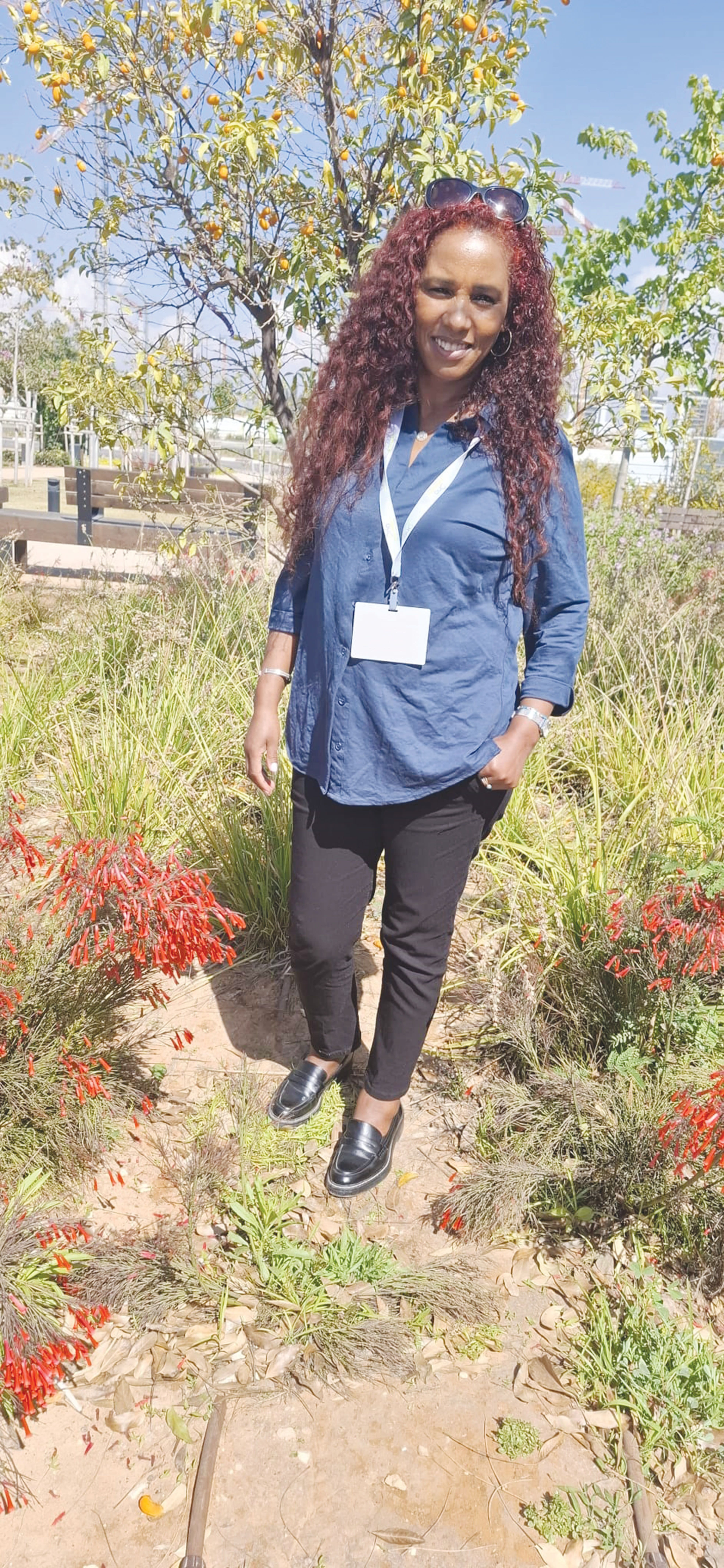
Mimi ‘Mabrat’ Biyadgilon, 49
From Gondar, Ethiopia to Netanya