




惯性聚合 高效追踪和阅读你感兴趣的博客、新闻、科技资讯
阅读原文 在惯性聚合中打开

推荐订阅源

C
CERT Recently Published Vulnerability Notes
U
Unit 42
T
The Blog of Author Tim Ferriss
H
Hackread – Cybersecurity News, Data Breaches, AI and More
B
Blog RSS Feed
Microsoft Azure Blog
Threat Intelligence Blog | Flashpoint
S
Securelist
L
Lohrmann on Cybersecurity
Blog — PlanetScale
Blog — PlanetScale
Recorded Future
Recorded Future
D
DataBreaches.Net
Spread Privacy
Spread Privacy
T
Threat Research - Cisco Blogs
I
Intezer
P
Palo Alto Networks Blog
Simon Willison's Weblog
cs.CL updates on arXiv.org
I
InfoQ
宝玉的分享
宝玉的分享
Security Latest
Security Latest
Cyber Security Advisories - MS-ISAC
T
Threatpost
Cisco Talos Blog
Cisco Talos Blog
P
Proofpoint News Feed
博客园 - 司徒正美
H
Hacker News: Front Page
Y
Y Combinator Blog
爱范儿
爱范儿
让小产品的独立变现更简单 - ezindie.com
cs.AI updates on arXiv.org
NISL@THU
NISL@THU
月光博客
月光博客
有赞技术团队
有赞技术团队
Cloudbric
Cloudbric
酷 壳 – CoolShell
酷 壳 – CoolShell
G
Google Developers Blog
A
Arctic Wolf
博客园 - 【当耐特】
W
WeLiveSecurity
V
Visual Studio Blog
Exploit-DB.com RSS Feed
OSCHINA 社区最新新闻
OSCHINA 社区最新新闻
cs.CV updates on arXiv.org
V
V2EX
C
Cyber Attacks, Cyber Crime and Cyber Security
S
SegmentFault 最新的问题
The GitHub Blog
The GitHub Blog
The Cloudflare Blog
Stack Overflow Blog
Stack Overflow Blog

Securelist

HelloNet campaign: a threat via the ViPNet update system GoSerpent backdoor attacks in Southeast Asia OkoBot framework infection chain Threat landscape for industrial automation systems. Q1 2026 When checking the URL isn't enough: phishing via the Microsoft identity platform Armored Likho's new weapon: BusySnake Stealer How to improve your organization's security based on compromise assessment findings How a single ScreenConnect incident exposed a massive campaign How the ToddyCat APT group gains access to Gmail accounts The Gentlemen RaaS: rapid growth and a new ransomware variant CVE-2024-2658 vulnerability in Schneider Electric software: risks to industrial control systems Threat landscape for SMBs in 2026: fake AI tools, phishing and more StrikeShark: a new campaign involving a custom SharkLoader and Cobalt Strike Beacon An unknown actor distributes malicious VBS scripts via WhatsApp Gamers beware: malicious wallpapers on Steam found stealing accounts Hacktivists are broadening their scope beyond political motivation Argamal: Malware hidden in hentai games Wardriving assessment across Mexico: Preparing for the 2026 World Cup Containers on fire: from container escapes to supply chain attacks Security risks for OpenClaw users and how to mitigate them What’s in the container? Analyzing vulnerabilities, risks and protection with Kaspersky Container Security and Pirates in the crosshairs: how one cybercrime gang has been infecting book, movie, and TV show fans for years Cloud Atlas activity in the second half of 2025 and early 2026: new tools and a new payload How an image could compromise your Mac: understanding an ExifTool vulnerability (CVE-2026-3102) IT threat evolution in Q1 2026. Mobile statistics IT threat evolution in Q1 2026. Non-mobile statistics Kimsuky targets organizations with PebbleDash-based tools State of ransomware in 2026 CVE-2025-68670: an RCE vulnerability in the xrdp server The vulnerability landscape in Q1 2026 OceanLotus suspected of distributing ZiChatBot malware via wheel packages in PyPI How to spot a suspicious website “Legitimate” phishing: how attackers weaponize Amazon SES to bypass email security PhantomRPC: A new privilege escalation technique in Windows RPC Threat landscape for industrial automation systems in Q4 2025 JanelaRAT: a financial threat targeting users in Latin America The long road to your crypto: ClipBanker and its marathon infection chain Financial cyberthreats in 2025 and the outlook for 2026 A laughing RAT: CrystalX combines spyware, stealer, and prankware features An AI gateway designed to steal your data Coruna: the framework used in Operation Triangulation The SOC Files: Time to “Sapecar”. Unpacking a new Horabot campaign in Mexico Free real estate: GoPix, the banking Trojan living off your memory BeatBanker: A dual‑mode Android Trojan Exploits and vulnerabilities in Q4 2025
Anatomy of a Cyber World Global Report 2026
Kaspersky Security Services · 2026-03-25 · via Securelist

SOC, TI and IR posts

SOC, TI and IR posts

minute read

Kaspersky Security Services provide a comprehensive cybersecurity ecosystem, taking enterprise threat protection to another level. Services like Kaspersky Managed Detection and Response and Compromise Assessment allow for timely detection of threats and cyberattacks. SOC Consulting provides a practical approach ensuring the corporate infrastructure stays secured, while Incident Response is suited for timely remediation with a maximized recovery rate.
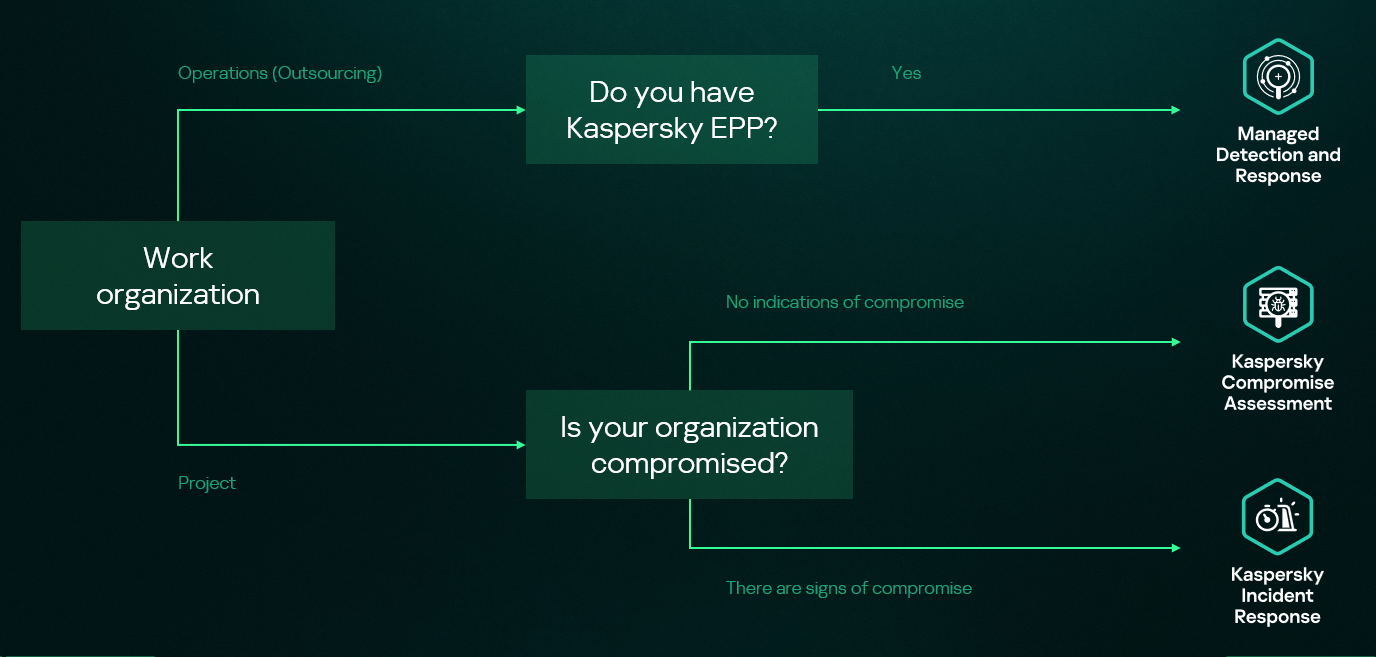
High-level overview of the MDR, IR and CA connection

High-level overview of the MDR, IR and CA connection

This new report brings together statistics across regions and industries from our Managed Detection and Response and Incident Response services, and for the first time, it also includes insights from our Compromise Assessment and SOC Consulting services — all to provide you with more comprehensive view of different aspects of corporate information security worldwide.

The scope of MDR and IR services

Provision of Kaspersky’s MDR and IR services follows a global approach. The majority of customers accounted for the CIS (34.7%), the Middle East (20.1%), and Europe (18.6%).
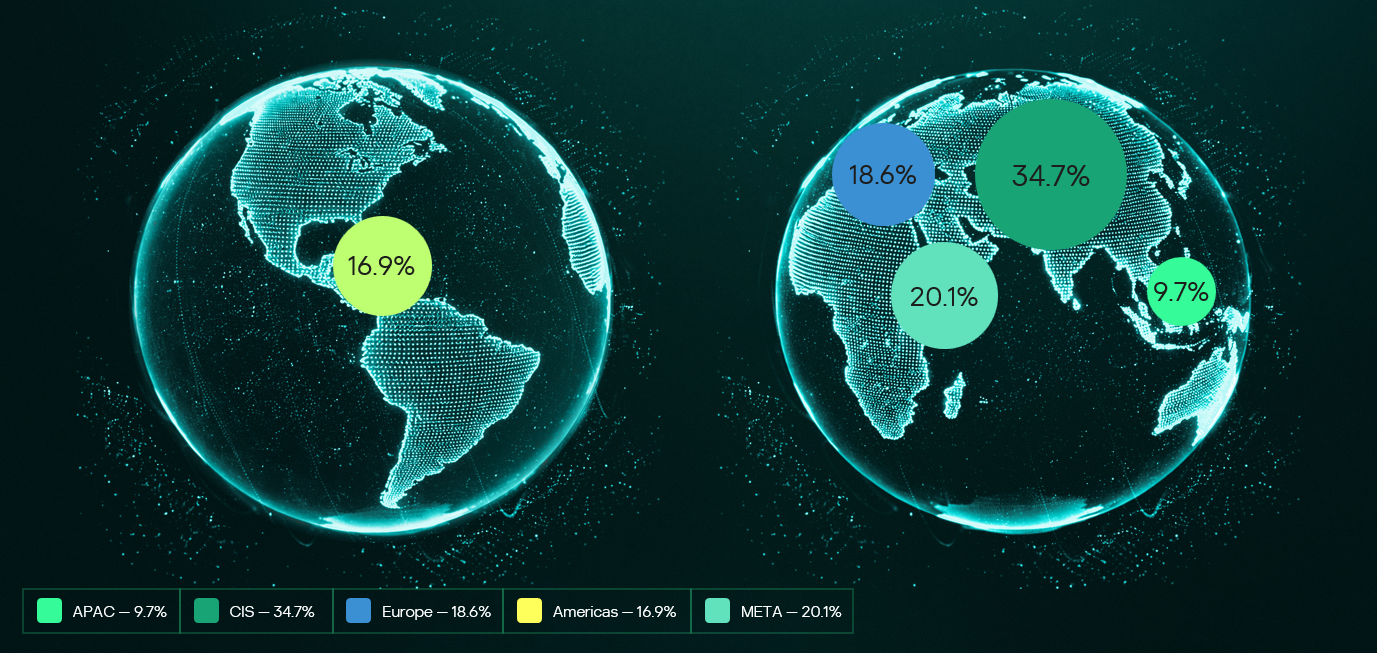
Distribution of customers by geographical region, 2025

Distribution of customers by geographical region, 2025

MDR telemetry

Following the previous year’s numbers, in 2025, the MDR infrastructure received and processed an average of 15,000 telemetry events per host every day, generating security alerts as a result. These alerts are first processed by AI-powered detection logic, after which Kaspersky SOC analysts handle them as required. Overall, a total of approximately 400,000 alerts were generated in 2025. After counting out false positives, 39,000 alerts were further investigated.
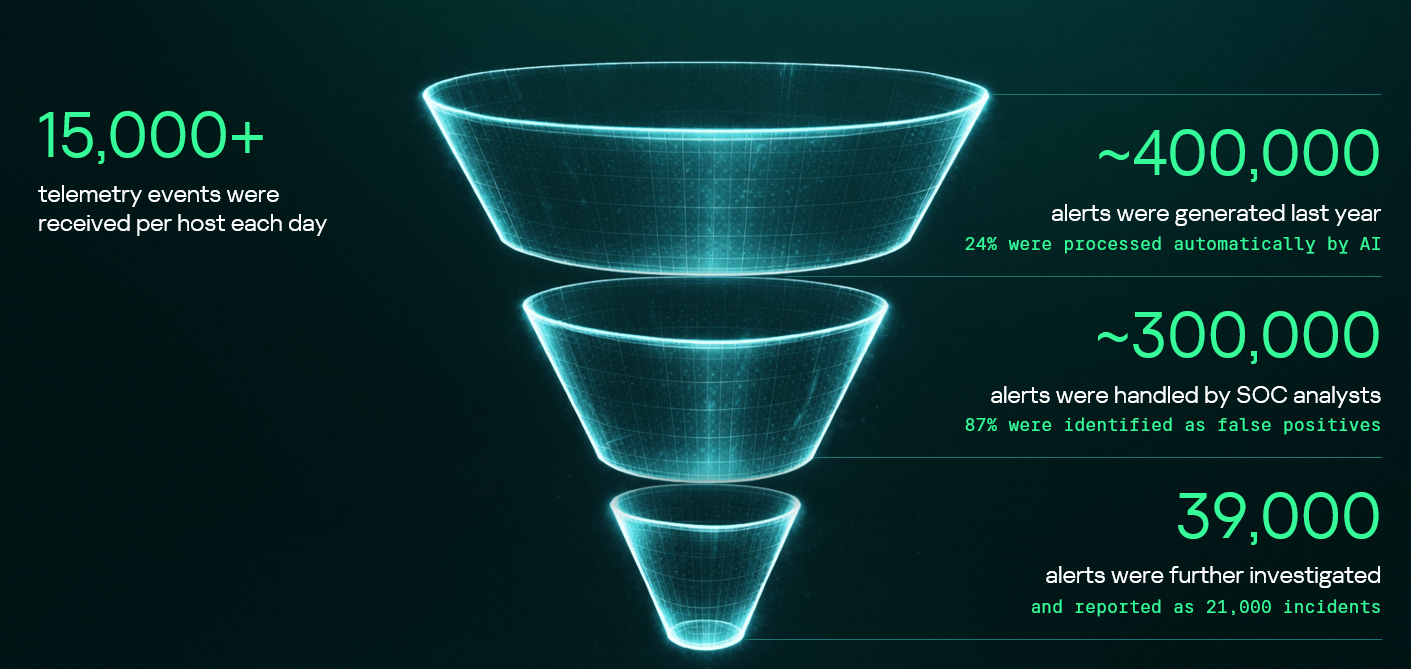
MDR telemetry statistics, 2025

MDR telemetry statistics, 2025

Incident statistics

The distribution of remediation requests by industry has slightly changed as compared to previous years’ pattern. Government (18.5%) and industrial (16.6%) organizations are still the most targeted industries in regards to cyberattacks that require incident response activities. However, this year, the IT sector saw a growth in the number of IR requests, eventually being placed third in the overall industry distribution rankings and thus replacing financial organizations, which were targeted less often than in 2024. This is equally true for smaller-scale attacks that can be contained and remediated through automated means — the only difference is that medium- and low-severity incidents are more often experienced by financial organizations.
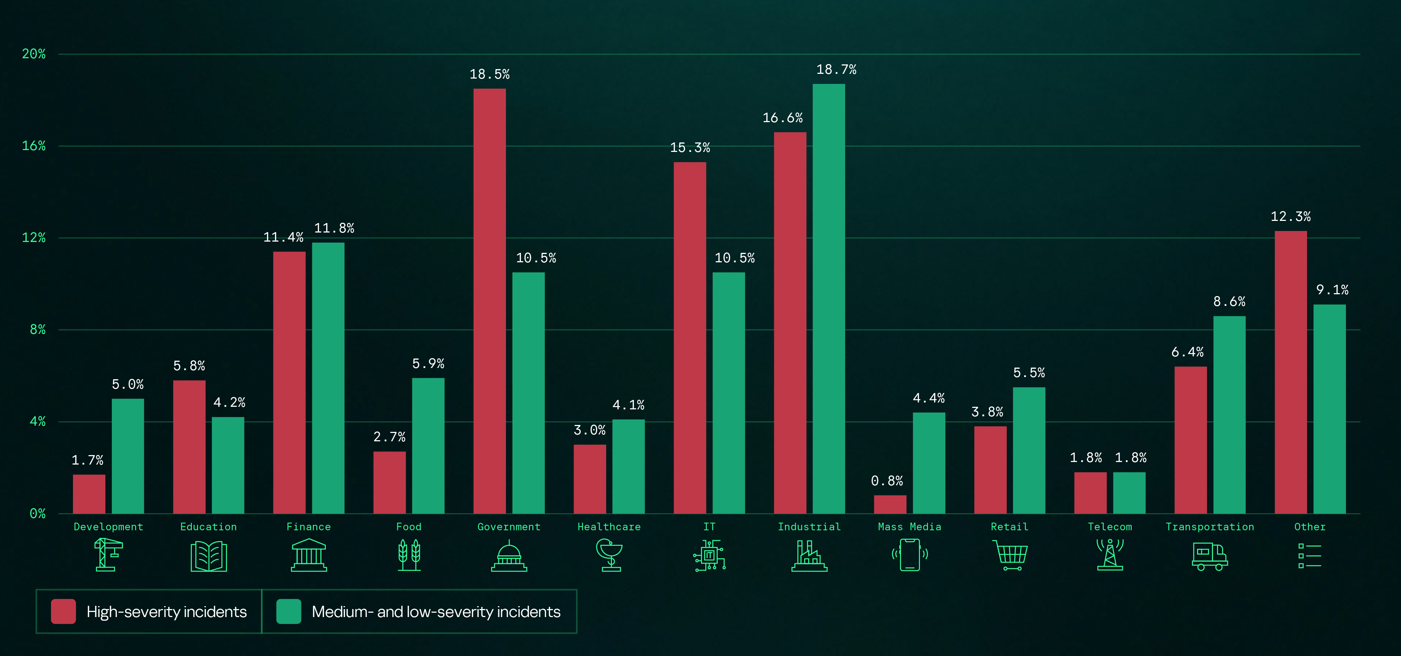
Distribution of all incidents by industry sector, 2025

Distribution of all incidents by industry sector, 2025

This section presents key findings and trends in cyberattacks in 2025:

  • The number of high-severity incidents decreased, following a downward trend that we’ve been observing since 2021. The majority of those incidents account for APT attacks and red teaming exercises, which indicates two landscape trends. On the one hand, skilled adversaries make efforts to increase impact, while on the other, organizations spend more resources on probing their defense systems.
  • The most common vulnerabilities exploited in the wild were related to Microsoft products. Half of all identified CVEs led to remote code execution, notably without authentication in some cases.
  • Exploitation of public-facing applications, valid accounts, and trusted relationships remain the most popular initial vectors, and their overall share has increased, accounting to over 80% of all attacks in 2025. In particular, attacks through trusted relationships are evolving: their share has increased to 15.5% from 12.8% in 2024. They are also becoming more complex: for instance, we witnessed a case where adversaries had compromised more than two organizations in sequence to ultimately gain access to a third target.
  • Standard Windows utilities remain a popular LotL tool. Adversaries use those to minimize the risk of detection during delivery to a compromised system. The most popular LOLBins we observed in high-severity incidents were powershell.exe (14.4%), rundll32.exe (5.9%), and mshta.exe (3.8%). Among the most popular legitimate tools used in incidents we flag Mimikatz (14.3%), PowerShell (8.1%), PsExec (7.5%), and AnyDesk (7.5%).

The full 2026 Global Report provides additional information about cyberattacks, including real-world cases discovered by Kaspersky experts. We also describe SOC Consulting projects and Compromise Assessment requests. The report includes comprehensive analysis of initial attack vectors in correlation with the MITRE ATT&CK tactics and techniques and the full list of vulnerabilities that we detected during Incident Response engagements.

  • Latest Posts
    Latest Webinars
    Reports

    Cloud Atlas attacks the public sector and diplomatic structures of Russia and Belarus, using ReverseSocks, SSH, and Tor for persistence in infected systems and its new tool, PowerCloud.

    Kaspersky researchers analyze a range of new PebbleDash-based tools used in recent Kimsuky campaigns and reveal their connection to the AppleSeed malware cluster.

    Kaspersky researchers uncovered malicious wheel packages in PyPI that targeted both Windows and Linux and contained a dropper delivering malware dubbed ZiChatBot. We attribute this activity to OceanLotus APT.

    Kaspersky researchers analyze updated CoolClient backdoor and new tools and scripts used in HoneyMyte (aka Mustang Panda or Bronze President) APT campaigns, including three variants of a browser data stealer.