
惯性聚合 高效追踪和阅读你感兴趣的博客、新闻、科技资讯
阅读原文 在惯性聚合中打开

推荐订阅源

freeCodeCamp Programming Tutorials: Python, JavaScript, Git & More
G
Google Developers Blog
Hugging Face - Blog
Hugging Face - Blog
博客园 - 【当耐特】
S
SegmentFault 最新的问题
宝玉的分享
宝玉的分享
博客园 - Franky
博客园_首页
钛媒体:引领未来商业与生活新知
钛媒体:引领未来商业与生活新知
WordPress大学
WordPress大学
有赞技术团队
有赞技术团队
月光博客
月光博客
博客园 - 聂微东
OSCHINA 社区最新新闻
OSCHINA 社区最新新闻
小众软件
小众软件
Microsoft Security Blog
Last Week in AI
Last Week in AI
Vercel News
Vercel News
Cyber Security Advisories - MS-ISAC
爱范儿
爱范儿
J
Java Code Geeks
博客园 - 叶小钗
Engineering at Meta
Engineering at Meta
阮一峰的网络日志
阮一峰的网络日志

Malwarebytes

Carnival confirms data breach impacting nearly 6 million Kali365 phishing kit bypasses MFA and steals Microsoft logins Company bragged phone mics could listen to conversations. They couldn’t. Fake LinkedIn emails abuse Adobe to track victims Fake software on GitHub and SourceForge distribute Deno RAT 700+ education and tech websites hijacked in huge ClickFix malware campaign Scammers pretending to be Microsoft had help from US executives A week in security (May 18 – May 24) Update Chrome now: Critical bugs could let attackers run code Microsoft Defender vulnerabilities are being exploited in the wild TikTok, YouTube, and Roblox face scrutiny, but age gates won’t fix child safety Catch spyware in the act with Windows Webcam Monitoring Researchers left AI agents alone in a virtual town and watched it all unravel Fake malware-signing service Fox Tempest dismantled by Microsoft Firefox 151 packs big privacy upgrades into a small update Biometrics, diagnoses, and bank details exposed in major healthcare breach Facebook scam promises cheap Aldi meat boxes, steals payment info instead YouTube wants your face to fight deepfakes Microsoft is changing Edge’s plaintext password behavior A week in security (May 11 – May 17) AI is distorting the Holocaust (Lock and Code S07E10) Attackers replaced JDownloader installer downloads with malware Meta’s confusing new approach to chat privacy Why Malwarebytes blocks some Yahoo Mail redirects Deepfake sextortion forces schools to remove student photos from websites Texas sued Netflix over claims it secretly collected and sold users’ data May 2026 Patch Tuesday: no zero-days but plenty to fix Fake Claude search results lure Mac users into ClickFix attack 1 in 8 employees have sold company logins or know someone who has Stolen Canvas data was “returned” after hacker agreement, Instructure says
ShinyHunters escalates Canvas attacks with school login d...
2026-05-08 · via Malwarebytes

Days after confirming a major data breach, Instructure is now facing a second blow.

Earlier this week, Instructure confirmed a major data breach affecting its cloud‑hosted Canvas environment, with the ShinyHunters group claiming it stole hundreds of millions of records tied to thousands of schools and universities worldwide. As discussed in our earlier blog, that incident involved data such as student and staff records, enrollment details, and private messages allegedly accessed through Canvas export features and APIs. At that stage, the focus was on large‑scale data theft and the long‑term risks for affected students and families, including identity fraud and highly targeted phishing.

According to new reporting, ShinyHunters has now hit Instructure again, this time moving from quiet data theft to very visible extortion. Using another vulnerability in Instructure’s systems, the attackers were able to modify Canvas login portals for hundreds of educational institutions, defacing both web logins and the Canvas app with an on‑screen ransom message.
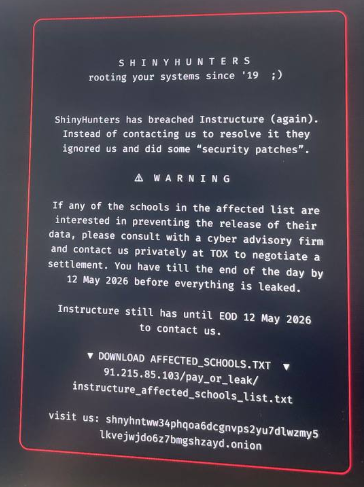
applying extra pressure
Image credit: vx-underground

The message both claimed responsibility for the earlier breach and set a deadline of May 12 for Instructure and affected schools to contact the gang or risk the public release of stolen data.

This second wave matters for two reasons. First, it confirms that ShinyHunters still has meaningful access to Instructure’s environment, or at least to components that control the look and behavior of school login pages. Second, it marks a clear escalation in pressure tactics, from leaked claims and dark web posts to messages shown directly to students, parents, and staff trying to access their courses.

How to deal with this data breach

For students and families, the practical advice from our original blog still applies:

  • Reset Canvas‑related passwords
  • Enable multi‑factor authentication where possible
  • Monitor financial and credit activity as children get older
  • Stay wary of highly personalized phishing that references real schools, courses, or teachers

For schools and districts, this latest extortion campaign underlines the need to coordinate closely with Instructure, review single sign-on (SSO) integrations, and prepare clear communications so that any future defacements or data leaks do not catch staff and parents by surprise.


CNET Editors' Choice Award 2026

“One of the best cybersecurity suites on the planet.” 

According to CNET. Read their review


About the author

Was a Microsoft MVP in consumer security for 12 years running. Can speak four languages. Smells of rich mahogany and leather-bound books.