

惯性聚合 高效追踪和阅读你感兴趣的博客、新闻、科技资讯
阅读原文 在惯性聚合中打开

推荐订阅源

AI
AI
Scott Helme
Scott Helme
W
WeLiveSecurity
N
News | PayPal Newsroom
G
GRAHAM CLULEY
SecWiki News
SecWiki News
V2EX - 技术
V2EX - 技术
Security Latest
Security Latest
H
Heimdal Security Blog
L
LINUX DO - 最新话题
Application and Cybersecurity Blog
C
Cyber Attacks, Cyber Crime and Cyber Security
P
Palo Alto Networks Blog
Simon Willison's Weblog
PCI Perspectives
PCI Perspectives
钛媒体:引领未来商业与生活新知
钛媒体:引领未来商业与生活新知
Hugging Face - Blog
Hugging Face - Blog
博客园_首页
Spread Privacy
Spread Privacy
T
Troy Hunt's Blog
V
Vulnerabilities – Threatpost
罗磊的独立博客
C
CXSECURITY Database RSS Feed - CXSecurity.com
宝玉的分享
宝玉的分享
T
The Blog of Author Tim Ferriss
阮一峰的网络日志
阮一峰的网络日志
Martin Fowler
Martin Fowler
The Hacker News
The Hacker News
C
Cisco Blogs
T
Tor Project blog
cs.CV updates on arXiv.org
The Register - Security
Cyber Security Advisories - MS-ISAC
P
Privacy & Cybersecurity Law Blog
奇客Solidot–传递最新科技情报
奇客Solidot–传递最新科技情报
S
Security Affairs
T
Tenable Blog
V
Visual Studio Blog
C
Check Point Blog
Hacker News - Newest:
Hacker News - Newest: "LLM"
CTFtime.org: upcoming CTF events
美团技术团队
月光博客
月光博客
J
Java Code Geeks
量子位
Vercel News
Vercel News
I
Intezer
博客园 - 聂微东
Know Your Adversary
Know Your Adversary
aimingoo的专栏
aimingoo的专栏

Malwarebytes

Carnival confirms data breach impacting nearly 6 million Kali365 phishing kit bypasses MFA and steals Microsoft logins Company bragged phone mics could listen to conversations. They couldn’t. Fake LinkedIn emails abuse Adobe to track victims Fake software on GitHub and SourceForge distribute Deno RAT 700+ education and tech websites hijacked in huge ClickFix malware campaign Scammers pretending to be Microsoft had help from US executives A week in security (May 18 – May 24) Update Chrome now: Critical bugs could let attackers run code Microsoft Defender vulnerabilities are being exploited in the wild TikTok, YouTube, and Roblox face scrutiny, but age gates won’t fix child safety Catch spyware in the act with Windows Webcam Monitoring Researchers left AI agents alone in a virtual town and watched it all unravel Fake malware-signing service Fox Tempest dismantled by Microsoft Firefox 151 packs big privacy upgrades into a small update Biometrics, diagnoses, and bank details exposed in major healthcare breach Facebook scam promises cheap Aldi meat boxes, steals payment info instead YouTube wants your face to fight deepfakes Microsoft is changing Edge’s plaintext password behavior A week in security (May 11 – May 17) AI is distorting the Holocaust (Lock and Code S07E10) Attackers replaced JDownloader installer downloads with malware Meta’s confusing new approach to chat privacy Why Malwarebytes blocks some Yahoo Mail redirects Deepfake sextortion forces schools to remove student photos from websites Texas sued Netflix over claims it secretly collected and sold users’ data May 2026 Patch Tuesday: no zero-days but plenty to fix Fake Claude search results lure Mac users into ClickFix attack 1 in 8 employees have sold company logins or know someone who has Stolen Canvas data was “returned” after hacker agreement, Instructure says Yarbo responds to robot flaws that could mow down their owners A week in security (May 4 – May 10) Microsoft says Edge’s plaintext password behavior is “by design” ShinyHunters escalates Canvas attacks with school login defacements Massive AI investment scam network spans 15,500 domains If a fake moustache can fool age checks, is the Online Safety Act working? Google Chrome’s silent 4GB AI download problem Attackers adopt JavaScript runtime Bun to spread NWHStealer Millions of students’ personal data stolen in major education breach Update WhatsApp now: Two new flaws could expose you to malicious files Cyberattacks are raising your prices (Lock and Code S07E09) Thousands of Facebook accounts stolen by phishing emails sent through Google The 2026 World Cup scam economy is already running before the first whistle A week in security (April 27 – May 3) 3 easy-to-miss cybersecurity risks for small businesses Actively exploited cPanel bug exposes millions of websites to takeover More PayPal emails hijacked to deliver tech support scams Hackers stole hundreds of thousands of Roblox accounts: Here’s what to do Researchers built a chatbot that only knows the world before 1931 Microsoft won’t patch PhantomRPC: Feature or bug? Scam-checking just got a lot easier: Malwarebytes is now in Claude Fake CAPTCHA scam turns a quick click into a costly phone bill Chinese engineer stole US military and NASA software for years A week in security (April 20 – April 26) Medical data of 500,000 UK volunteers listed for sale on Alibaba How cyberattacks on companies affect everyone Apple fixes iOS bug that kept deleted notifications, including chat previews Roblox clamps down on chats and age checks as legal pressure builds Malicious trading website drops malware that hands your browser to attackers Researcher claims Claude Desktop installs “spyware” on macOS Fake Google Antigravity downloads are stealing accounts in minutes Real Apple notifications are being used to drive tech support scams Android 17 ends all-or-nothing access to your contacts Big Tech can stop scams. They just don’t (Lock and Code S07E08) Mythos: An AI tool too powerful for public release A week in security (April 13 – April 19) This old-school scam is still working “Your shipment has arrived” email hides remote access software Browser Guard gets even better with Access Control “iCloud storage is full” scam is back, and now it wants your payment details A fake Slack download is giving attackers a hidden desktop on your machine Booking.com breach gives scammers what they need to target guests AI clickbait can turn your notifications into a scam feed Fake YouTube copyright notices can steal your Google login From fake Proton VPN sites to gaming mods, this Windows infostealer is everywhere April Patch Tuesday fixes two zero-days, including one under active attack Credit Resources Vault: Why this credit email set off our scam alarms Omnistealer uses the blockchain to steal everything it can ChatGPT under scrutiny as Florida investigates campus shooting Simply opening a PDF could trigger this Adobe Reader zero-day A week in security (April 6 – April 12) Fake Claude site installs malware that gives attackers access to your computer ClickFix finds a new way to infect Macs Scammers pose as Amazon support to steal your account NSFW app leak exposes 70,000 prompts linked to individual users 30,000 private Facebook images allegedly downloaded by Meta employee This fake Windows support website delivers password-stealing malware Russian hacking group targets home and small office routers to spy on users Timeshare owners warned to watch out for cartel-linked scams Traffic violation scams swap links for QR codes to steal your card details Support platform breach exposes Hims & Hers customer data A week in security (March 30 – April 5) Killer robots are here. Now what? (Lock and Code S07E07) That dream job offer from Coca-Cola or Ferrari? It’s a trap for your passwords Blocking children from social media is a badly executed good idea Apple expands “DarkSword” patches to iOS 18.7.7 Malwarebytes Privacy VPN receives full third-party audit Wikipedia’s AI agent row likely just the beginning of the bot-ocalypse WhatsApp on Windows users targeted in new campaign, warns Microsoft Why we’re still not doing April Fools’ Day
Your extensions leak clues about you, so we made sure Browser Guard doesn’t
2026-04-08 · via Malwarebytes

Did you know you can be profiled based on the browser extensions you use? Advertisers can detect which extensions are installed and use that to build a picture of the kind of user you are.

For instance, do you pride yourself on being a good online shopper who never pays full price? Maybe you use a shopping extension that scours the web for active promo codes. Are you a developer who builds online tools? You might use extensions for auditing site performance, checking accessibility, or inspecting page elements.  Or maybe you’re a productive person? You likely use the extensions for tab management, content summaries, or even tracking timed tasks. 

Advertisers care about your browser extensions because they reveal what kind of audience you belong to, and what you’re likely to buy. But it’s not just advertisers. The more data there is about you in the wild, the more there is for scammers, identity thieves, and stalkers to exploit. 

If a website can detect what you’ve installed, it can learn more about you than you might expect.

This is not a hypothetical problem. Recent reports found that LinkedIn was using scripts to scan visitors’ browsers for more than 6,000 Chrome extensions, linking that data to user profiles.

And earlier this year, cybercriminals breached a major data broker, Gravy Analytics. It’s a little-known company that collects vast quantities of smartphone location data. Although the company collects this data legally, the breach exposed highly sensitive information and put millions of people at risk.

What extensions can be profiled? 

Last year, a group of PhD students investigated exactly how certain websites track users through their choice of browser extensions. One student compiled an impressive list of over 10,000 extensions. Their findings showed that it’s not fully possible for an extension to hide itself without some changes to a browser’s underlying technology. 

Take Malwarebytes Browser Guard as an example. It needs to communicate internally to check things like, “Is this site in the allowlist?” or “Is there a security event we need to tell the user about?” Because of how browsers work, this messaging system is not fully isolated from the web page, which means it could be monitored.

You might think encryption would solve this, but it’s not that simple. If only one extension encrypts its data in a specific way, that behavior itself becomes a unique fingerprint.

How we made Browser Guard undetectable 

That said, we’ve introduced more techniques into Browser Guard to make it harder for advertisers and scammers to see you’ve installed it. By staying hidden, Browser Guard reduces what others can learn, and limits how they respond.
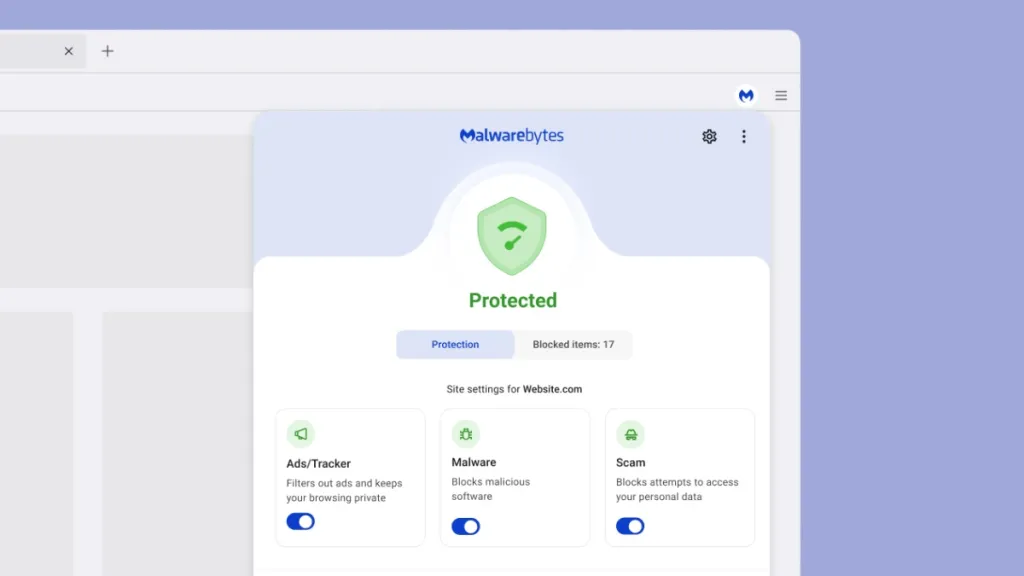
Browser Guard

Using browser storage APIs 

Any data left behind on the page can be used to figure out which extensions are installed. Browser Guard uses available extension tools provided by browser vendors to avoid leaving behind these kinds of traces. 

Using dynamic URLs 

use_dynamic_url is a flag you can turn on in the browser extension’s manifest file.  

  • The setting is off by default in Chrome and Edge. 
  • Firefox enables this behavior by default, and there is no way to turn it off. 

So what does this mean for fingerprinting? 

Previously, a website could just check for specific resources, like an image loaded by an extension. If it found that resource, it would know the extension was installed. 

But dynamic URLs generate a new, unique ID for each browsing session, so when a site tries the same trick, it looks like the extension doesn’t exist. 

In fact, we’ve found this technique is also used by some anti-adblockers to detect which ad blocker is running on the machine. 

What others can detect about your extensions (Chrome only)


If you’re reading this on Chrome, click the button below to see what installed extensions can be discovered using publicly accessible resources—the same technique described in this article.

Then install Browser Guard on Chrome and see how it stays private.