






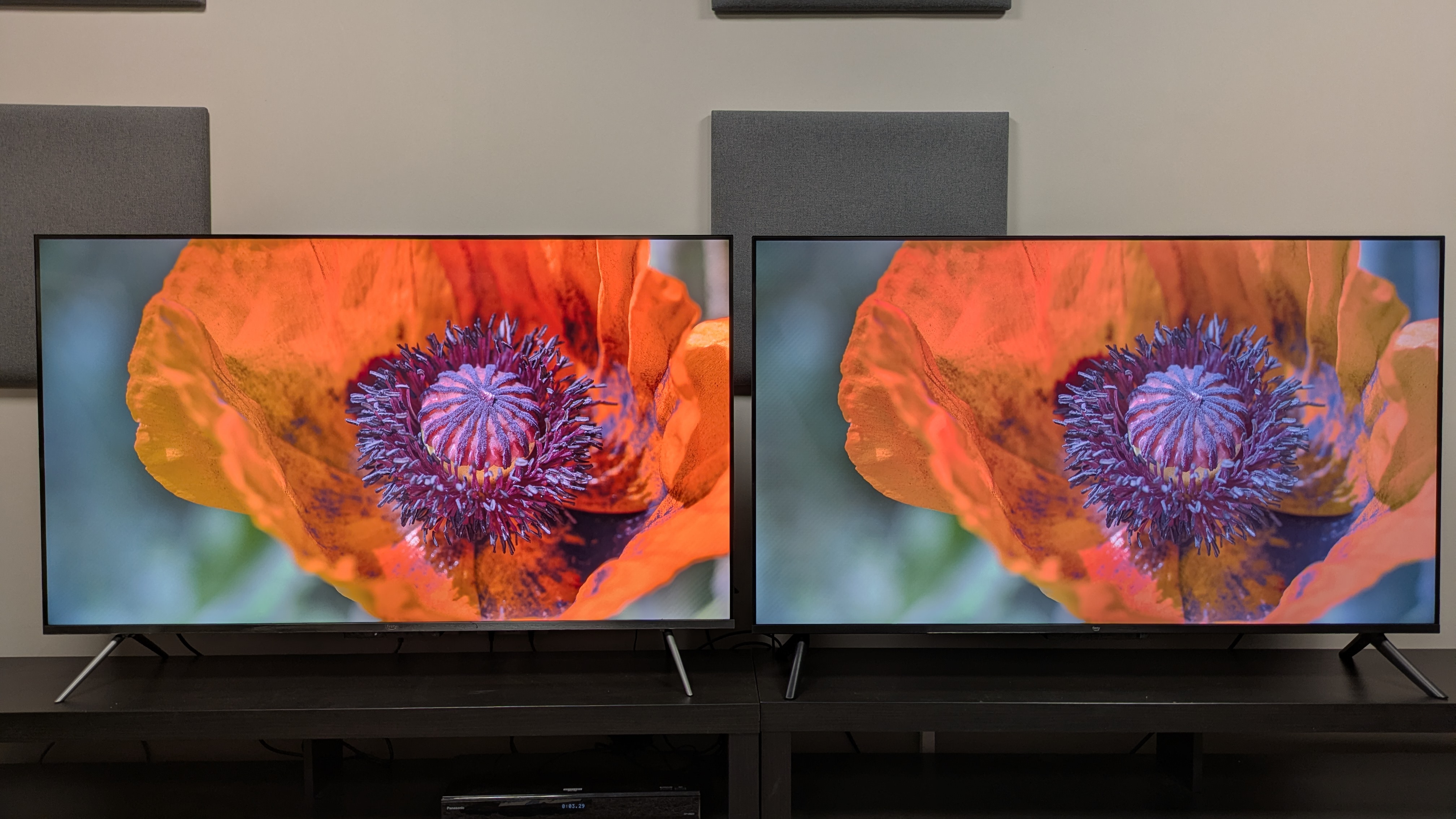
 (Image credit: Future)
The budget TV market is becoming an increasingly competitive space, with more companies entering every year. Whereas QLED was the go-to tech for the budget TV hunter several years ago, companies such as TCL and Hisense have made mini-LED much more affordable in recent times. In fact, both TCL and Hisense’s ultra-competitive mini-LEDs featured among our picks for the best TVs in 2025.
Back in 2023, when mini-LED hadn’t quite nailed the quality-for-the-money balance it has now, the Amazon Fire TV Omni QLED (2023) was one of the better budget TVs I’d seen, and was a good option despite mini-LED competition. Since then, Amazon has released a new generation of Fire TVs, now known as Ember TVs, including the Omni QLED’s successor, the Amazon Ember Omni QLED (2025), and the Amazon Ember 4-series (2025).
When we tested the Amazon Omni QLED (2025), we described it as an “average TV” as although it's reasonable value for the money, the aforementioned budget mini-LEDs provide better bang for your buck. We haven’t fully tested the 4-series (2025) yet, but we do have both models in our labs. So, I decided to compare them side-by-side: will the 4-series prove to be a budget gem?
Article continues below
Image
1
of
2
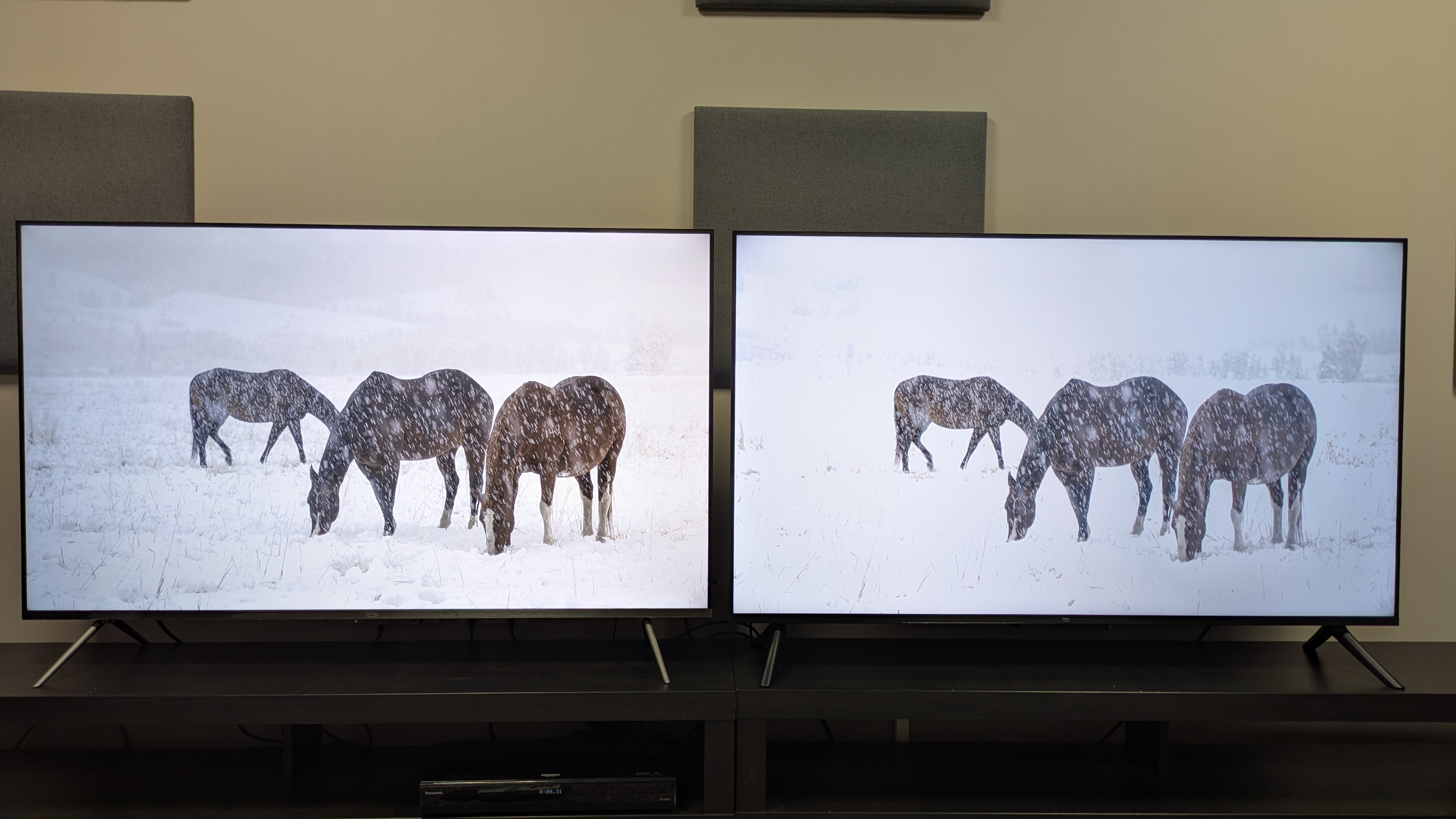
Starting with some brightness measurements, the QLED produced a measured 510 nits peak HDR brightness and 510 nits HDR fullscreen brightness in Filmmaker Mode, and 598 nits peak and 528 nits fullscreen HDR brightness in Standard. The fullscreen number is decent, beating the OLED average of roughly 150-300 nits. The 4 series, with its LED panel, could only muster 340 nits peak and fullscreen HDR brightness in Filmmaker Mode, and 356 nits peak and fullscreen HDR brightness in Standard.
How did this translate into real-world scenes? Simply put, the QLED was better at handling bright scenes. Scenes of snow from the Spears & Munsil demo footage looked decent on the QLED with some nice bright whites, but the 4 series struggled to handle the bright scenes, showing signs of clipping and detail loss. This happened in both the 1,000 nits, the standard footage, and 600 nits reels, the dimmest HDR footage on the disc.
Another issue I found was settling on a picture mode for both TVs. Filmmaker Mode was more vibrant on the QLED, perfect for the whites, but it was bordering on too bright. Movie Dark was more controlled, but lacked detail. The same was true with the 4 series, though for pure white, Movie Dark was better.
With other brighter scenes from the footage, such as sunlight reflecting off a red-colored canyon, the 4 series struggled to deliver the brightness you’d find on more premium TVs, even budget mini-LEDs like the TCL QM6K/TCL C6K. The QLED was the better for bright scenes, though it too did have a tendency to overexert its brightness at times.
Sign up for breaking news, reviews, opinion, top tech deals, and more.
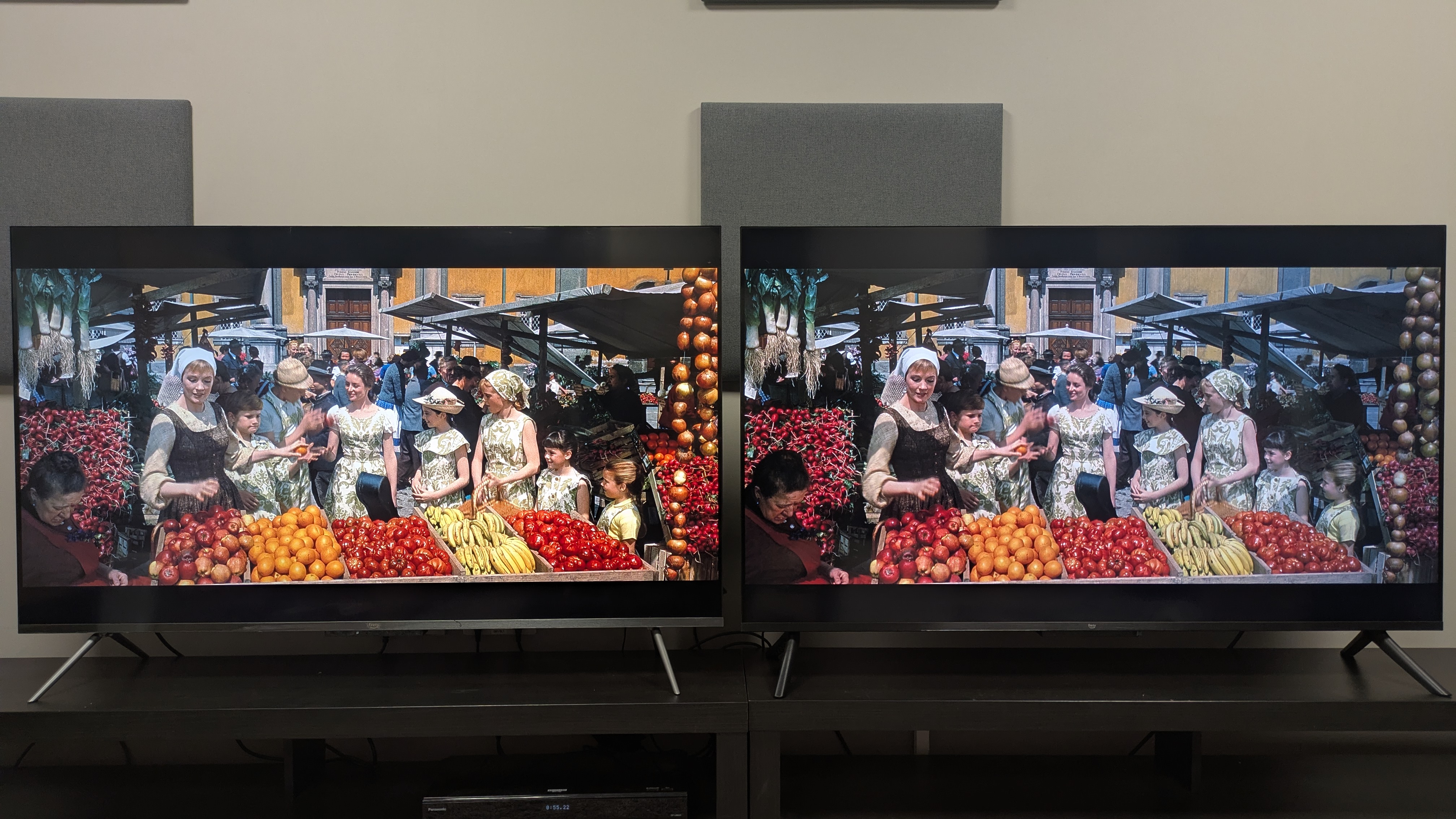
As you’d expect, the Omni QLED demonstrated the better color reproduction of the two TVs here. Using the market scene from The Sound of Music, which contains punchy reds and oranges from the fruits on the stall, the QLED delivered more pop and vibrancy in its colors compared to the 4 series, thanks to its QLED panel. The 4 series still had some nice punch, but colors did look a little flat in places.
As with the white scenes from before, I found myself struggling to settle on a picture mode. While Movie Dark arguably suited the QLED more, everything felt too dim and neutral, taking away the impact of the colors from the scene. Filmmaker Mode is clearly pushing the brightness and saturation of the colors, but I felt like it needed it.
One crucial setting to change on the QLED in Filmmaker was Local Dimming. Changing this from Off to Low made a big difference, making the picture look more accurate.
As the 4-series does not have a full array backlight like the QLED, there was no local dimming option to change. The default Filmmaker Mode was best for this scene, as the 4 series’ Movie modes, both Dark and Bright, looked far too washed out, despite the latter modes working better for all white scenes of snow.
One color where the 4-series did look better was green. Although dimmer and more toned down compared to the QLED, greens looked more natural in any scenes in the mountains, such as the Do Re Mi scene, on the 4 series. Still, if you’re looking for more striking colors, the QLED is the better choice.
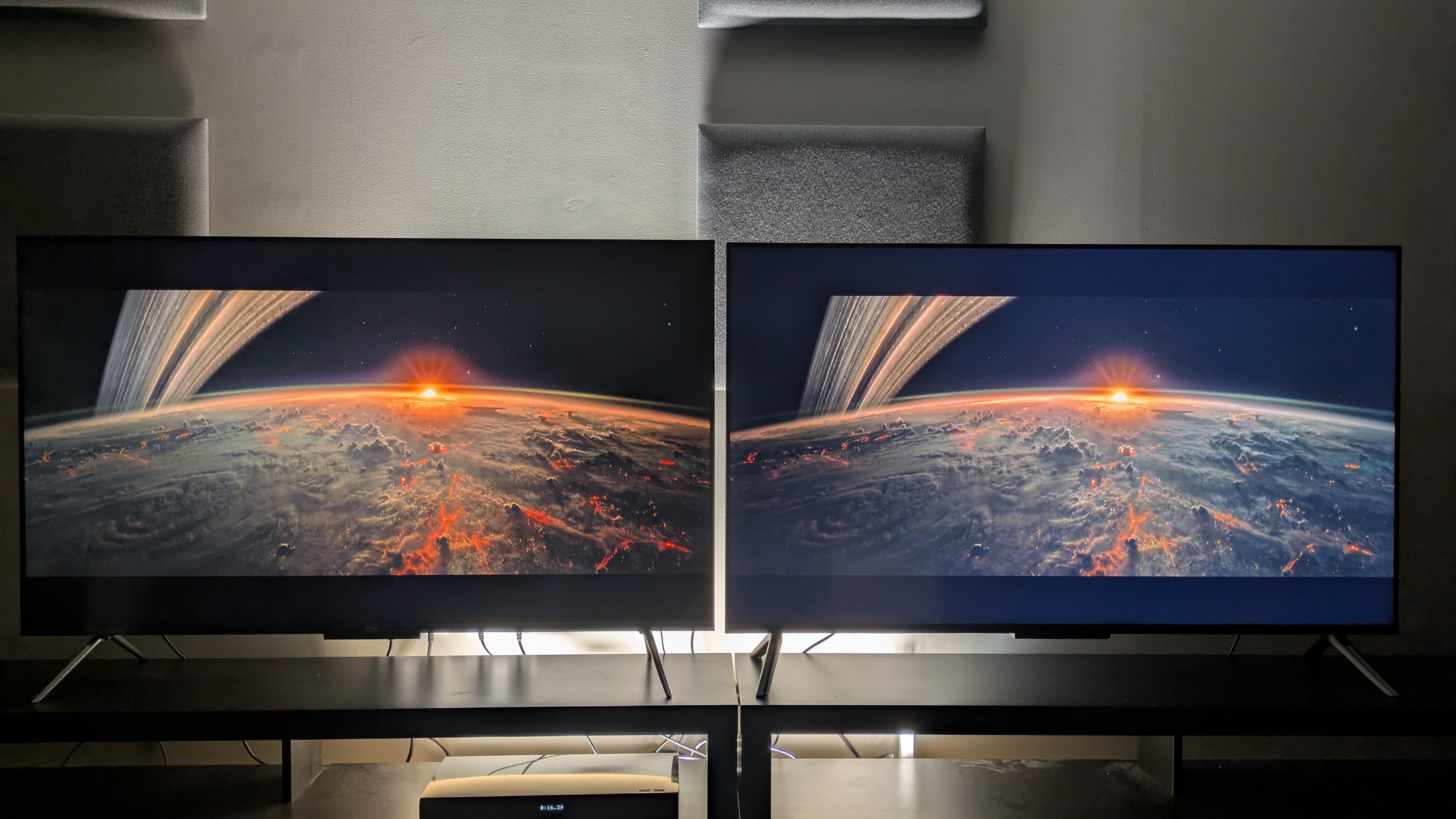
Thanks to the Omni QLED’s full array dimming, it performed better with darker and high contrast scenes than the 4 series. Several scenes from Alien: Romulus, such as shots of space and bright lights contrasting with dark hallways, look better on the QLED. Its blacks are fairly deep and rich, though can look raised at times, and its brightness delivers decent impact with peak areas, shown with stars in space and on the sun on the horizon as the group leaves the Jackson’s Star mining colony.
The 4-series does an OK job at delivering Alien: Romulus’ high-contrast scenes, with some solid brightness in peak areas, I found that some scenes had raised blacks which took a gray tone (in more fullscreen areas) and black crush (in smaller areas like the corners of a hallway).
Image
1
of
2
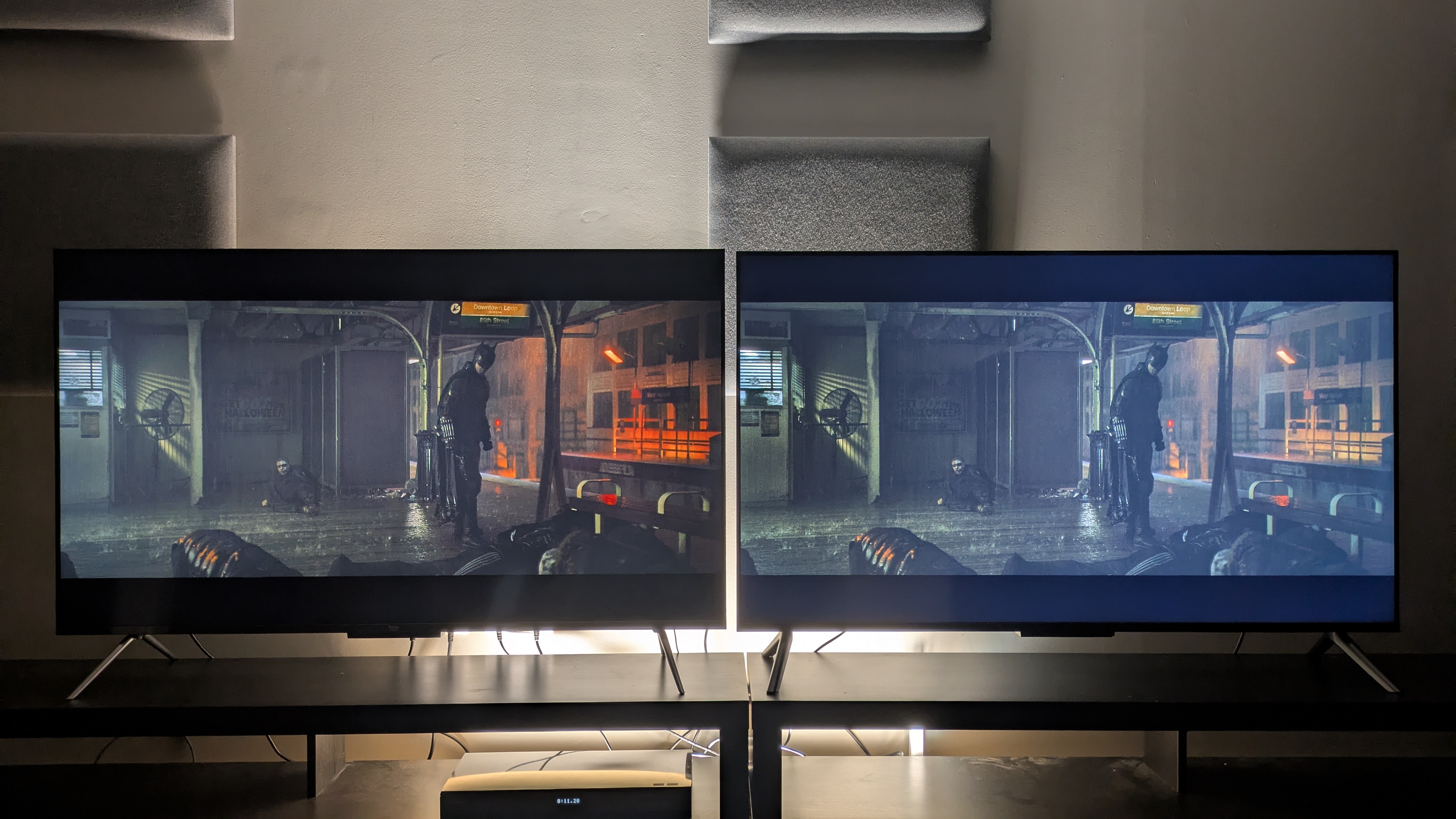
As the 4 series doesn’t have any dimming however, there was the usual backlight clouding issue you’ll find with LED panels, creating a blue haze over the whole screen which was pronounced in darker scenes. Underneath the haze, I thought the picture looked decent at times for a budget model, but the clouding is a distraction, made worse in pitch black viewing.
The Batman really showed off the 4-series’ lack of local dimming, with the clouding effect shown in Alien: Romulus even more obvious here. The Omni QLED did a better job handling the darker scenes, again showing solid contrast, but blacks were still raised. Movie Dark was arguably more accurate, but I picked the brighter Filmmaker Mode to make it easier to see.
Image
1
of
2
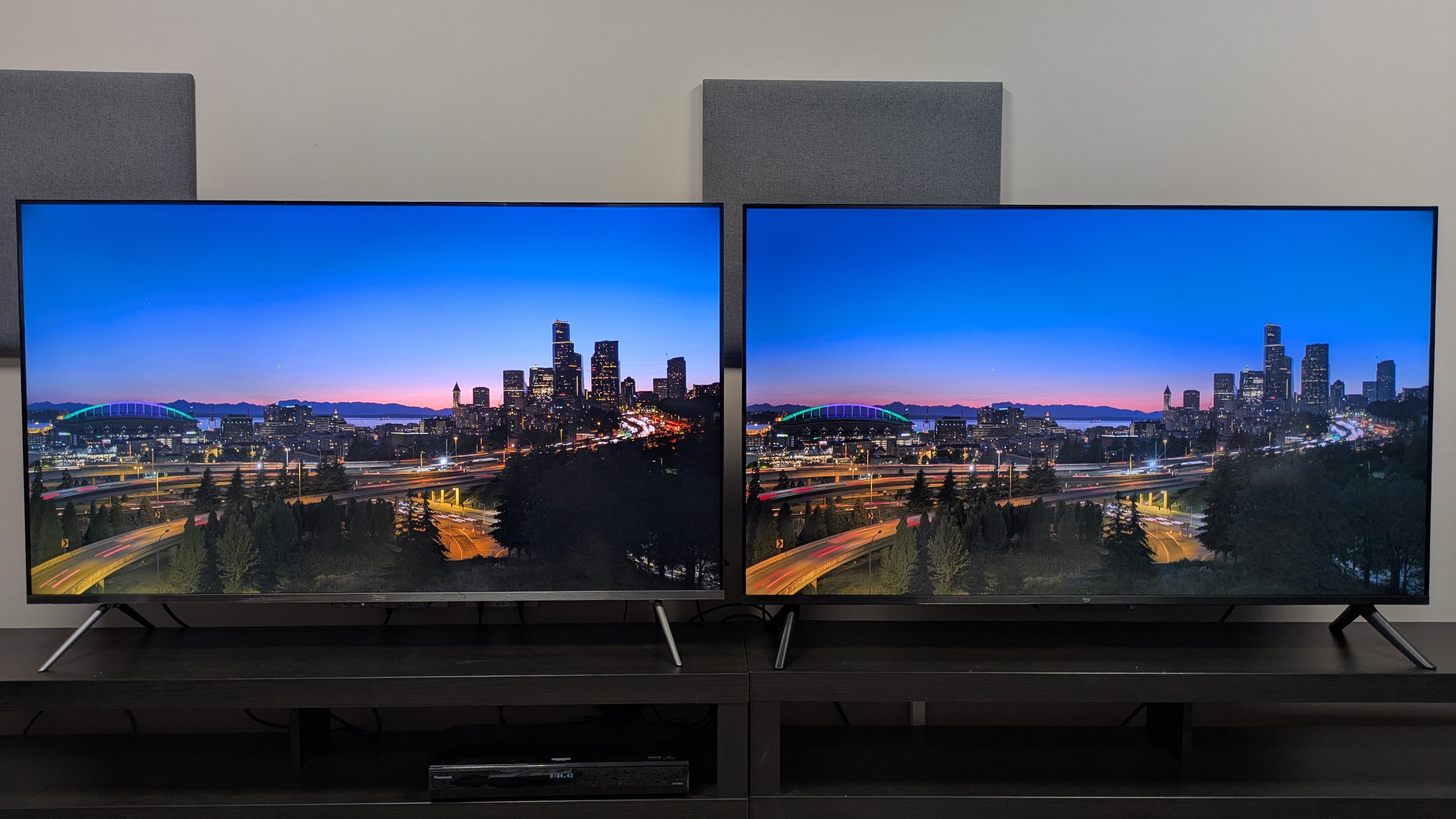
The 55-inch Amazon Omni QLED (2025) I tested retails for around $589.99 / £749.99 full price, but you’ll regularly see it drop to $489.99 / £499.99, while the 55-inch Amazon 4-series retails for around $459.99 / £549.99, but again this has dropped to $279.99 / £359.99 during sales events like Black Friday and Prime Day. These sales events are really the only time you should be buying these TVs, as those prices are a better reflection of their value.
While there is a big price gap of $200 / £140 price gap between the two (at their best price), I would still choose the Omni QLED over the 4-series. Not only does it support Dolby Vision (which the 4-series doesn’t), it has better picture quality and more features.
If, however you can stretch your budget, it’s worth looking at the budget mini-LEDs I mentioned at the start of this article. The TCL QM6K (C6K in the UK) 55-inch has hit $399.99 / £499 before and for the money, it’s among the best gaming TVs at this price and delivers much better picture quality thanks to its mini-LED panel and backlight. You can even find the more step-up models at bargain prices during the same sales events.
These two TVs do the best they can with the tech they’re given, and if I had to choose one, it would be the QLED. The 4 series is a decent enough TV if you set it up right, but the QLED is the better model for the money overall. If you want the best bang for your buck, however, I'd be looking at cheap mini-LEDs.

Follow TechRadar on Google News and add us as a preferred source to get our expert news, reviews, and opinion in your feeds.
James is the TV Hardware Staff Writer at TechRadar. Before joining the team, he worked at a major UK based AV retailer selling TV and audio equipment, where he was either telling customers the difference between OLED and QLED or being wowed by watching a PS5 run on the LG 65G2. When not writing about the latest TV tech, James can be found gaming, reading, watching rugby or coming up with another idea for a novel.
You must confirm your public display name before commenting
Please logout and then login again, you will then be prompted to enter your display name.
此内容由惯性聚合(RSS阅读器)自动聚合整理,仅供阅读参考。 原文来自 — 版权归原作者所有。