


Seagate, Toshiba, and Western Digital are the only remaining manufacturers of hard disk drives. They not only continue to produce these storage devices but are also actively advancing them as demand for HDDs rises again. While hard drives from these companies share many similarities, each relies on a different set of underlying technologies — distinct recording methods, actuator designs, platter materials, and magnetic alloys, among others — resulting in markedly different roadmaps. In this story, we examine these roadmaps and attempt to make sense of them.
The state of the HDD market
Hard drives have been around for nearly 70 years, and over 220 companies have produced HDDs since they were introduced in 1956. In 2026, only three hard drive manufacturers — Seagate, Toshiba, and Western Digital — remain on the market, and their supply chains are largely integrated or consolidated, meaning that the industry has largely shrunk from where it used to be a decade ago. Nonetheless, the combination of per-TB cost, storage density, and storage performance that HDDs offer makes them competitive enough, particularly in AI and traditional data centers, which need to store plenty of data that must be accessed relatively quickly and therefore placed 'near online', or nearline.
In fact, over 60% of hard drives shipped today are nearline HDDs, according to Nidec, the world's largest supplier of HDD motors. The remaining circa 40% are consumer and enterprise NAS hard drives, video surveillance HDDs, desktop HDDs (a declining category), external drives, laptop drives (an almost extinct category), and legacy high-performance enterprise HDDs (Toshiba only).
Nidec estimates that 119 million HDDs were shipped in its FY2023 (ending on March 31, 2024), and 125 million hard drives were shipped in its FY2024 (ending March 31, 2025), an indication that unit sales of mechanical storage devices are stable and are growing due to demand from AI and traditional data centers.
Unit sales of HDDs increased in calendar 2025 compared to calendar 2024, according to reports from Hoya (the only maker of glass substrates for HDD platters) and Resonac (the largest independent supplier of HDD platters), though exact numbers are unknown.
"While 2.5-inch substrates declined as forecasted, 3.5-inch substrates achieved double-digit growth, resulting in overall steady performance," said Eiichiro Ikeda, chief executive of Hoya. "Current demand is exceptionally strong and is expected to increase further. Preparations to enhance our supply capacity are also underway."
The road to 100TB and beyond
All HDD makers have adopted energy-assisted magnetic recording (EAMR) technologies, though everyone uses different methods. Seagate is ahead of the pack with its HAMR-based 44TB drive, which is shipping to two leading cloud service providers (CSPs), whereas Toshiba and WD are trailing the leader with their FC-MAMR and ePMR/ePMR2 recording technologies, as they pursue deliberately more cautious strategies.
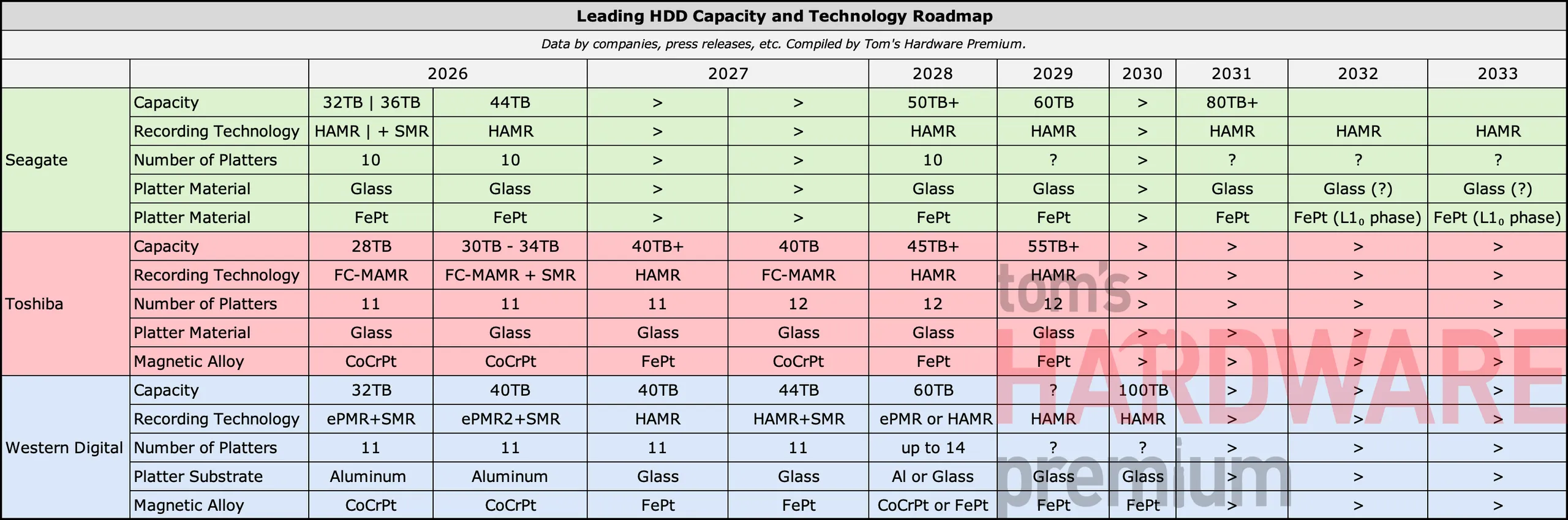
Note: HDD makers tend to list maximum drive capacities with shingled recording. To that end, even if the table does not explicitly list SMR, presume that range-topping HDDs with leading capacity use shingled recording tech, with all of its pros and cons.
Meanwhile, both Toshiba and WD plan to transition to HAMR in the coming years, though before that, they plan to perfect their HDD platforms and push their existing recording technologies to their absolute limits. Once everyone adopts heat-assisted magnetic recording (HAMR) technology that uses platters made of glass with granular FePt magnetic alloy, the development of their roadmaps will be more or less consistent and introduce HDDs with a circa 100TB capacity by around 2030 – 2031, though some roadmap slides are more optimistic, whereas others are more cautious.
Seagate: All-in on HAMR
All HDD makers tend to experiment with various recording technologies, platters, and heads. Just like others, Seagate has experimented with all kinds of EAMR methods, including microwave-assisted magnetic recording (MAMR), but publicly it bet everything on HAMR as the most capable one.
Image
1
of
2
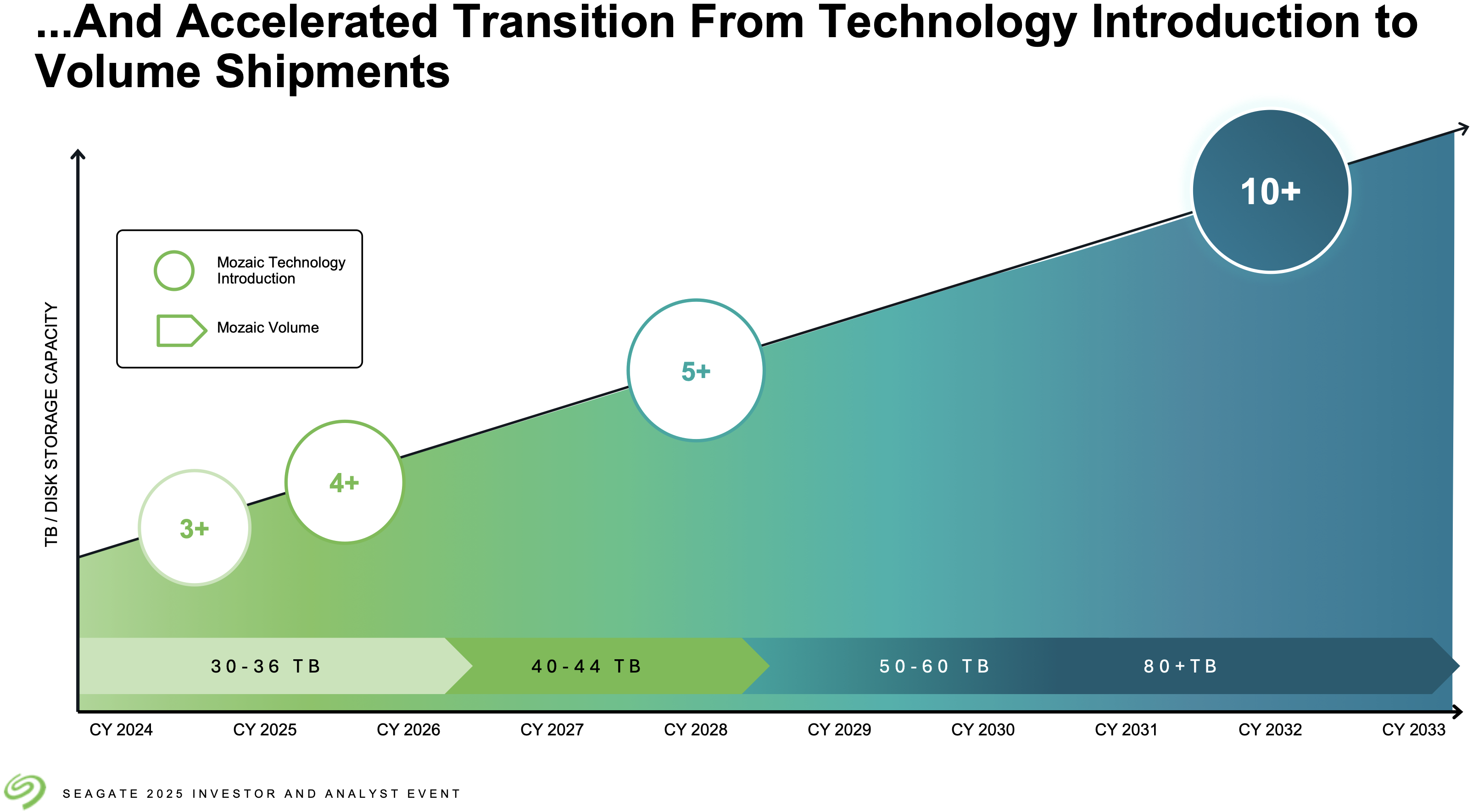
Before Seagate finally shipped its Mozaic 3+ Exos HDDs in Q1 2024, it spent over a decade evolving HAMR from lab demonstrations (FePt + laser writing) through prototype drives and hyperscaler trials. Starting from around 2016, the company repeatedly said 'next year' for high-volume HAMR-based HDD production, only to roll out the same statement the year after.
Between 2020 and 2023, Seagate's HAMR rollout ran into a series of well-known hiccups that repeatedly pushed back commercialization despite earlier aggressive timelines. The company had originally targeted volume shipments of 20TB HAMR drives around 2020, but persistent issues, such as near-field transducer (NFT) reliability, iron platinum (FePt) media durability under repeated heating, and manufacturing yield, slowed progress. These challenges made HAMR technically viable but difficult to produce at scale, which led to multiple delays and extended customer qualification cycles.
To solve these challenges, Seagate had to develop its 2nd Generation HAMR platform, which it eventually named Mozaic 3+, which went into high-volume production in 2024. But now that Seagate has mastered everything that accompanies HAMR, it can introduce new capacity points, qualify them, and ramp up production of new HAMR-based HDDs fairly quickly. For example, the company is now shipping its 44TB Mozaic 4-based drives to select clients and plans to expand availability in 2027. Meanwhile, Seagate intends to start qualification shipments of 50TB HDDs featuring the next-generation Mozaic 5 platform in late 2027.
Following 50TB HDDs in 2028, 60 TB HDDs by 2029 – 2030, and plans for 80+ TB drives in 2031. With ~100TB HDDs, Seagate intends to adopt high-anisotropic ordered granular FePt (FePt L1₀ phase) magnetic alloy, which will give it a further boost to set new areal density records and ultimately produce HDDs with capacities beyond 100TB.
Toshiba: Stretching MAMR (almost) to the limit
Toshiba is the smallest of all HDD makers, so it has a very calculated strategy that is designed to address parts of the market that are not served by its rivals and to derisk everything as much as possible.
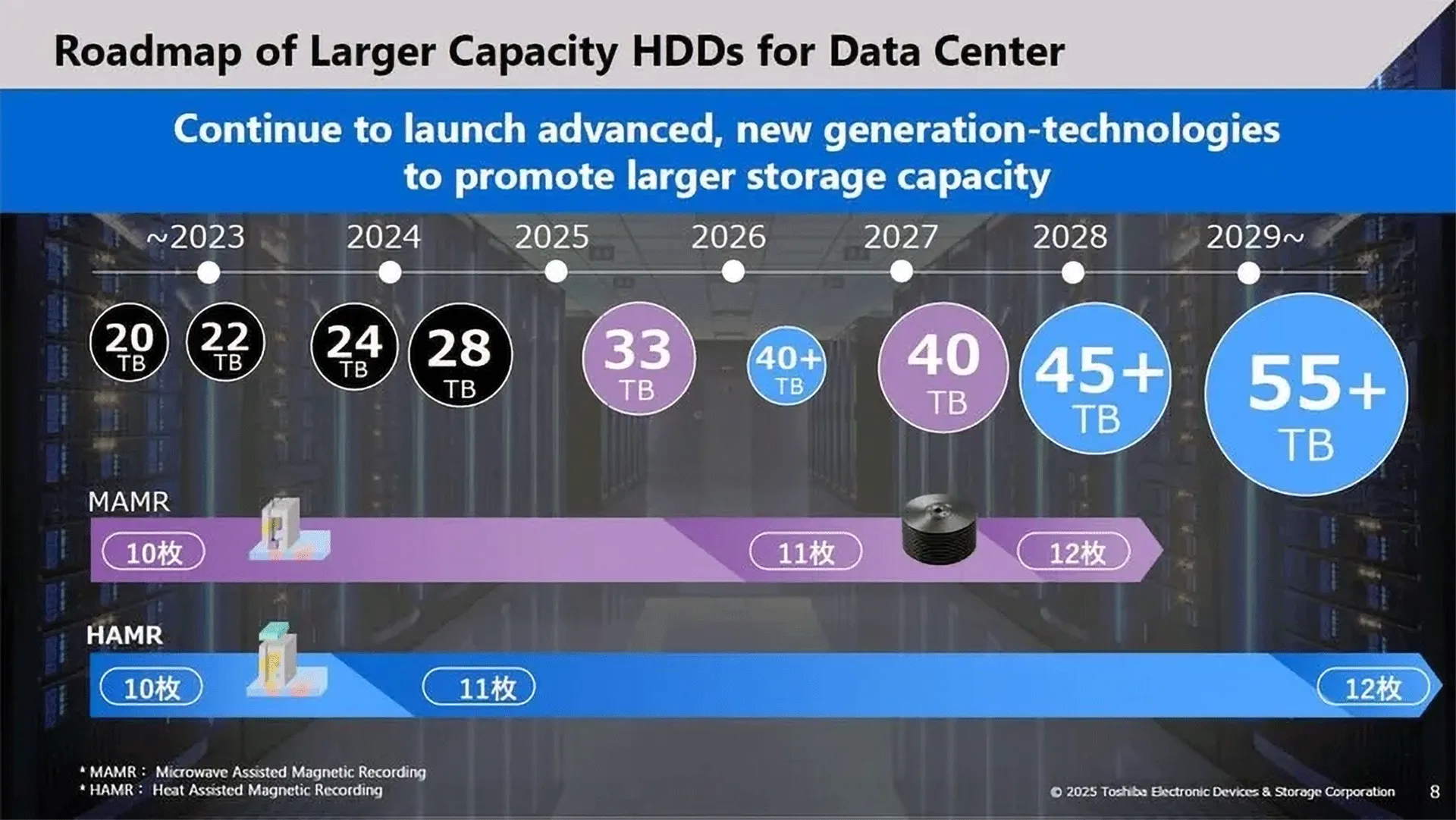
To that end, Toshiba's HDD roadmap is built around a conservative, step-by-step scaling strategy focused on flux-controlled microwave-assisted magnetic recording (FC-MAMR) with some HAMR-based HDDs due in 2026 – 2027 being test vehicles, rather than high-volume products. The company's roadmap no longer lists microwave assisted switching microwave-assisted magnetic recording (MAS-MAMR) it envisioned as an intermediate step between FC-MAMR and HAMR a few years ago.
For now, Toshiba has its M12-series 28TB FC-MAMR-based 11-platter drive with conventional magnetic recording (CMR) and is sampling shingled FC-MAMR HDDs based on the same platform with 30TB – 34 TB capacities. The new M12 hard drives rely on glass platters, but with traditional cobalt platinum (CoCrPt) magnetic alloy, which once again highlights Toshiba's step-by-step approach to adopting new technologies.
Looking forward, Toshiba's roadmap scales capacity primarily through more platters (up to 12), and continued FC-MAMR improvements targeting ~40TB drives around 2027. While the company intends to launch HAMR-based HDDs too, the 40TB capacity point will likely be limited to drives for select customers rather than true workhorses. More capacious HAMR-based HDDs are due late this decade.
In essence, Toshiba is taking a lower-risk, hybrid path: maximize MAMR and mechanical scaling first, then transition to HAMR only when necessary for the next major density jump.
Western Digital: Coexisting ePMR and HAMR
After abandoning MAMR technology in 2017 and having concentrated on energy-assisted perpendicular magnetic recording (ePMR) since then, WD expects its ePMR and ePMR 2-based hard drives to co-exist with HAMR for years to come. Furthermore, as ePMR and HAMR HDDs are very different, this means that the company isn't pursuing a dual-track, like Toshiba, but a multi-track roadmap aimed at maximizing yields and derisking all the technology transitions.
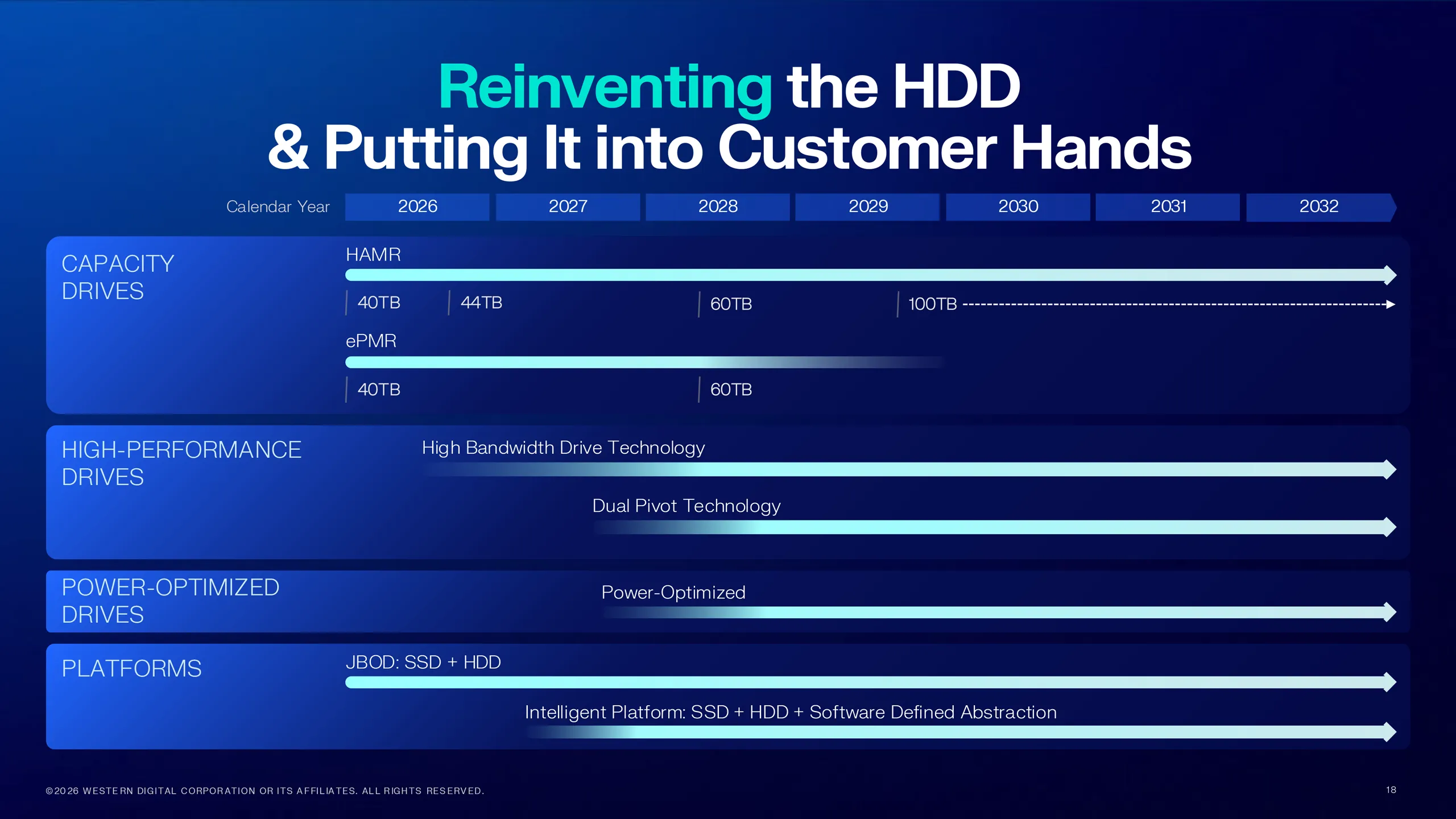
This year, the company's flagship 40TB offerings will rely on ePMR with SMR technology and feature 11 aluminum platters with cobalt platinum (CoCrPt) magnetic alloy. To squeeze in 11 aluminum disks and avoid using glass platters, WD had to squeeze the internal mechanics of the drive.
At the same time, Western Digital plans to start the transition to HAMR, with the first commercial 40TB and 44TB HAMR drives entering volume production around 2027, following hyperscaler qualification. Since WD's HAMR drives use edge-emitting lasers to briefly heat the iron-platinum (FePt) layer on the platters to its Curie point — where its magnetic characteristics shift — and temporarily lower coercivity to write the data, the HDD platters must be made of glass (or glass ceramic, though this will be used sometimes next decade), not aluminum, as it may degrade or deform over time. However, based on a comment made by the chief executive of Hoya, the only glass substrate maker for HDD platters in the world, it does not look like WD plans to use glass platters in high volumes for at least a couple of years, which in turn suggests a relatively slow production ramp.
"Starting in the latter half of FY2026 [which begins on October 1, 2026], shipments [of glass substrates] to the second customer will begin in addition to our current primary customer," said Eiichiro Ikeda, chief executive of Hoya. "We expect volume to increase substantially in FY2027 [April 1, 2027]. Equipment arrangements for FY2027, specifically for the second customer, have already been decided. Regarding volume beyond FY2028 [April 1, 2028], we are currently analyzing the situation, taking into account not only the increase from the second customer but also the movements of a potential third customer. Capital expenditures will be determined based on that schedule."
Seagate seems to be the primary producer of HDD platters based on glass substrates for its HAMR HDDs, Resonac (former Showa Denko) is catching up with its glass platters for Toshiba (and Seagate), whereas WD is the world's third maker of HDD media that is about to start using glass substrates.
WD expects to use both ePMR + SMR and HAMR technologies till at least 60TB capacity sometimes in 2028 or 2029, though it looks like proven ePMR + SMR will prevail in its shipments in the coming years. Yet, looking further out, WD's roadmap becomes aggressively HAMR-driven after 60TB: capacities are expected to scale to ~100TB in 2029 – 2030, enabled by higher areal density and drive architecture that supports up to 14 platters.
In short, Western Digital's strategy is a bridge-and-accelerate model — extend ePMR as far as possible, then rapidly scale with HAMR once the transition is justified. Beyond that, the company is targeting 140TB+ drives in the 2030s, which will require a transition to even more advanced media concepts, such as ordered granular and bit-patterned media, once HAMR on granular media reaches its limits.
Beyond capacity: High-performance and energy-efficient HDDs
In addition to increasing the capacities of their hard drives, Seagate and WD intend to increase the bandwidth and I/O performance of HDDs.
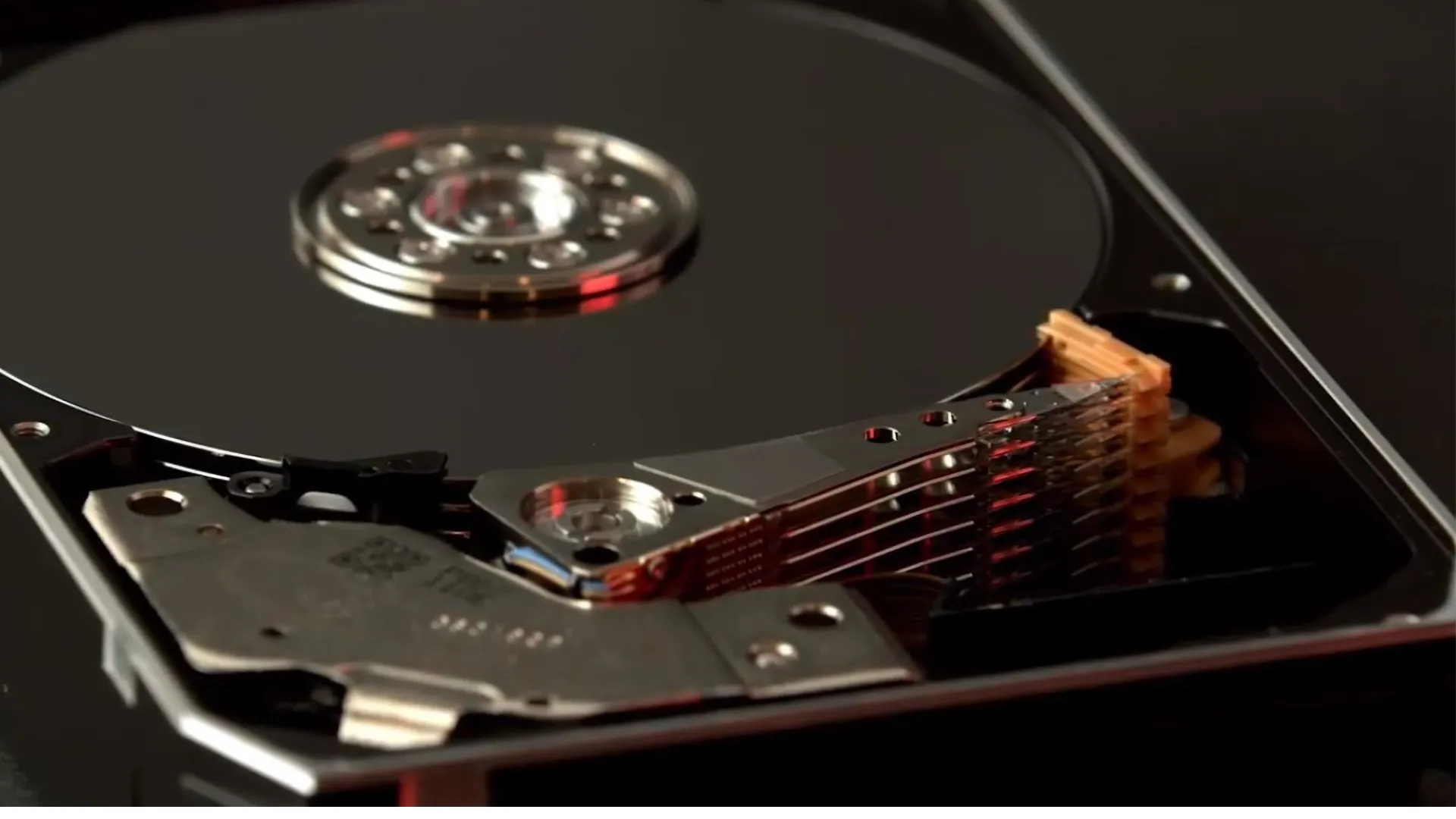
Seagate has offered its Mach.2-series hard drives with two actuators that double the per-TB IOPS performance of its drives, which is important for many clients that need to maintain their quality-of-service (QoS) specification, something that is getting increasingly hard to do amid growing storage density. Going forward, Seagate intends to increase the number of actuators, though the company expects to reveal its multi-actuator HDD roadmap in late May, when the company has an event for analysts and investors.
WD plans to split its HDD lineup into High-Performance drives (High-Bandwidth and Dual Pivot) and Power-Optimized drives, each tailored for different data center workloads. High-performance HDDs aim to increase bandwidth and/or I/O performance of a single drive with a roadmap towards 8× bandwidth and 4× I/O scaling.
Among the methods used to increase performance are using more than one head to read or write data at the same time, installing another fully independent actuator on a separate pivot that has its own set of heads, and therefore acting like another HDD. Dual-Pivot HDDs are currently in the lab and are targeted to become available in 2028.
In contrast, Power-Optimized drives target 'active cold' storage tiers, where data must remain accessible but does not require high performance. These drives reduce random I/O activity and are engineered to cut power consumption by roughly 20% to lower operating costs in large-scale deployments while offering predictable performance. Such HDDs will be positioned against 3D QLC SSDs starting in 2027. WDl expects these drives to be used to store massive datasets — such as AI logs and checkpoints — at a lower total cost of ownership.
Summary
The HDD market has shrunk from over 200 drive makers in the 1980s to just three in 2026. These three companies — Seagate, Toshiba, and Western Digital — tend to compete on capacity and performance, but they tend to do so using a completely different set of technologies, even despite the fact that they use some industry-standard components (HDD platter substrates, motors, etc.).
On the technology front, Seagate is all-in on HAMR; the company is already shipping 44TB drives and targeting 100TB-class products in the early 2030s. By contrast, Toshiba is taking a cautious, step-by-step approach, stretching MAMR and mechanical scaling before introducing HAMR later this decade. Western Digital is arguably the most cautious of the HDD makers, pursuing a multi-track strategy, which includes extending ePMR to 60TB, increasing the number of platters per drive to 14, all while gradually ramping production of HAMR-based HDDs, and targeting to launch 100TB+ drives around 2030.
Beyond capacity, both Seagate and Western Digital are also rethinking HDD performance with multi-actuator and dual-pivot designs to boost bandwidth and I/O performance to make HDD-based storage systems more competitive with SSD-powered systems. In addition, WD is also developing power-optimized drives to cut energy use for 'active cold' storage.
In general, 70 years after inception, the HDD industry is alive and kicking. Three companies are competing intensely to achieve higher storage density, higher efficiency, and predictable performance while retaining competitive per-TB cost compared to solid-state drives.